Bitcoin: As supply shock meets demand gap, who drives the market now?

ambcryptoОпубликовано 2026-03-23Обновлено 2026-03-23

Введение

Bitcoin miner-to-exchange flows surged above 8,000 BTC in late January due to operational disruptions and liquidity constraints, but have since declined to around 4,300 BTC, reducing sell-side pressure. Despite this, the Coinbase Premium remains negative at -0.02, indicating weak U.S. institutional demand. Price stability near $68,600 is largely driven by offshore liquidity and derivatives markets. Meanwhile, Bitcoin’s hashrate dropped significantly from 1,200 EH/s to 800 EH/s, reflecting reduced mining activity and a shift of resources toward AI compute for higher returns. Miners sold over 15,000 BTC to fund this transition, adding short-term supply pressure. The market now depends heavily on external demand, making it vulnerable to shifts in global liquidity.

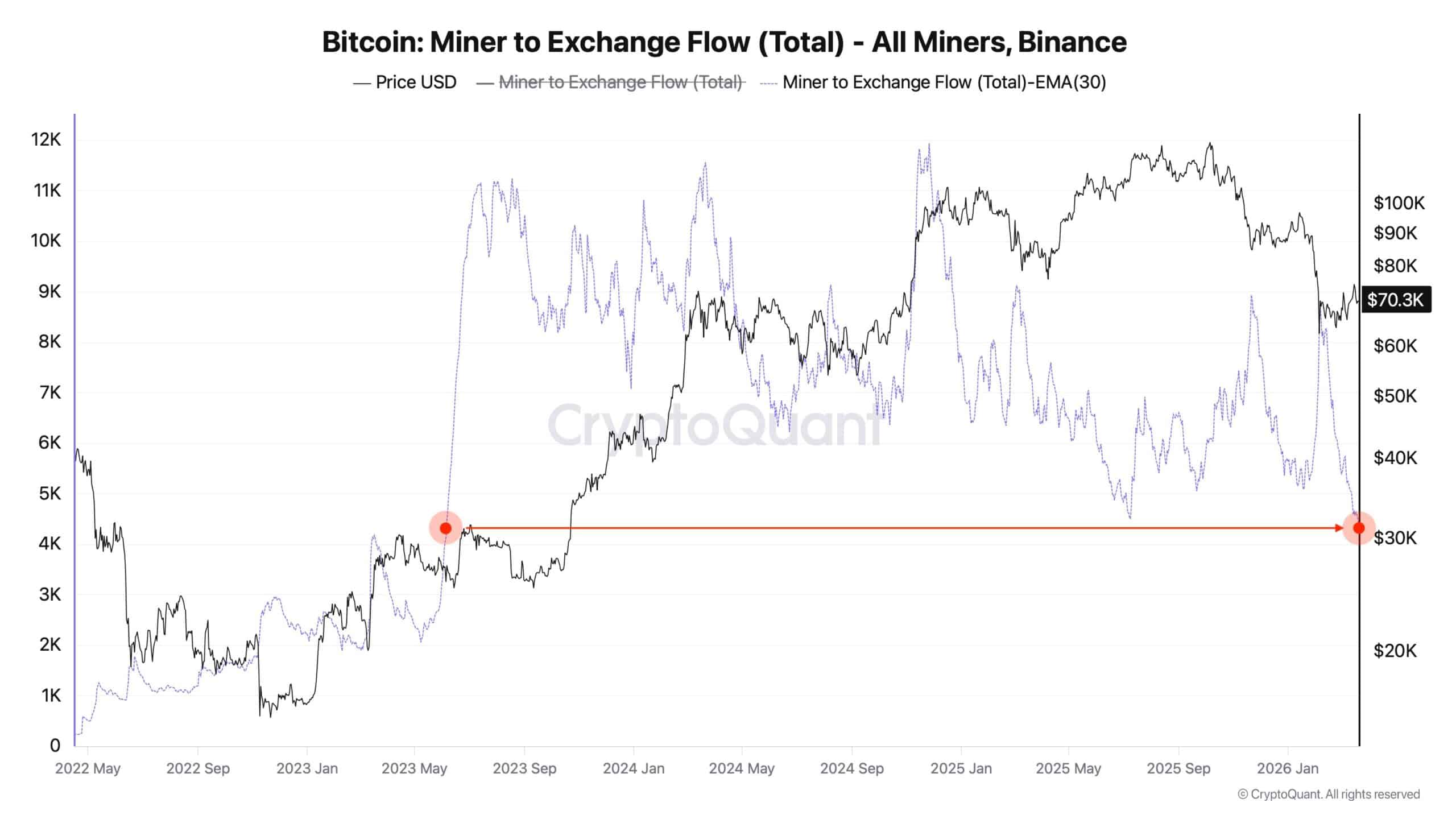
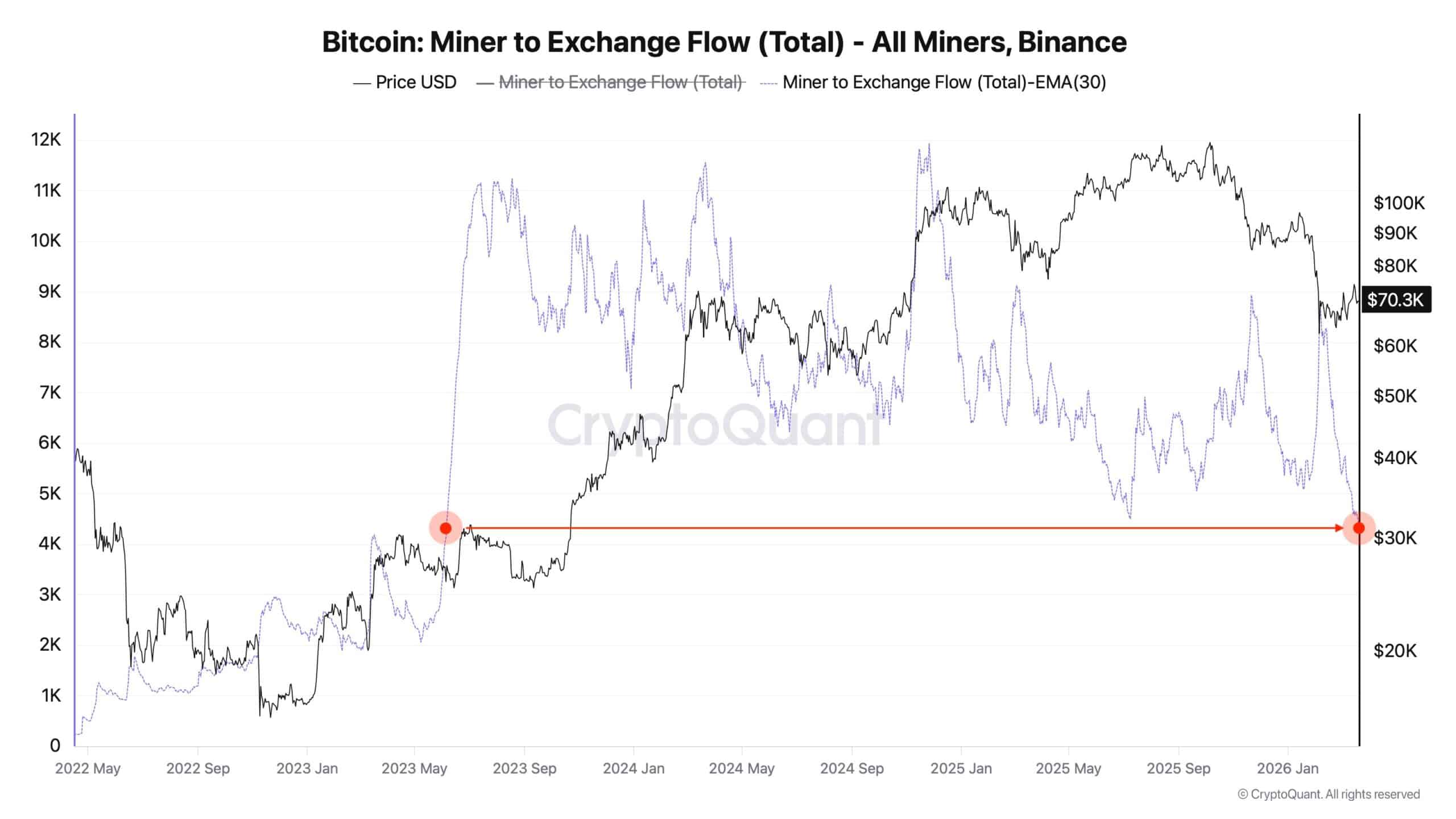
Bitcoin’s [BTC] miner-to-Binance flows surged above 8,000 BTC in late January, as U.S. ice storms disrupted operations and tightened miner liquidity. As mining slowed, fixed costs persisted, which forced miners to liquidate reserves and sustain operations, while price momentum weakened.

As conditions improved, flows began to reverse, signaling a transition from forced selling toward controlled distribution. The 30-day average now stands near 4,300 BTC, returning to levels last seen in June 2023, which reflects a sharp reduction in sell-side pressure.

Source: Darkfost/X

Bitcoin traded near $68,600 at the time of writing. This implied that price held firm despite earlier distribution, reinforcing the impact of declining inflows.

This shift matters because miners act as consistent suppliers, so reduced transfers directly constrain available market liquidity.

With total Exchange Inflows near 2,500 BTC and Miner Reserves around 1.8 million BTC, current restraint suggests strategic holding, which supports stability unless external pressure forces renewed selling.

U.S. demand gap as offshore liquidity drives Bitcoin

Bitcoin miner flows recently declined, which reduced structural sell pressure and tightened available supply across the market. As that pressure eased, a stronger recovery would typically require fresh demand to absorb limited supply.

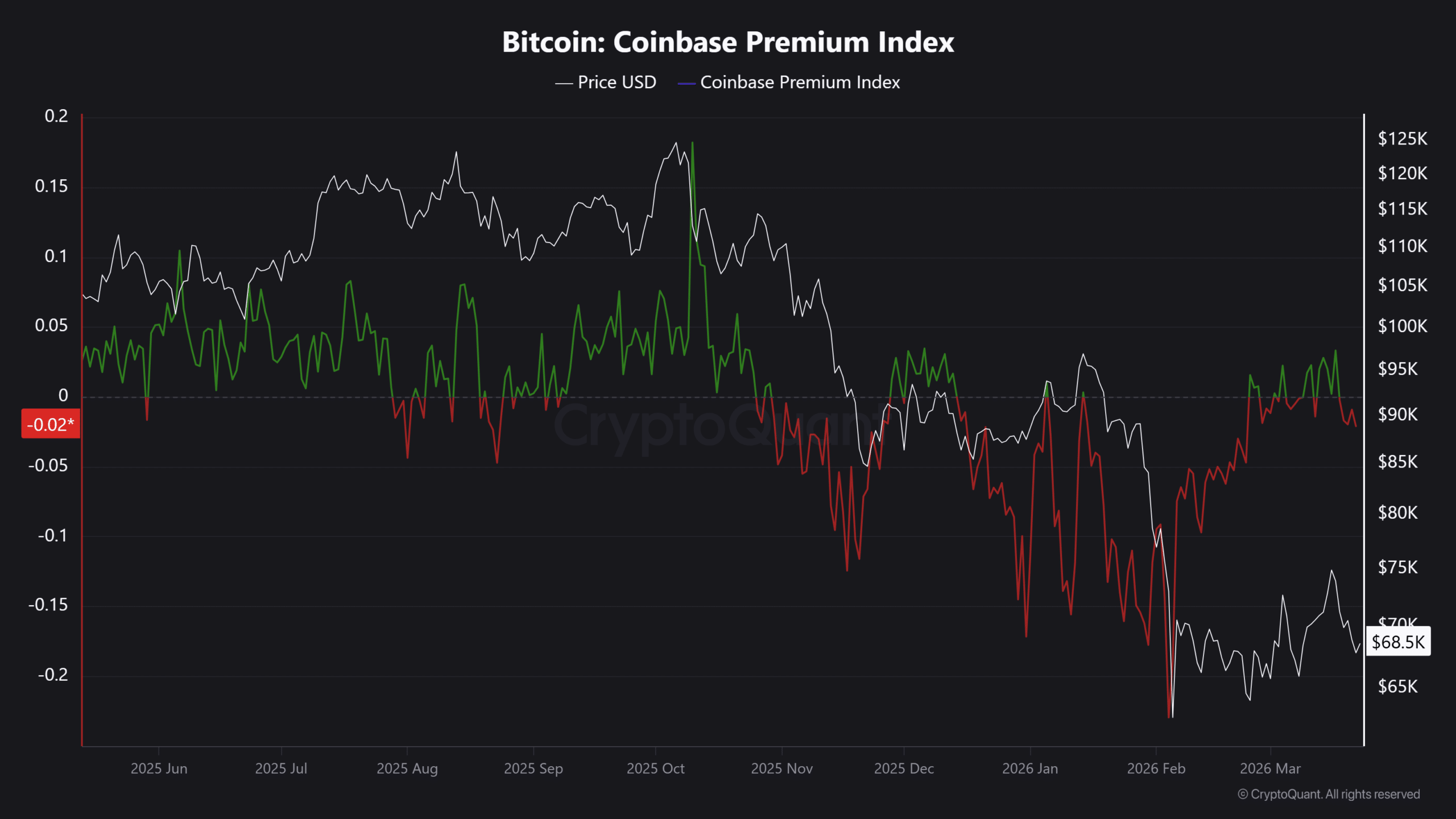
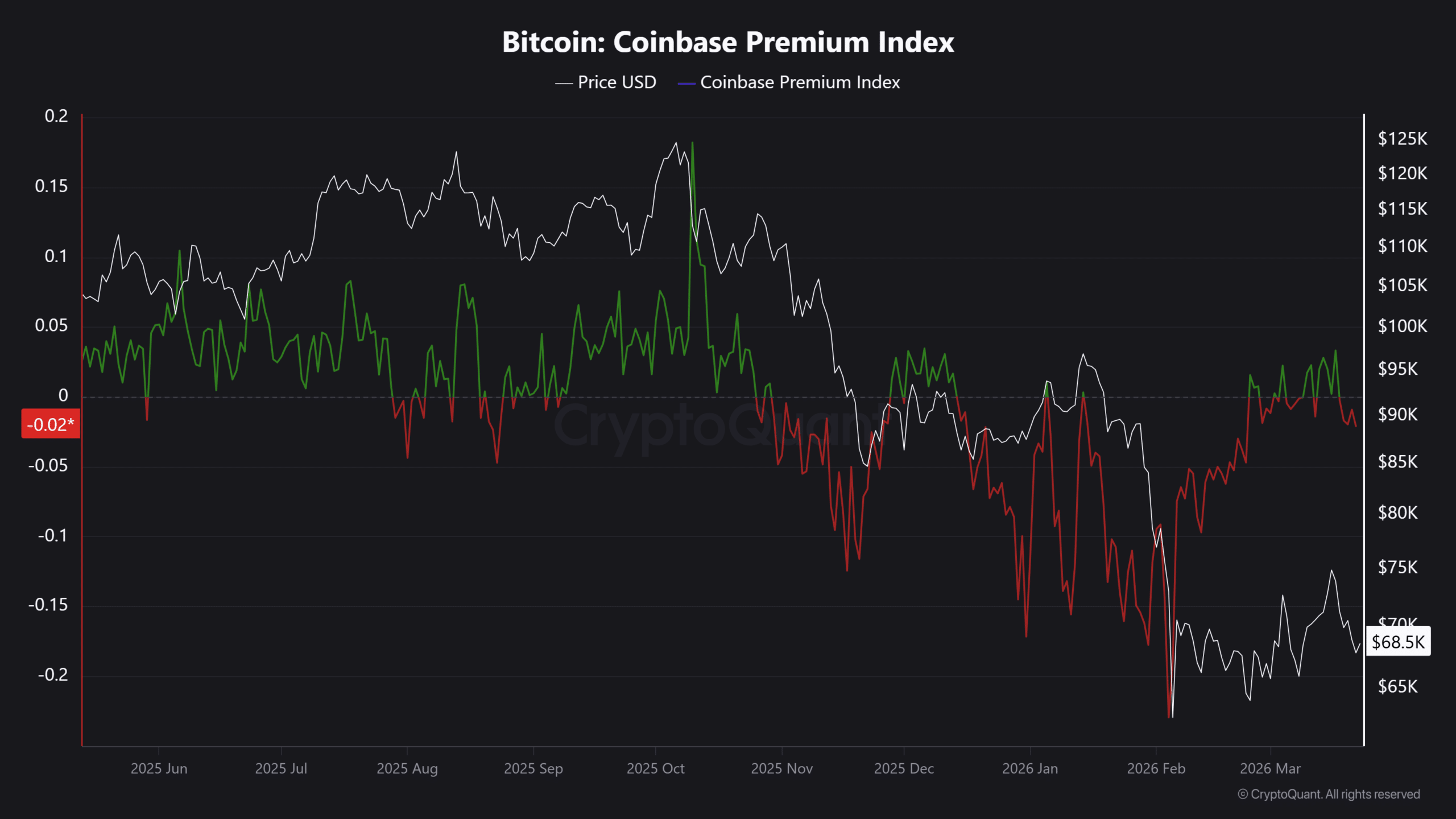
Instead, the Coinbase Premium Index remains near −0.02, holding below zero and signaling weak U.S. spot participation.

The premium turned deeply negative in February, dropping below −0.20, as selling pressure intensified on Coinbase. As this unfolded, the price fell toward $65,000, reflecting weak demand.

Stabilizing conditions helped Bitcoin rebound toward $68,500, yet the premium failed to recover, signaling that U.S. demand remained absent.

This divergence suggests that offshore markets are driving price discovery, likely through global liquidity and derivatives positioning.

Without U.S. institutional absorption, reduced supply alone cannot sustain momentum, which leaves the current structure dependent on external flows and vulnerable to shifts in offshore demand.

Hashrate decline signals miner shift toward AI compute

As offshore liquidity continues to drive price discovery, attention shifts toward the supply side, where mining dynamics add another layer of pressure.

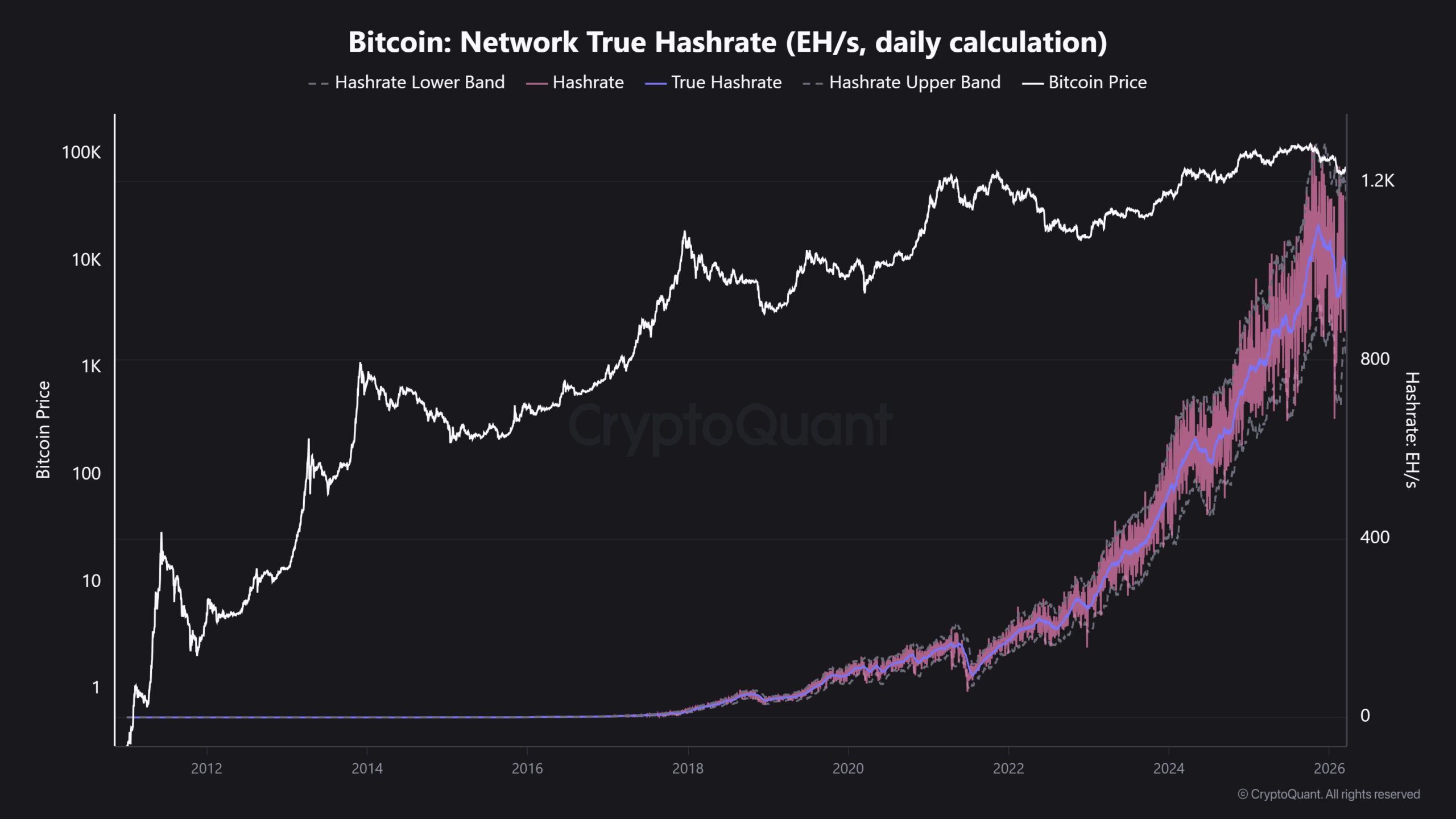
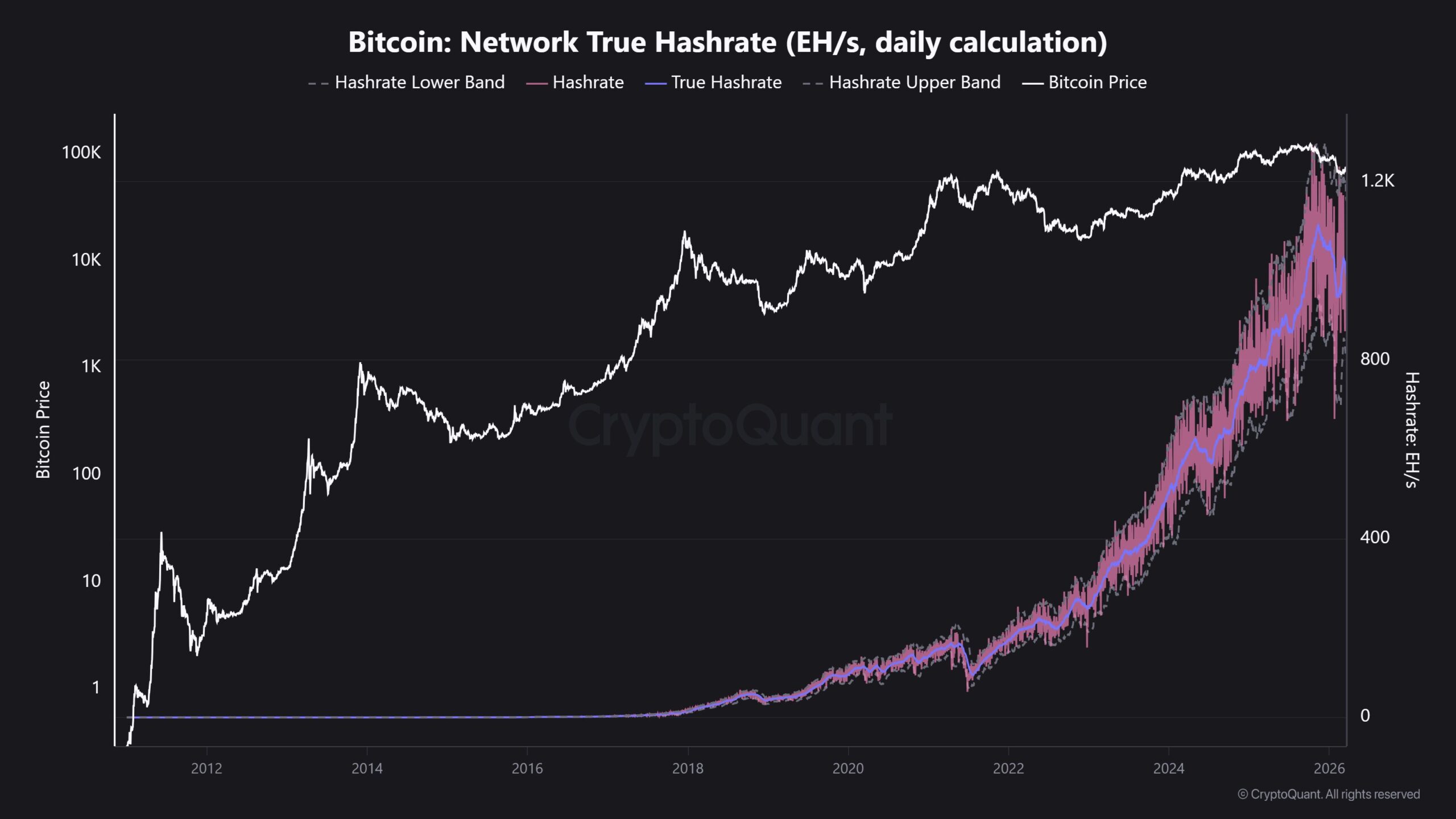
Bitcoin’s Network Hashrate previously climbed above 1,200 EH/s, reflecting strong participation and infrastructure expansion. As profitability tightened after the halving, this trend reversed, with Hashrate falling toward 800 EH/s, signaling reduced mining activity.

Source: CryptoQuant

As this decline unfolds, mining difficulty is expected to drop by about 8%, which aligns with miners scaling back or shutting down less efficient operations.

This adjustment reflects a deeper shift, as some operators redirected capital and infrastructure toward AI compute for higher returns.

As miners sold over 15,000 BTC to fund this transition, short-term supply pressure increased, while network strength weakened. This evolution suggests mining is no longer purely price-driven but increasingly shaped by external competition for capital and compute resources.


Final Summary

  • Falling miner inflows near 4,316 BTC tighten supply, yet a negative Coinbase Premium near −0.02 shows weak U.S. demand, leaving price reliant on offshore liquidity.
  • Bitcoin hashrate drops from 1,200 EH/s to 800 EH/s, and 15,000 BTC miner sales reflect an AI-driven capital shift, risking renewed sell pressure.

Связанные с этим вопросы

QWhat caused the surge in Bitcoin miner-to-Binance flows in late January?

AThe surge was caused by U.S. ice storms that disrupted mining operations and tightened miner liquidity, forcing miners to liquidate reserves to sustain operations.

QWhat does the negative Coinbase Premium Index indicate about the Bitcoin market?

AThe negative Coinbase Premium Index near -0.02 signals weak U.S. spot demand and suggests that offshore markets are driving price discovery.

QHow has Bitcoin's network hashrate changed recently, and what does it signify?

ABitcoin's network hashrate dropped from over 1,200 EH/s to around 800 EH/s, indicating reduced mining activity due to tightened profitability and a shift of capital toward AI compute.

QWhy is the current Bitcoin market structure vulnerable despite reduced sell pressure from miners?

AThe market is vulnerable because reduced supply alone cannot sustain momentum without strong U.S. institutional demand, making it dependent on external offshore flows.

QWhat strategic shift are some Bitcoin miners making, and how does it impact the market?

ASome miners are redirecting capital and infrastructure toward AI compute for higher returns, which has led to sales of over 15,000 BTC, increasing short-term supply pressure.

Похожее

Aave Is Surrendering the Throne of DeFi Lending Due to Its Own Stupidity

Aave, a leading DeFi lending protocol, is facing a severe crisis and losing its dominant market position due to its poor handling of a recent security incident. The crisis began when Kelp DAO suffered a hack resulting in a loss of $292 million in rsETH. In the aftermath, approximately $17.2 billion in funds flowed out of Aave as user panic escalated. The article criticizes Aave's crisis management as "extremely foolish." Instead of promptly offering reassurance or committing to cover the potential bad debt—estimated between $123.7 million and $230.1 million, which Aave could have afforded—the protocol initially deflected blame, emphasizing that its code was not at fault. This delay and lack of a clear guarantee led to widespread user anxiety, triggering a bank run-like scenario where users withdrew funds or borrowed aggressively from other pools, causing liquidity shortages. Meanwhile, Aave’s competitor Spark—a fork of Aave’s own code—has benefited significantly. Having removed support for rsETH months earlier, Spark avoided any losses from the incident and has since seen its TVL grow by nearly $2 billion, attracting major deposits such as over $1.24 billion from Justin Sun. Spark has actively capitalized on the situation, publicly criticizing Aave’s security reputation. Although Aave’s founder Stani eventually announced a relief plan named "DeFi United" with several partners and a personal donation, the damage to user trust and capital outflows may be irreversible. The article concludes that Aave is losing its throne in DeFi lending to aggressive competitors like Spark, Morpho, and Jupiter Lend.

Odaily星球日报1 ч. назад

Aave Is Surrendering the Throne of DeFi Lending Due to Its Own Stupidity

Odaily星球日报1 ч. назад

Торговля

Спот
Фьючерсы

Популярные статьи

Тест по Bitcoin Биткоина

HTX Learn: Изучите Bitcoin halving и Заработаете Токены USDT

3.0k просмотров всегоОпубликовано 2024.04.16Обновлено 2024.04.16

Тест по Bitcoin  Биткоина

Что такое $BITCOIN

ЦИФРОВОЕ ЗОЛОТО ($BITCOIN): Комплексный анализ Введение в ЦИФРОВОЕ ЗОЛОТО ($BITCOIN) ЦИФРОВОЕ ЗОЛОТО ($BITCOIN) — это проект на основе блокчейна, работающий в сети Solana, который стремится объединить характеристики традиционных драгоценных металлов с инновациями децентрализованных технологий. Хотя он носит имя Биткойн, часто называемого “цифровым золотом” из-за его восприятия как средства хранения ценности, ЦИФРОВОЕ ЗОЛОТО является отдельным токеном, предназначенным для создания уникальной экосистемы в ландшафте Web3. Его цель — позиционировать себя как жизнеспособный альтернативный цифровой актив, хотя детали его применения и функциональности все еще развиваются. Что такое ЦИФРОВОЕ ЗОЛОТО ($BITCOIN)? ЦИФРОВОЕ ЗОЛОТО ($BITCOIN) — это токен криптовалюты, специально разработанный для использования в блокчейне Solana. В отличие от Биткойна, который выполняет широко признанную роль хранения ценности, этот токен, похоже, сосредоточен на более широких приложениях и характеристиках. Примечательные аспекты включают: Инфраструктура блокчейна: Токен построен на блокчейне Solana, известном своей способностью обрабатывать высокоскоростные и недорогие транзакции. Динамика предложения: ЦИФРОВОЕ ЗОЛОТО имеет максимальное предложение, ограниченное 100 квадриллионами токенов (100P $BITCOIN), хотя детали о его обращающемся предложении в настоящее время не раскрыты. Утилита: Хотя точные функциональные возможности не описаны, есть указания на то, что токен может быть использован для различных приложений, потенциально связанных с децентрализованными приложениями (dApps) или стратегиями токенизации активов. Кто создатель ЦИФРОВОГО ЗОЛОТА ($BITCOIN)? На данный момент личность создателей и команды разработчиков, стоящих за ЦИФРОВЫМ ЗОЛОТОМ ($BITCOIN), остается неизвестной. Эта ситуация типична для многих инновационных проектов в области блокчейна, особенно тех, которые связаны с децентрализованными финансами и феноменом мем-криптовалют. Хотя такая анонимность может способствовать культуре, ориентированной на сообщество, она усиливает опасения по поводу управления и ответственности. Кто инвесторы ЦИФРОВОГО ЗОЛОТА ($BITCOIN)? Доступная информация указывает на то, что у ЦИФРОВОГО ЗОЛОТА ($BITCOIN) нет известных институциональных спонсоров или значительных венчурных капиталовложений. Проект, похоже, функционирует по модели пирингового взаимодействия, сосредоточенной на поддержке и принятии сообществом, а не на традиционных путях финансирования. Его активность и ликвидность в основном сосредоточены на децентрализованных биржах (DEX), таких как PumpSwap, а не на устоявшихся централизованных торговых платформах, что еще больше подчеркивает его подход, ориентированный на grassroots. Как работает ЦИФРОВОЕ ЗОЛОТО ($BITCOIN) Операционные механизмы ЦИФРОВОГО ЗОЛОТА ($BITCOIN) можно подробно описать на основе его дизайна блокчейна и характеристик сети: Механизм консенсуса: Используя уникальный механизм доказательства истории (PoH) Solana в сочетании с моделью доказательства доли (PoS), проект обеспечивает эффективную валидацию транзакций, что способствует высокой производительности сети. Токеномика: Хотя конкретные дефляционные механизмы не были подробно описаны, большое максимальное предложение токенов подразумевает, что оно может быть предназначено для микротранзакций или нишевых случаев использования, которые еще предстоит определить. Интероперабельность: Существует потенциал для интеграции с более широкой экосистемой Solana, включая различные платформы децентрализованных финансов (DeFi). Однако детали относительно конкретных интеграций остаются неуточненными. Хронология ключевых событий Вот хронология, которая подчеркивает значимые вехи, касающиеся ЦИФРОВОГО ЗОЛОТА ($BITCOIN): 2023: Первоначальное развертывание токена происходит в блокчейне Solana, отмеченное его адресом контракта. 2024: ЦИФРОВОЕ ЗОЛОТО приобретает видимость, когда оно становится доступным для торговли на децентрализованных биржах, таких как PumpSwap, позволяя пользователям обменивать его на SOL. 2025: Проект наблюдает спорадическую торговую активность и потенциальный интерес к инициативам, возглавляемым сообществом, хотя на данный момент не зафиксировано никаких значительных партнерств или технических достижений. Критический анализ Сильные стороны Масштабируемость: Основная инфраструктура Solana поддерживает высокие объемы транзакций, что может повысить полезность $BITCOIN в различных сценариях транзакций. Доступность: Потенциально низкая цена торговли за токен может привлечь розничных инвесторов, способствуя более широкому участию благодаря возможностям дробного владения. Риски Отсутствие прозрачности: Отсутствие публично известных спонсоров, разработчиков или процесса аудита может вызвать скептицизм относительно устойчивости и надежности проекта. Волатильность рынка: Торговая активность сильно зависит от спекулятивного поведения, что может привести к значительной волатильности цен и неопределенности для инвесторов. Заключение ЦИФРОВОЕ ЗОЛОТО ($BITCOIN) является интригующим, но неоднозначным проектом в быстро развивающейся экосистеме Solana. Хотя он пытается использовать нарратив “цифрового золота”, его отход от установленной роли Биткойна как средства хранения ценности подчеркивает необходимость более четкого различения его предполагаемой утилиты и структуры управления. Будущее принятие и усвоение, вероятно, будут зависеть от решения текущей непрозрачности и более четкого определения его операционных и экономических стратегий. Примечание: Этот отчет охватывает синтезированную информацию, доступную на октябрь 2023 года, и с тех пор могут произойти события.

99 просмотров всегоОпубликовано 2025.05.13Обновлено 2025.05.13

Что такое $BITCOIN

Fractal Bitcoin: масштабирование Биткоина с помощью рекурсивной системы

Fractal Bitcoin — масштабное Layer-1-решнение, созданное на базе кода Биткоина, позволяющего достигать бесконечного масштабирования с помощью рекурсивного подхода.

2.2k просмотров всегоОпубликовано 2025.06.30Обновлено 2025.06.30

Fractal Bitcoin: масштабирование Биткоина с помощью рекурсивной системы

Обсуждения

Добро пожаловать в Сообщество HTX. Здесь вы сможете быть в курсе последних новостей о развитии платформы и получить доступ к профессиональной аналитической информации о рынке. Мнения пользователей о цене на BTC (BTC) представлены ниже.

活动图片