Bitcoin decouples from stocks in second half of 2025

cointelegraphОпубликовано 2025-12-12Обновлено 2025-12-12

Введение

In the second half of 2025, Bitcoin decoupled from U.S. equities, falling nearly 18% while major stock indexes posted strong gains. Despite hitting new all-time highs and avoiding a "red September" for the third consecutive year, Bitcoin underperformed relative to historical trends. Key events included the GENIUS Act boosting crypto in July, Ether reaching an ATH after Powell’s dovish signals in August, and Bitcoin’s community divide over a network upgrade in September. October saw a historic $19 billion liquidation event triggered by Trump’s tariff threats, and November was Bitcoin’s worst month of the year, down 17.67%. By December, analysts like Standard Chartered revised year-end Bitcoin targets down to $100,000, delaying longer-term bullish forecasts.

The US Federal Reserve announced its third interest rate cut of the year on Wednesday, lifting US equities while Bitcoin (BTC) slipped before bouncing back.

That dynamic has defined the second half of 2025. Even as capital flows into Bitcoin are increasingly tied to traditional equity investors, the cryptocurrency has continued to diverge from the stock market.

Over the past six months, Bitcoin has fallen almost 18%. Meanwhile, the three major US stock indexes posted strong and consistent gains, with the Nasdaq Composite up 21%, the S&P 500 rising 14.35% and the Dow Jones Industrial Average climbing 12.11%.

Bitcoin has still recorded notable milestones this year, including setting new all-time highs and avoiding the typical “red September” for the third year in a row.

Here’s how Bitcoin’s divergence from stocks has widened through the second half of the year.
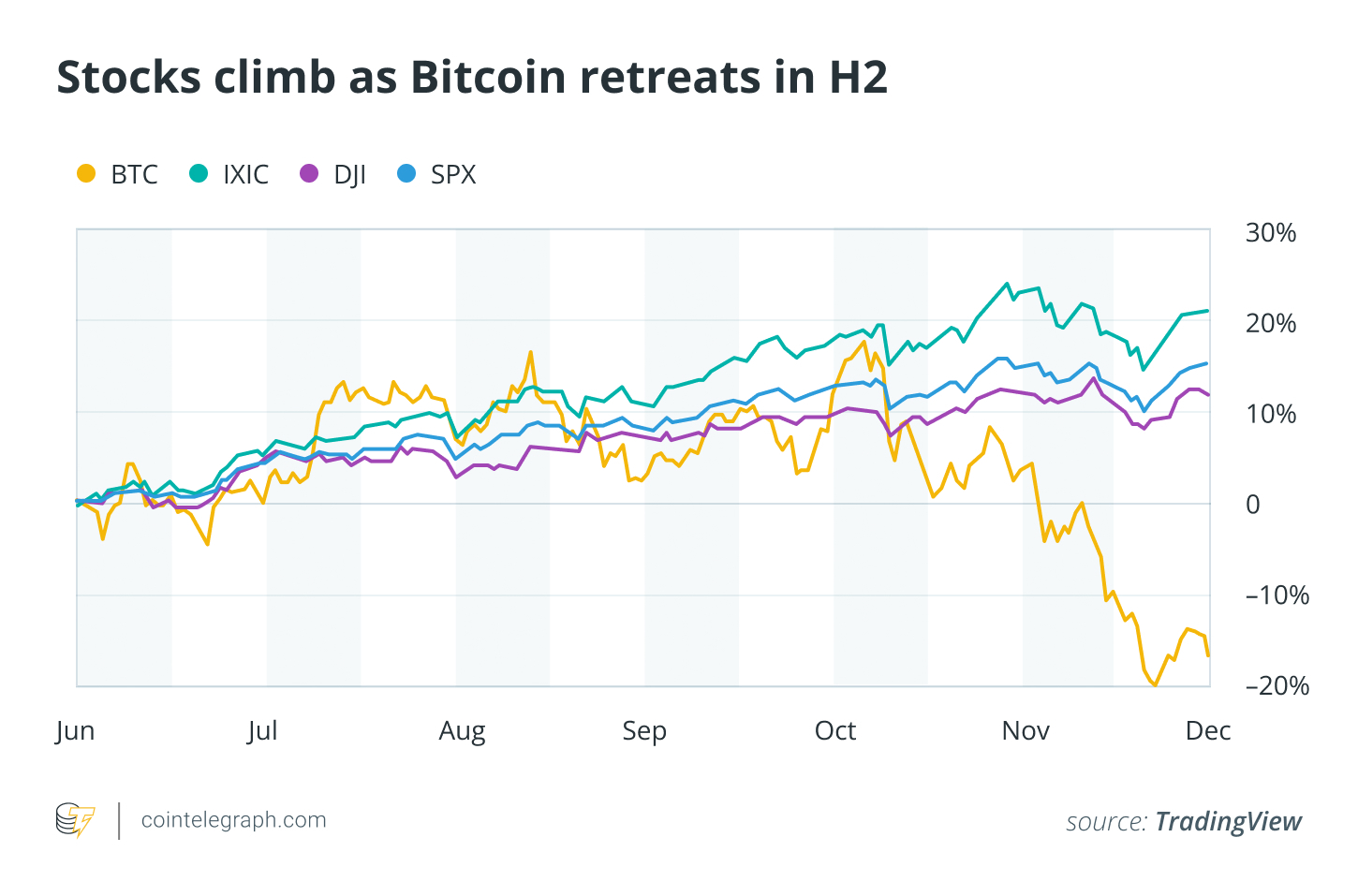
Bitcoin moved alongside the three major equity indexes in the third quarter but started to decouple in Q4.

July: GENIUS Act lifts crypto

July 2025 was defined by strong equity performance and a resilient risk appetite that persisted despite significant tariff announcements.

Early-July trade rhetoric caused brief turbulence, but markets quickly shifted their focus back to corporate earnings and underlying growth fundamentals.

Related: DATs bring crypto’s insider trading problem to TradFi: Shane Molidor

On July 9, AI chip giant Nvidia became the first company to reach a $4-trillion valuation. On the same day, equities shrugged off trade-related shocks as the S&P 500 and Nasdaq posted fresh record highs even after the US announced 50% tariffs on copper.

Bitcoin ended July up 8.13%, marking its strongest monthly performance in the second half of the year to date, including December. Crypto markets strengthened after US President Donald Trump signed the GENIUS Act into law, injecting fresh optimism into the sector, particularly for stablecoin-related businesses.
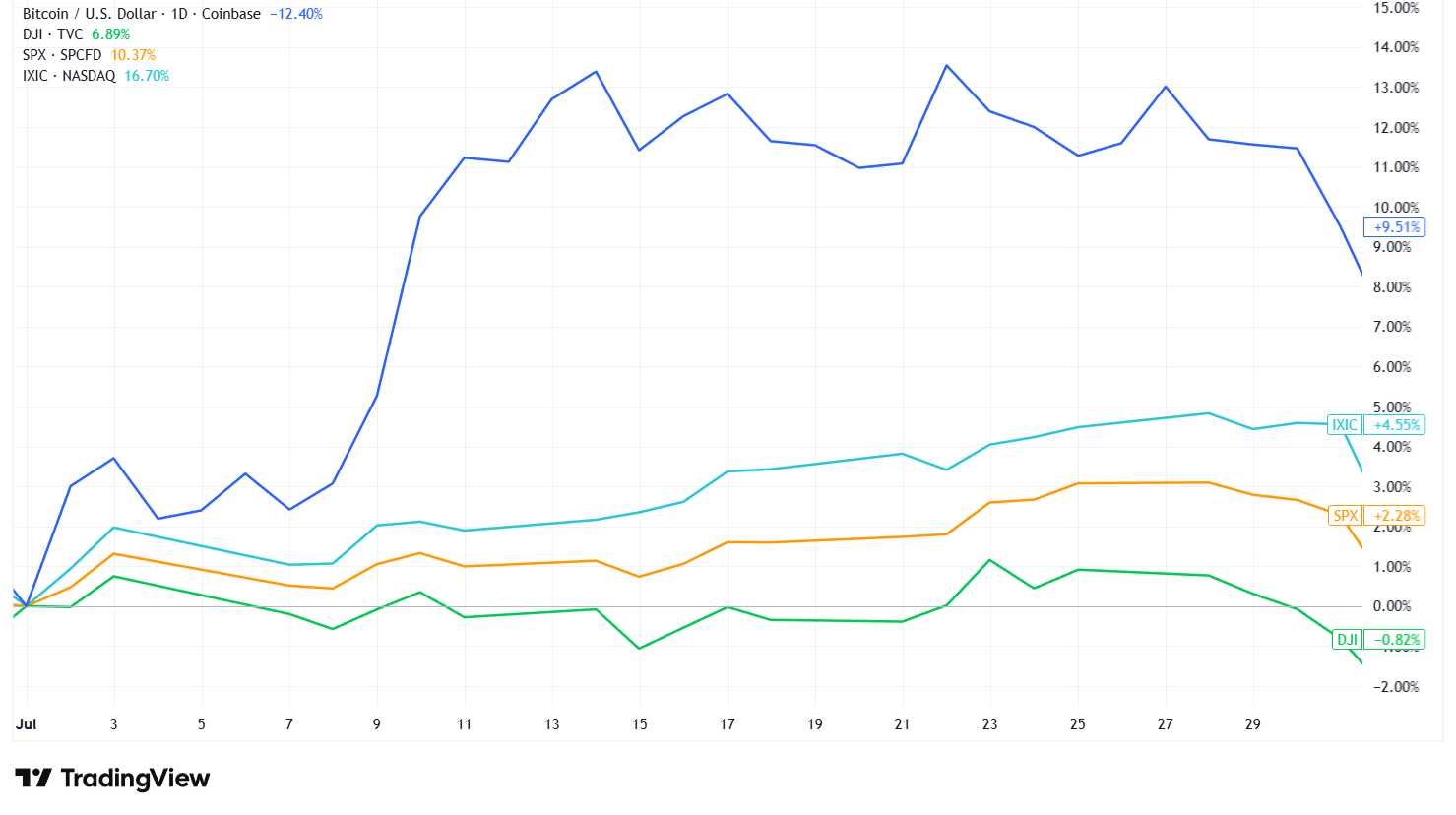
Equities crab walk, while Treasurys and stablecoins lift crypto. Source: TradingView

Corporate adoption also remained a key theme, with companies continuing to add Bitcoin to their balance sheets as part of digital asset treasury strategies. By July, interest in other major cryptocurrencies, including Ether (ETH) and Solana (SOL), also began to pick up.

August: Powell’s speech powers Ether’s ATH

August was driven by rising expectations that the Federal Reserve would soon cut interest rates. Those hopes fueled a broad rally across traditional markets, while crypto moved even faster. Bitcoin surged to a new all-time high of around $124,000 on Aug. 14 as the US dollar weakened amid rising trade tensions.

The Jackson Hole Economic Symposium then brought markets’ attention back to monetary policy. On Aug. 22, Fed Chair Jerome Powell delivered a dovish signal, suggesting that rate cuts were still possible later in the year, pushing Ether to a new all-time high.
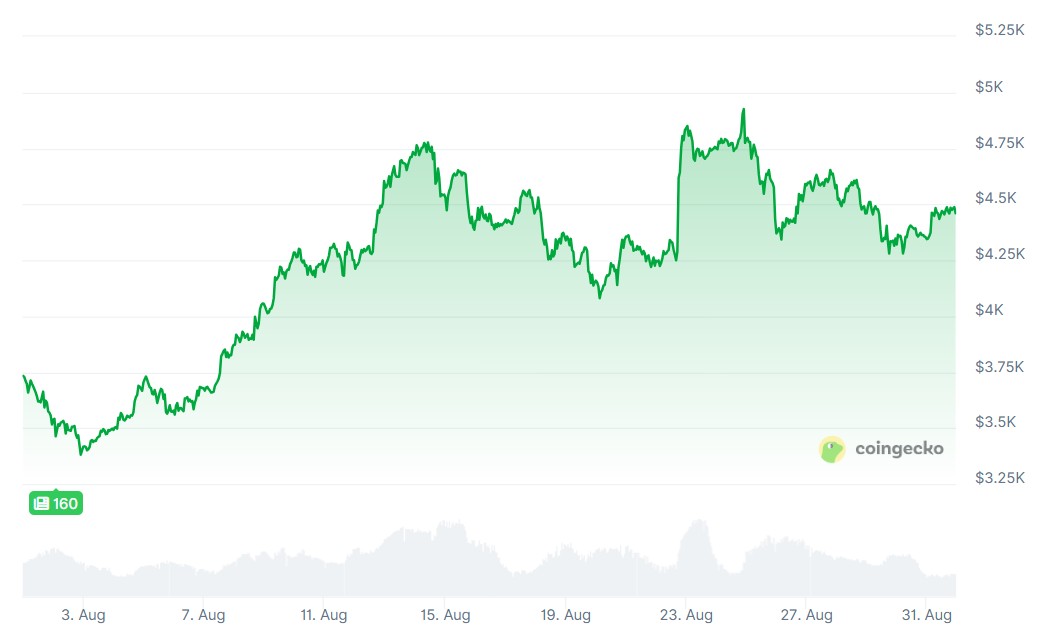
The Fed’s dovish signal sends Ether to new highs. Source: CoinGecko

Equities responded positively, but Bitcoin failed to sustain its momentum. The asset saw a sharp but brief uptick immediately after Powell’s speech before resuming its decline. By month’s end, Bitcoin’s post-ATH correction had clearly diverged from traditional markets. Bitcoin closed August down 6.49%.

September: First rate cut of 2025

September has historically been Bitcoin’s weakest month. Along with June, it is one of only two months that posts a negative average monthly return, earning it the nickname “red September.”

In 2025, however, Bitcoin defied that trend, recording its third consecutive positive September. The gain came as the Fed delivered its first rate cut of the year, a 25-basis-point reduction justified by signs of a cooling labor market. Bitcoin ended the month up 5.16%.

Related: Bitcoin set to beat ‘red September’ dip for third straight year

Equities also responded positively, extending their third-quarter rally as markets priced in the likelihood of additional monetary easing in October.

Bitcoin, however, faced a new internal challenge. The community became divided over a major network upgrade that would remove limits on how much arbitrary data can be embedded on the blockchain.

Bitcoin Core, the software implementation most widely used by miners and node operators, supported lifting the limit. Those who view non-financial data on Bitcoin as spam pushed back against the change, contributing to increased adoption of Bitcoin Knots as an alternative implementation.
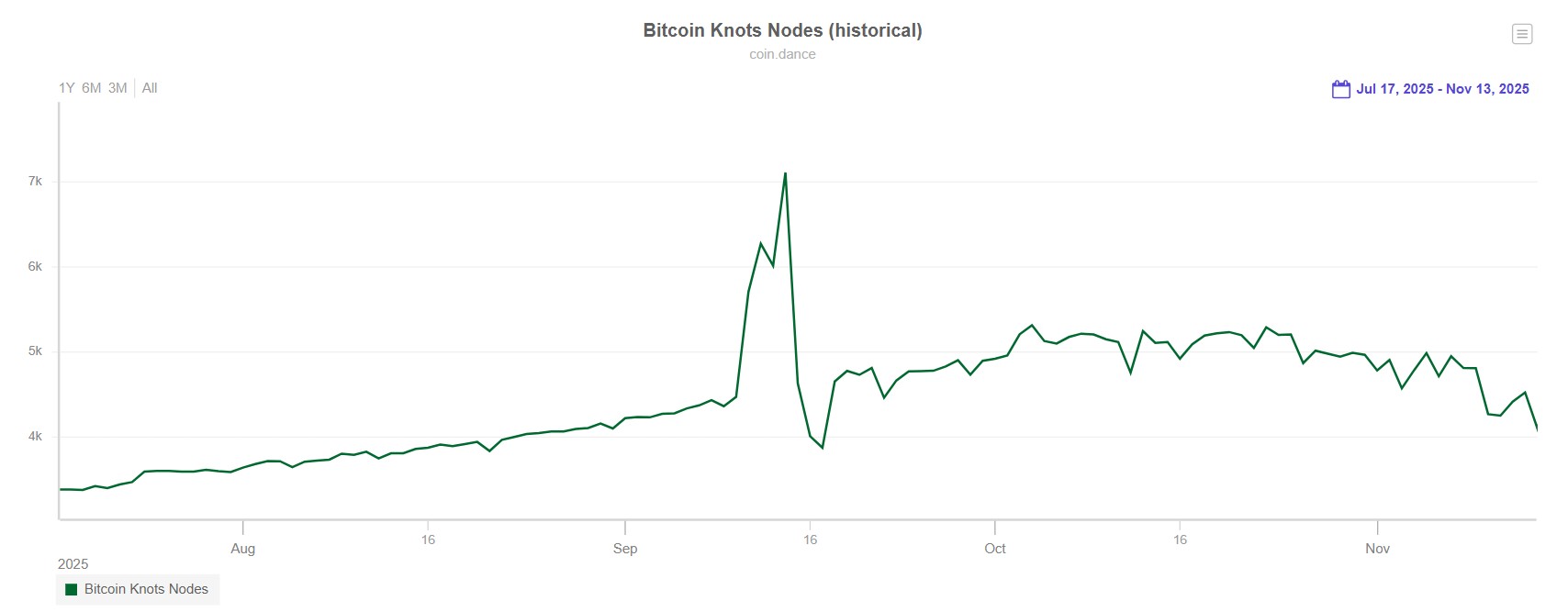
Bitcoin’s upgrade divides the community as Knots nodes rise as alternatives. Source: Coin Dance

October: Trump threatens 100% tariffs on China

Bitcoin hit another all-time high on Oct. 6, but the month was ultimately defined by the largest liquidation event in Bitcoin’s history, with roughly $19 billion in positions wiped out.

Several factors were identified as contributors to the liquidation cascade that sent Bitcoin plunging below $110,000. These included a price glitch on Binance and the industry’s heavy reliance on futures-based trading, which amplified forced liquidations as prices fell.

The immediate catalyst, however, was a social media post by President Trump threatening 100% tariffs on Chinese imports. The comment triggered a sharp sell-off across both crypto and equity markets.

Although October is often referred to as Uptober in the crypto community due to its historically strong performance, 2025 proved to be an exception. Bitcoin snapped a five-year streak of positive Octobers and ended the month down 3.69% even as major stock indexes recovered from the trade-related shock.
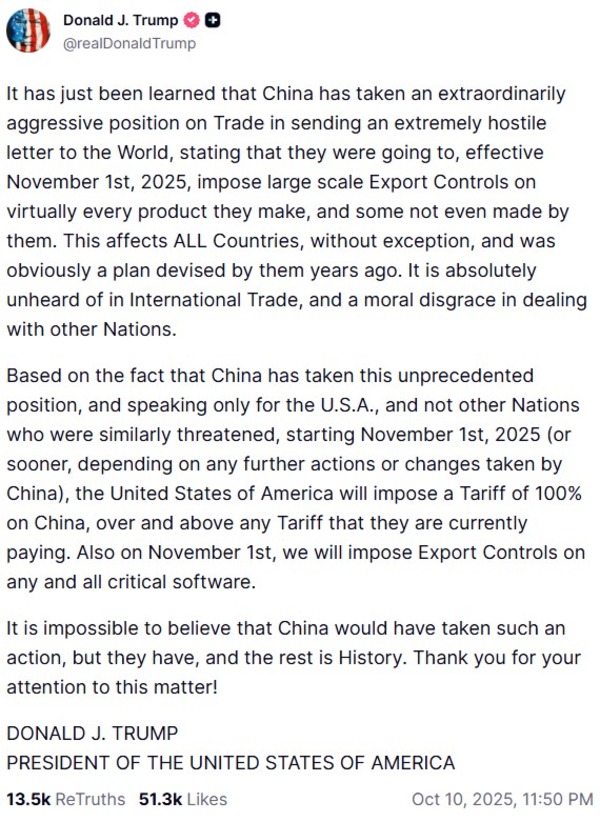
Trump’s social post sparks a crypto liquidation frenzy. Source: Donald Trump

By the end of the month, the Fed delivered its second consecutive rate cut, lowering the federal funds rate by another 25 basis points. Meanwhile, the US government remained shut throughout October, extending what became the longest government shutdown in history.

November: End of the US government shutdown

October may carry the nickname Uptober, but November has historically been Bitcoin’s strongest month, posting an average gain of 41.12% — more than double October’s average return of about 20%.

In 2025, November proved to be Bitcoin’s worst-performing month of the year, with the asset falling 17.67%. Selling pressure intensified throughout the month, pushing Bitcoin below the $100,000 mark by mid-November.
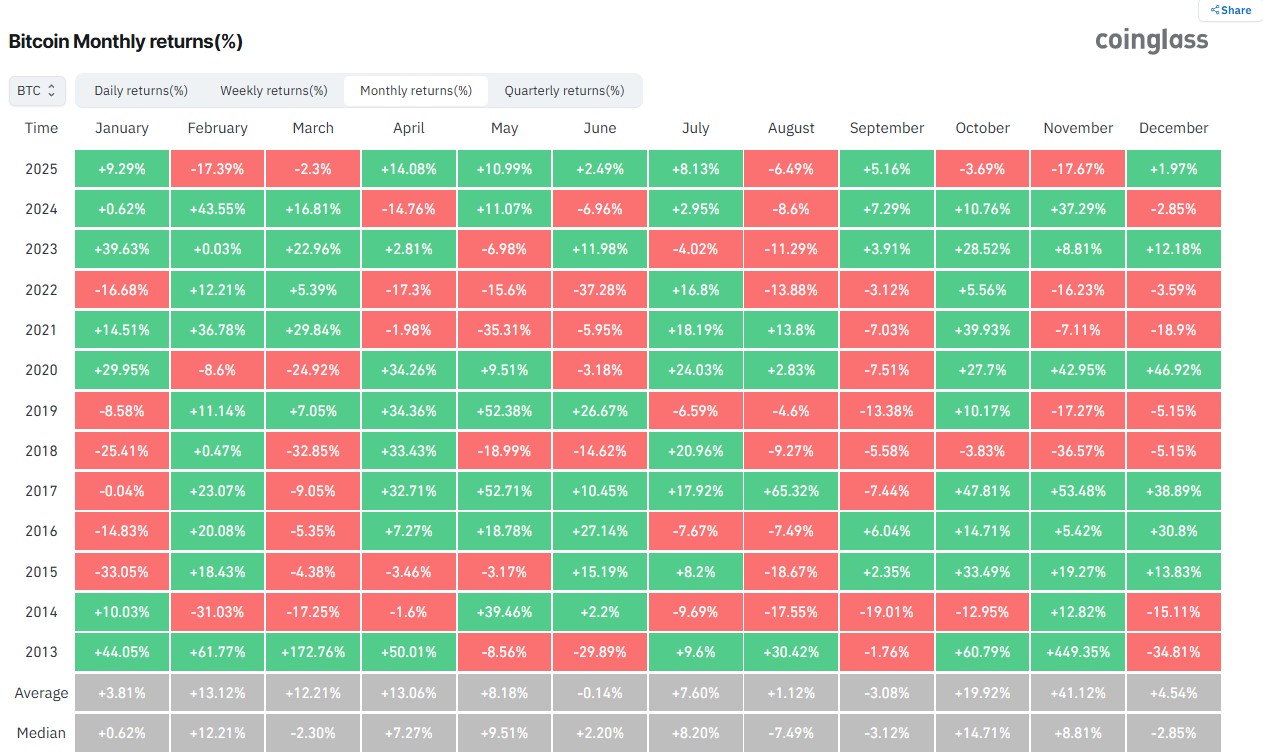
November is historically Bitcoin’s best month, but it was the worst month of 2025. Source: CoinGlass

The divergence from equities was pronounced. Stock markets traded largely sideways as the US government shutdown came to an end. Investors remained cautious amid concerns over a potential AI-driven bubble. Some of those fears were eased later in the month after Nvidia reported record earnings for the third quarter, helping stabilize sentiment across technology stocks.

Bitcoin’s year-end target slashed

So far, Bitcoin is up about 2% in December, with major equity indexes also posting moderate gains. Bitcoin’s average December return currently stands at 4.54% at the time of writing.

While the holiday season has been relatively quiet for Bitcoin in recent years, history suggests the crypto market does not necessarily slow down during the festivities.

In December 2020, for example, Bitcoin surged nearly 47%, even as market-shaking news emerged from the US Securities and Exchange Commission: the launch of a years-long lawsuit against Ripple Labs and its executives.

This year, much of the optimism surrounding Bitcoin’s potential year-end rally has faded. Several market watchers have lowered their price targets for the cryptocurrency, including Standard Chartered.

The bank had previously forecast a year-end price of $200,000 for Bitcoin, but on Monday, it revised that target down to $100,000. Standard Chartered has also delayed its longer-term forecast for Bitcoin reaching $500,000, pushing the target from 2028 to 2030.

Magazine: Big questions: Would Bitcoin survive a 10-year power outage?

Похожее

Bernstein's 97-Page Report Decoded: The Battle for AI Data Center Connectivity, Who Will Be the True Winner by 2026?

Bernstein's 97-page report analyzes the AI data center connectivity landscape. It argues that the bottleneck is shifting from raw compute (GPU) to the systems connecting GPUs, crucial for cluster efficiency. Copper and optical interconnects are not in a simple replacement cycle but will coexist long-term, with copper dominating short-distance "scale-up" connections and optics favored for longer "scale-out" scenarios. While Co-Packaged Optics (CPO) is the long-term direction for power and cost savings, its widespread adoption faces manufacturing and reliability hurdles, with mass deployment unlikely before 2028. Transitional technologies like Linear Pluggable Optics (LPO) and Near-Packaged Optics (NPO) are seen as near-term leaders. A key insight is that CPO will fundamentally reshape the value chain, shifting profits from traditional optical module suppliers towards chip designers (e.g., NVIDIA, Broadcom), advanced packaging (e.g., TSMC), and system integrators. For 2026, the report highlights more immediate and certain investment opportunities in the essential "infrastructure" enabling this connectivity shift. This includes upgrades for PCBs, ABF substrates, and CCLa driven by new AI server/switch platforms, alongside demand for 1.6T optical modules, LPO/NPO, and the testing/validation equipment required for future CPO scale-up.

marsbit19 мин. назад

Bernstein's 97-Page Report Decoded: The Battle for AI Data Center Connectivity, Who Will Be the True Winner by 2026?

marsbit19 мин. назад

Understanding the New Economic Model of Tokenization

Understanding the New Token Economics Model The commercialization of AI applications is evolving from selling software and subscriptions to selling token call capacity. Tokens, the fundamental unit of information processing for large language models (LLMs), have become the basis for API billing and consumption. With call volumes exploding, tokens themselves are now being traded—procured, routed, split, and resold—forming a new intermediary market. This layer connects upstream LLM providers with downstream developers and enterprises, acting as a global wholesale-to-retail liquidity network. The rise of this business is fueled by a massive surge in China's daily token call volume—growing over a thousandfold from 100 billion in early 2024 to over 140 trillion by March 2026—and significant improvements in domestic LLM capabilities, which are now competitive globally. The core value of token distribution platforms extends beyond simple arbitrage. Key functions include aggregating multiple models (like GPT, Claude, and domestic models such as Kimi and DeepSeek) under a unified API, lowering network and payment barriers, and providing enterprise services like model selection, prompt engineering, and system integration. Profit models are diversifying: (1) resale margins; (2) technical premiums from proprietary inference acceleration (e.g., reducing costs to 1/10 of the industry standard); and (3) enterprise value-added services. High-consumption scenarios like marketing, short-form video, gaming, and e-commerce are primary drivers. Investment opportunities are seen in both companies with strong model capabilities (e.g., Alibaba, Tencent, MiniMax) and those with high-consumption client scenarios (e.g., marketing agencies with overseas reach). However, risks are significant: low entry barriers leading to intense competition, capital requirements and bad debt risks from advance payments, and dependency on policy changes from upstream LLM providers who control API pricing and access.

marsbit40 мин. назад

Understanding the New Economic Model of Tokenization

marsbit40 мин. назад

Farewell to the Copper Era: Understanding the Logic of the AI Silicon Photonics Industry Chain and Key US Stock Players

**Summary: The Era of Silicon Photonics and Key AI Infrastructure Stocks** The article delves into the transition from copper-based interconnects to silicon photonics (SiPh) as a critical enabler for next-generation AI data centers. It explains that copper faces fundamental physical limits—the bandwidth wall, density wall, and power wall—at high data rates (1.6T+), making a material shift essential. Silicon photonics, which integrates components like lasers, modulators, and detectors onto a silicon chip, offers a solution by leveraging mature CMOS manufacturing for cost-effective, high-volume production. A key challenge is that silicon itself is not an efficient light source, making Indium Phosphide (InP) lasers a critical and supply-constrained component. A major industry catalyst was NVIDIA's 2025 GTC announcement, declaring optical interconnects a "standard" from its Rubin platform onward, followed by strategic investments to secure the supply chain. The industry is structured in four key layers: 1. **Foundries:** TSMC leads with its COUPE platform, while Tower Semiconductor (specialized SiPh foundry) and GlobalFoundries are major players. 2. **Core Component Suppliers:** Lumentum is highlighted as the sole volume manufacturer of the crucial 200G/lane EML laser, with orders locked by NVIDIA through 2027. 3. **Module & System Manufacturers:** Coherent holds significant market share, with Chinese manufacturers like InnoLight also noted for scale. 4. **System Integrators:** NVIDIA, Broadcom, and Marvell dominate this layer, setting standards and integrating technology. The article identifies core public investment targets: **NVIDIA (NVDA)** as the ecosystem driver; **Broadcom (AVGO)** and **Marvell (MRVL)** in networking/switching chips; **Lumentum (LITE)** and **Coherent (COHR)** for critical components; and foundries **TSMC (TSM)** and **Tower Semiconductor (TSEM)**. Private companies Lightmatter and Ayar Labs are noted as key IPO candidates. The silicon photonics shift is driving a re-rating of company valuations, moving them from traditional telecom/industrial metrics to premium AI infrastructure multiples. The industry features high barriers to entry (e.g., multi-year lead times for InP laser capacity, complex 3D integration/thermal management, and lengthy customer qualification cycles), suggesting a "winner-takes-most" dynamic. Risks include dependence on hyperscaler capex cycles, potential technology disruption among competing optical approaches (LPO, CPO, OCS, Optical I/O), and a timeline where widespread CPO deployment may not occur until ~2028, with LPO serving as a transitional technology. The conclusion advises that betting on the overall industry trend may be safer than betting on any single company.

marsbit1 ч. назад

Farewell to the Copper Era: Understanding the Logic of the AI Silicon Photonics Industry Chain and Key US Stock Players

marsbit1 ч. назад

Deconstructing the Real Risks of DeFi Lending: Annual Loss Rate Only 0.03%

Deconstructing the true risks of DeFi lending reveals an annual loss rate of only 0.03% from hacks and exploits. Analysis of DeFi Llama data (excluding cross-chain bridge incidents) for EVM and Solana lending protocols shows that despite high historical attack frequency due to concentrated assets, the sector's security has matured significantly. Over the past year, non-cross-chain lending on these chains saw gross losses of $309M, with net losses after recoveries at $301M. Against a daily average TVL of $99.6B, this translates to a minimal annualized loss rate of approximately 0.03%. The Euler Finance case in 2023, where $197M was fully recovered, exemplifies improving asset recovery capabilities, which now account for roughly 20% of losses in this sector. Loss events follow a log-normal distribution: most are small-scale, with catastrophic losses being rare outliers. This pattern, combined with the massive scale of the total lending market, means single incidents rarely impact the broader ecosystem. It underscores the effectiveness of portfolio diversification and provides a basis for sustainable insurance models. The data indicates DeFi lending has entered a mature phase where risks are quantifiable, categorized, and manageable. The actual financial loss relative to the total capital deployed is extremely low, challenging prevailing narratives of systemic risk.

marsbit1 ч. назад

Deconstructing the Real Risks of DeFi Lending: Annual Loss Rate Only 0.03%

marsbit1 ч. назад

Торговля

Спот
Фьючерсы

Популярные статьи

Тест по Bitcoin Биткоина

HTX Learn: Изучите Bitcoin halving и Заработаете Токены USDT

3.0k просмотров всегоОпубликовано 2024.04.16Обновлено 2024.04.16

Тест по Bitcoin  Биткоина

Что такое $BITCOIN

ЦИФРОВОЕ ЗОЛОТО ($BITCOIN): Комплексный анализ Введение в ЦИФРОВОЕ ЗОЛОТО ($BITCOIN) ЦИФРОВОЕ ЗОЛОТО ($BITCOIN) — это проект на основе блокчейна, работающий в сети Solana, который стремится объединить характеристики традиционных драгоценных металлов с инновациями децентрализованных технологий. Хотя он носит имя Биткойн, часто называемого “цифровым золотом” из-за его восприятия как средства хранения ценности, ЦИФРОВОЕ ЗОЛОТО является отдельным токеном, предназначенным для создания уникальной экосистемы в ландшафте Web3. Его цель — позиционировать себя как жизнеспособный альтернативный цифровой актив, хотя детали его применения и функциональности все еще развиваются. Что такое ЦИФРОВОЕ ЗОЛОТО ($BITCOIN)? ЦИФРОВОЕ ЗОЛОТО ($BITCOIN) — это токен криптовалюты, специально разработанный для использования в блокчейне Solana. В отличие от Биткойна, который выполняет широко признанную роль хранения ценности, этот токен, похоже, сосредоточен на более широких приложениях и характеристиках. Примечательные аспекты включают: Инфраструктура блокчейна: Токен построен на блокчейне Solana, известном своей способностью обрабатывать высокоскоростные и недорогие транзакции. Динамика предложения: ЦИФРОВОЕ ЗОЛОТО имеет максимальное предложение, ограниченное 100 квадриллионами токенов (100P $BITCOIN), хотя детали о его обращающемся предложении в настоящее время не раскрыты. Утилита: Хотя точные функциональные возможности не описаны, есть указания на то, что токен может быть использован для различных приложений, потенциально связанных с децентрализованными приложениями (dApps) или стратегиями токенизации активов. Кто создатель ЦИФРОВОГО ЗОЛОТА ($BITCOIN)? На данный момент личность создателей и команды разработчиков, стоящих за ЦИФРОВЫМ ЗОЛОТОМ ($BITCOIN), остается неизвестной. Эта ситуация типична для многих инновационных проектов в области блокчейна, особенно тех, которые связаны с децентрализованными финансами и феноменом мем-криптовалют. Хотя такая анонимность может способствовать культуре, ориентированной на сообщество, она усиливает опасения по поводу управления и ответственности. Кто инвесторы ЦИФРОВОГО ЗОЛОТА ($BITCOIN)? Доступная информация указывает на то, что у ЦИФРОВОГО ЗОЛОТА ($BITCOIN) нет известных институциональных спонсоров или значительных венчурных капиталовложений. Проект, похоже, функционирует по модели пирингового взаимодействия, сосредоточенной на поддержке и принятии сообществом, а не на традиционных путях финансирования. Его активность и ликвидность в основном сосредоточены на децентрализованных биржах (DEX), таких как PumpSwap, а не на устоявшихся централизованных торговых платформах, что еще больше подчеркивает его подход, ориентированный на grassroots. Как работает ЦИФРОВОЕ ЗОЛОТО ($BITCOIN) Операционные механизмы ЦИФРОВОГО ЗОЛОТА ($BITCOIN) можно подробно описать на основе его дизайна блокчейна и характеристик сети: Механизм консенсуса: Используя уникальный механизм доказательства истории (PoH) Solana в сочетании с моделью доказательства доли (PoS), проект обеспечивает эффективную валидацию транзакций, что способствует высокой производительности сети. Токеномика: Хотя конкретные дефляционные механизмы не были подробно описаны, большое максимальное предложение токенов подразумевает, что оно может быть предназначено для микротранзакций или нишевых случаев использования, которые еще предстоит определить. Интероперабельность: Существует потенциал для интеграции с более широкой экосистемой Solana, включая различные платформы децентрализованных финансов (DeFi). Однако детали относительно конкретных интеграций остаются неуточненными. Хронология ключевых событий Вот хронология, которая подчеркивает значимые вехи, касающиеся ЦИФРОВОГО ЗОЛОТА ($BITCOIN): 2023: Первоначальное развертывание токена происходит в блокчейне Solana, отмеченное его адресом контракта. 2024: ЦИФРОВОЕ ЗОЛОТО приобретает видимость, когда оно становится доступным для торговли на децентрализованных биржах, таких как PumpSwap, позволяя пользователям обменивать его на SOL. 2025: Проект наблюдает спорадическую торговую активность и потенциальный интерес к инициативам, возглавляемым сообществом, хотя на данный момент не зафиксировано никаких значительных партнерств или технических достижений. Критический анализ Сильные стороны Масштабируемость: Основная инфраструктура Solana поддерживает высокие объемы транзакций, что может повысить полезность $BITCOIN в различных сценариях транзакций. Доступность: Потенциально низкая цена торговли за токен может привлечь розничных инвесторов, способствуя более широкому участию благодаря возможностям дробного владения. Риски Отсутствие прозрачности: Отсутствие публично известных спонсоров, разработчиков или процесса аудита может вызвать скептицизм относительно устойчивости и надежности проекта. Волатильность рынка: Торговая активность сильно зависит от спекулятивного поведения, что может привести к значительной волатильности цен и неопределенности для инвесторов. Заключение ЦИФРОВОЕ ЗОЛОТО ($BITCOIN) является интригующим, но неоднозначным проектом в быстро развивающейся экосистеме Solana. Хотя он пытается использовать нарратив “цифрового золота”, его отход от установленной роли Биткойна как средства хранения ценности подчеркивает необходимость более четкого различения его предполагаемой утилиты и структуры управления. Будущее принятие и усвоение, вероятно, будут зависеть от решения текущей непрозрачности и более четкого определения его операционных и экономических стратегий. Примечание: Этот отчет охватывает синтезированную информацию, доступную на октябрь 2023 года, и с тех пор могут произойти события.

99 просмотров всегоОпубликовано 2025.05.13Обновлено 2025.05.13

Что такое $BITCOIN

Fractal Bitcoin: масштабирование Биткоина с помощью рекурсивной системы

Fractal Bitcoin — масштабное Layer-1-решнение, созданное на базе кода Биткоина, позволяющего достигать бесконечного масштабирования с помощью рекурсивного подхода.

2.3k просмотров всегоОпубликовано 2025.06.30Обновлено 2025.06.30

Fractal Bitcoin: масштабирование Биткоина с помощью рекурсивной системы

Обсуждения

Добро пожаловать в Сообщество HTX. Здесь вы сможете быть в курсе последних новостей о развитии платформы и получить доступ к профессиональной аналитической информации о рынке. Мнения пользователей о цене на BTC (BTC) представлены ниже.

活动图片