Opinion: AI Bubble Bursts, Bitcoin and Other Risky Assets Are the First to Be Impacted

marsbitОпубликовано 2026-06-30Обновлено 2026-06-30

Введение

BIS Warns AI Investment Boom Could Trigger Market Stress, Impacting Bitcoin First The Bank for International Settlements (BIS) warns that a potential bursting of the "AI bubble" could tighten liquidity and severely impact risk assets like Bitcoin in the near term. Major tech firms are projected to spend over $1 trillion on AI infrastructure in 2025-2026. The BIS cautions that if returns fail to meet expectations, a sudden withdrawal of financing could turn this investment boom into a prolonged bust, creating ripple effects across financial markets. While AI holds long-term economic promise, the current scale and speed of investment, coupled with intense competition and physical bottlenecks (e.g., semiconductors, power grids), mirror historical bubbles. The report highlights that the AI funding web—spanning corporate debt, private credit, and complex vendor agreements—makes systemic risks harder to see. A disappointment in AI adoption could transmit stress through this chain, widening credit spreads and pressuring weaker borrowers. For Bitcoin, the initial reaction to such a market shock would likely be defensive. As liquidity tightens, investors typically sell liquid assets first, and Bitcoin often trades in line with other risk assets during portfolio de-risking. Recent correlations, like Bitcoin's drop following a sharp decline in South Korea's stock market, support this view. However, the longer-term outcome for Bitcoin depends on the policy response. If an AI-driven c...

Author: CryptoSlate

Compilation: Deep Tide TechFlow

Deep Tide Introduction: The Bank for International Settlements warns that the five tech giants will invest $1 trillion in AI infrastructure from 2025 to 2026. If the return on investment falls short of expectations, a funding squeeze could first impact risky assets like Bitcoin. While loose monetary policy may benefit Bitcoin in the long run, traders must first survive this round of sell-offs.

Over the past year, AI trading has become one of the main pillars supporting global risk appetite.

However, the Bank for International Settlements (BIS) is now warning: if expected returns fail to materialize, this spending frenzy could become a source of financial stress.

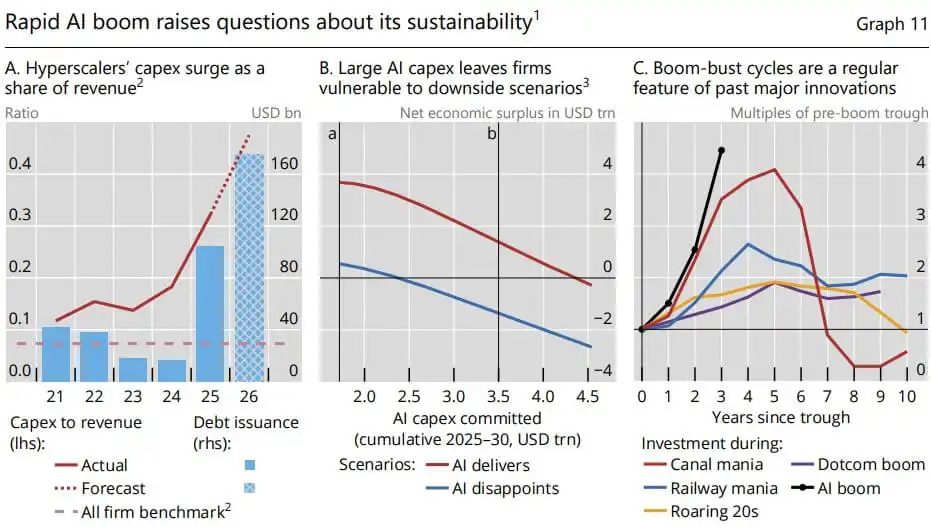
In its annual economic report, the Basel-based institution that advises central banks noted that the five largest cloud computing giants will have AI-related capital expenditures exceeding $1 trillion in 2025 and 2026.

The BIS stated that such massive investment raises the question of whether companies are committing too much capital before their business models are fully validated.

The BIS said:

"Disappointing returns could trigger a sudden withdrawal of financing, turning the capital expenditure boom into a prolonged investment slump, with knock-on effects on financial conditions."

For Bitcoin traders, the implications of this warning extend far beyond the chip and data center race in Silicon Valley.

A sharp reversal in AI spending could tighten liquidity in equity and credit markets, forcing cryptocurrencies to face a tough test: in a sell-off, will Bitcoin initially behave like another risky asset, or will its long-term monetary narrative regain strength after the shock?

AI Spending Boom Draws Central Bank Attention

The Bank for International Settlements (BIS), a forum for central banks, warned in its annual economic report that the race for AI dominance may be pushing investment to levels that future returns cannot sustain.

The BIS stated:

"If supply bottlenecks limit production, the current capital expenditure surge may not be sustainable. Fierce competition for market leadership could further fuel overinvestment, as seen in previous innovation waves, increasing the risk of a sharp reversal if AI returns disappoint."

The issue is not a lack of economic potential for AI. The BIS indicated that this technology could ultimately boost productivity in ways different from earlier waves of automation and software development. If AI systems can self-improve and help generate new ideas, the long-term macroeconomic impact could be significant.

But the near-term financial risks are different. Companies like Google, OpenAI, and Anthropic are pouring huge sums of money without clarity on how much revenue the spending will generate, how long that revenue will last, or how quickly the infrastructure behind AI will become obsolete.

In practice, the largest tech companies are splurging on chips, cloud capacity, data centers, power supplies, and networking equipment, competing for users and market share.
The scale of this race has helped solidify investor confidence in tech stocks while boosting demand for suppliers and infrastructure companies linked to AI construction.

However, the BIS warned that intense competition itself creates fragility. If every major player spends heavily to avoid falling behind, the entire industry could end up with overcapacity, lower returns, and financing structures difficult to maintain once optimism fades.

This dynamic has occurred before. The BIS pointed to earlier investment booms associated with canals, railways, electrification, and the internet.

While each technology later transformed the economy, they also produced periods where investors financed too much, too fast, ultimately leading to painful reversals.

With this in mind, the BIS concluded:

"The scale and speed of the current AI investment boom, coupled with expectations of a significant productivity boost, resemble these precedents and highlight the potential near-term downside risks."

Compounding the issue are severe physical bottlenecks. The insatiable demand for computing power is straining supplies of advanced semiconductors, grid equipment, and raw electricity.

According to the BIS, this surging demand is already pushing up electricity prices, potentially feeding into broader inflation measures—at a time when geopolitical conflicts in the Middle East are independently straining global supply chains.

Credit Risks Build Beneath Equity Rally

Meanwhile, the BIS's concerns extend far beyond a simple stock market correction to how an AI shock could affect the broader financial system.

While the early stages of AI development were funded largely by the massive cash reserves of Silicon Valley giants, the current trillion-dollar scale of investment relies more on debt and increasingly opaque financing structures.

The BIS noted that AI infrastructure now spans corporate debt markets, private credit, lease financing, data center construction, energy contracts, and supplier agreements.

Chipmakers, cloud providers, AI labs, and data center operators are becoming increasingly interconnected through equity investments, procurement commitments, and long-term capacity trades.

Indeed, Bitcoin-focused financial services firm Onramp Bitcoin recently pointed out:

"A web of overlapping commitments now binds AI construction into roughly a $1 trillion loop: Nvidia invests in AI labs like OpenAI, the labs lease cloud capacity from Oracle and CoreWeave, and those cloud services buy Nvidia chips. The same dollar can be booked simultaneously as investment, funding, revenue, and sales, so headline numbers are no longer as meaningful as they appear."
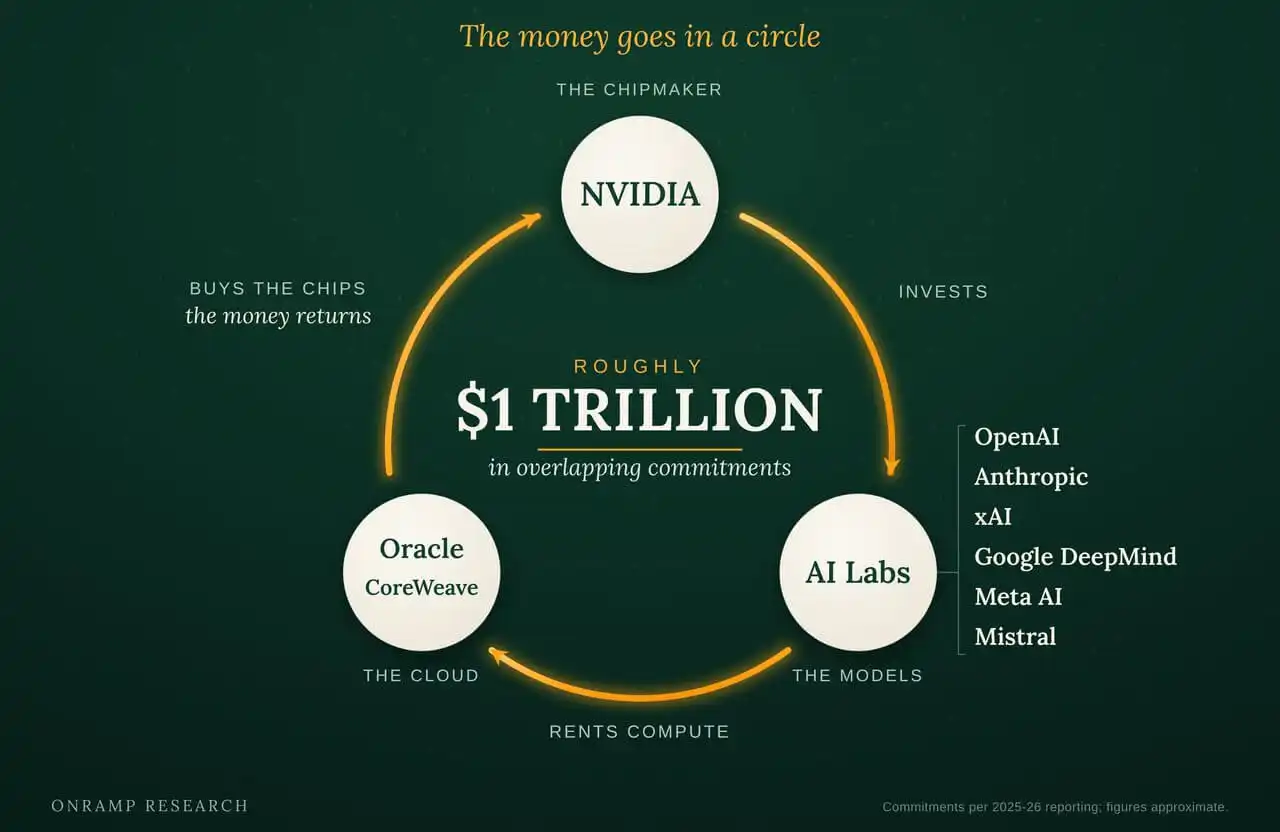
The BIS warned that these arrangements can make risks harder to see, noting that this network of claims is built on expectations of future demand. If AI adoption continues to accelerate, this structure can be self-reinforcing.

But if demand disappoints, stress could reverberate back through the chain.

This could lead to a scenario where suppliers might lose orders, and data center developers might struggle to fill capacity.

Meanwhile, private credit funds could face stress on loans linked to software, infrastructure, or tech borrowers. Banks might find their exposure to private credit and non-bank finance more complex than surface numbers suggest.

This is why the BIS's warning extends beyond tech stocks. A decline in AI-related stocks directly hurts investors. A broader reassessment of AI financing could tighten credit conditions for companies relying on the same funding environment.

Credit spreads have remained relatively narrow, reflecting investor belief that borrowers can continue servicing debt.

A sharp repricing of equity risk could quickly change that. Once lenders demand more risk compensation, weaker borrowers face higher refinancing costs, reduced access to capital, and pressure to cut investment.

This is the path through which AI disappointment could evolve into a macro event.

Bitcoin's Initial Reaction May Be Defensive

In such an economic shock, Bitcoin's role would be complex. Proponents of the asset often describe it as a hedge against currency debasement, fiscal stress, and financial system fragility. Its supply is fixed, it has no corporate issuer, and it does not rely on corporate profits or debt repayment schedules.

These properties could become more attractive if an AI credit crunch ultimately forces policymakers to ease financial conditions. But in the early stages of a broad sell-off, Bitcoin would likely face the same pressure as other risk assets.

When liquidity tightens, investors typically sell liquid positions first. Bitcoin trades continuously, can be sold quickly, and is held by many investors who also own stocks, exchange-traded products, derivatives, and other high-beta assets. This makes it vulnerable during portfolio de-risking.

Recent market behavior supports this concern. CryptoSlate recently reported that Bitcoin fell below $63,000 after South Korea's benchmark KOSPI stock index plunged nearly 10% last week.

This decline suggests that liquidity conditions, leverage, and risk appetite can overwhelm the scarcity narrative for extended periods.

A market shock triggered by AI could follow a similar sequence. Tech stocks linked to construction might fall first. As investors reassess debt linked to data centers, suppliers, and private financing vehicles, credit spreads could widen. Funds facing losses or margin pressure might subsequently cut positions in cryptocurrencies and other liquid assets.

At that stage, Bitcoin wouldn't need a direct link to AI infrastructure to be affected. It just needs to be part of the same risk budget.

Liquidity Questions Follow

But the second stage depends on the government's response to the ensuing market distress.

If a reversal in AI investment remains confined to a small group of tech companies, the damage could be limited. Stocks would reprice, suppliers would adjust, investors would reassess valuations, without forcing a major shift in monetary policy.

But the risk flagged by the BIS is that the spending boom is already large enough to affect the broader financial system.

This suggests that a significant pullback in AI capital expenditure could simultaneously hit corporate investment, employment, household wealth, and credit availability. If inflation remains high and central banks feel unable to cut rates quickly, these pressures could become more severe.

This creates a difficult scenario for risk assets. Higher inflation could keep policy tight even as investment weakens. Tighter credit could expose leverage in private markets. Falling stock prices could reduce household wealth and slow consumption. Each channel could reinforce the others.

For Bitcoin, the policy path is crucial. This asset typically performs best when liquidity is expanding, real rates are falling, and investors anticipate central bank support for markets. A credit shock that ultimately brings looser money could restart that trade.

BitMEX co-founder Arthur Hayes believes that an AI crash could help propel Bitcoin significantly higher if authorities respond by re-creating liquidity, and investors shift away from debt-laden financial structures.

This view remains speculative, but it captures why some crypto traders see AI capital expenditure and credit markets as potential drivers for the next Bitcoin cycle.

But the timing is uncertain. Therefore, traders betting on an eventual liquidity response may still have to endure the preceding drawdown.

Bitcoin rose 2.28% in the past 24 hours and is currently ranked first by market capitalization.

Broader Market Status

Currently, the total cryptocurrency market capitalization is $2.09 trillion, with a 24-hour trading volume of $81.45 billion. Bitcoin's dominance is 57.97%.

For two years, buying more Bitcoin was enough to push up treasury stock prices. Strategy's BTC Yield is now declining, Metaplanet's market capitalization is below the value of its Bitcoin holdings, and new entrants in Europe are asking investors to fund them at terms no one is pricing.


Трендовые криптовалюты

Связанные с этим вопросы

QAccording to the BIS's warning, what could be the initial impact on Bitcoin and other risk assets if the trillion-dollar AI investment boom fails to deliver expected returns?

AThe initial impact would likely be a sharp sell-off. Liquidity could tighten across equity and credit markets, forcing investors to de-risk their portfolios. As a highly liquid asset held by many of the same investors exposed to tech stocks and high-beta assets, Bitcoin would be vulnerable to these initial waves of selling pressure and would likely behave like another risk asset.

QWhat specific financial system vulnerabilities does the BIS highlight regarding the current AI infrastructure investment boom?

AThe BIS highlights vulnerabilities in the complex and opaque financing web binding the AI ecosystem. This includes corporate debt, private credit, leasing, and long-term capacity contracts between chipmakers, cloud providers, AI labs, and data center operators. This structure, built on expectations of future demand, could transmit stress throughout the chain if demand disappoints, potentially impacting banks with indirect exposure and tightening credit conditions more broadly.

QWhy might Bitcoin's price action be complex in the scenario of an AI-induced market shock, according to the article?

ABitcoin's price action would be complex due to a potential two-phase reaction. In the initial phase, it would likely fall alongside other risk assets as investors sell liquid holdings. However, if the shock is severe enough to force central banks to ease monetary policy and inject liquidity to prevent a broader crisis, Bitcoin's long-term narrative as a hedge against monetary debasement could reassert itself, potentially leading to a significant rally in a subsequent phase.

QWhat historical precedents does the BIS cite to support its concern about the current AI investment surge?

AThe BIS cites historical investment booms associated with major technological innovations like canals, railroads, electrification, and the internet. While these technologies ultimately transformed economies, they also led to periods where investment and financing raced ahead of sustainable returns, resulting in painful reversals and downturns.

QApart from financial risks, what other challenge does the BIS identify that could hinder the AI investment boom?

AThe BIS identifies severe physical bottlenecks as a major challenge. The insatiable demand for computing power is straining supplies of advanced semiconductors, grid equipment, and raw electricity. This is already pushing up electricity prices and could contribute to broader inflationary pressures, adding another layer of economic complexity.

Похожее

Грант Кардон увеличил свои холдинги биткоина до 2700 BTC – Почему сейчас?

Кардона Кэпитал, компания Гранта Кардона, увеличила свои биткоин-холдинги до примерно 2700 BTC (стоимостью около $159 млн), купив актив по средней цене $59 000 на фоне падения рынка. Эта покупка контрастирует с действиями крупнейшего корпоративного держателя, MicroStrategy, который впервые утвердил план продажи до $1,25 млрд биткоинов и уже начал распродажу. Направление задают и спотовые биткоин-ETF США, зафиксировавшие в июне рекордный отток средств примерно в $4,06 млрд. Несмотря на массовую продажу и слабые настроения, технический анализ указывает на возможное дно цены биткоина. На недельном графике цена достигла нижней полосы Боллинджера (зеленая линия), которая неоднократно выступала в качестве поддержки и предшествовала восстановлению.

ambcrypto13 мин. назад

Грант Кардон увеличил свои холдинги биткоина до 2700 BTC – Почему сейчас?

ambcrypto13 мин. назад

Чем останется биткойн в эпоху ИИ?

Недавнее падение биткойна ниже 60 000 долларов вновь поднимает вопрос о его ценности в эпоху ИИ. Автор рассматривает ИИ и биткойн как две стороны одной медали. ИИ радикально снизил стоимость создания контента (текстов, изображений, видео) почти до нуля, что привело к потоку информации, где подлинное и сфабрикованное становится все труднее отличить. В результате истинную ценность приобретает не сам контент, а возможность его **верификации** — подтверждения подлинности фактов, активов, записей. Здесь и проявляется суть биткойна. Его часто критикуют за огромное энергопотребление, которое, в отличие от ИИ, кажется непродуктивным. Однако автор предлагает другую точку зрения: если ИИ сжигает энергию для **создания** (генерирования контента и возможностей), то биткойн сжигает её для **верификации**. Его децентрализованная сеть, основанная на криптографии и консенсусе, создает неизменяемый и самостоятельно проверяемый реестр транзакций. Энергия тратится на то, чтобы сделать подделку истории или мошенническую транзакцию астрономически дорогой и практически невозможной без захвата всей сети. Проводя историческую параллель, автор сравнивает ИИ с печатным станком Гутенберга, который резко удешевил распространение знаний, а биткойн/блокчейн — с двойной бухгалтерией, которая снизила затраты на доверие в коммерции. Таким образом, ИИ и блокчейн не конкурируют, а дополняют друг друга в новой цифровой реальности: один отвечает за безграничное **создание**, другой — за надежное **доказательство** и проверку. Биткойн, в этой логике, — это не просто машина для создания монет, а «машина для создания верифицируемости». В мире, где ИИ может сгенерировать что угодно, конечной ценностью может стать не количество контента, а наличие независимо проверяемых фактов и активов. Будущее биткойна остается неопределенным, но его основная функция — обеспечение доверия без доверия — приобретает новую актуальность в эпоху повсеместных глубоких подделок.

marsbit17 мин. назад

Чем останется биткойн в эпоху ИИ?

marsbit17 мин. назад

В эпоху ИИ, что остаётся у биткоина?

Автор: Sevclub, Seven Research В эпоху искусственного интеллекта, когда генерация текстов, изображений и видео стала дешёвой и быстрой, подлинность информации становится всё более сомнительной. ИИ снижает стоимость производства контента почти до нуля, что приводит к переизбытку и смешению правды и лжи. В этих условиях ключевой ценностью становится возможность верификации — подтверждения истинности. В этом контексте можно по-новому взглянуть на Биткоин, который часто критикуют за высокое энергопотребление. Его суть не в вере, а в криптографической проверке. Биткоин тратит энергию не на вычисления, как ИИ, а на обеспечение "неизменяемости", повышая стоимость фальсификации истории транзакций. Это делает его своего рода машиной по производству "верифицируемости". Проводя параллель с эпохой Возрождения, можно сказать, что ИИ — это новая "печатная пресса", радикально снижающая стоимость создания. Тогда как блокчейн (и Биткоин как его первое воплощение) может стать аналогом "двойной бухгалтерии", снижающим стоимость проверки и установления доверия в цифровом мире. Они не конкурируют, а дополняют друг друга: ИИ генерирует, блокчейн доказывает и верифицирует. Таким образом, в эпоху, когда ИИ может создать что угодно, истинным дефицитом становится не сам контент, а возможность независимой проверки фактов. Биткоин представляет собой попытку создать основу для такой верифицируемости цифровых активов и записей.

链捕手26 мин. назад

В эпоху ИИ, что остаётся у биткоина?

链捕手26 мин. назад

Маркировка Cardano как "призрачной цепи" опровергнута? Почему 34 dApps ADA не раскрывают полной картины

Термин «ghost chain» («цепь-призрак») относится к блокчейну с минимальной активностью и развитием. Хотя Cardano (ADA) обвиняют в этом из-за малого количества dApps (34 против 442 у Solana и 1564 у Ethereum) и значительно более низких показателей транзакций и пользователей, статья объясняет это архитектурными особенностями. Cardano использует модель EUTXO и механизмы батчинга (объединения транзакций), которые повышают детерминизм и безопасность, но при этом статистика «недооценивает» реальную активность в сети. При этом разработка на Cardano остается интенсивной. Автор приходит к выводу, что, несмотря на разрыв в метриках с другими ведущими блокчейнами (Ethereum, Solana, Tron), лишь одно это не является достаточным основанием для ярлыка «ghost chain», так как Cardano занимает свою нишу, делая акцент на научно обоснованный подход, безопасность и соответствие требованиям институциональных клиентов.

ambcrypto1 ч. назад

Маркировка Cardano как "призрачной цепи" опровергнута? Почему 34 dApps ADA не раскрывают полной картины

ambcrypto1 ч. назад

Запас Ethereum у Bitmine достиг $9,8 млрд: «Лучшие годы для криптовалют еще впереди»

Криптокомпания Bitmine Immersion Technologies увеличила свои запасы Ethereum (ETH) на 27 084 монеты за последнюю неделю. Теперь в её казне находится 5 700 040 ETH, что составляет 4,7% от общего предложения Ethereum и оценивается примерно в 9,01 млрд долларов по цене 1569 долларов за монету. Это произошло на фоне падения цены ETH и оттока средств из ETF-фондов Ethereum в июне. Несмотря на слабые рыночные условия и критику в адрес аналогичной стратегии накопления биткоинов компанией MicroStrategy, Bitmine продолжает агрессивно покупать ETH. Председатель Bitmine Том Ли считает, что текущая волатильность отчасти связана с «оконной отделкой» перед концом квартала, и выражает уверенность в будущем крипторынка. Компания подчеркивает свою устойчивость, отмечая ежегодный доход от стейкинга в размере около 211 млн долларов, наличие 555 млн долларов денежных средств и ликвидных ценных бумаг, а также включение в индекс Russell 1000. Ли заявил, что лучшие годы для криптовалют ещё впереди, и ожидает, что токенизация и прогресс в области искусственного интеллекта подстегнут спрос на блокчейн и децентрализованные криптоактивы.

ambcrypto2 ч. назад

Запас Ethereum у Bitmine достиг $9,8 млрд: «Лучшие годы для криптовалют еще впереди»

ambcrypto2 ч. назад

Торговля

Спот

Популярные статьи

Тест по Bitcoin Биткоина

HTX Learn: Изучите Bitcoin halving и Заработаете Токены USDT

3.1k просмотров всегоОпубликовано 2024.04.16Обновлено 2024.04.16

Тест по Bitcoin  Биткоина

Что такое $BITCOIN

ЦИФРОВОЕ ЗОЛОТО ($BITCOIN): Комплексный анализ Введение в ЦИФРОВОЕ ЗОЛОТО ($BITCOIN) ЦИФРОВОЕ ЗОЛОТО ($BITCOIN) — это проект на основе блокчейна, работающий в сети Solana, который стремится объединить характеристики традиционных драгоценных металлов с инновациями децентрализованных технологий. Хотя он носит имя Биткойн, часто называемого “цифровым золотом” из-за его восприятия как средства хранения ценности, ЦИФРОВОЕ ЗОЛОТО является отдельным токеном, предназначенным для создания уникальной экосистемы в ландшафте Web3. Его цель — позиционировать себя как жизнеспособный альтернативный цифровой актив, хотя детали его применения и функциональности все еще развиваются. Что такое ЦИФРОВОЕ ЗОЛОТО ($BITCOIN)? ЦИФРОВОЕ ЗОЛОТО ($BITCOIN) — это токен криптовалюты, специально разработанный для использования в блокчейне Solana. В отличие от Биткойна, который выполняет широко признанную роль хранения ценности, этот токен, похоже, сосредоточен на более широких приложениях и характеристиках. Примечательные аспекты включают: Инфраструктура блокчейна: Токен построен на блокчейне Solana, известном своей способностью обрабатывать высокоскоростные и недорогие транзакции. Динамика предложения: ЦИФРОВОЕ ЗОЛОТО имеет максимальное предложение, ограниченное 100 квадриллионами токенов (100P $BITCOIN), хотя детали о его обращающемся предложении в настоящее время не раскрыты. Утилита: Хотя точные функциональные возможности не описаны, есть указания на то, что токен может быть использован для различных приложений, потенциально связанных с децентрализованными приложениями (dApps) или стратегиями токенизации активов. Кто создатель ЦИФРОВОГО ЗОЛОТА ($BITCOIN)? На данный момент личность создателей и команды разработчиков, стоящих за ЦИФРОВЫМ ЗОЛОТОМ ($BITCOIN), остается неизвестной. Эта ситуация типична для многих инновационных проектов в области блокчейна, особенно тех, которые связаны с децентрализованными финансами и феноменом мем-криптовалют. Хотя такая анонимность может способствовать культуре, ориентированной на сообщество, она усиливает опасения по поводу управления и ответственности. Кто инвесторы ЦИФРОВОГО ЗОЛОТА ($BITCOIN)? Доступная информация указывает на то, что у ЦИФРОВОГО ЗОЛОТА ($BITCOIN) нет известных институциональных спонсоров или значительных венчурных капиталовложений. Проект, похоже, функционирует по модели пирингового взаимодействия, сосредоточенной на поддержке и принятии сообществом, а не на традиционных путях финансирования. Его активность и ликвидность в основном сосредоточены на децентрализованных биржах (DEX), таких как PumpSwap, а не на устоявшихся централизованных торговых платформах, что еще больше подчеркивает его подход, ориентированный на grassroots. Как работает ЦИФРОВОЕ ЗОЛОТО ($BITCOIN) Операционные механизмы ЦИФРОВОГО ЗОЛОТА ($BITCOIN) можно подробно описать на основе его дизайна блокчейна и характеристик сети: Механизм консенсуса: Используя уникальный механизм доказательства истории (PoH) Solana в сочетании с моделью доказательства доли (PoS), проект обеспечивает эффективную валидацию транзакций, что способствует высокой производительности сети. Токеномика: Хотя конкретные дефляционные механизмы не были подробно описаны, большое максимальное предложение токенов подразумевает, что оно может быть предназначено для микротранзакций или нишевых случаев использования, которые еще предстоит определить. Интероперабельность: Существует потенциал для интеграции с более широкой экосистемой Solana, включая различные платформы децентрализованных финансов (DeFi). Однако детали относительно конкретных интеграций остаются неуточненными. Хронология ключевых событий Вот хронология, которая подчеркивает значимые вехи, касающиеся ЦИФРОВОГО ЗОЛОТА ($BITCOIN): 2023: Первоначальное развертывание токена происходит в блокчейне Solana, отмеченное его адресом контракта. 2024: ЦИФРОВОЕ ЗОЛОТО приобретает видимость, когда оно становится доступным для торговли на децентрализованных биржах, таких как PumpSwap, позволяя пользователям обменивать его на SOL. 2025: Проект наблюдает спорадическую торговую активность и потенциальный интерес к инициативам, возглавляемым сообществом, хотя на данный момент не зафиксировано никаких значительных партнерств или технических достижений. Критический анализ Сильные стороны Масштабируемость: Основная инфраструктура Solana поддерживает высокие объемы транзакций, что может повысить полезность $BITCOIN в различных сценариях транзакций. Доступность: Потенциально низкая цена торговли за токен может привлечь розничных инвесторов, способствуя более широкому участию благодаря возможностям дробного владения. Риски Отсутствие прозрачности: Отсутствие публично известных спонсоров, разработчиков или процесса аудита может вызвать скептицизм относительно устойчивости и надежности проекта. Волатильность рынка: Торговая активность сильно зависит от спекулятивного поведения, что может привести к значительной волатильности цен и неопределенности для инвесторов. Заключение ЦИФРОВОЕ ЗОЛОТО ($BITCOIN) является интригующим, но неоднозначным проектом в быстро развивающейся экосистеме Solana. Хотя он пытается использовать нарратив “цифрового золота”, его отход от установленной роли Биткойна как средства хранения ценности подчеркивает необходимость более четкого различения его предполагаемой утилиты и структуры управления. Будущее принятие и усвоение, вероятно, будут зависеть от решения текущей непрозрачности и более четкого определения его операционных и экономических стратегий. Примечание: Этот отчет охватывает синтезированную информацию, доступную на октябрь 2023 года, и с тех пор могут произойти события.

153 просмотров всегоОпубликовано 2025.05.13Обновлено 2025.05.13

Что такое $BITCOIN

Fractal Bitcoin: масштабирование Биткоина с помощью рекурсивной системы

Fractal Bitcoin — масштабное Layer-1-решнение, созданное на базе кода Биткоина, позволяющего достигать бесконечного масштабирования с помощью рекурсивного подхода.

2.4k просмотров всегоОпубликовано 2025.06.30Обновлено 2025.06.30

Fractal Bitcoin: масштабирование Биткоина с помощью рекурсивной системы

Обсуждения

Добро пожаловать в Сообщество HTX. Здесь вы сможете быть в курсе последних новостей о развитии платформы и получить доступ к профессиональной аналитической информации о рынке. Мнения пользователей о цене на BTC (BTC) представлены ниже.

活动图片