The NSA Is Trying To Backdoor Bitcoin, Warns Peter Todd — Here’s How

bitcoinistОпубликовано 2025-10-07Обновлено 2025-10-07

Введение

Prominent Bitcoin developer Peter Todd alleged on Monday, October 6, that the US National Security Agency (NSA) is “looking to...

Trusted Editorial content, reviewed by leading industry experts and seasoned editors. Ad Disclosure

Prominent Bitcoin developer Peter Todd alleged on Monday, October 6, that the US National Security Agency (NSA) is “looking to backdoor crypto again” via the rollout of so-called quantum-secure algorithms—this time by pushing deployments that exclude tried-and-tested classical cryptography.

“Tl;dr: the NSA is clearly looking to backdoor crypto again with the rollout of “quantum secure” algorithms. The obvious way to implement them is AND: traditional AND quantum secure. So you need to break both. The NSA is trying to remove that seatbelt: quantum-only,” Todd wrote.

Is The NSA Plotting A Quantum Backdoor Into Bitcoin?

Todd’s comments came as cryptographer Daniel J. Bernstein (DJB) published a pair of blog posts—on October 4 and 5—criticizing current Internet Engineering Task Force (IETF) processes and warning that “weakened cryptography” could be standardized through procedural changes that suppress dissent.

In “MODPOD: The collapse of IETF’s protections for dissent,” Bernstein argues that a new moderation framework enables content-based censorship of objections, including objections to eliminating “hybrid” deployments that combine classical and post-quantum schemes. He adds there is “useful action” stakeholders can take by Tuesday, October 7 to oppose these changes.

At the heart of the dispute is whether migrations to post-quantum cryptography (PQC) should favor hybrid combinations—e.g., classical ECDH and PQ key encapsulation—rather than quantum-only switches. Hybrids hedge the unknowns of newly standardized PQC by requiring an attacker to break both components to compromise a session or signature. The IETF formalized the term “hybrid” in June 2025 (RFC 9794), and NIST’s own guidance and FAQs likewise describe and allow hybrid key-establishment modes during transition. That context underpins Todd’s claim that pushing “quantum-only” is a dangerous deviation from best practice.

Bernstein’s companion post on October 4 details real-world hybrid deployments—Google’s CECPQ1/2 experiments (ECC+NewHope, ECC+NTRU, ECC+SIKE), multi-vendor SSH support for ECC+sntrup761, and today’s browser usage dominated by ECC+ML-KEM (Kyber)—as evidence that hybridization is already mainstream and operationally feasible at Internet scale. The post argues that eliminating hybrids would lower safety margins precisely when new PQC is still maturing.

NIST, for its part, has led the global PQC program since 2016 and in August 2024 finalized standards for ML-KEM (Kyber) and two signature schemes (ML-DSA/Dilithium and SLH-DSA/SPHINCS+), with additional algorithms such as HQC selected in 2025. Throughout its materials, NIST acknowledges hybrid modes as legitimate transition mechanisms and has hosted dedicated workshops on KEM guidance—positions that cut against a blanket “quantum-only” mandate.

Why this matters for Bitcoin and broader crypto is twofold. First, Bitcoin’s ecosystem relies heavily on standardized primitives and network protocols—hashes, signatures, handshakes—whose evolution is shaped by NIST and IETF outputs even when implementation occurs in open-source codebases. Second, Todd grounds his warning in history: the NSA’s alleged role in the Dual_EC_DRBG fiasco two decades ago, where a NIST-endorsed random number generator was later withdrawn amid credible backdoor concerns, including reports that RSA made it the default in its toolkit following a secret payment. “Endorsement of backdoored crypto has happened before at the behest of the NSA,” Todd wrote, adding “It’s not a theoretical risk. They’re clearly gearing up to do it again.”

There is, however, no public proof that the NSA is currently inserting a specific backdoor into NIST’s PQC standards or IETF drafts. NIST continues to publish open guidance, workshops, and public comment processes around PQC, including explicit documentation of hybrid approaches. Developer Fudmottin (@Fudmottin) objected to Todd: “If NIST endorsed cryptographic algorithms such as SHA-256 turn out to have back doors or a weakness, then NIST is done. No one will even ask them about the time of day (yes, NIST keeps that standard for the USA).”

The immediate call to action comes from Bernstein’s posts urging stakeholders to engage IETF mechanisms by Tuesday, October 7 (any time zone) to object to MODPOD-style moderation and to defend hybrid cryptography as the default transition path. Todd’s amplification into the Bitcoin community underscores a longstanding mistrust of intelligence-led cryptographic policy—shaped by Dual_EC and other episodes—and a desire to keep consensus-critical systems insulated from standards that may weaken defense-in-depth.

At press time, Bitcoin traded at $134,545.
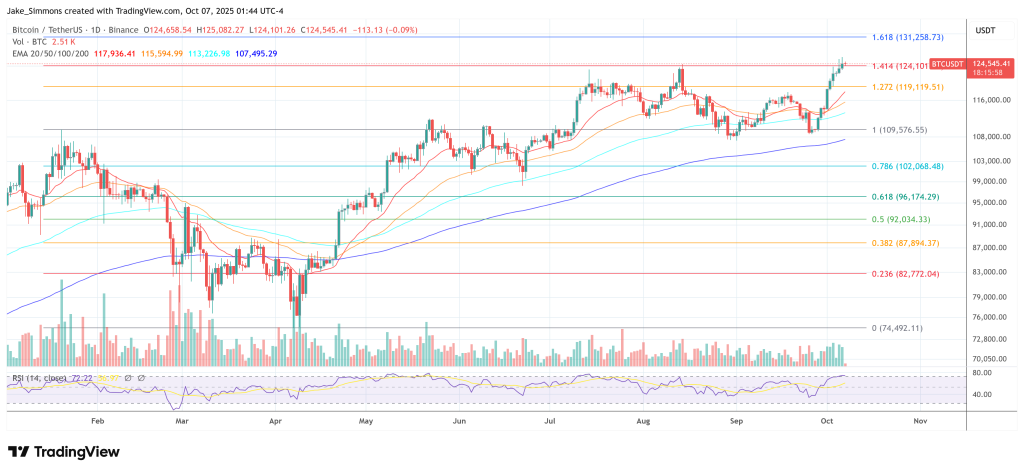
Bitcoin price
BTC remains above $124,000, 1-day chart | Source: BTCUSDT on TradingView.com
Featured image created with DALL.E, chart from TradingView.com
Editorial Process for bitcoinist is centered on delivering thoroughly researched, accurate, and unbiased content. We uphold strict sourcing standards, and each page undergoes diligent review by our team of top technology experts and seasoned editors. This process ensures the integrity, relevance, and value of our content for our readers.

Jake Simmons has been a Bitcoin enthusiast since 2016. Ever since he heard about Bitcoin, he has been studying the topic every day and trying to share his knowledge with others. His goal is to contribute to Bitcoin's financial revolution, which will replace the fiat money system. Besides BTC and crypto, Jake studied Business Informatics at a university. After graduation in 2017, he has been working in the blockchain and crypto sector. You can follow Jake on Twitter at @realJakeSimmons.

Похожее

Global Crypto Regulation "Closing the Net": Hong Kong, EU, US Simultaneously Take Action, Is the Compliance Window Closing?

Global Crypto Regulation Tightens: Hong Kong, EU, and US Simultaneously Enforce Rules, Closing the Compliance Window? The global virtual asset regulatory landscape is shifting from rule-making to enforcement. Recent moves by Hong Kong, the EU, and the US signal a coordinated push towards market restructuring based on licensing, product classification, custody, and client segmentation. **Hong Kong**'s SFC issued a circular on "Relevant Stablecoins" on May 27, formally establishing a two-tier regulatory architecture where the HKMA oversees issuance and the SFC oversees trading and distribution. This creates differentiated, often lighter-touch, rules for compliant, licensed stablecoins compared to other virtual assets, fitting into a broader strategy to develop stablecoins as settlement infrastructure, tokenized securities as investment products, and licensed VATP platforms as distribution channels. The **European Union** is approaching a critical deadline, with the MiCA transition period ending on July 1. After this date, unlicensed Crypto-Asset Service Providers (CASPs) must cease serving EU clients. With only about 210 authorized CASPs across 23 member states so far, a significant market consolidation is expected, as the application process now takes 6-9 months. In the **United States**, the CLARITY Act passed a key Senate committee vote on May 14. This landmark bill aims to clarify jurisdiction between the SEC and CFTC, establish registration rules for trading platforms and custodians, and create a federal framework for stablecoin regulation. A key compromise prohibits "passive yield" on stablecoin balances but allows "activity rewards" tied to specific functions like payments. The convergence of these regulatory actions highlights a fundamental shift: stablecoins, with a payment volume rivaling major card networks, are being treated as critical financial infrastructure rather than unregulated digital assets. The core message is clear: compliance is transitioning from an operational cost to a mandatory license for market access, determining which players will participate in the next phase of the digital asset economy.

marsbit15 мин. назад

Global Crypto Regulation "Closing the Net": Hong Kong, EU, US Simultaneously Take Action, Is the Compliance Window Closing?

marsbit15 мин. назад

Торговля

Спот
Фьючерсы

Популярные статьи

Тест по Bitcoin Биткоина

HTX Learn: Изучите Bitcoin halving и Заработаете Токены USDT

3.1k просмотров всегоОпубликовано 2024.04.16Обновлено 2024.04.16

Тест по Bitcoin  Биткоина

Что такое $BITCOIN

ЦИФРОВОЕ ЗОЛОТО ($BITCOIN): Комплексный анализ Введение в ЦИФРОВОЕ ЗОЛОТО ($BITCOIN) ЦИФРОВОЕ ЗОЛОТО ($BITCOIN) — это проект на основе блокчейна, работающий в сети Solana, который стремится объединить характеристики традиционных драгоценных металлов с инновациями децентрализованных технологий. Хотя он носит имя Биткойн, часто называемого “цифровым золотом” из-за его восприятия как средства хранения ценности, ЦИФРОВОЕ ЗОЛОТО является отдельным токеном, предназначенным для создания уникальной экосистемы в ландшафте Web3. Его цель — позиционировать себя как жизнеспособный альтернативный цифровой актив, хотя детали его применения и функциональности все еще развиваются. Что такое ЦИФРОВОЕ ЗОЛОТО ($BITCOIN)? ЦИФРОВОЕ ЗОЛОТО ($BITCOIN) — это токен криптовалюты, специально разработанный для использования в блокчейне Solana. В отличие от Биткойна, который выполняет широко признанную роль хранения ценности, этот токен, похоже, сосредоточен на более широких приложениях и характеристиках. Примечательные аспекты включают: Инфраструктура блокчейна: Токен построен на блокчейне Solana, известном своей способностью обрабатывать высокоскоростные и недорогие транзакции. Динамика предложения: ЦИФРОВОЕ ЗОЛОТО имеет максимальное предложение, ограниченное 100 квадриллионами токенов (100P $BITCOIN), хотя детали о его обращающемся предложении в настоящее время не раскрыты. Утилита: Хотя точные функциональные возможности не описаны, есть указания на то, что токен может быть использован для различных приложений, потенциально связанных с децентрализованными приложениями (dApps) или стратегиями токенизации активов. Кто создатель ЦИФРОВОГО ЗОЛОТА ($BITCOIN)? На данный момент личность создателей и команды разработчиков, стоящих за ЦИФРОВЫМ ЗОЛОТОМ ($BITCOIN), остается неизвестной. Эта ситуация типична для многих инновационных проектов в области блокчейна, особенно тех, которые связаны с децентрализованными финансами и феноменом мем-криптовалют. Хотя такая анонимность может способствовать культуре, ориентированной на сообщество, она усиливает опасения по поводу управления и ответственности. Кто инвесторы ЦИФРОВОГО ЗОЛОТА ($BITCOIN)? Доступная информация указывает на то, что у ЦИФРОВОГО ЗОЛОТА ($BITCOIN) нет известных институциональных спонсоров или значительных венчурных капиталовложений. Проект, похоже, функционирует по модели пирингового взаимодействия, сосредоточенной на поддержке и принятии сообществом, а не на традиционных путях финансирования. Его активность и ликвидность в основном сосредоточены на децентрализованных биржах (DEX), таких как PumpSwap, а не на устоявшихся централизованных торговых платформах, что еще больше подчеркивает его подход, ориентированный на grassroots. Как работает ЦИФРОВОЕ ЗОЛОТО ($BITCOIN) Операционные механизмы ЦИФРОВОГО ЗОЛОТА ($BITCOIN) можно подробно описать на основе его дизайна блокчейна и характеристик сети: Механизм консенсуса: Используя уникальный механизм доказательства истории (PoH) Solana в сочетании с моделью доказательства доли (PoS), проект обеспечивает эффективную валидацию транзакций, что способствует высокой производительности сети. Токеномика: Хотя конкретные дефляционные механизмы не были подробно описаны, большое максимальное предложение токенов подразумевает, что оно может быть предназначено для микротранзакций или нишевых случаев использования, которые еще предстоит определить. Интероперабельность: Существует потенциал для интеграции с более широкой экосистемой Solana, включая различные платформы децентрализованных финансов (DeFi). Однако детали относительно конкретных интеграций остаются неуточненными. Хронология ключевых событий Вот хронология, которая подчеркивает значимые вехи, касающиеся ЦИФРОВОГО ЗОЛОТА ($BITCOIN): 2023: Первоначальное развертывание токена происходит в блокчейне Solana, отмеченное его адресом контракта. 2024: ЦИФРОВОЕ ЗОЛОТО приобретает видимость, когда оно становится доступным для торговли на децентрализованных биржах, таких как PumpSwap, позволяя пользователям обменивать его на SOL. 2025: Проект наблюдает спорадическую торговую активность и потенциальный интерес к инициативам, возглавляемым сообществом, хотя на данный момент не зафиксировано никаких значительных партнерств или технических достижений. Критический анализ Сильные стороны Масштабируемость: Основная инфраструктура Solana поддерживает высокие объемы транзакций, что может повысить полезность $BITCOIN в различных сценариях транзакций. Доступность: Потенциально низкая цена торговли за токен может привлечь розничных инвесторов, способствуя более широкому участию благодаря возможностям дробного владения. Риски Отсутствие прозрачности: Отсутствие публично известных спонсоров, разработчиков или процесса аудита может вызвать скептицизм относительно устойчивости и надежности проекта. Волатильность рынка: Торговая активность сильно зависит от спекулятивного поведения, что может привести к значительной волатильности цен и неопределенности для инвесторов. Заключение ЦИФРОВОЕ ЗОЛОТО ($BITCOIN) является интригующим, но неоднозначным проектом в быстро развивающейся экосистеме Solana. Хотя он пытается использовать нарратив “цифрового золота”, его отход от установленной роли Биткойна как средства хранения ценности подчеркивает необходимость более четкого различения его предполагаемой утилиты и структуры управления. Будущее принятие и усвоение, вероятно, будут зависеть от решения текущей непрозрачности и более четкого определения его операционных и экономических стратегий. Примечание: Этот отчет охватывает синтезированную информацию, доступную на октябрь 2023 года, и с тех пор могут произойти события.

99 просмотров всегоОпубликовано 2025.05.13Обновлено 2025.05.13

Что такое $BITCOIN

Fractal Bitcoin: масштабирование Биткоина с помощью рекурсивной системы

Fractal Bitcoin — масштабное Layer-1-решнение, созданное на базе кода Биткоина, позволяющего достигать бесконечного масштабирования с помощью рекурсивного подхода.

2.3k просмотров всегоОпубликовано 2025.06.30Обновлено 2025.06.30

Fractal Bitcoin: масштабирование Биткоина с помощью рекурсивной системы

Обсуждения

Добро пожаловать в Сообщество HTX. Здесь вы сможете быть в курсе последних новостей о развитии платформы и получить доступ к профессиональной аналитической информации о рынке. Мнения пользователей о цене на BTC (BTC) представлены ниже.

活动图片