Bitcoin At Risk? Simon Dixon Alleges BlackRock’s Hidden Takeover Plan

bitcoinistОпубликовано 2025-10-06Обновлено 2025-10-06

Введение

In an interview with Bitcoin Archive’s Archie, early Bitcoiner and Bank to the Future co-founder Simon Dixon characterized the current...

Trusted Editorial content, reviewed by leading industry experts and seasoned editors. Ad Disclosure

In an interview with Bitcoin Archive’s Archie, early Bitcoiner and Bank to the Future co-founder Simon Dixon characterized the current moment as nothing less than “the Wall Street attack phase,” arguing that institutional finance is assembling the plumbing and incentives to pull customer coins into custodial wrappers—and, in crisis, separate investors from their bitcoin. “People underestimate what Wall Street is willing to do to take your Bitcoin,” he said. The essential defense, in his view, is unambiguous: “Bitcoin is money you can own, money you can spend, and money that has a fixed supply with a monetary policy that nobody can change.”

How BlackRock Is Allegedly Trying To Control Bitcoin

Dixon framed the last 14 years of Bitcoin’s history as a series of counter-attacks, from exchange failures to regulatory squeezes, culminating now in what he described as a two-tier system: bitcoin held in Wall Street custody—via ETFs, pensions, corporate treasuries and bitcoin-backed loans—and bitcoin held in self-custody. The danger, he argued, is not price manipulation forever, but engineered liquidity events designed to vacuum up coins from leveraged or custodial holders. “They can’t change the long-term price. The fixed supply is the fixed supply,” he said. “But they can do elaborate schemes to steal your Bitcoin.”

At the core of his thesis is the scale and reach of the modern asset-management complex. Dixon pointed to BlackRock’s centrality—its index weight across “20,000 companies,” its Aladdin risk platform used by large asset managers, and its proximity to policymaking—as symptomatic of a broader “financial-industrial complex.”

In Dixon’s telling, that complex has already rebuilt the crypto industry in its own image: first by presiding over (or benefiting from) a parade of high-profile implosions and banking disruptions like FTX and Celsius, then by shepherding a pro-ETF, pro-tokenization framework that channels retirement savings, insurance float and corporate balance sheets into custodial bitcoin exposure. “Through this tax efficiency plus individuals thinking about inheritance, we have essentially given the asset managers full control,” he claimed. The net effect, he warned, is the consolidation of coins into a few systemically important pools.

Archie challenged the causal chain between the 2022–2023 enforcement wave and spot ETF approvals, noting that Grayscale had to sue to win its conversion. Dixon acknowledged that “you have to take a few leaps” when reconstructing opaque policy sequences, but insisted the net result is plain: the industry was discredited and de-banked, only for a tightly regulated, Wall-Street-led version to emerge. He cited his inside view as a major creditor in the Celsius Chapter 11 as formative, saying that bankruptcy taught him how quickly “Bitcoin IOUs” become indistinguishable from the legacy system’s risks. “Anybody that’s left Bitcoin on an exchange and received a Bitcoin IOU… realizes the importance of the ability to self-custody,” he said.

The conversation repeatedly returned to leverage. Archie drew a distinction between the margin chains and rehypothecation that blew up in 2021–2022 and the long-duration, corporate-finance tools used by publicly listed “bitcoin operating companies,” arguing these are “night and day” in terms of systemic fragility. Dixon’s reply was that the real risk emerges when individually sensible structures are linked into a pipeline—ETFs and index funds directing flows, corporate debt and dividend commitments denominated in fiat, stablecoin credit interlacing with bitcoin-backed loans, distressed buyouts rolling assets into the largest public vehicles, and mining equities sitting inside the same index-fund complex.

“When you combine all of these different products together… you can then do this margin process,” he said. He sketched a scenario in which a severe drawdown triggers margin cascades and bankruptcy proceedings that deliver even more coins into a few custodial honeypots. “All you need to do to protect yourself when that event happens is own bitcoin in self-custody,” he said.

Beyond market structure, Dixon placed Bitcoin in a wider macro and geopolitical frame. He argued the United States is pursuing “fiscal dominance”—debt-financed spending that inflates away obligations—while a multipolar currency order accelerates. In that transition, he expects both gold and bitcoin to be instrumentalized. “Bitcoin is going to be placed at the very, very center of a future and upcoming currency war,” he said, asserting that the same financial-industrial network that shapes rates and credit will not hesitate to “engineer some kind of pump and dump cycle that resets the chessboard.” Whether or not readers accept that framing, his prescription does not waver: self-custody first.

Dixon also laid out a personal rule set forged across cycles: buy on a fixed cadence, hold coins in self-custody, and think in multi-year horizons. “Most people come in for number-go-ups,” he said, “but until they go through a disaster, then they realize that the money you can own and money you can spend is the real utility.” He urged viewers to build the operational competence of self-custody now—keys, inheritance planning, and disciplined accumulation—rather than outsourcing it to product wrappers that trade convenience for counterparty risk. “Everybody has to do it,” he said. “The skill of self-custody is something everyone has to do.”

Archie added two caveats for balance: allocate only capital you can leave untouched for at least four years, and remember to upgrade quality of life rather than “bask in the warmth of your UTXOs” indefinitely. Dixon agreed, stressing that the point of reducing financial anxiety is to live better, not to hoard at all costs. Still, he closed with urgency: “There will never be another five years like the five years ahead… In the next five years, you need to accumulate as much bitcoin as is humanly possible,” he said, adding his standard disclaimer—“not financial advice.”

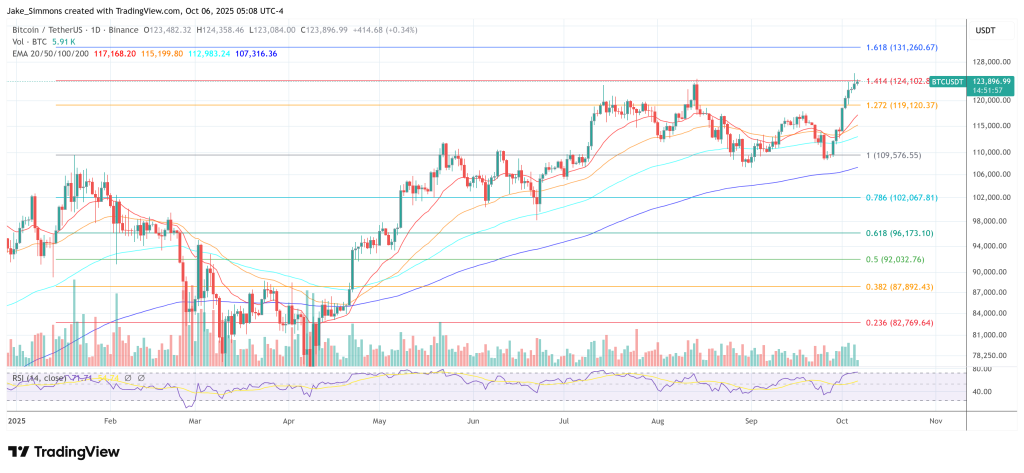
At press time, BTC traded at $123,896.
Bitcoin price
BTC hovers below $124,000, 1-day chart | Source: BTCUSDT on TradingView.com
Featured image created with DALL.E, chart from TradingView.com
Editorial Process for bitcoinist is centered on delivering thoroughly researched, accurate, and unbiased content. We uphold strict sourcing standards, and each page undergoes diligent review by our team of top technology experts and seasoned editors. This process ensures the integrity, relevance, and value of our content for our readers.

Jake Simmons has been a Bitcoin enthusiast since 2016. Ever since he heard about Bitcoin, he has been studying the topic every day and trying to share his knowledge with others. His goal is to contribute to Bitcoin's financial revolution, which will replace the fiat money system. Besides BTC and crypto, Jake studied Business Informatics at a university. After graduation in 2017, he has been working in the blockchain and crypto sector. You can follow Jake on Twitter at @realJakeSimmons.

Похожее

STRC Breaks Below $95: Why Does It Continue to Depeg? Is There Default Risk?

"STRC Falls Below $95: Why the Persistent Depegging and Is There Default Risk?" The article discusses the recent decline in the price of STRC, a perpetual preferred stock issued by Strategy (MSTR) designed to trade around a $100 par value. As of publication, STRC traded at $94.65, raising market concerns. STRC is described as a high-yield cash flow product, offering an 11.50% annual dividend paid monthly. Its "preferred" status grants it priority over common stock for dividends and in liquidation. Key reasons cited for the price depegging include: 1. **Bitcoin's Price Drop:** MSTR's assets are heavily tied to Bitcoin (BTC), which fell over 21% from its recent high, pressuring all Strategy-related products. 2. **Competitive Pressure:** Rival Strive Asset Management's similar product, SATA, offers daily dividends and has maintained its $100 par value with a ~13% yield. In response, Strategy has proposed changing STRC's dividend frequency from monthly to bi-weekly, pending shareholder vote. 3. **Technical Selling:** A break below $100 may have triggered algorithmic selling and stop-losses, exacerbating the decline. Regarding default risk, the analysis suggests it is currently low. Strategy founder Michael Saylor confirmed the June 2026 dividend rate remains at 11.50% with no cuts or suspensions. The company's massive reserve of 843,706 BTC provides a significant backstop for its obligations. Industry opinions are mixed. Some analysts view the BTC holdings as reliable support for dividends, while critics like Peter Schiff warn of potential dividend cuts leading to price crashes and lawsuits. Others highlight inflation risk and the company's ability to reduce dividends without a formal default. In summary, STRC's drop is attributed to BTC volatility, competition, and technical factors. While immediate default risk appears contained, the product faces challenges from market conditions and competitive dynamics.

marsbit37 мин. назад

STRC Breaks Below $95: Why Does It Continue to Depeg? Is There Default Risk?

marsbit37 мин. назад

AI Trading Cools, South Korean Stocks Plunge 1.8%, Spot Gold Rises 1%, Bitcoin Dives

A sell-off in AI-related stocks, triggered by Broadcom's disappointing earnings forecast, sent shockwaves through global markets. South Korea's KOSPI led Asia's decline, plunging 1.8% as the risks from concentrated chip stock gains and surging leveraged investments came to the fore. The tech-heavy Nasdaq 100 futures fell 0.5% following Broadcom's 14% after-hours plunge, which signaled a slower-than-expected transition to AI clients. This pullback extended Wall Street's weakness, halting the S&P 500's nine-day rally amid hawkish Fed signals and renewed Middle East tensions. South Korean authorities convened an emergency meeting, pledging "immediate measures" against market volatility and warning of record-high stock margin debt. The adjustment rippled across assets: Bitcoin fell to around $64,000, its lowest since February, while safe-haven gold rose 1% on bargain hunting. Oil prices dipped on Middle East ceasefire news. Market analysts noted the sell-off was driven by profit-taking after massive gains, particularly in chip stocks like Samsung and SK Hynix, which now dominate the KOSPI. Wall Street banks are divided on Korea's outlook, with Goldman Sachs raising its target while Citigroup and others warn of overvaluation and a potential bubble. Bridgewater's Ray Dalio noted that great technological shifts often create bubbles. Meanwhile, Fed officials' hints at potential future rate hikes added to the cautious mood ahead of key U.S. jobs data.

华尔街日报1 ч. назад

AI Trading Cools, South Korean Stocks Plunge 1.8%, Spot Gold Rises 1%, Bitcoin Dives

华尔街日报1 ч. назад

Seeking Alpha's Hot Article: Why Might the U.S. Stock Market Crash in June?

In a recent Seeking Alpha article, financial professor and analyst Damir Tokic argues that the US stock market may be poised for a significant crash in June 2026. The core thesis centers on a "mega-bubble" in equities, particularly within the technology sector, which has driven the S&P 500 to near-record valuations, with a Shiller P/E ratio exceeding 40—a level comparable to the 2000 dot-com bubble. Tokic identifies two primary catalysts for a potential collapse. First, he points to unsustainable market exuberance fueled by what he terms the "Trump Stimulus"—massive AI capital expenditure by tech giants, which he believes is politically driven and cannot last. Second, and more urgently, he highlights the escalating Iran war as a critical threat. The ongoing closure of the Strait of Hormuz has created a severe global energy supply crunch. Strategic petroleum reserves are projected to hit critically low operational levels by June, potentially causing oil prices to spike above $200 per barrel and triggering a severe, supply-driven inflationary shock. This scenario, Tokic warns, would force the Federal Reserve's hand. Despite currently maintaining a dovish bias, the Fed would likely be compelled to officially pivot to a hawkish stance at its June FOMC meeting to combat soaring inflation and bond yields. He contends that such a shift—or even a failure to act, which would destroy Fed credibility—could be the trigger that punctures the market bubble. The resulting downturn, he concludes, could rival the bear markets of 2000 and 2008, advising investors to prepare for a major correction.

marsbit1 ч. назад

Seeking Alpha's Hot Article: Why Might the U.S. Stock Market Crash in June?

marsbit1 ч. назад

Торговля

Спот
Фьючерсы

Популярные статьи

Тест по Bitcoin Биткоина

HTX Learn: Изучите Bitcoin halving и Заработаете Токены USDT

3.1k просмотров всегоОпубликовано 2024.04.16Обновлено 2024.04.16

Тест по Bitcoin  Биткоина

Что такое $BITCOIN

ЦИФРОВОЕ ЗОЛОТО ($BITCOIN): Комплексный анализ Введение в ЦИФРОВОЕ ЗОЛОТО ($BITCOIN) ЦИФРОВОЕ ЗОЛОТО ($BITCOIN) — это проект на основе блокчейна, работающий в сети Solana, который стремится объединить характеристики традиционных драгоценных металлов с инновациями децентрализованных технологий. Хотя он носит имя Биткойн, часто называемого “цифровым золотом” из-за его восприятия как средства хранения ценности, ЦИФРОВОЕ ЗОЛОТО является отдельным токеном, предназначенным для создания уникальной экосистемы в ландшафте Web3. Его цель — позиционировать себя как жизнеспособный альтернативный цифровой актив, хотя детали его применения и функциональности все еще развиваются. Что такое ЦИФРОВОЕ ЗОЛОТО ($BITCOIN)? ЦИФРОВОЕ ЗОЛОТО ($BITCOIN) — это токен криптовалюты, специально разработанный для использования в блокчейне Solana. В отличие от Биткойна, который выполняет широко признанную роль хранения ценности, этот токен, похоже, сосредоточен на более широких приложениях и характеристиках. Примечательные аспекты включают: Инфраструктура блокчейна: Токен построен на блокчейне Solana, известном своей способностью обрабатывать высокоскоростные и недорогие транзакции. Динамика предложения: ЦИФРОВОЕ ЗОЛОТО имеет максимальное предложение, ограниченное 100 квадриллионами токенов (100P $BITCOIN), хотя детали о его обращающемся предложении в настоящее время не раскрыты. Утилита: Хотя точные функциональные возможности не описаны, есть указания на то, что токен может быть использован для различных приложений, потенциально связанных с децентрализованными приложениями (dApps) или стратегиями токенизации активов. Кто создатель ЦИФРОВОГО ЗОЛОТА ($BITCOIN)? На данный момент личность создателей и команды разработчиков, стоящих за ЦИФРОВЫМ ЗОЛОТОМ ($BITCOIN), остается неизвестной. Эта ситуация типична для многих инновационных проектов в области блокчейна, особенно тех, которые связаны с децентрализованными финансами и феноменом мем-криптовалют. Хотя такая анонимность может способствовать культуре, ориентированной на сообщество, она усиливает опасения по поводу управления и ответственности. Кто инвесторы ЦИФРОВОГО ЗОЛОТА ($BITCOIN)? Доступная информация указывает на то, что у ЦИФРОВОГО ЗОЛОТА ($BITCOIN) нет известных институциональных спонсоров или значительных венчурных капиталовложений. Проект, похоже, функционирует по модели пирингового взаимодействия, сосредоточенной на поддержке и принятии сообществом, а не на традиционных путях финансирования. Его активность и ликвидность в основном сосредоточены на децентрализованных биржах (DEX), таких как PumpSwap, а не на устоявшихся централизованных торговых платформах, что еще больше подчеркивает его подход, ориентированный на grassroots. Как работает ЦИФРОВОЕ ЗОЛОТО ($BITCOIN) Операционные механизмы ЦИФРОВОГО ЗОЛОТА ($BITCOIN) можно подробно описать на основе его дизайна блокчейна и характеристик сети: Механизм консенсуса: Используя уникальный механизм доказательства истории (PoH) Solana в сочетании с моделью доказательства доли (PoS), проект обеспечивает эффективную валидацию транзакций, что способствует высокой производительности сети. Токеномика: Хотя конкретные дефляционные механизмы не были подробно описаны, большое максимальное предложение токенов подразумевает, что оно может быть предназначено для микротранзакций или нишевых случаев использования, которые еще предстоит определить. Интероперабельность: Существует потенциал для интеграции с более широкой экосистемой Solana, включая различные платформы децентрализованных финансов (DeFi). Однако детали относительно конкретных интеграций остаются неуточненными. Хронология ключевых событий Вот хронология, которая подчеркивает значимые вехи, касающиеся ЦИФРОВОГО ЗОЛОТА ($BITCOIN): 2023: Первоначальное развертывание токена происходит в блокчейне Solana, отмеченное его адресом контракта. 2024: ЦИФРОВОЕ ЗОЛОТО приобретает видимость, когда оно становится доступным для торговли на децентрализованных биржах, таких как PumpSwap, позволяя пользователям обменивать его на SOL. 2025: Проект наблюдает спорадическую торговую активность и потенциальный интерес к инициативам, возглавляемым сообществом, хотя на данный момент не зафиксировано никаких значительных партнерств или технических достижений. Критический анализ Сильные стороны Масштабируемость: Основная инфраструктура Solana поддерживает высокие объемы транзакций, что может повысить полезность $BITCOIN в различных сценариях транзакций. Доступность: Потенциально низкая цена торговли за токен может привлечь розничных инвесторов, способствуя более широкому участию благодаря возможностям дробного владения. Риски Отсутствие прозрачности: Отсутствие публично известных спонсоров, разработчиков или процесса аудита может вызвать скептицизм относительно устойчивости и надежности проекта. Волатильность рынка: Торговая активность сильно зависит от спекулятивного поведения, что может привести к значительной волатильности цен и неопределенности для инвесторов. Заключение ЦИФРОВОЕ ЗОЛОТО ($BITCOIN) является интригующим, но неоднозначным проектом в быстро развивающейся экосистеме Solana. Хотя он пытается использовать нарратив “цифрового золота”, его отход от установленной роли Биткойна как средства хранения ценности подчеркивает необходимость более четкого различения его предполагаемой утилиты и структуры управления. Будущее принятие и усвоение, вероятно, будут зависеть от решения текущей непрозрачности и более четкого определения его операционных и экономических стратегий. Примечание: Этот отчет охватывает синтезированную информацию, доступную на октябрь 2023 года, и с тех пор могут произойти события.

99 просмотров всегоОпубликовано 2025.05.13Обновлено 2025.05.13

Что такое $BITCOIN

Fractal Bitcoin: масштабирование Биткоина с помощью рекурсивной системы

Fractal Bitcoin — масштабное Layer-1-решнение, созданное на базе кода Биткоина, позволяющего достигать бесконечного масштабирования с помощью рекурсивного подхода.

2.3k просмотров всегоОпубликовано 2025.06.30Обновлено 2025.06.30

Fractal Bitcoin: масштабирование Биткоина с помощью рекурсивной системы

Обсуждения

Добро пожаловать в Сообщество HTX. Здесь вы сможете быть в курсе последних новостей о развитии платформы и получить доступ к профессиональной аналитической информации о рынке. Мнения пользователей о цене на BTC (BTC) представлены ниже.

活动图片