Bitcoin Nears Critical Address Threshold With Bull Run In Sight – Details

bitcoinistОпубликовано 2024-09-14Обновлено 2024-09-14

Введение

According to data from CoinMarketCap, Bitcoin (BTC) appears to have finally found some stability in September, recording a price gain...

According to data from CoinMarketCap, Bitcoin (BTC) appears to have finally found some stability in September, recording a price gain of nearly 13% in the last week. Interestingly, crypto analyst Burak Kesmeci has unveiled a certain condition behind this price rise which could prove vital in initiating a market bull run.

Bitcoin Bulls Dominance Strengthens, Network Address Nears 350,000 Level

On Friday, Kesmeci shared via an X post detailing how the number of new Bitcoin addresses per day is a strong indicator of price movement. With respect to recent price gain, the analyst noted that new Bitcoin addresses have been on the rise reaching 330,000 with a potential of touching the critical threshold of 350,000. 

Kesmeci explains the pivotal status of 350,000 stating that whenever the number of new Bitcoin addresses moves above this level, it indicates that bulls are gaining market influence and the price trajectory is upward.  Alternatively, when new BTC addresses fall below this threshold, it could represent a price correction or the beginning of a bearish season. 

For the latter case, the crypto analyst explains that a straight decline in new BTC addresses to below 250,000 would result in a full-fledged bearish market as previously seen on three occasions in the last six years i.e. from $19,000 to $6,000 in 2018, from $64,000 to $30,000 in 2021, and from a record $74,000 to $49,000 in 2024.

However, the recent rise in new Bitcoin addresses which had dipped below 200,000 to above 300, 000 has been largely impressive. Kesmeci postulates that if this metric reaches above 350,000, especially following the US Federal Reserve meeting next week, BTC investors could be in for a “delicious” period.
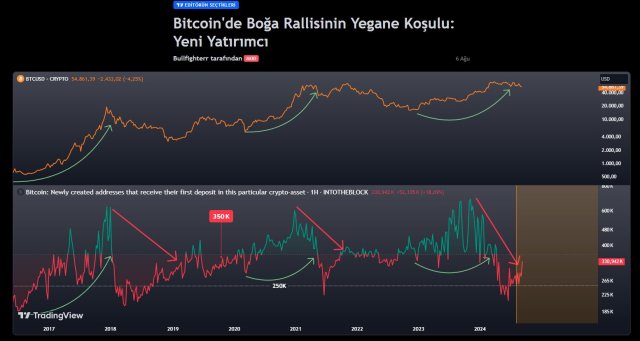
 

Bitcoin
Source: Burak Kesmeci


Related Reading: Bitcoin Recovers After CPI Data Drop, But Is It Sustainable?

BTC Spot ETF To Threaten Network Growth?

The Bitcoin spot ETF market is one of the most exciting crypto developments in 2024. It is widely believed that these exchanged-traded products will drive Institutional demand for Bitcoin in the long run. While such notions may be true, Kesmeci has expressed concerns about these ETFs hampering network growth. 

This is because a single ETF could hold BTC for several investors who would have created individual network addresses if they invested in Bitcoin directly. Therefore, there is a need for constant new waves of retail investors even in the advent of ETF-driven price growth.

At the time of writing, BTC trades at $60,395 reflecting a price gain of 4.31 % in the last day. Alternatively, the asset’s daily trading volume is down by 9.35% and valued at $30.5 billion.

Bitcoin
BTC trading at $60,362 on the daily chart | Source: BTCUSDT  chart on Tradingview.com
Featured image from Investopedia, chart from Tradingview
Semilore Faleti

Semilore Faleti

Semilore Faleti works as a crypto-journalist at Bitconist, providing the latest updates on blockchain developments, crypto regulations, and the DeFi ecosystem. He is a strong crypto enthusiast passionate about covering the growing footprint of blockchain technology in the financial world.

Похожее

The Next Generation of Payments Lies Not in the Payment Layer

The Next-Generation of Payment is Not in the Payment Layer This is the second piece in a series analyzing Stripe's AI strategy. The series stems from Stripe's vision of becoming the economic infrastructure for the AI Agent era, announced at Stripe Sessions 2026. A key debate centers on whether Know Your Agent (KYA) is merely an upgrade to existing payment systems. The author argues the opposite: payment will become a subsystem of KYA, not the other way around. Historically, major payment innovations (online banking, mobile wallets, QR codes) emerged from new transaction scenarios that broke the underlying assumptions of old systems, not from optimization within the payment layer itself. Agent economy is that new scenario, and KYA is the foundational infrastructure growing to support it. KYA's proposed five layers—Agent Identity, Authorization Scope, Intent Signing, Liability Chain Auditing, and Credit Rating—extend far beyond payments. Only authorization and auditing directly touch the payment链路. Identity, intent, and credit layers serve broader needs like cross-platform calls, AI alignment, and permission management. Stripe's strategic moves validate this view. Its focus on "economic infrastructure for AI," investments in protocols like Agentic Commerce Protocol (an identity/session protocol), Shared Payment Tokens, stablecoin infrastructure, embedded wallets, and its own Tempo blockchain for settlement, all point to building the KYA layer, not just optimizing payments. Data shows the core challenge in AI commerce has shifted upstream: determining "who this is, what they intend to do, and if they deserve resources" happens long before checkout. This is why Stripe is moving its Radar fraud prevention from the transaction moment to the entire user lifecycle—a KYA-layer concern. Legally, ultimate responsibility will still fall on a human, as laws like AB 316 dictate. However, in a distributed,网状 liability chain involving users, Agent platforms, model providers, and payment protocols, KYA's role is to use cryptography to make every entity's actions and roles verifiable and traceable. This enables accountability where it was previously impossible to pinpoint evidence, fundamentally changing责任追溯, not just payment efficiency. The next-generation payment形态 will not be designed within the payment layer. It will emerge from the Agent economy scenario after the KYA infrastructure is established.

marsbit54 мин. назад

The Next Generation of Payments Lies Not in the Payment Layer

marsbit54 мин. назад

The Next Generation of Payments Is Not in the Payment Layer

The next generation of payments won't be designed within the payment layer itself. This article argues that historical payment innovations (e.g., online banking, mobile wallets) emerged from new transactional scenarios, not from optimizing existing payment systems. The new scenario is the Agent economy. Know Your Agent (KYA) is not merely a payment-layer upgrade for efficiency. It is the foundational infrastructure layer for the Agent economy. KYA’s five layers—Agent identity, authorization scope, intent signature, accountability chain audit, and credit rating—primarily serve broader needs like cross-platform identification, AI alignment, and permission management. Payment is just one application built on top of this KYA foundation. Stripe’s strategy exemplifies this shift. Its focus on "economic infrastructure for AI," investments in protocols like the Agentic Commerce Protocol (identity/session layer), stablecoin infrastructure, embedded wallets, and moving risk management (Radar) to the user lifecycle all indicate it is building the KYA layer, not just optimizing payments. While ultimate legal liability remains with a human (as laws like AB 316 stipulate), KYA enables traceability in a distributed,网状 responsibility chain involving multiple entities (user, Agent platform, model provider, etc.). It makes accountability verifiable where previously it was opaque. The conclusion: A new class of economic actors (Agents) forces a new infrastructure layer (KYA) to emerge. This layer redefines identity, authorization, and accountability. On top of it, the next generation of payment will reorganize and emerge from the demands of the scenario, not from within the traditional payment system.

链捕手1 ч. назад

The Next Generation of Payments Is Not in the Payment Layer

链捕手1 ч. назад

The "Big Short" Prototype Makes a Major Bet: Shorting Nvidia, Going Long on Software Stocks 'Scared Away' by AI

'The Big Short' Legend Michael Burry Doubles Down on AI Bet: Shorts Nvidia, Buys Beaten-Down Software Stocks As the Nasdaq hits record highs and Nvidia's market cap nears $5.3 trillion, Michael Burry—famed for his 2008 subprime mortgage bet—is making a major contrarian move. He is significantly expanding his bearish wagers against the AI frenzy while buying traditional software stocks he believes have been unfairly punished. Burry's latest portfolio adjustments, revealed in his Substack column, include maintaining and increasing put options on Nvidia and Palantir. He has also initiated new short positions on Palantir and expanded bearish bets on the semiconductor ETF (SOXX), the Nasdaq 100 ETF (QQQ), and Oracle. Simultaneously, he is buying shares of software companies like Adobe, Autodesk, Salesforce, and Veeva Systems. He argues these stocks have been sold off due to "AI disruption" fears and technical selling pressure from private credit funds, not deteriorating fundamentals. Their valuations have fallen to multi-year lows. This creates a complete hedge: short the perceived "AI winners" and long the oversold "AI losers." Burry believes the current AI infrastructure spending boom mirrors the late-1990s internet bubble, with inflated demand projections and questionable accounting practices by large cloud customers extending GPU depreciation schedules. While his Palantir short is currently profitable, his Nvidia put options are deeply underwater as the stock trades near all-time highs. Burry remains steadfast, comparing Nvidia to Cisco during the dot-com era. He anticipates a broad repricing of the AI bubble, where overvalued beneficiaries fall and unfairly battered companies rebound.

marsbit1 ч. назад

The "Big Short" Prototype Makes a Major Bet: Shorting Nvidia, Going Long on Software Stocks 'Scared Away' by AI

marsbit1 ч. назад

Торговля

Спот
Фьючерсы

Популярные статьи

Тест по Bitcoin Биткоина

HTX Learn: Изучите Bitcoin halving и Заработаете Токены USDT

3.0k просмотров всегоОпубликовано 2024.04.16Обновлено 2024.04.16

Тест по Bitcoin  Биткоина

Что такое $BITCOIN

ЦИФРОВОЕ ЗОЛОТО ($BITCOIN): Комплексный анализ Введение в ЦИФРОВОЕ ЗОЛОТО ($BITCOIN) ЦИФРОВОЕ ЗОЛОТО ($BITCOIN) — это проект на основе блокчейна, работающий в сети Solana, который стремится объединить характеристики традиционных драгоценных металлов с инновациями децентрализованных технологий. Хотя он носит имя Биткойн, часто называемого “цифровым золотом” из-за его восприятия как средства хранения ценности, ЦИФРОВОЕ ЗОЛОТО является отдельным токеном, предназначенным для создания уникальной экосистемы в ландшафте Web3. Его цель — позиционировать себя как жизнеспособный альтернативный цифровой актив, хотя детали его применения и функциональности все еще развиваются. Что такое ЦИФРОВОЕ ЗОЛОТО ($BITCOIN)? ЦИФРОВОЕ ЗОЛОТО ($BITCOIN) — это токен криптовалюты, специально разработанный для использования в блокчейне Solana. В отличие от Биткойна, который выполняет широко признанную роль хранения ценности, этот токен, похоже, сосредоточен на более широких приложениях и характеристиках. Примечательные аспекты включают: Инфраструктура блокчейна: Токен построен на блокчейне Solana, известном своей способностью обрабатывать высокоскоростные и недорогие транзакции. Динамика предложения: ЦИФРОВОЕ ЗОЛОТО имеет максимальное предложение, ограниченное 100 квадриллионами токенов (100P $BITCOIN), хотя детали о его обращающемся предложении в настоящее время не раскрыты. Утилита: Хотя точные функциональные возможности не описаны, есть указания на то, что токен может быть использован для различных приложений, потенциально связанных с децентрализованными приложениями (dApps) или стратегиями токенизации активов. Кто создатель ЦИФРОВОГО ЗОЛОТА ($BITCOIN)? На данный момент личность создателей и команды разработчиков, стоящих за ЦИФРОВЫМ ЗОЛОТОМ ($BITCOIN), остается неизвестной. Эта ситуация типична для многих инновационных проектов в области блокчейна, особенно тех, которые связаны с децентрализованными финансами и феноменом мем-криптовалют. Хотя такая анонимность может способствовать культуре, ориентированной на сообщество, она усиливает опасения по поводу управления и ответственности. Кто инвесторы ЦИФРОВОГО ЗОЛОТА ($BITCOIN)? Доступная информация указывает на то, что у ЦИФРОВОГО ЗОЛОТА ($BITCOIN) нет известных институциональных спонсоров или значительных венчурных капиталовложений. Проект, похоже, функционирует по модели пирингового взаимодействия, сосредоточенной на поддержке и принятии сообществом, а не на традиционных путях финансирования. Его активность и ликвидность в основном сосредоточены на децентрализованных биржах (DEX), таких как PumpSwap, а не на устоявшихся централизованных торговых платформах, что еще больше подчеркивает его подход, ориентированный на grassroots. Как работает ЦИФРОВОЕ ЗОЛОТО ($BITCOIN) Операционные механизмы ЦИФРОВОГО ЗОЛОТА ($BITCOIN) можно подробно описать на основе его дизайна блокчейна и характеристик сети: Механизм консенсуса: Используя уникальный механизм доказательства истории (PoH) Solana в сочетании с моделью доказательства доли (PoS), проект обеспечивает эффективную валидацию транзакций, что способствует высокой производительности сети. Токеномика: Хотя конкретные дефляционные механизмы не были подробно описаны, большое максимальное предложение токенов подразумевает, что оно может быть предназначено для микротранзакций или нишевых случаев использования, которые еще предстоит определить. Интероперабельность: Существует потенциал для интеграции с более широкой экосистемой Solana, включая различные платформы децентрализованных финансов (DeFi). Однако детали относительно конкретных интеграций остаются неуточненными. Хронология ключевых событий Вот хронология, которая подчеркивает значимые вехи, касающиеся ЦИФРОВОГО ЗОЛОТА ($BITCOIN): 2023: Первоначальное развертывание токена происходит в блокчейне Solana, отмеченное его адресом контракта. 2024: ЦИФРОВОЕ ЗОЛОТО приобретает видимость, когда оно становится доступным для торговли на децентрализованных биржах, таких как PumpSwap, позволяя пользователям обменивать его на SOL. 2025: Проект наблюдает спорадическую торговую активность и потенциальный интерес к инициативам, возглавляемым сообществом, хотя на данный момент не зафиксировано никаких значительных партнерств или технических достижений. Критический анализ Сильные стороны Масштабируемость: Основная инфраструктура Solana поддерживает высокие объемы транзакций, что может повысить полезность $BITCOIN в различных сценариях транзакций. Доступность: Потенциально низкая цена торговли за токен может привлечь розничных инвесторов, способствуя более широкому участию благодаря возможностям дробного владения. Риски Отсутствие прозрачности: Отсутствие публично известных спонсоров, разработчиков или процесса аудита может вызвать скептицизм относительно устойчивости и надежности проекта. Волатильность рынка: Торговая активность сильно зависит от спекулятивного поведения, что может привести к значительной волатильности цен и неопределенности для инвесторов. Заключение ЦИФРОВОЕ ЗОЛОТО ($BITCOIN) является интригующим, но неоднозначным проектом в быстро развивающейся экосистеме Solana. Хотя он пытается использовать нарратив “цифрового золота”, его отход от установленной роли Биткойна как средства хранения ценности подчеркивает необходимость более четкого различения его предполагаемой утилиты и структуры управления. Будущее принятие и усвоение, вероятно, будут зависеть от решения текущей непрозрачности и более четкого определения его операционных и экономических стратегий. Примечание: Этот отчет охватывает синтезированную информацию, доступную на октябрь 2023 года, и с тех пор могут произойти события.

99 просмотров всегоОпубликовано 2025.05.13Обновлено 2025.05.13

Что такое $BITCOIN

Fractal Bitcoin: масштабирование Биткоина с помощью рекурсивной системы

Fractal Bitcoin — масштабное Layer-1-решнение, созданное на базе кода Биткоина, позволяющего достигать бесконечного масштабирования с помощью рекурсивного подхода.

2.2k просмотров всегоОпубликовано 2025.06.30Обновлено 2025.06.30

Fractal Bitcoin: масштабирование Биткоина с помощью рекурсивной системы

Обсуждения

Добро пожаловать в Сообщество HTX. Здесь вы сможете быть в курсе последних новостей о развитии платформы и получить доступ к профессиональной аналитической информации о рынке. Мнения пользователей о цене на BTC (BTC) представлены ниже.

活动图片