# Yield Related Articles

HTX News Center provides the latest articles and in-depth analysis on "Yield", covering market trends, project updates, tech developments, and regulatory policies in the crypto industry.

Michael Saylor Identifies the Next Financial Opportunity Worth Billions

Michael Saylor, Executive Chairman of Strategy Inc. (Nasdaq: MSTR), identified digital credit as the next billion-dollar business opportunity in finance. In an August 7th post on X, he suggested entrepreneurs explore this category. Saylor's post included a chart showing the effective yields of four of Strategy's digital credit products as of 11:10 AM EDT. Leading was Stride Preferred Shares (STRD) with a 15.29% yield, followed by Stretch Preferred Shares (STRC) at 12.63%, Strike Preferred Shares (STRK) at 12.08%, and Strife Preferred Shares (STRF) at 10.38%. These preferred securities allow Strategy to raise capital from income-seeking investors, offering various dividend rates, risk levels, and positions in the company's capital structure. Strategy has developed a suite of preferred shares classified as digital credit instruments. For instance, the Stretch Preferred Shares (STRC) are perpetual, variable-rate securities. This approach applies established credit market structures to companies with digital asset-based balance sheets, connecting capital-seeking issuers with yield-seeking investors through Wall Street-like products. Saylor positioned these as a "digital credit stack," built upon but not backed by Strategy's bitcoin reserve, expanding the company's capital access while targeting yield-focused buyers. The billion-dollar potential lies in creating a scalable, replicable business model where issuers can raise capital via tailored income securities and investors can select products based on yield, risk, and capital priority. For Strategy, this model attracts capital from investors seeking income without direct bitcoin exposure, while the company maintains its broader bitcoin strategy. Growing dividend obligations have influenced how Strategy manages its bitcoin holdings and cash reserves, with the company selling some bitcoin to fund preferred share payments and build a USD reserve for liquidity.

cryptonews.ru08/09 11:25

Michael Saylor Identifies the Next Financial Opportunity Worth Billions

cryptonews.ru08/09 11:25

Should Ethereum's Staking Rate Be Capped? EIP-8363 Proposal Ignites Heated Debate

The Ethereum community is currently engaged in intense debate over EIP-8363, a proposal aiming to cap the network's staking ratio. With the ETH staking rate exceeding 33% and rising, concerns have grown about potential centralization if a few large entities control most staked ETH and about perpetual dilution for non-stakers. The "diminishing issuance burn" mechanism of EIP-8363 would progressively burn an increasing portion of validator rewards as the total staked ETH approaches roughly 50% of the supply. At that threshold, new consensus issuance would effectively stop, leaving validators to earn solely from transaction fees and MEV until the staking ratio falls back below 50%. Proponents argue this protects ETH's monetary properties by limiting dilution and establishing a firmer supply cap, while also disincentivizing excessive growth by large stakers first. Critics, however, warn the proposal threatens DeFi vitality by destabilizing the staking yield which serves as a benchmark rate for lending and other protocols. They also argue it could make independent, home staking economically unviable as fixed costs remain while rewards shrink, potentially increasing centralization as MEV becomes a larger portion of validator income. Some suggest the proposal's economic rationale needs refinement. The proposal's procedural status for inclusion in a future upgrade is pending. Regardless of the immediate outcome, the debate centers on whether Ethereum currently overpays for security and if implementing such a cap is worth the potential disruption.

marsbit08/08 12:45

Should Ethereum's Staking Rate Be Capped? EIP-8363 Proposal Ignites Heated Debate

marsbit08/08 12:45

CoinShares Analysts Record RWA Growth Amid DeFi Downturn

Analysts from CoinShares and Token Terminal report significant growth in real-world asset (RWA) activity within decentralized finance (DeFi) from Q2 2025 to Q2 2026, contrasting with a broader DeFi downturn. The volume of RWAs on credit platforms and decentralized exchanges surged to $7.4 billion from $2.3 billion a year prior, while overall DeFi deposits fell by approximately 15%. This divergence suggests demand is driven by the financial utility of assets, not just market cycles. Income-generating RWAs, such as tokenized treasury funds (e.g., JTRSY, BUIDL), private credit products (e.g., JAAA), and yield-bearing stablecoins (e.g., sUSDS, sUSDe), now constitute about 6% of all DeFi deposits, up from 1.7%. Their appeal lies in continuing to generate yield even when used as collateral. Most RWA deposits are on Ethereum-based platforms. Spot trading volume for RWAs on DEXs grew 220% year-over-year, albeit from a small base, reaching about $6.3 billion (less than 2% of total DEX spot volume). Trading was concentrated in tokenized gold (XAUT, PAXG) and sUSDe. Perpetual futures trading for traditional assets exceeded $200 billion, nearing 32% of the total perpetuals market, with platforms like Hyperliquid's tradeXYZ seeing 20x growth. Despite this expansion, RWA growth has not yet offset declining revenues from crypto-native trading and lending in DeFi. The segment remains early-stage; for instance, the $2.2 billion market cap of tokenized equities is minuscule compared to the global equities market. Analysts compare its current phase to stablecoins in 2019.

cryptonews.ru08/06 13:54

CoinShares Analysts Record RWA Growth Amid DeFi Downturn

cryptonews.ru08/06 13:54

Opinion: EIP-8361 is a Meaningless and Counterproductive 'Helping Hand'—Ethereum Should Not Cut Off Its Own Arms

Author: 0xTodd Discussion of the EIP-8361 proposal submitted by Ethereum France (organizer of ETHCC, considered a core Ethereum organization). In essence, this proposal aims to drastically reduce the APR for ETH staking. If the staking rate exceeds 50%, it would slash the yield to 0%. The author evaluates this as a meaningless and counterproductive proposal. The principle is that a functioning system should not be altered lightly, and Ethereum currently operates well. Based on the author's extensive experience with Ethereum staking, the current staking yield is only about 2.4%, less competitive than half the yield of U.S. Treasury bonds. For individual散户 stakers, solo staking收益 barely covers costs, resulting in minimal profit or even a slight loss, sustained mainly by dedicated supporters. Implementing EIP-8361 would push solo stakers into an untenable position, while large institutional stakers with fixed server costs would be less affected. Solo stakers are crucial for maintaining the decentralization of the Ethereum ledger. Regarding concerns about validator churn rates, the issue has already improved post the large-node era (2048 ETH), and adjusting the churn rate parameter is a low-risk, simple change. In contrast, slashing staking yields requires a hard fork,涉及 the core interests of ETH and could potentially lead to a new token split. For Ethereum in its current volatile state, this carries excessively high risk. The proposal is deemed毫无意义.

marsbit08/06 11:11

Opinion: EIP-8361 is a Meaningless and Counterproductive 'Helping Hand'—Ethereum Should Not Cut Off Its Own Arms

marsbit08/06 11:11

Ethereum Community in Uproar! Whose Cake is EIP-8363 Cutting Into?

**Ethereum Community Debates Controversial Staking Proposal EIP-8363** A new Ethereum proposal, EIP-8363, dubbed "Tapered Issuance Burn," has ignited heated debate within the community. The core idea is to reduce and eventually eliminate new issuance rewards for validators as the total amount of staked ETH approaches 50% of the total supply (around 60.25 million ETH). The authors, including EthCC founder Jérôme de Tychey and Ethereum Foundation researcher Justin Drake, argue the current system perpetually incentivizes more staking, potentially leading to centralization as stake flows to large custodians and liquid staking tokens (LSTs). They also aim to reduce dilution pressure on non-staking ETH holders. Under the proposal, validator rewards from consensus-layer issuance would be partially burned based on a formula tied to the total staked amount. Net rewards would gradually approach zero as staking nears the 50% threshold. Notably, execution-layer rewards (tips, MEV) are unaffected. A proposed 18-month transition period would soften the initial impact. The community reaction has been predominantly critical. Key concerns include: * **Centralization Risk:** Critics like Obol's Oisín Kyne argue very low rewards could drive out solo stakers and smaller operators, leaving only large, cost-insensitive institutions, thus increasing validator centralization. * **Ecosystem Impact:** Aave's Stani Kulechov warns it could hurt ETH's predictable yield appeal for institutions and compress yields for LST-based DeFi strategies (e.g., recursive lending). * **Process & Timing:** Some, like ether.fi's Mike Silagadze, criticize the proposal's late submission ahead of a key upgrade deadline, limiting discussion time. Supporters believe the change is necessary to maintain ETH as a neutral reserve asset and avoid excessive security costs and holder dilution. If implemented, solo stakers would face higher relative operational costs and longer recovery times from penalties. LST yields would converge with native ETH, challenging their value proposition. The entire DeFi interest rate ecosystem, built around staking yield, could be pressured. While all ETH holders would benefit from reduced dilution, the net effect on ETH's price and adoption remains uncertain due to potential demand-side impacts from lower yields. The proposal is currently an early-stage draft and has not been officially slated for inclusion in any upcoming network upgrade.

marsbit08/06 05:22

Ethereum Community in Uproar! Whose Cake is EIP-8363 Cutting Into?

marsbit08/06 05:22

Michael Saylor: Bitcoin Halved, My Digital Credit is Making Money

Michael Saylor discusses Bitcoin, digital credit, and corporate treasury strategies in a recent roundtable. He explains that while Bitcoin remains "digital capital" with no counterparty risk, its ~40% annual volatility makes it unsuitable for most institutional and retail capital. To attract this capital, he advocates for Bitcoin-backed "digital credit" and "digital currency" products. These offer low volatility against fiat currencies, generate yield, and compete with traditional money market funds, stablecoins, and other yield-bearing crypto assets. Saylor clarifies that these products are not meant to replace direct Bitcoin ownership but to onboard capital that otherwise wouldn't enter the Bitcoin ecosystem. He provides examples: during a period when Bitcoin fell 50%, his company's digital credit products (STRC, SATA) delivered positive returns of 3-4%, demonstrating their ability to strip out ~90% of Bitcoin's volatility. He frames "digital currency" as a fiat-referenced, yield-bearing, stable-value asset backed by Bitcoin, designed to meet the needs of the global capital pool. This approach, he argues, can expand the Bitcoin network's reach by 10x to 100x more effectively than pure education. The discussion also covers corporate finance for Bitcoin treasury companies. Saylor argues that equity issuance is not inherently dilutive if done above net asset value per share and if the acquired asset (Bitcoin or cash) supports future value creation. He distinguishes between debt with maturity dates and hybrid capital like preferred shares (e.g., STRC), which offer issuer options and do not force liquidation. Evaluating these companies requires modeling based on future Bitcoin price and volatility assumptions, not relying on a single metric like mNAV (market-adjusted net asset value). The business models are still evolving, and investors must analyze full disclosures to form a complete view.

marsbit08/06 01:13

Michael Saylor: Bitcoin Halved, My Digital Credit is Making Money

marsbit08/06 01:13

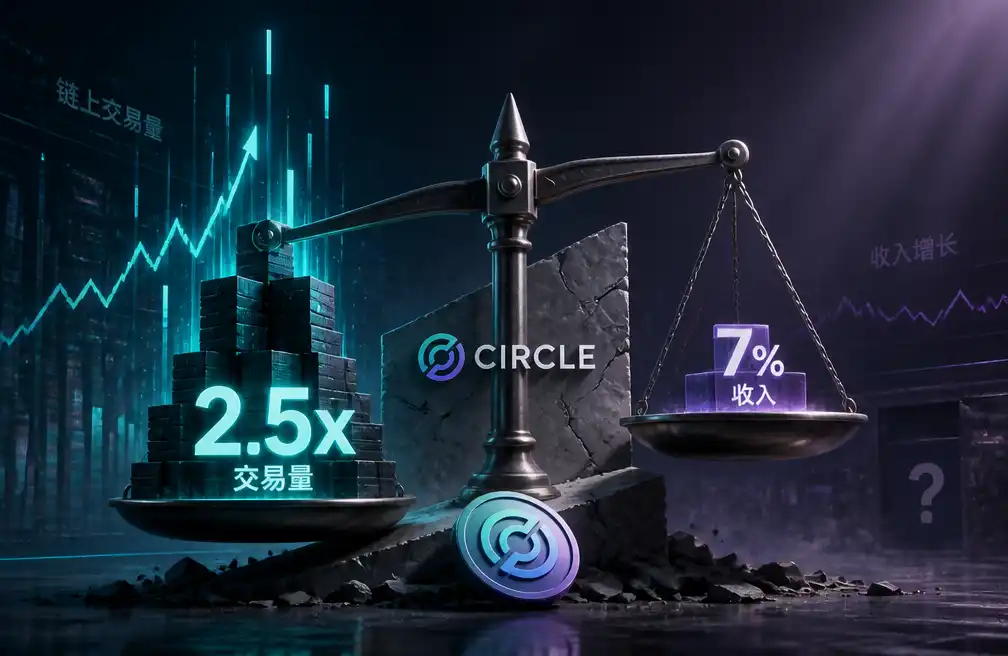
Trading Volume Increased by 2.5x, Why Did Circle's Revenue Only Grow by 7%?

Circle's Q2 performance presents a seemingly contradictory picture: the transaction volume of its stablecoin USDC surged 151% year-over-year to $14.8 trillion, while its "Total Revenue & Reserve Revenue" grew by only 7% to $701 million. This discrepancy highlights the core of Circle's business model. Revenue is primarily driven not by transaction volume, but by the average amount of USDC in circulation and the yield generated from its reserves. Key points: 1. **Revenue Drivers:** Over 90% of revenue comes from "reserve income," which is a function of average USDC circulation (up 25% YoY) and the reserve yield (which fell by 66 basis points). The net effect was a mere ~5% increase in reserve income. 2. **Transaction vs. Revenue:** High transaction volume indicates robust usage of USDC for payments and settlements, but does not translate directly to revenue. It must first convert into a sustained, average circulating balance. 3. **Cost Structure:** After accounting for distribution and other costs, the metric "Revenue Less Direct Costs" (RLDC) grew faster than total revenue, with its margin improving. However, rising operating expenses (up 23% YoY) meant that Adjusted EBITDA growth was limited to 8%. 4. **New Initiatives:** Circle reported progress on new networks like the Circle Payments Network and upcoming products (Arc, Agent Stack), but these are currently measured by adoption metrics (e.g., transaction run-rate, number of services) rather than material revenue contribution this quarter. In summary, the financial results are determined by the interplay of USDC circulation, reserve yields, and cost structures, while high transaction volume signals underlying network strength that has not yet fully flowed through to the income statement.

marsbit08/05 11:29

Trading Volume Increased by 2.5x, Why Did Circle's Revenue Only Grow by 7%?

marsbit08/05 11:29

活动图片