# Yield Related Articles

HTX News Center provides the latest articles and in-depth analysis on "Yield", covering market trends, project updates, tech developments, and regulatory policies in the crypto industry.

Ethena's USDe Captures 43% of Stablecoin Supply on Robinhood Chain for Capital Placement

USDe from Ethena has rapidly become the primary source of dollar liquidity on the Robinhood Chain, surging from about $17 million a month ago to roughly $253 million, accounting for nearly 43% of the network's total stablecoin volume. This synthetic dollar, which maintains its value through crypto assets and offsetting derivatives positions, indicates that incoming capital is seeking more than just a trading venue. It reflects a broader shift where crypto investors are using stablecoins for DeFi, collateral, and yield strategies. Robinhood Chain, an Ethereum L2, is seeing its dollar base shift towards yield-bearing assets. Unlike traditional stablecoins like Paxos's USDG, USDe is a synthetic dollar that does not inherently pay yield; users must stake it to earn rewards via sUSDe within Ethena's delta-neutral framework. Analysts view the rapid inflow as capital being deposited within the network, not just transiting through it, potentially boosting lending and trading activities even without user growth. While transaction activity has spiked—averaging about 11.6 million daily transactions, up 30% weekly—daily active accounts have grown only modestly and remain below July peaks. Currently, memecoins like $CASHCAT dominate over 99% of trading volume, driving speculation rather than the platform's long-term focus on tokenized securities. The key challenge for Robinhood will be converting this initial speculative activity into sustainable, long-term financial transactions aligned with its tokenization strategy.

cryptonews.ru08/12 12:11

Ethena's USDe Captures 43% of Stablecoin Supply on Robinhood Chain for Capital Placement

cryptonews.ru08/12 12:11

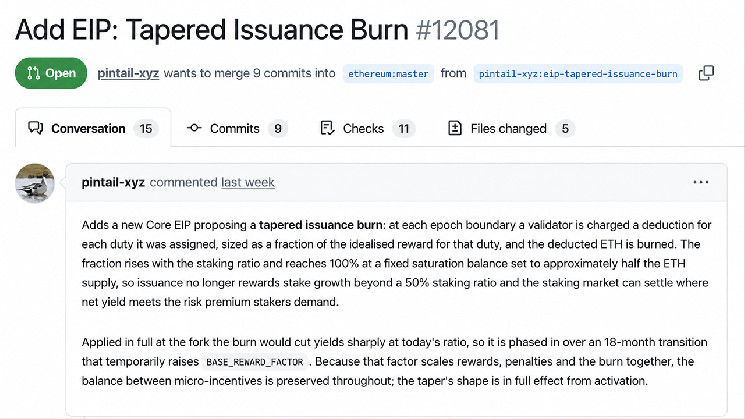
EIP-8363 Explained: Burning Staking Rewards to Save Ethereum? Independent Node Operators Might Be the First to Leave

Analysis of EIP-8363: A Proposal to Burn Staking Rewards and its Potential Impacts on Ethereum A new Ethereum Improvement Proposal, EIP-8363, has sparked significant debate. Its core mechanism is to progressively burn validator consensus rewards, aiming to reduce the issuance rate to 0% once 50% of the total ETH supply is staked. Proponents argue this would cap the staked ETH ratio, enhancing credible neutrality and censorship resistance by discouraging excessive centralization among large staking operators and liquid staking token (LST) providers. However, a critical analysis suggests the proposal may create more problems than it solves. While it compresses the ETH staking range where profitability turns negative (from 70-100 million ETH down to 50-60 million ETH), it does not fundamentally alter the competitive disadvantage of independent stakers. Due to economies of scale, large operators would still retain advantages in costs and MEV opportunities. Independent stakers are predicted to be the first to face negative real returns under the new curve. The economic repercussions could be severe. A sharp decline in base staking yield would disrupt DeFi ecosystems built around this yield, potentially reversing incentives for borrowing ETH and triggering large-scale unwinding of leveraged staking strategies. This could lead to significant selling pressure on ETH as professional staking operations become unprofitable and exit. The proposal is criticized for being based on uncertain future market equilibriums and for potentially imposing costs that outweigh its stated benefits, without fully addressing the underlying issues of centralization it aims to solve.

marsbit08/12 09:01

EIP-8363 Explained: Burning Staking Rewards to Save Ethereum? Independent Node Operators Might Be the First to Leave

marsbit08/12 09:01

U.S. Stock Market Trend (August 12): Stocks Fluctuated and Closed Lower on Eve of CPI, Storage Sector Bucked the Trend

U.S. Stock Market Trends (August 12): Stocks Dip, Storage Sector Gains Ahead of CPI Data On Tuesday, ahead of the July CPI release, major U.S. stock indices closed lower. The S&P 500 fell 0.32%, the Dow Jones declined 0.34%, and the Nasdaq dropped 0.60%, though the Russell 2000 rose 0.32%. Market pressures stemmed from fluctuating tensions in the Strait of Hormuz and concerns over AI financing impacting large-cap tech stocks. The alternative asset management sector rallied strongly, with KKR surging nearly 7%. The storage/semiconductor sector also gained, providing market support. Investors reduced positions cautiously, awaiting inflation data to set the tone for the September Fed rate path. Treasury yields edged lower reflecting dovish expectations, while gold retreated from recent highs. Oil prices rose over 1%. Large-cap tech stocks faced pressure, with Google falling nearly 4% amid ongoing AI capital expenditure concerns. Nvidia clarified details of a reported financing plan but still closed lower. The alternative asset management sector saw broad gains (KKR +6.92%, Apollo +6.23%, Blackstone +3.89%) as funds rotated toward sectors benefiting from potential rate cuts and strong capital intermediation demand. The storage segment advanced despite mixed signals: SK Hynix plans to expand its China NAND factory capacity, but Korean brokerages concurrently cut price targets for Samsung and SK Hynix, citing peak cycle concerns for general memory chips. The market focused on sustained AI-related HBM demand. The Nasdaq Golden Dragon China Index fell 2.94%, with Tencent Music down nearly 12%, as investors took profits amid macro uncertainty. The market's focus remains squarely on the upcoming CPI data, which will determine whether the recent bond rally and sector rotations persist or if a correction is ahead.

marsbit08/12 01:45

U.S. Stock Market Trend (August 12): Stocks Fluctuated and Closed Lower on Eve of CPI, Storage Sector Bucked the Trend

marsbit08/12 01:45

AI Leverage, U.S. Bond Yields, and the Strait of Hormuz — The Three Factors Dominating Global Markets This Summer

This summer, global markets are being pulled by three major forces: a high-leverage AI stock selloff, U.S. long-term bond yields hitting 19-year highs despite a rate-cutting cycle, and the on-again, off-again ceasefire in the Strait of Hormuz. Goldman Sachs frames these disparate events under a single theme: the world may be shifting from "savings glut" to "capital scarcity." AI infrastructure demands massive funding, governments are borrowing at record levels, and geopolitical tensions constrain physical commodity supplies—all simultaneously straining finite global capital. Central banks, once reliable liquidity providers, now have less capacity to intervene. The AI selloff, exemplified by a highly leveraged fund's collapse, reveals that while AI demand is strong, the capital to finance it is becoming scarce and expensive. The surge in long-term Treasury yields reflects markets pricing in massive government borrowing needs rather than Fed policy, amid weakening demand from traditional buyers like foreign central banks. Meanwhile, volatility in oil prices, with the Strait of Hormuz a persistent flashpoint, underscores strained physical supply buffers, as U.S. strategic reserves hit a 40-year low. Together, these pressures—from trading, bond markets, and physical commodities—create a rare "liquidity triple squeeze," explaining the extreme market swings of July. The underlying takeaway is structural: even if any single crisis eases, the broader shift toward scarcer, more expensive capital is likely to sustain a new era of higher market volatility.

marsbit08/12 00:51

AI Leverage, U.S. Bond Yields, and the Strait of Hormuz — The Three Factors Dominating Global Markets This Summer

marsbit08/12 00:51

Selling Call Options: On-Chain Protocol Attempts to Achieve 4-14% APY with Gold

Selling Call Options: On-chain Protocol Aims to Generate 4-14% Annual Yield from Gold Gold, a $30+ trillion asset, produces no inherent cash flow. Traditional methods to generate yield involve lending it out or selling its volatility via call options. While the covered call strategy is proven, access has been limited to institutions, burdened by fees, issuer risk, and opaque pricing. On-chain gold leads in custody and liquidity but lags in yield generation. Lending demand is thin, and AMM liquidity provision exposes holders to impermanent loss, eroding gold's price upside. Enhanced is a structured products infrastructure tackling this. Its core is an RFQ auction engine where institutional market-makers competitively bid to purchase call options sold against user-deposited assets, converting asset volatility into premium income. Its first product, the PAXG Volatility Yield Vault, allows users to deposit PAXG (tokenized gold). The vault automatically sells bi-weekly, out-of-the-money call options via the RFQ auction. Premiums are distributed to depositors, targeting 4-14% APY. The strategy dynamically adjusts strike prices based on market conditions to balance yield and retained upside. Unlike first-generation on-chain vaults, Enhanced emphasizes competitive price discovery, alignment with holders via flexible OTM strikes, and a focus on yield-starved real-world assets (RWA) like gold. The protocol acknowledges the trade-offs: capped upside, no principal protection, and dependence on volatility. It suits holders seeking to generate income from otherwise idle assets while maintaining most of their underlying exposure. Enhanced represents a shift towards on-chain wealth management, transforming volatility from a cost into yield. Starting with gold, the infrastructure is designed to expand to tokenized equities, commodities, and broader RWA, marking a new phase for structured products on-chain.

marsbit08/10 10:49

Selling Call Options: On-Chain Protocol Attempts to Achieve 4-14% APY with Gold

marsbit08/10 10:49

活动图片