Should Ethereum's Staking Rate Be Capped? EIP-8363 Proposal Ignites Heated Debate

marsbitPublished on 2026-08-08Last updated on 2026-08-08

Abstract

The Ethereum community is currently engaged in intense debate over EIP-8363, a proposal aiming to cap the network's staking ratio. With the ETH staking rate exceeding 33% and rising, concerns have grown about potential centralization if a few large entities control most staked ETH and about perpetual dilution for non-stakers. The "diminishing issuance burn" mechanism of EIP-8363 would progressively burn an increasing portion of validator rewards as the total staked ETH approaches roughly 50% of the supply. At that threshold, new consensus issuance would effectively stop, leaving validators to earn solely from transaction fees and MEV until the staking ratio falls back below 50%. Proponents argue this protects ETH's monetary properties by limiting dilution and establishing a firmer supply cap, while also disincentivizing excessive growth by large stakers first. Critics, however, warn the proposal threatens DeFi vitality by destabilizing the staking yield which serves as a benchmark rate for lending and other protocols. They also argue it could make independent, home staking economically unviable as fixed costs remain while rewards shrink, potentially increasing centralization as MEV becomes a larger portion of validator income. Some suggest the proposal's economic rationale needs refinement. The proposal's procedural status for inclusion in a future upgrade is pending. Regardless of the immediate outcome, the debate centers on whether Ethereum currently overpays for securit...

Author: Bankless

Compiled by: Deep Tide TechFlow

Deep Tide's Take: Ethereum's staking rate has exceeded 33% and continues to rise. An EF researcher has proposed capping the staking rate below 50% through a burn mechanism. Supporters argue this can prevent staking giants from monopolizing and protect non-staking ETH holders; opponents warn it could undermine the DeFi yield benchmark and stifle independent stakers. This debate concerns the direction of Ethereum's economic model for the next decade.

The Ethereum community has been engaged in a heated debate this week surrounding the EIP-8363 proposal.

The concept of "decremental issuance burn" can be traced back to 2023, when Ethereum Foundation researchers began expressing public concerns about the lack of a ceiling on ETH staking rates. The Bankless Summit hosted a related discussion in 2024.

Why EIP-8363, and Why Now?

Under Ethereum's current issuance curve, the incentive to stake has no stopping point. As more ETH is staked, yields decrease, but researchers indicate that yields would only bottom out around 1.5% even if nearly 100% of ETH supply were locked.

Currently, Ethereum's staking rate has surpassed 33% of the ETH supply, with no signs of slowing down. The issue is, if this trend continues, two risks emerge:

It could lead to the concentration of most ETH in the hands of a few companies and liquid staking providers, weakening the Ethereum community's ability to resist a manipulated validator set through forking.

Beyond a certain staking threshold, issuance essentially becomes a permanent dilution tax on all non-stakers, forcing every ETH holder to choose between joining the stake or watching their share shrink.

EIP-8363 was born to address this problem. If implemented, this mechanism would continue to calculate validator rewards as it does now, then burn an increasingly larger portion of them. The burn ratio increases with the total amount staked, until it completely offsets the consensus rewards when staked ETH reaches approximately 50% of the total supply.

Once this line is crossed, EIP-8363 would cause validators to profit solely from transaction tips and MEV (the extra value block producers gain by including, excluding, or reordering transactions), rather than new issuance, until the staking rate falls back below 50%.

Therefore, validators would still have incentives under this model, but less ETH would be minted. The core goal of this model is to control the staking rate and the risk of ETH dilution. Although well-intentioned, the proposal has recently faced criticism from detractors who argue its design is flawed.

The main opposing argument I've seen is that EIP-8363 threatens DeFi vitality. Staking yield has become the benchmark rate for ETH, with on-chain lending, liquid staking tokens, and more priced against it. Aave founder Stani Kulechov believes the proposal would make it difficult for institutional buyers to predict staking yields, potentially killing the rationale for borrowing ETH.

"Ethereum should not be penalized for its growth," he wrote.
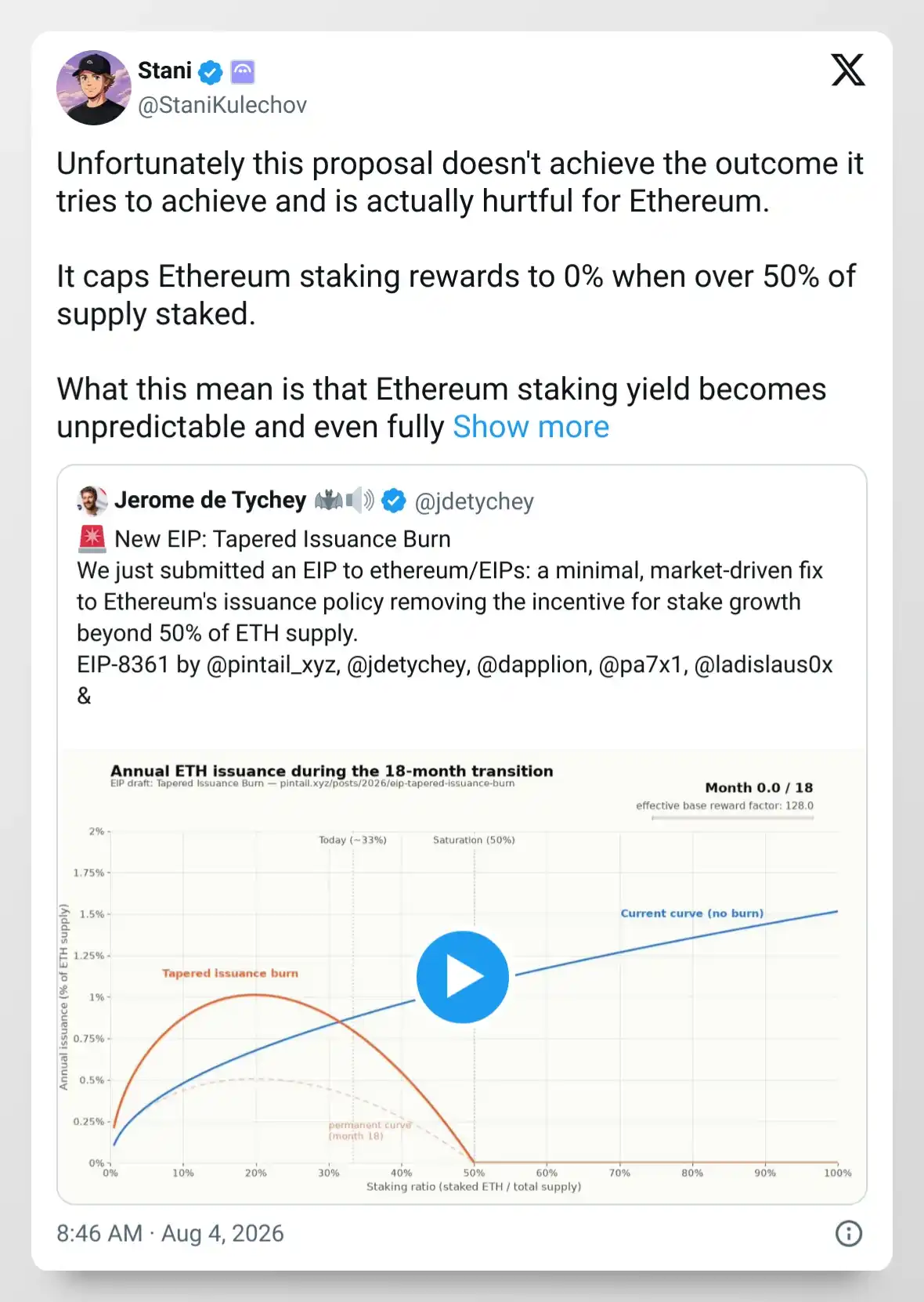
I've also seen skeptics argue that EIP-8363 would destroy the viability of independent staking. The key point is that home stakers' hardware and electricity costs do not shrink with reduced earnings, so any downward pressure on net rewards would erode their profit margins more than for centralized exchanges running thousands of validators.

Furthermore, as consensus issuance decreases, MEV would constitute a larger portion of validators' remaining income. Critics point out that this dynamic itself could foster centralization effects, as MEV capture rewards scale and sophistication more than raw issuance.

On the other hand, supporters of EIP-8363 insist it would enhance ETH's monetary properties by protecting non-staking ETH from dilution while giving ETH a true supply cap, further solidifying ETH's status as "hard money."
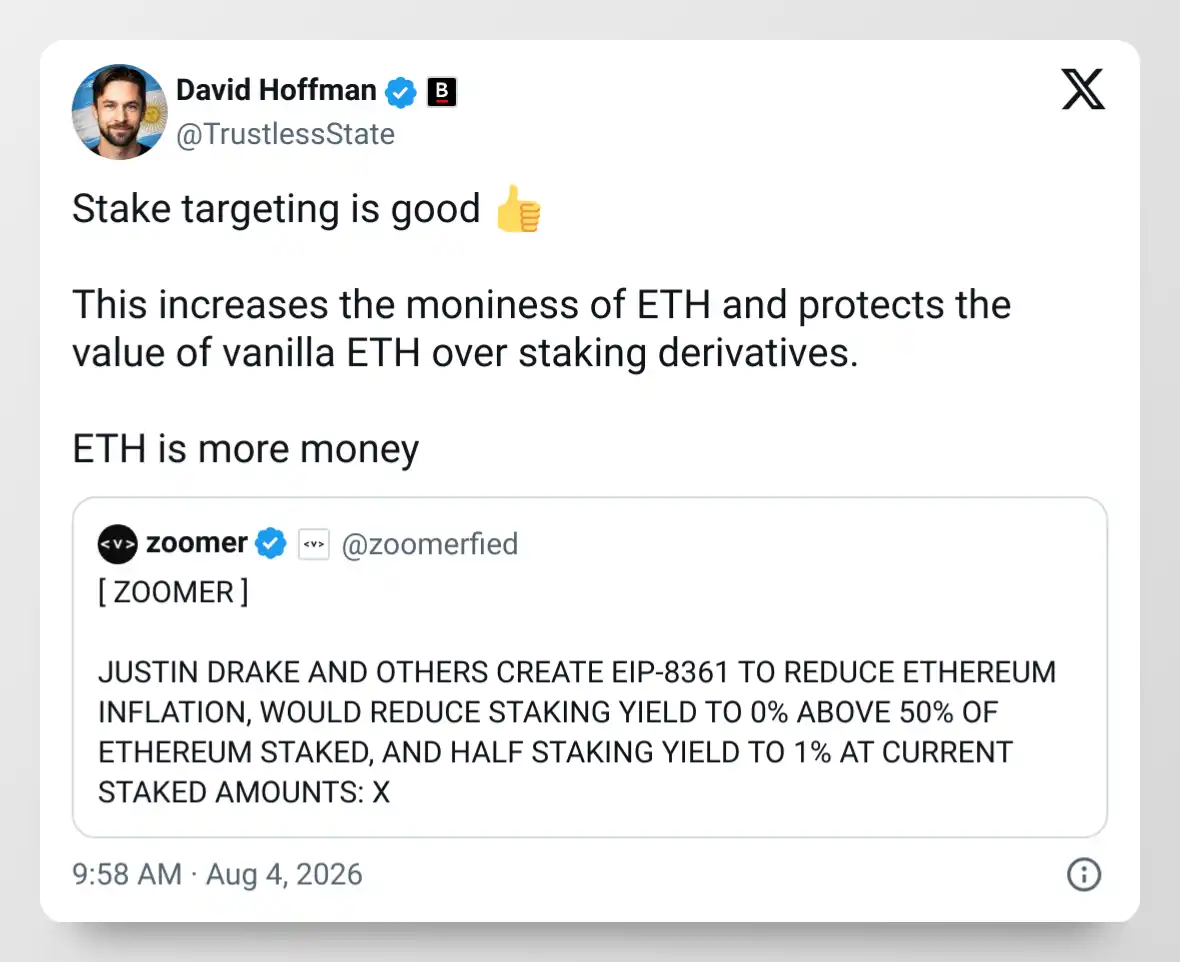
Supporters also counter the argument that independent stakers would be disproportionately impacted, arguing that because the burn scales with total stake, the inflection point where adding more validators is no longer worthwhile arrives earliest for those who already hold the largest shares.

This means home stakers would still have incentive to grow all the way to the 50% threshold, while large stakers would not. In contrast, today's curve rewards growth regardless of who you are or how much you've already staked.

That said, the best discussion I've seen on EIP-8363 so far comes from the EF's DeFi expert ivangbi, who today (in a personal, not official EF capacity) presented a reasonable middle ground in a new post. He believes the model is theoretically workable and DeFi could survive it, but only if the "fix and argument are more robust," not based on "pseudo-economics." It's worth a full read.

To my knowledge, today is the deadline for EIP-8363 to attain PFI status (i.e., "Proposed for Inclusion," Ethereum's lowest procedural threshold, meaning "put this on the agenda for discussion") for the Hegotá upgrade. That said, nothing is approved yet, and Hegotá itself isn't expected to hit mainnet until next year.

If EIP-8363 does move forward, there will be a long lead time regardless, as its arrival would kick off an 18-month transition period. However, the proposal could also stall after this week, with the staking rate continuing its upward trend. Then we'll see if this debate resurfaces in the future.

Regardless of the outcome, the grand question is whether Ethereum is currently overpaying for security, and if so, is this fix worth the validator pain? No one has the definitive answer yet, so keep an eye on this topic in the coming months.


Trending Cryptos

Related Questions

QWhat is the main purpose of the EIP-8363 proposal according to the article?

AThe main purpose of the EIP-8363 proposal is to limit the Ethereum staking rate, specifically capping it at around 50% of the total ETH supply. It aims to achieve this by implementing a 'diminishing issuance burn' mechanism that burns an increasing portion of validator rewards as the total staked ETH increases, effectively eliminating new issuance for consensus rewards once the 50% threshold is crossed. Its core goals are to prevent the concentration of staked ETH among a few large entities, protect non-staking ETH holders from dilution, and potentially strengthen ETH's monetary properties by giving it a more defined supply cap.

QWhat are two major concerns cited in the article regarding the current trend of rising Ethereum staking rates?

A1. It could lead to most ETH being concentrated in the hands of a few companies and liquid staking providers, potentially weakening the Ethereum community's ability to fork in response to a malicious validator set. 2. Beyond a certain staking threshold, new ETH issuance acts as a permanent dilution tax on all non-stakers, forcing every ETH holder to choose between joining the stake or watching their share of the total supply shrink.

QWhy do critics argue that EIP-8363 could harm DeFi and independent stakers?

ACritics argue it could harm DeFi because the staking yield serves as a benchmark rate for ETH, used to price on-chain lending and liquid staking tokens. Introducing unpredictability could stifle reasons to borrow ETH. For independent (home) stakers, critics warn that any reduction in net rewards disproportionately erodes their smaller profit margins (as their hardware and electricity costs are fixed) compared to large centralized operations. Furthermore, as consensus issuance decreases, MEV becomes a larger portion of validator income, which could centralize staking as MEV capture rewards scale and sophistication.

QHow do supporters of EIP-8363 counter the argument that it would disproportionately hurt independent stakers?

ASupporters counter by arguing that because the burn mechanism scales with the total amount staked, the point at which adding more validators becomes unprofitable arrives *first* for those who already hold the largest staking shares. This means home stakers would still have an incentive to stake up to the 50% threshold, while large stakers would not. In contrast, the current curve rewards growth equally regardless of the size of the existing stake.

QWhat is the current procedural status and potential timeline for EIP-8363 mentioned in the article?

AAccording to the article, the day of publication was the deadline for EIP-8363 to achieve 'Proposed for Inclusion' (PFI) status for the Hegotá upgrade. However, no approval had been granted at that time. The Hegotá upgrade itself is not expected to go live on the mainnet until next year. If the proposal does move forward, it would initiate an 18-month transition period, meaning implementation is still a long way off. The proposal could also stall after this week.

Related Reads

Bitcoin and Ethereum ETFs Attract $220 Million, with Blackrock Leading Again

As the week progressed, capital continued flowing into major cryptocurrency ETFs. Bitcoin funds attracted another nine-figure sum, demand for Ethereum surged, and several altcoin products found new buyers. Overall market sentiment remained positive, though Solana ETFs saw moderate outflows. Bitcoin ETFs recorded a net inflow of $128.69 million across six funds. BlackRock's IBIT led again, attracting $128.33 million, followed by Morgan Stanley's MSBT ($14.94M) and Fidelity's FBTC ($11.20M). Grayscale's GBTC and Bitcoin Mini Trust added $7.48M and $6.83M respectively, while Bitwise's BITB attracted $1.75M. These gains were partially offset by outflows from VanEck's HODL (-$32.77M) and Valkyrie's BRRR (-$9.07M). Bitcoin ETF trading volume reached $1.36 billion, extending their inflow streak to four sessions. Ethereum ETFs posted some of the day's best results, drawing $92.15 million into five funds. BlackRock's ETHA led with $81.14M, followed by Grayscale's Ether Mini Trust ($4.55M) and ETHE ($3.07M). BlackRock's ETHB and Fidelity's FETH added $1.96M and $1.42M respectively, with no Ethereum ETFs experiencing outflows. Altcoin ETFs showed mixed results. XRP ETFs returned to positive territory with a $3.45 million inflow. Hyperliquid ($HYPE) ETFs continued their recovery with a $2.84M inflow into Bitwise's BHYP. In contrast, Solana ETFs saw outflows, with Fidelity's FSOL losing $859,450. Thursday's flows confirmed the week's main trend: institutional demand remains concentrated on Bitcoin and Ethereum, with BlackRock continuing to capture the largest share of new capital.

cryptonews.ru4m ago

Bitcoin and Ethereum ETFs Attract $220 Million, with Blackrock Leading Again

cryptonews.ru4m ago

Michael Saylor's Latest Interview: The 'Wealth Logic' of AI and Bitcoin

Michael Saylor, in a recent interview, discussed leveraging AI for financial innovation, leading to a $15 billion capital raise. He advised focusing on directing AI rather than competing with it, emphasizing the search for "S-curve" opportunities in technology. Saylor argued that fiat currencies inevitably depreciate, citing a ~7% annual loss in the U.S. dollar's purchasing power. He positioned Bitcoin as the superior, universal capital asset for long-term savings, outperforming gold, real estate, and major indices due to its verifiable scarcity and resistance to confiscation. Addressing AI's impact, he agreed that basic commodities would become abundant but contended that status-driven demand for scarce assets would persist, ensuring money's role. For careers, he warned against entering fields like law or medicine at the end of their S-curves, urging instead to master AI tools and tackle novel, edge-case problems. Saylor outlined ten foundational life principles, including focus, health, critical thinking, and integrity. He defended MicroStrategy's recent minor Bitcoin sale as a strategic move to dispel market myths about a potential "death spiral," affirming their ability to fund dividends sustainably if Bitcoin appreciates above 3.2% annually. He predicted Bitcoin's continued outperformance versus traditional assets and recommended that individuals invest in both AI subscriptions and Bitcoin. Finally, he shared two profound personal learnings: applied statistics (via Taleb's works) for discerning signal from noise, and a deep study of history (Will Durant's "The Story of Civilization") to gain perspective on recurring human patterns, including the inevitable debasement of all fiat currencies.

marsbit4h ago

Michael Saylor's Latest Interview: The 'Wealth Logic' of AI and Bitcoin

marsbit4h ago

Trading

Spot

Hot Articles

Discussions

Welcome to the HTX Community. Here, you can stay informed about the latest platform developments and gain access to professional market insights. Users' opinions on the price of S (S) are presented below.

活动图片