Artículos Relacionados con Recruitment

El Centro de Noticias de HTX ofrece los artículos más recientes y un análisis profundo sobre "Recruitment", cubriendo tendencias del mercado, actualizaciones de proyectos, desarrollos tecnológicos y políticas regulatorias en la industria de cripto.


Intern, Earning 120,000 Monthly

An article titled "Intern, Monthly Income of 120,000 RMB" discusses the intense competition for top AI talent in China, highlighted by a viral social media post. A Tsinghua University student from the prestigious Yao Class reportedly received a staggering internship offer from the AI company DeepSeek with a daily salary of 5,500 RMB (pre-tax), translating to over 120,000 RMB per month. This case exemplifies the fierce "talent war" raging among major tech firms. Companies like DeepSeek, Huawei, Tencent, and ByteDance are aggressively recruiting interns and fresh graduates with unprecedented compensation packages, high conversion rates to full-time positions, and even company stock options for top performers like those in Moonshot AI's "Time Travel Plan." The trend shows recruitment starting earlier, even targeting high school students. The driving force is the belief that a few exceptional individuals can be pivotal in the AI race. Salaries for elite AI researchers have skyrocketed from around one million RMB annually to tens of millions. Young, highly-educated talents from top schools, seen as adaptable "AI Natives," are being placed at the forefront of core projects. Examples include Tencent appointing a 27-year-old former OpenAI researcher as its Chief AI Scientist. In essence, the competition is shifting from just models and computing power to a battle for talent density. A new generation of young experts is rapidly rising to central roles, poised to reshape the future AI landscape.

marsbit07/19 08:48

Intern, Earning 120,000 Monthly

marsbit07/19 08:48

After Snagging a Nobel Laureate, Anthropic Poaches Berkeley CS Department Head, Recruiting Four Top Talents in Two Weeks

In a stunning move, Anthropic has recruited Jelani Nelson, the chair of UC Berkeley's prestigious EECS Computer Science Division and a leading theoretical computer scientist, on a leave of absence. This follows a two-week hiring spree where Anthropic also secured Nobel laureate John Jumper and two key Gemini researchers from Google. Nelson's expertise in streaming algorithms, dimensionality reduction, and randomized algorithms—fundamentally about processing vast data with minimal resources—directly addresses core challenges in large language models: training efficiency, data compression, and computational complexity. His work on the Johnson-Lindenstrauss lemma underpins modern vector search and embedding compression. Anthropic's recruitment signals a strategic shift in the AI race from merely scaling models to optimizing foundational algorithms for efficiency. This "leave of absence" model, exemplified by figures like Fei-Fei Li, is becoming a mainstream talent pipeline, allowing scholars to retain academic positions while gaining industry access to unprecedented compute and real-world problems. The recent talent war has escalated from poaching between AI firms to raiding top university departments, with Berkeley being a prime target. As OpenAI and Anthropic near potential IPOs, offering pre-IPO equity, they are effectively becoming parallel research institutions. The competition's focus is now descending to the theoretical bedrock of algorithms.

marsbit07/02 09:03

After Snagging a Nobel Laureate, Anthropic Poaches Berkeley CS Department Head, Recruiting Four Top Talents in Two Weeks

marsbit07/02 09:03

a16z: In the AI Era, Company Competition for Talent Starts with Job Title Naming

The article discusses how companies in the AI era are competing for talent through strategic "title arbitrage," or the renaming of key roles to reflect and attract new, high-value capabilities. It uses Palantir's creation of the "Forward-Deployed Engineer" (FDE) as a prime example. This title reframed client-facing technical work from a peripheral "implementation" role into a core, high-status engineering function. The move was strategic, allowing Palantir to attract talent that blended technical skill with business acumen and to dominate the market's perception of this capability. The piece argues that job titles are an organizational language that signals the value and authority of certain work. Effective new titles, like "Data Scientist" or "Site Reliability Engineer," emerge when a role's strategic importance genuinely outgrows its old name. Conversely, mere title inflation without substantive change is ineffective. For AI companies, particularly in B2B, this is a crucial strategy. AI transformation creates new high-leverage roles (e.g., "Legal Engineer," "GTM Engineer") that combine domain expertise with technical automation. By naming these roles, a company can help clients internally legitimize these change-makers. This, in turn, builds market mindshare, associating the company with the new capability. In conclusion, as AI blurs the lines between product and service, the ability to accurately name and organize the critical, client-adjacent work that defines product learning will be a key competitive advantage. The first to define this new organizational language plants a flag in the market's mind.

marsbit06/24 12:20

a16z: In the AI Era, Company Competition for Talent Starts with Job Title Naming

marsbit06/24 12:20

Insider: DeepSeek Is Forming a Harness Team to Benchmark Against Claude Code

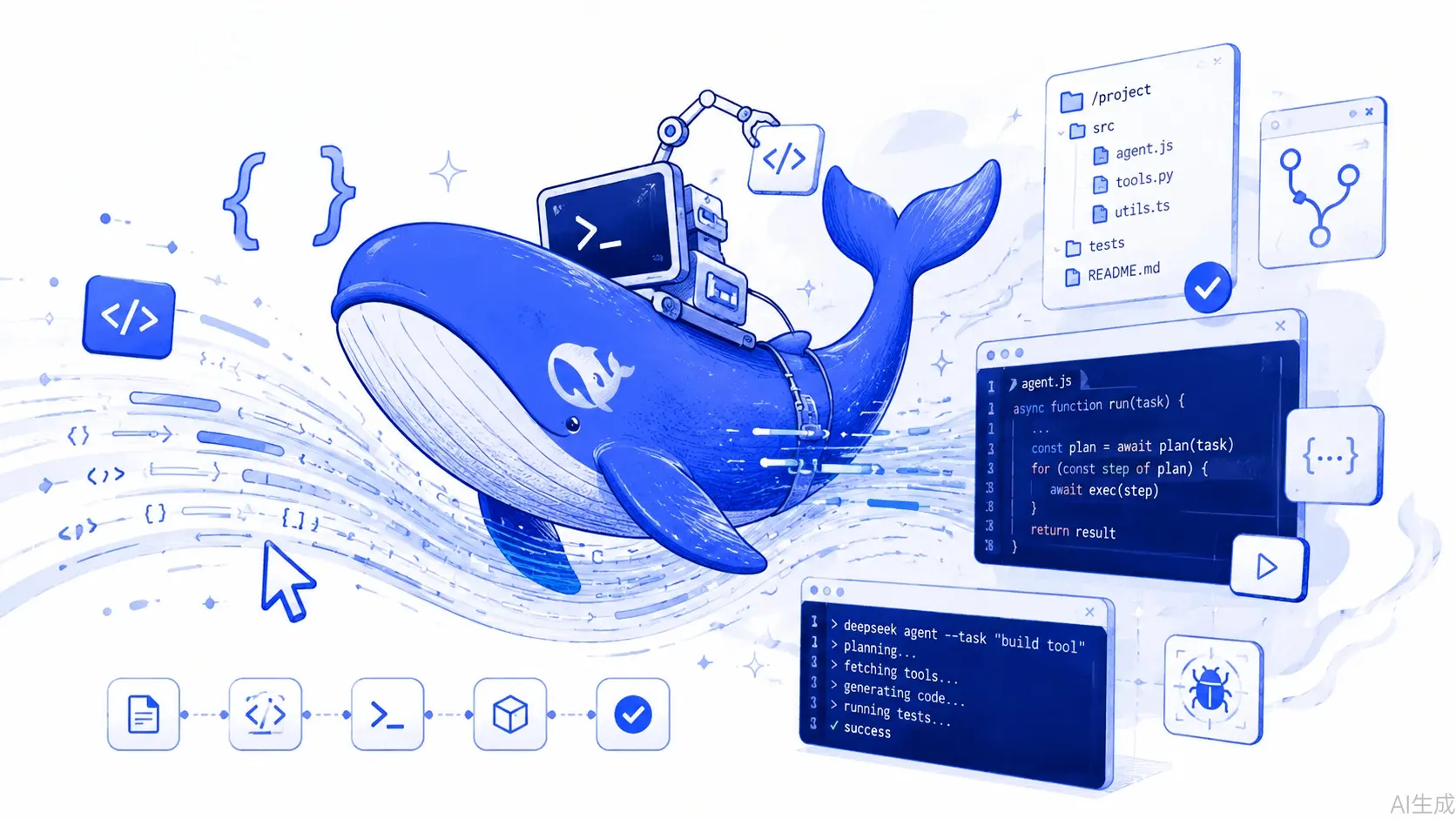
DeepSeek is reportedly forming a dedicated "Harness" team to develop a code agent product, directly targeting Anthropic's Claude Code. According to internal sources and a social media post by DeepSeek senior researcher Chen Deli, the team will focus on building "DeepSeek Code Harness." The initiative involves recruiting for key roles like Harness Product Manager and Harness R&D Engineer in Beijing. DeepSeek defines its approach with the core formula: Model + Harness = Agent. This signifies a strategic shift from merely offering a powerful coding model to creating the essential middleware that connects the model to real-world developer workflows. The Harness will handle context management, tool calls, task planning, file operations, code editing, terminal execution, and feedback loops. The move highlights that competition in AI-assisted coding is evolving from pure model capability to ownership of the developer workflow entry point. While DeepSeek has strong foundational models (e.g., DeepSeek-Coder series), it has lacked an integrated, productized agent experience. The popularity of a community-built project, DeepSeek-TUI, demonstrated developer demand for a Claude Code-like tool using DeepSeek's models, but also revealed the limitations of unofficial solutions. By building its official Code Harness, DeepSeek aims to leverage its unique advantages: direct collaboration with its model training team, control over APIs and design, the ability to create a data feedback loop for model improvement, and access to real internal task scenarios. This step is seen as crucial for DeepSeek to transform its advanced models into a leading agent product that can deeply integrate into and enhance the actual software development process.

链捕手05/22 02:14

Insider: DeepSeek Is Forming a Harness Team to Benchmark Against Claude Code

链捕手05/22 02:14

Musk Posted a Recruitment Ad for SpaceX, and After Reading the Comments Section, I Understood

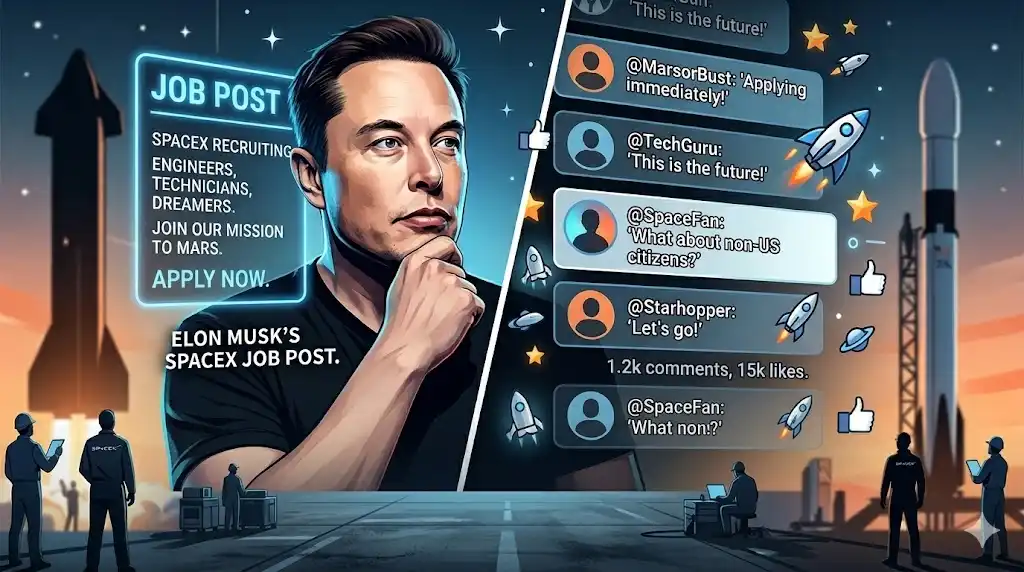
On May 20th, SpaceX filed for a landmark IPO with a $1.75 trillion valuation. Shortly after, Elon Musk posted a recruitment call on X, seeking "world-class engineers and physicists" for SpaceX. The application process was starkly simple: email with three bullet points proving "exceptional ability," with real, complex projects as a plus. Musk promised to review qualifying emails himself. The post garnered millions of views and thousands of replies, revealing a spectrum of responses. Most comments, including a highly-upvoted humorous one listing absurd "skills," merely listed credentials or experiences in a conventional, non-differentiating way. This highlighted a key insight: a traditional resume listing degrees and skills often fails to demonstrate true exceptionalism. Effective self-presentation requires "performance efficiency." A standout reply came from an OpenAI engineering lead, who simply stated "codex." This demonstrated that for those who have built significant, recognized products, the product itself becomes the ultimate resume. The article argues that in the AI era, any tangible, shareable output—a tool, research, or online project—serves as a living, self-evident credential more powerful than a list of attributes. However, a twist emerged when applicants found the provided email address non-functional, leading to speculation that the post might also serve as an IPO publicity stunt, projecting an image of aggressive talent acquisition to investors. Ultimately, the episode served as a microcosm: some participate through performance, others through proof of work, while some question the reality of the stage itself. It underscores the enduring challenge of defining and demonstrating value in an age of abundant, yet often superficial, content.

marsbit05/21 11:34

Musk Posted a Recruitment Ad for SpaceX, and After Reading the Comments Section, I Understood

marsbit05/21 11:34

In the Age of AI, the Organization Itself Is the Moat

In the AI era, where products, interfaces, and narratives are easily replicated, a company's true moat is its organizational structure. The article argues that exceptional companies like OpenAI, Anthropic, and Palantir differentiate themselves not merely through technology but by inventing new organizational forms that allow a specific type of talent to thrive and become a version of themselves they couldn't elsewhere. These companies compete on identity, offering ambitious individuals a sense of being special, chosen, close to power, and part of a historic mission. However, this emotional commitment must be matched by structural commitment—real power, ownership, status, and economic participation. For founders, the key question is not how to tell a better story, but what kind of person can only truly realize their potential within their specific company structure. For individuals evaluating opportunities, the distinction between "being chosen" (an emotional feeling) and "being seen" (a structural reality of tangible power and rewards) is crucial. The most dangerous promises are those priced in future time. While AI makes copying visible elements easy, it does not make building a great, novel organization any easier. The next frontier of competition is creating organizational vessels that attract, structure, and compound the judgment of the right people—those whom traditional boxes cannot contain. The company itself becomes the moat.

marsbit05/10 07:09

In the Age of AI, the Organization Itself Is the Moat

marsbit05/10 07:09

When Technology Is No Longer a Moat, Only One Thing Remains as the Ultimate Moat in the AI Field

In the rapidly converging AI landscape, where technology and product differentiators can be copied in months, the ultimate moat for a company is no longer its product, but its organizational form. Great companies innovate in their very structure, creating new institutional models that attract, empower, and unleash a specific type of talent. Examples like OpenAI and Palantir show how unique architectures—built around frontier model development or navigating complex client systems—foster new kinds of hybrid roles that competitors cannot replicate. These organizations compete on identity and emotional resonance, not just salary. They offer talent a path to become a version of themselves they aspire to be, fulfilling core human desires: to feel unique, destined, part of exponential progress, or proven. This requires structural alignment: if customer proximity is key, client-facing roles must have high status; if speed matters, decision rights must be decentralized. For founders, the critical question is: "What kind of person can only become themselves here?" They must build a company form that matches their ambitious narrative. For job seekers, the warning is to distinguish between feeling "chosen" (emotional validation) and being "seen" (tangible power, scope, and reward). The most dangerous promise is deferred compensation. While AI makes replicating products easy, it cannot replicate a novel, high-trust organizational system that compounds judgment over time. The future will belong not to companies that merely make employees feel special, but to those that invent entirely new structures, enabling a new breed of talent to emerge and thrive.

marsbit05/09 11:05

When Technology Is No Longer a Moat, Only One Thing Remains as the Ultimate Moat in the AI Field

marsbit05/09 11:05

活动图片