# Сопутствующие статьи по теме DeFi

Новостной центр HTX предлагает последние статьи и углубленный анализ по "DeFi", охватывающие рыночные тренды, новости проектов, развитие технологий и политику регулирования в криптоиндустрии.


Stablecoins at a Crossroads: Clear Regulations Drive Adoption, Systemic Risks Remain

Stablecoins are at a critical juncture, with regulatory clarity driving their rapid evolution from crypto trading tools to mainstream payment and settlement infrastructure. The U.S. GENIUS Act and the EU’s MiCA framework have established federal and regional standards for issuance, reserves, and auditing, accelerating their adoption. Market capitalization has surpassed $300 billion, with USD-pegged stablecoins dominating, though euro and other fiat-backed alternatives are growing. Use cases are expanding significantly, with enterprises adopting stablecoins for cross-border payments, payroll, and treasury management due to their 24/7 availability and low transaction costs. They are increasingly integrated into traditional finance as settlement and custody solutions. However, systemic risks remain. USD-pegged stablecoins face potential de-pegging risks, insufficient reserve transparency, and high centralization, which could trigger liquidity crises. Large holdings of sovereign bonds or fixed-income assets may also impact bond markets and monetary policy. The IMF has warned about financial stability risks and dollarization concerns. For stablecoins to mature into reliable, compliant, and interoperable digital infrastructure—rather than just survive—they require transparent issuance mechanisms, robust regulatory coordination, and effective systemic risk controls.

cointelegraph_中文12/08 11:03

Stablecoins at a Crossroads: Clear Regulations Drive Adoption, Systemic Risks Remain

cointelegraph_中文12/08 11:03

When Nasdaq Starts 'Putting Stocks on the Chain', What Are We Really Welcoming?

Nasdaq is advancing a proposal to move U.S. stock settlement onto the blockchain, which could fundamentally reshape the infrastructure of American capital markets. This shift aims to replace the current slow, manual, and multi-layered clearing system with real-time, automated on-chain settlement. While many discussions focus on surface-level changes like 24/7 trading, the core transformation is structural: moving from outdated T+2 (or even T+1) settlement to instantaneous, programmable, and transparent ledger-based clearing. This isn’t about making stocks “more Web3” but modernizing a financial system that still relies on processes from the 1970s. The existing system—with its custodians, sub-custodians, and clearing intermediaries—creates operational friction, risk, and cost, as seen during events like the GameStop trading halts and the FTX collapse. On-chain settlement could reduce the need for traditional custodial roles, compress arbitrage opportunities built on settlement delays, and turn static securities into dynamic, composable financial instruments. The move faces significant resistance from entrenched intermediaries who profit from the current structure, but the direction of change appears inevitable. As demonstrated by Hong Kong’s recent issuance of a green bond settled in one second (versus five days), tokenization of traditional assets is becoming an operational reality—not a conceptual experiment. When stocks migrate on-chain, other assets like bonds and derivatives may follow, leading to a quiet but profound shift in how global markets function. This isn’t just a change in technology; it’s a change in the nature of finance itself.

cointelegraph_中文12/08 10:33

When Nasdaq Starts 'Putting Stocks on the Chain', What Are We Really Welcoming?

cointelegraph_中文12/08 10:33

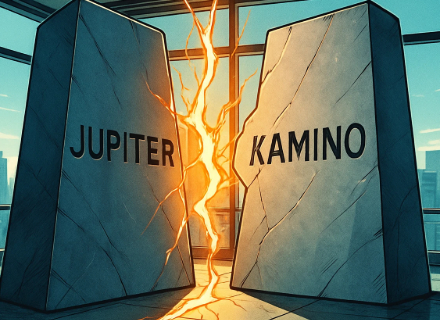
Solana's Two Leading Lending Protocols Clash, Foundation Steps In to Mediate

Summary: Over the weekend, a public dispute erupted between Solana's two leading lending protocols, Jupiter Lend and Kamino, centered on the definition of "risk isolation." The conflict began when Kamino's co-founder, Marius Ciubotariu, accused Jupiter Lend of misleading users. He argued that Jupiter's early marketing claimed its lending pools were "risk-isolated," preventing cross-contamination between assets. However, Kamino contends that Jupiter Lend's design, which allows for the rehypothecation (re-use) of collateral across pools, creates a risk of contagion, contradicting its marketing. In response, Jupiter's COO, Kash Dhanda, admitted the initial "zero contagion risk" social media posts were inaccurate and apologized. The debate highlights a core disagreement on the definition of "risk isolation." Jupiter and its supporters argue the term has design flexibility, noting that while pools share a liquidity layer, each has independent parameters. Kamino and its allies insist that any rehypothecation negates true risk isolation. The dispute escalated when Tushar Jain, a partner at Kamino investor Multicoin Capital, strongly criticized Jupiter, accusing the team of being either incompetent or deliberately misleading. In contrast, Solana Foundation President Lily Liu urged for cooperation, emphasizing that the Solana lending market is much smaller than Ethereum's and that internal conflict only helps competitors. The clash is seen as an inevitable result of intense competition. Kamino was long the Solana lending leader, but Jupiter Lend has rapidly gained significant market share. In a tighter market with reduced liquidity and heightened safety concerns, the competition between the two protocols has become increasingly fierce.

marsbit12/08 10:22

Solana's Two Leading Lending Protocols Clash, Foundation Steps In to Mediate

marsbit12/08 10:22

2025 Tether Financial Analysis: An Additional $45 Billion in Reserves Needed to Maintain Stability

The article analyzes Tether's financial stability in 2025, arguing it functions as an unregulated bank rather than a simple payment operator. It applies a banking regulatory framework (Basel Capital Framework) to assess if Tether holds sufficient capital (its ~$6.8B in excess reserves) to cover potential losses from its asset portfolio. The core issue is whether Tether's total capital is adequate for its risk-weighted assets (RWAs). Its $181.2B in assets are largely in low-risk instruments (~77%), but ~13% is in volatile commodities like gold and Bitcoin. The analysis estimates Tether's RWAs between $62.3B and $175.3B, depending on the conservative treatment of its Bitcoin holdings. Under a baseline scenario, Tether's capital ratio is near minimum regulatory requirements. However, compared to well-capitalized banks, it may need an additional ~$4.5B in capital to support its current $USDT issuance. A more punitive treatment of Bitcoin could imply a deficit of $12.5B-$25B. Tether's counter-argument points to substantial group-level profits and equity (~$20B+), but these are not legally committed to the token entity and are invested in illiquid ventures like mining and AI. The article concludes that the sufficiency of Tether's capital is a complex, structural question without a definitive answer, dependent on asset risk weightings and the firm's willingness to mobilize group resources in a crisis.

marsbit12/08 07:31

2025 Tether Financial Analysis: An Additional $45 Billion in Reserves Needed to Maintain Stability

marsbit12/08 07:31

活动图片