South Korea’s government has reportedly missed the deadline to submit its highly anticipated stablecoin legislation, risking a delay of the second phase of the country’s regulatory efforts to align with global standards and foster innovation.
FSC Misses Key Deadline Amid BOK Disagreement
On Wednesday, local media outlets affirmed that the South Korean government failed to submit the long-awaited bill for the Second Phase of the Virtual Asset User Protection Act, which is expected to address the issuance and distribution of won-denominated stablecoins.
Chosun Biz reported that the Financial Services Commission (FSC) did not meet the National Assembly’s submission deadline for the government’s legislation. On December 1, authorities set December 10 as the deadline to submit the bill to the National Policy Committee.
According to political circles cited by the report, the government bill was delayed because the FSC and the Bank of Korea (BOK) failed to resolve their differences over the issuance of won-pegged stablecoins.
As reported by Bitcoinist, local outlets stated in late November that South Korea’s stablecoin legislation risked being delayed due to a disagreement between financial authorities and the central bank over the extent of banks’ role.
The BOK and FSC seemingly agreed that the financial institutions must be involved in the issuance of won-pegged tokens. However, the central bank has been pushing for a consortium of banks owning at least 51% of any stablecoin issuer seeking regulatory approval in the country.
Meanwhile, the FSC was willing to involve diverse players in the process, expressing concern that giving a majority stake to banks could reduce participation from tech firms and limit the market’s innovation.
The November report noted that the regulatory standoff appeared to leave the market in limbo, with some tech companies actively preparing to get approval and others taking a cautious approach due to the unclear regulatory direction.
Stablecoin Legislation Risks ‘Prolonged Deliberation Process’
Chosun Biz noted that the Democratic Party of Korea (DPK) initially intended to advance the second phase of its virtual asset bill by reviewing the government bill. Nonetheless, if the government draft continues to be delayed, the bills previously introduced by lawmakers could be reviewed first.
Since June, multiple bills related to the issuance and distribution of won-pegged stablecoins have been introduced in the National Assembly. Min Byung-deok, a member of the National Assembly’s Government Committee, introduced the “Digital Assets Basic Act, proposing enabling the issuance of won-pegged stablecoins and establishing a Digital Asset Committee under the direct authority of the president.
In July, South Korea’s ruling and opposition parties proposed rival bills to establish the highly anticipated regulatory framework. Notably, Ahn Do-gil, a member of the Planning and Finance Committee from the Democratic Party, introduced the “Act on the Issuance and Distribution of Value-Stable Digital Assets.”
Similarly, Kim Eun-hye, a member of the Land, Infrastructure, and Transport Committee from the People Power Party (PPP), proposed the “Act on Payment Innovation Using Value-Fixed Digital Assets.”
The two bills shared similarities, like the assignment of stablecoin oversight to the FSC. However, they differed over the issue of interest payments, with the PPP’s bill allowing interest payments and the DPK’s bill completely banning them to prevent market disruption.
It’s worth noting that the FSC chairman, Lee Eun-won, recently affirmed that the regulatory agency will “fundamentally prohibit the payment of interest on stablecoins as a principle,” adopting the same principle as the US framework, the GENIUS Act, which prohibits interest payments on the holding or use of payment-purpose stablecoins.
Following the Wednesday delay, a member of the National Policy Committee from the Democratic Party affirmed that, “for now, it looks difficult to narrow the differences between the FSC and the BOK.”
“If the government bill continues not to be submitted, the deliberation process could be prolonged, so we should at least review the bills introduced by lawmakers first,” they concluded.
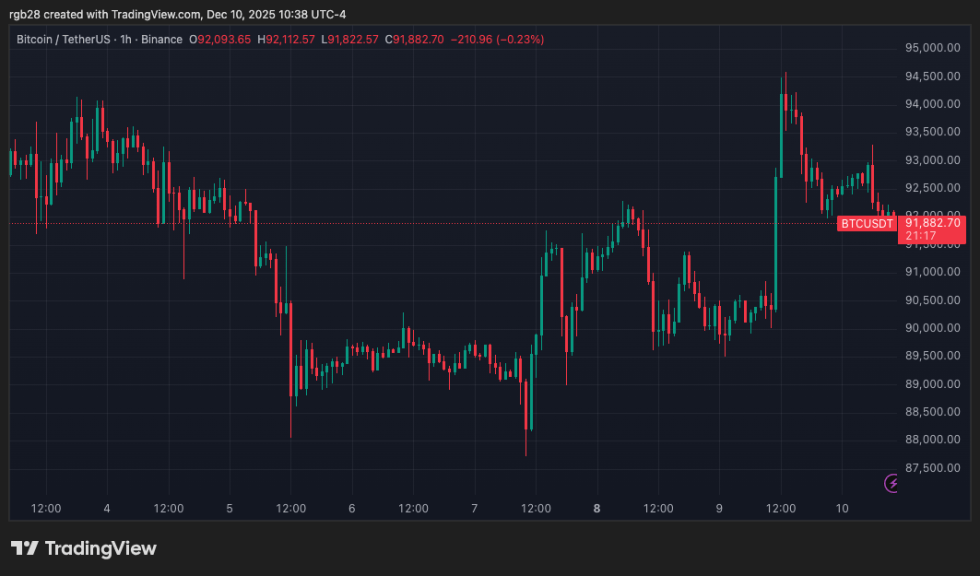
Bitcoin (BTC) trades at $91,882 in the one-week chart. Source: BTCUSDT on TradingView