South Korea’s Stablecoin Legislation Hits Roadblock As FSC Misses December 10 Deadline

bitcoinistPublished on 2025-12-11Last updated on 2025-12-11

Abstract

South Korea's government has missed the December 10 deadline to submit its stablecoin legislation, the second phase of the Virtual Asset User Protection Act. The delay stems from a disagreement between the Financial Services Commission (FSC) and the Bank of Korea (BOK) over the role of banks in issuing won-pegged stablecoins. The BOK insists a bank consortium must own at least 51% of any issuer, while the FSC wants to involve diverse players, including tech firms, to foster innovation. This impasse risks prolonging the legislative process. Multiple rival bills have already been proposed in the National Assembly, with key differences including whether to allow interest payments on stablecoins, a practice the FSC chairman has stated will be "fundamentally prohibited."

South Korea’s government has reportedly missed the deadline to submit its highly anticipated stablecoin legislation, risking a delay of the second phase of the country’s regulatory efforts to align with global standards and foster innovation.

FSC Misses Key Deadline Amid BOK Disagreement

On Wednesday, local media outlets affirmed that the South Korean government failed to submit the long-awaited bill for the Second Phase of the Virtual Asset User Protection Act, which is expected to address the issuance and distribution of won-denominated stablecoins.

Chosun Biz reported that the Financial Services Commission (FSC) did not meet the National Assembly’s submission deadline for the government’s legislation. On December 1, authorities set December 10 as the deadline to submit the bill to the National Policy Committee.

According to political circles cited by the report, the government bill was delayed because the FSC and the Bank of Korea (BOK) failed to resolve their differences over the issuance of won-pegged stablecoins.

As reported by Bitcoinist, local outlets stated in late November that South Korea’s stablecoin legislation risked being delayed due to a disagreement between financial authorities and the central bank over the extent of banks’ role.

The BOK and FSC seemingly agreed that the financial institutions must be involved in the issuance of won-pegged tokens. However, the central bank has been pushing for a consortium of banks owning at least 51% of any stablecoin issuer seeking regulatory approval in the country.

Meanwhile, the FSC was willing to involve diverse players in the process, expressing concern that giving a majority stake to banks could reduce participation from tech firms and limit the market’s innovation.

The November report noted that the regulatory standoff appeared to leave the market in limbo, with some tech companies actively preparing to get approval and others taking a cautious approach due to the unclear regulatory direction.

Stablecoin Legislation Risks ‘Prolonged Deliberation Process’

Chosun Biz noted that the Democratic Party of Korea (DPK) initially intended to advance the second phase of its virtual asset bill by reviewing the government bill. Nonetheless, if the government draft continues to be delayed, the bills previously introduced by lawmakers could be reviewed first.

Since June, multiple bills related to the issuance and distribution of won-pegged stablecoins have been introduced in the National Assembly. Min Byung-deok, a member of the National Assembly’s Government Committee, introduced the “Digital Assets Basic Act, proposing enabling the issuance of won-pegged stablecoins and establishing a Digital Asset Committee under the direct authority of the president.

In July, South Korea’s ruling and opposition parties proposed rival bills to establish the highly anticipated regulatory framework. Notably, Ahn Do-gil, a member of the Planning and Finance Committee from the Democratic Party, introduced the “Act on the Issuance and Distribution of Value-Stable Digital Assets.”

Similarly, Kim Eun-hye, a member of the Land, Infrastructure, and Transport Committee from the People Power Party (PPP), proposed the “Act on Payment Innovation Using Value-Fixed Digital Assets.”

The two bills shared similarities, like the assignment of stablecoin oversight to the FSC. However, they differed over the issue of interest payments, with the PPP’s bill allowing interest payments and the DPK’s bill completely banning them to prevent market disruption.

It’s worth noting that the FSC chairman, Lee Eun-won, recently affirmed that the regulatory agency will “fundamentally prohibit the payment of interest on stablecoins as a principle,” adopting the same principle as the US framework, the GENIUS Act, which prohibits interest payments on the holding or use of payment-purpose stablecoins.

Following the Wednesday delay, a member of the National Policy Committee from the Democratic Party affirmed that, “for now, it looks difficult to narrow the differences between the FSC and the BOK.”

“If the government bill continues not to be submitted, the deliberation process could be prolonged, so we should at least review the bills introduced by lawmakers first,” they concluded.
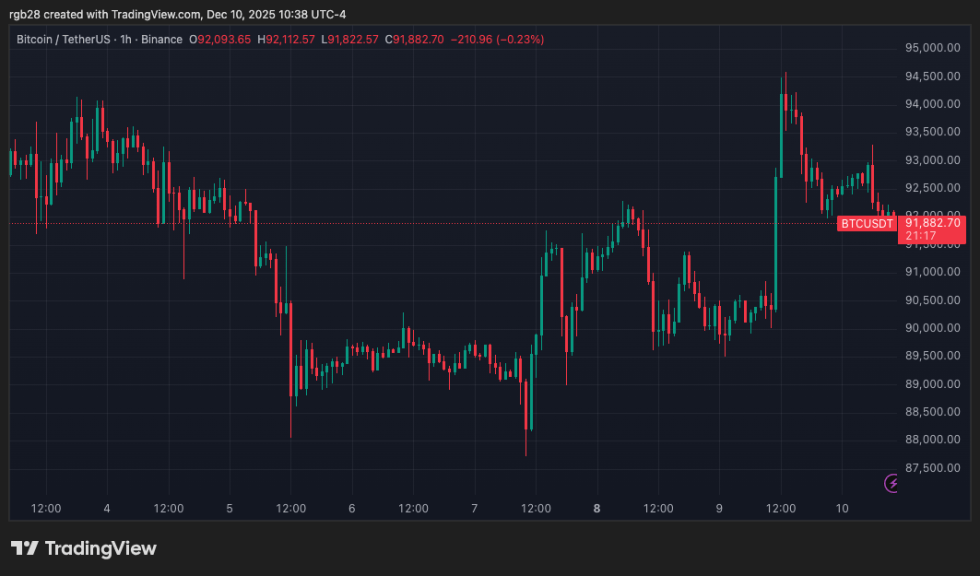
Bitcoin (BTC) trades at $91,882 in the one-week chart. Source: BTCUSDT on TradingView


Trending Cryptos

Related Reads

HKEX Welcomes Its Largest IPO of the Day

Today (July 8th), Momenta successfully listed on the Hong Kong Stock Exchange, becoming the "first Physical AI stock." The company, founded in 2016 by Tsinghua University alumnus Cao Xudong, focuses on autonomous driving as an entry point into Physical AI research. Momenta's IPO price was HK$295.6 per share. With a market cap exceeding HK$70 billion post-listing, it was the largest among the five companies debuting that day. The offering raised approximately HK$6.8 billion and attracted a "star-studded" lineup of 14 cornerstone investors, including top-tier international funds, leading strategic industrial investors like Mercedes-Benz and BYD, and major Chinese financial institutions. The company has pioneered a "flywheel" strategy, integrating mass-produced advanced driver-assistance systems (ADAS) with its full-self-driving (L4) development. Data from over 1 million vehicles equipped with its systems fuels its AI models, enabling continuous improvement. This massive real-world data scale is a core competitive advantage. In April, Momenta launched its self-developed R7 World Model for mass production, a foundational model designed to understand and predict physical world dynamics. The company positions itself not just as an automotive tech supplier, but as a platform-level Physical AI company. Its technology platform has the potential to expand beyond autonomous vehicles into areas like logistics and embodied AI. Financially, Momenta's revenue grew from RMB 743 million in 2023 to RMB 2.413 billion in 2025, with licensing income surging 42-fold during this period. While still reporting adjusted losses, it is nearing breakeven. The company boasts partnerships with 24 global automakers, including 9 of the world's top 10, and holds a 65% market share in China's third-party urban NOA segment. The listing marks a significant moment for Physical AI in global capital markets, reflecting strong investor confidence in Momenta's unique technology path and commercial execution.

marsbit4m ago

HKEX Welcomes Its Largest IPO of the Day

marsbit4m ago

Not Betting on Goals but on 'Tears': Polymarket Users Argue Over Ronaldo's Final World Cup Match

Title: Beyond Goals, Betting on Tears: Polymarket Users Clash Over Ronaldo's Emotional World Cup Exit On July 6, Portugal's 0-1 loss to Spain in the World Cup round of 16 marked the final tournament for Cristiano Ronaldo. The 41-year-old star's emotional reaction—red eyes, wiping his face, fighting back tears—was captured globally. Concurrently, a fierce debate erupted on the crypto prediction platform Polymarket over a specific market: "Will Ronaldo cry during the 2026 FIFA World Cup?" The market, with over $23 million in volume, saw its "YES" probability surge to 99% after the match, but the result was disputed and entered a final review phase. The core conflict centered on the market's precise rules: it required "clearly visible tears streaming down [Ronaldo's] face" in photos/videos taken on the field or bench area during Portugal's matches. While major media outlets described Ronaldo as "in tears" and footage showed him emotional, "NO" bettors argued visible tear tracks were not conclusively evident, only red eyes and dampness. Polymarket's official clarification on July 8 stated that eligible evidence existed showing Ronaldo crying with visible tears on his face post-match. The dispute now goes to a UMA oracle community vote for resolution. This incident highlights a recurring challenge for prediction markets: they excel with quantifiable events but can spark major controversies over subjective, visual, or emotional interpretations. It also serves as a reminder for participants to scrutinize rule wording meticulously, not rely on general perception. Ultimately, such high-profile disputes drive significant trading volume and attention for the platform.

Foresight News1h ago

Not Betting on Goals but on 'Tears': Polymarket Users Argue Over Ronaldo's Final World Cup Match

Foresight News1h ago

Trading

Spot

Hot Articles

Discussions

Welcome to the HTX Community. Here, you can stay informed about the latest platform developments and gain access to professional market insights. Users' opinions on the price of S (S) are presented below.

活动图片