Ethereum's Next Stop Glamsterdam: The Core Upgrades You Must Know

Foresight NewsDipublikasikan tanggal 2026-06-23Terakhir diperbarui pada 2026-06-23

Abstrak

The Glamsterdam upgrade, scheduled for late 2026, is a major Ethereum hard fork combining the Amsterdam execution layer and Glasgow consensus layer updates. Its primary goal is not simply increasing throughput but restructuring Ethereum's block production, validation, and resource pricing to enable future scaling. Key technical changes include **EIP-7732 (ePBS)**, which formally enshrines proposer-builder separation into the protocol. This decouples consensus and execution tasks, extending the execution payload propagation window to ~9 seconds. This provides more time for node verification, allowing for safer increases in block capacity (Gas limit) in the future. Another core component is **EIP-7928 (Block-Level Access Lists - BAL)**. It mandates a list of all state accessed within a block, moving this feature from an optional transaction-level (EIP-2930) to a mandatory block-level requirement. This explicit access list enables client optimizations like parallel disk reads and state root computations, paving the way for parallel execution. To manage long-term state growth, **EIP-8037** increases the cost of creating new state (e.g., accounts, storage slots), separating the pricing of permanent database bloat from temporary computation. This allows execution capacity to scale more aggressively without causing state size to explode proportionally. The planned upgrade bundle includes around 10 EIPs categorized into: 1) Core protocol restructuring (ePBS, BAL), 2) Resource pri...


Author: KarenZ, Foresight News


The Glamsterdam upgrade for Ethereum is most easily misunderstood as yet another purely technical iteration to increase throughput. A more accurate description is: it is reorganizing Ethereum's block proposal process, validation process, resource pricing methods, and more, laying the groundwork for higher gas limits, larger blob capacities, and future parallel execution.


As of June 23, 2026, ethereum.org labels Glamsterdam as an upgrade planned for the second half of 2026. The name Glamsterdam comes from the combination of the execution layer upgrade "Amsterdam" and the consensus layer upgrade "Gloas." The official roadmap places it after Fusaka in December 2025 and before Hegotá, clearly listing two main features: enshrined proposer-builder separation (ePBS) and block-level access lists (BAL).


Who Proposes, Who Builds: ePBS Codifies Block Creation Roles into the Protocol


Today's Ethereum block production is like a very tight shift change: someone is responsible for proposing a block, someone else for building the transaction content, with dependencies on off-protocol infrastructure like MEV-Boost and third-party relays.


This system has been running for years, but it places some trust relationships off-protocol and also forces validators to handle consensus, execution, data availability, and other tasks within a very short time window.


One of Glamsterdam's headline changes, EIP-7732, or ePBS (Enshrined Proposer-Builder Separation), codifies the division of labor between proposers and builders into the protocol.


Simply put, the proposer is responsible for selecting the consensus block, and the builder is responsible for preparing the transaction content inside it. A builder cannot just make verbal promises; it must first "post a bond" within the protocol: specify exactly which execution payload it will deliver and how much it is willing to pay the proposer. Subsequently, a Payload Timeliness Committee (PTC) will check whether it delivers on time.


The key to this change is not just reducing reliance on third-party relays but also buying time for block propagation and validation.


Today, validators need to handle both consensus and execution simultaneously within a very short critical window; ePBS separates these two tasks, allowing the execution payload to be revealed and verified later. According to the design of EIP-7732, the propagation window for the execution payload—the available time for data to spread through the network and be received by nodes—can be extended from about 2 seconds to about 9 seconds. With a longer window, Ethereum can more safely handle larger payloads when increasing block capacity, reducing the risk of missed votes or reorgs due to nodes not having enough time to download, verify, and vote.


This change may not be directly perceptible to ordinary users, but it is crucial for Ethereum scaling. A longer propagation and validation window means the network can more securely handle larger loads. CoinDesk reported on June 16, 2026, citing Ethereum Foundation DevOps engineer Parithosh Jayanthi, that Glamsterdam could be one of the biggest forks since the Merge, changing many assumptions about Ethereum and preparing for larger-scale scaling in the future.


BAL and Repricing: Scaling Isn't Just About Stepping on the Gas, It's Also About Managing the Database


Another core change in Glamsterdam is EIP-7928, Block-Level Access Lists.


It can be understood as providing each block with an "access record": which accounts and which storage locations were touched during the block's execution, and what the related state became after execution, are all recorded. This way, nodes no longer process blocks completely like opening a blind box; they can know earlier which data needs to be read and which computations can be advanced in parallel.


The earlier EIP-2930 introduced transaction-level access lists, but they were optional and saw limited practical use. The change with EIP-7928 is that it elevates access lists to the block level: the block header contains a "fingerprint" (hash) of this list, while the execution payload stores the complete list. Nodes executing the block will verify whether the access records written in the list actually match the block's execution process; if they don't match, the block is invalid.


Why is this important? Today, when Ethereum executes transactions, many data accesses are only known when that specific step is reached. Nodes don't know if a batch of transactions will read/write the same account or storage slot simultaneously, making it hard to confidently process them in parallel. BAL explicitly writes out the access trajectory during block execution, allowing clients to perform parallel disk reads, parallel transaction validation, parallel state root computation, and also update the state in some scenarios without fully replaying transactions. It's not a direct button to lower user fees but opens up engineering space for client-side parallelization.


But Glamsterdam's scaling logic isn't just about "widening the road." It also needs to manage the long-term bloat of Ethereum's database. EIP-8037 increases state creation costs and introduces a cost per state byte (CPSB). State can be understood as the database content that Ethereum must preserve long-term, such as new accounts, new contracts, and new storage slots. Transactions end after execution, but state remains in the ledger that all nodes must maintain; if state grows too fast, running a node becomes increasingly expensive, and decentralization is gradually eroded.


The background numbers provided by EIP-8037 are straightforward: As of January 2026, a Geth node database dedicated to state is about 390 GiB; after the mainnet gas limit increased from 30 million to 60 million, daily new state growth rose from about 105 MiB to about 326 MiB, translating to an annual growth of about 116 GiB. Extrapolating proportionally under a 200 million gas limit, state growth could reach about 387 GiB per year and exceed the 650 GiB performance degradation threshold in less than a year.


Therefore, what EIP-8037 aims to do is separate the pricing of "temporary computation" from "permanently occupying the database." Creating new state will be more expensive because it imposes not a one-time computation cost on the network but a long-term storage burden.


Vitalik Buterin also mentioned, while explaining the Glamsterdam scaling roadmap, that Glamsterdam will separate state creation costs from execution and calldata costs: the goal is to allow execution capacity to expand more significantly while preventing state size from膨胀 at the same rate.


Looking at them together, BAL makes it easier for nodes to process blocks in parallel, addressing "running faster"; state creation repricing makes operations that long-term occupy the database pay a higher cost, addressing "don't let the ledger get fatter and fatter." Glamsterdam's scaling isn't simply raising the gas limit; it's asking a more realistic question: can Ethereum accommodate more transactions while preventing block propagation, transaction validation, and state storage pressures from spiraling out of control.


The Glamsterdam EIP List Takes Shape: Which Are Set, Which Are Still Waiting?


As of June 23, 2026, according to tracking content on Forkcast regarding Ethereum upgrades, Ethereum developers are currently testing the Glamsterdam upgrade in devnets environments, with deployment scheduled for Sepolia on August 3 and for the mainnet on September 16 (specific deployment dates are subject to change).
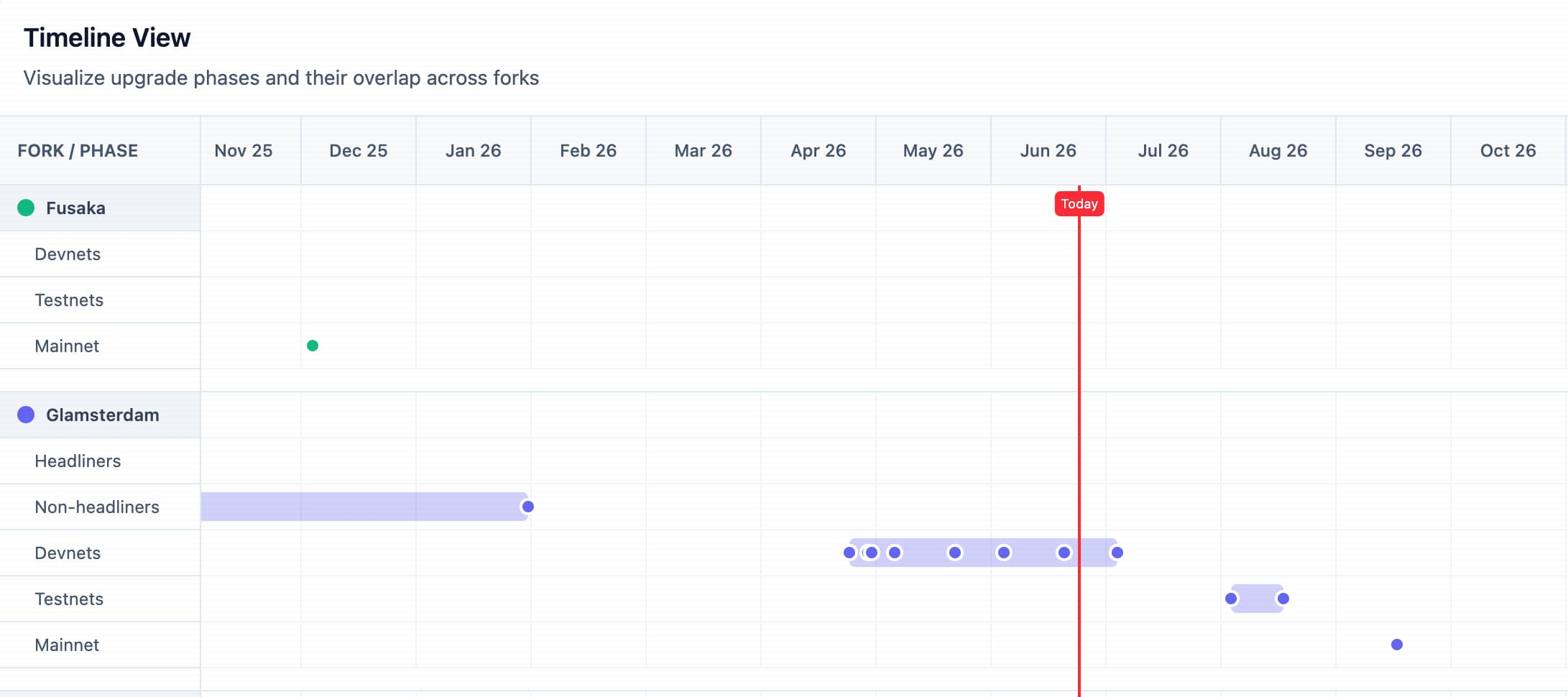


Currently, 10 EIPs are planned for inclusion in the Glamsterdam list:


  • EIP-7708 (ETH transfers will also trigger logs, facilitating indexing and tracking of native ETH transfers)
  • EIP-7732 (ePBS, codifying proposer-builder separation into the protocol, reducing reliance on off-protocol relays)
  • EIP-7778 (Removes block gas accounting related to gas refunds, simplifying block gas calculation)
  • EIP-7843 (Adds SLOTNUM opcode, allowing contracts to read the current slot number)
  • EIP-7928 (Block-level access lists BAL, recording accounts and storage locations accessed during block execution, paving the way for parallel verification)
  • EIP-7954 (Increases the maximum contract size limit, allowing larger contract bytecode)
  • EIP-7976 (Increases calldata floor cost, adjusting the minimum cost for calldata)
  • EIP-7981 (Increases access list cost, recalibrating gas pricing for access lists)
  • EIP-8024 (Backward-compatible SWAPN, DUPN, EXCHANGE opcodes, enhancing EVM stack operation capabilities)
  • EIP-8037 (Increases state creation gas cost,抑制 state database过快膨胀)


These EIPs can be roughly categorized into several groups: The first is the restructuring of block proposal and validation processes, with EIP-7732 and EIP-7928 at the core; the second is resource pricing adjustments, including EIP-7778, EIP-7976, EIP-7981, and EIP-8037; the third is EVM and developer experience changes, including EIP-7708, EIP-7843, EIP-7954, and EIP-8024.


In other words, Glamsterdam isn't changing just one feature point; it's simultaneously upgrading block creation roles, parallel validation, gas pricing, and EVM usability.


Another batch of EIPs remains on the "Considered for Inclusion" list:


  • EIP-2780 (Splits transaction intrinsic gas by resource)
  • EIP-7610 (Contract creation reverts when using a non-empty storage account)
  • EIP-7688 (Future-compatible consensus layer data structure)
  • EIP-7904 (Computational gas cost analysis, potentially to be removed from Glamsterdam)
  • EIP-7975 (eth/70, partial block receipt lists)
  • EIP-7997 (Deterministic factory contracts)
  • EIP-8038 (State access gas cost updates)
  • EIP-8045 (Excludes slashed validators from continuing to propose blocks)
  • EIP-8061 (Increases exit and merge churn)
  • EIP-8070 (eth/72, Sparse Blobpool)
  • EIP-8080 (Allows exits to use the consolidation queue)
  • EIP-8136 (Cell-level deltas for data column broadcasts)
  • EIP-8159 (eth/71, block access list exchange)
  • EIP-8246 (Removes SELFDESTRUCT burn)
  • EIP-8282 (Builder Execution Requests, provides dedicated registration and exit requests for ePBS builders)


Additionally, Forkcast currently lists EIP-8254 (Limits the number of deposit requests per execution layer block to 8192) on the "Proposed for Inclusion" list.


From a staker's perspective, EIP-8061 and EIP-8080 on the considered list are particularly noteworthy. For stakers, this could mean improved exit liquidity. Figment stated in an article on May 5, 2026, that institutional stakers should pay most attention to ePBS, EIP-8061, and EIP-8080, estimating that under the ~38.9 million ETH staked规模 as of April 2026, EIP-8061 could increase the exit churn limit from 256 ETH/epoch to ~1187 ETH/epoch, while EIP-8080 allows regular exits to utilize spare capacity in the merge queue. Figment also cautions that all pre-mainnet numbers should be considered speculative.
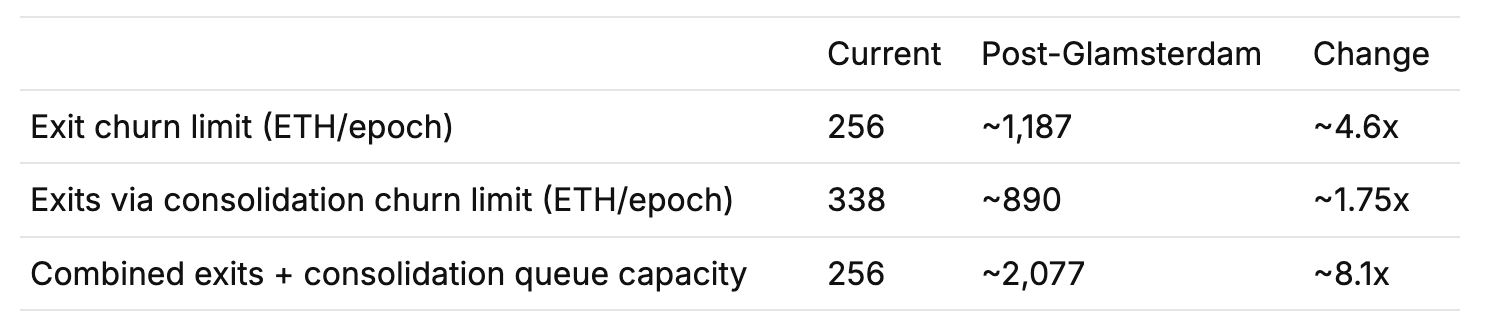

Source: Figment


The Protocol is Upgrading, and Foundation Members Are Also Changing


The technical preparation for Glamsterdam coincides almost simultaneously with personnel changes in the Ethereum Foundation's Protocol cluster. An Ethereum Foundation blog post on May 11, 2026, stated that Glamsterdam had reached several milestones: a 200 million gas limit floor had been established as a credible post-Glamsterdam target, ePBS was running stably on multi-client Glamsterdam devnets, and EIP-8037 was finalized.


The same article announced a leadership transition for the Protocol cluster: Will Corcoran, Kev Wedderburn, and Fredrik would become the new Protocol cluster coordinators. Original coordinators Barnabé Monnot and Tim Beiko left the Ethereum Foundation, and Alex Stokes is on leave.


The Foundation's description of the分工 for the three new coordinators is: Will Corcoran has cross-team coordination experience; Kev Wedderburn leads the zkEVM team; Fredrik leads the Protocol Security and Trillion Dollar Security project.


These changes didn't stop at the protocol team. On June 18, 2026, Hsiao-Wei Wang posted that after a leave of absence, they had decided to resign from their positions as Co-Executive Director and Board Member of the Ethereum Foundation.


Former Ethereum Foundation researcher Dankrad Feist stated on June 19, 2026, that those leaving the EF are believers in CROPS (Censorship & Capture Resistance, Open Source, Privacy, Security), that the issue isn't with strategy but with management, and called this wave of talent outflow slightly bearish for Ethereum. Miden co-founder Azeem interpreted it from the opposite direction, believing the EF struggles to change itself, and that the talent outflow might lead to the formation of new organizations better able to execute the Ethereum roadmap, ultimately a net positive for the ecosystem long-term.


The narrative from within the Ethereum Foundation sounds more like setting boundaries. Ethereum Foundation Interim Co-Executive Director Bastian Aue (Aerugo) responded that reasons for EF members leaving include strategic disagreements, role fit, normal institutional turnover, or personal choice, that the EF wouldn't discuss individual personnel matters on social media, but stated that those leaving should have a dignified way to depart.


The Ethereum Foundation later provided a clearer organizational narrative via an official Twitter thread: realizing Ethereum's potential requires a coalition of multiple organizations, and over the past year, several organizations have jointly enhanced the ecosystem's resilience and capabilities. Examples listed by the EF include: ethlabs announced on June 23 (a non-profit R&D lab focused on the next stage of Ethereum and ETH adoption), the Eth Apps Guild launched in April 2026 (focused on real adoption of Ethereum-native apps, especially in emerging markets), the Ethereum Economic Zone launched in 2026 (aiming to reduce ecosystem fragmentation through synchronous composability and zero-knowledge real-time proofs), and Argot established in 2025 (an autonomous collective of engineers and researchers maintaining Solidity and open-source compiler tools).


This official thread makes the recent changes at the Ethereum Foundation easier to understand: the Foundation isn't simply pushing people and projects out, nor is it abandoning central coordination; rather, it might be distributing the Ethereum roadmap across more organizations to shoulder together.


Summary


Therefore, Glamsterdam shouldn't be seen merely as a set of EIPs. It is a significant engineering reorganization by Ethereum before achieving higher throughput: who builds blocks, who proposes them, who validates them, which data must be stored long-term, and which resources should be more expensive are all being re-examined.


The keywords for the technical route are ePBS, BAL, and the beginning of multi-dimensional gas; the keywords for the organizational route are more pragmatic: can the Ethereum Foundation maintain its coordinating power, and can new organizations outside the Foundation turn this coordinating power into sustained delivery.


References:
https://forkcast.org/upgrade/glamsterdam/
https://ethereum.org/roadmap/glamsterdam/
https://blog.ethereum.org/2026/05/11/protocol-update-may-26
https://x.com/VitalikButerin/status/2027403360484430122


Kripto yang Sedang Tren

Pertanyaan Terkait

QWhat is the core purpose of the Glamsterdam upgrade for Ethereum?

AThe Glamsterdam upgrade is not simply about increasing throughput. Its core purpose is to restructure key processes like block production, validation, and resource pricing to pave the way for higher gas limits, larger blob capacity, and future parallel transaction execution. It aims to handle more transactions while preventing uncontrolled growth in block propagation time, verification pressure, and state storage size.

QWhat is ePBS (EIP-7732) and why is it significant in Glamsterdam?

AePBS (Enshrined Proposer-Builder Separation) formally encodes the division of labor between block proposers and block builders into the Ethereum protocol. Proposers choose consensus blocks, while builders prepare the transaction content. Builders must provide collateral and their execution payload, which is verified by a Payload Timeliness Committee (PTC). This reduces reliance on external relays like MEV-Boost and crucially extends the execution payload propagation window from ~2 seconds to ~9 seconds. This longer window allows for safer processing of larger block capacities without increasing the risk of missed votes or reorgs.

QHow does the Block-Level Access List (BAL, EIP-7928) facilitate future scaling?

AThe Block-Level Access List (BAL) attaches a detailed 'access record' to each block, listing every account and storage slot touched during execution and their resulting states. This allows nodes to know in advance which data needs to be read, enabling parallel disk reads, parallel transaction verification, and parallel state root calculations. By making data access patterns explicit, BAL creates an engineering foundation for parallel execution, allowing the network to process blocks faster and more efficiently, which is critical for handling higher transaction loads.

QWhy is EIP-8037 (increasing state creation cost) necessary alongside capacity increases?

AEIP-8037 is necessary to decouple the cost of 'permanent database occupancy' (state growth) from the cost of 'temporary computation'. State (like new accounts and contracts) persists indefinitely on all nodes, leading to database bloat and increased hardware costs that threaten decentralization. With projections showing state growth could exceed performance thresholds under higher gas limits, EIP-8037 significantly raises the gas cost for creating new state. This allows execution capacity (transactions per block) to increase more aggressively while preventing the state database from expanding at an unsustainable rate.

QWhat are the potential implications of the recent Ethereum Foundation personnel changes for the Glamsterdam upgrade and Ethereum's development?

AThe recent changes, including the departure of key figures and the promotion of new protocol cluster coordinators, have sparked debate. Some see it as a potential 'brain drain' that could slow progress. However, the Ethereum Foundation's official narrative frames it as part of a strategic shift towards a 'coalition of organizations' (like ethlabs, Eth Apps Guild, Ethereum Economic Zone, and Argot) sharing the responsibility for executing Ethereum's roadmap. The implication is that the Foundation aims to distribute coordination and development efforts more broadly across the ecosystem, which could enhance resilience and execution capacity in the long term, albeit with potential short-term transition challenges.

Bacaan Terkait

Trading

Spot

Artikel Populer

Apa Itu $S$

Memahami SPERO: Tinjauan Komprehensif Pengenalan SPERO Seiring dengan perkembangan lanskap inovasi, munculnya teknologi web3 dan proyek cryptocurrency memainkan peran penting dalam membentuk masa depan digital. Salah satu proyek yang telah menarik perhatian di bidang dinamis ini adalah SPERO, yang dilambangkan sebagai SPERO,$$s$. Artikel ini bertujuan untuk mengumpulkan dan menyajikan informasi terperinci tentang SPERO, untuk membantu para penggemar dan investor memahami dasar-dasar, tujuan, dan inovasi dalam domain web3 dan crypto. Apa itu SPERO,$$s$? SPERO,$$s$ adalah proyek unik dalam ruang crypto yang berusaha memanfaatkan prinsip desentralisasi dan teknologi blockchain untuk menciptakan ekosistem yang mendorong keterlibatan, utilitas, dan inklusi finansial. Proyek ini dirancang untuk memfasilitasi interaksi peer-to-peer dengan cara baru, memberikan pengguna solusi dan layanan keuangan yang inovatif. Pada intinya, SPERO,$$s$ bertujuan untuk memberdayakan individu dengan menyediakan alat dan platform yang meningkatkan pengalaman pengguna dalam ruang cryptocurrency. Ini termasuk memungkinkan metode transaksi yang lebih fleksibel, mendorong inisiatif yang dipimpin komunitas, dan menciptakan jalur untuk peluang finansial melalui aplikasi terdesentralisasi (dApps). Visi mendasar dari SPERO,$$s$ berputar di sekitar inklusivitas, bertujuan untuk menjembatani kesenjangan dalam keuangan tradisional sambil memanfaatkan manfaat teknologi blockchain. Siapa Pencipta SPERO,$$s$? Identitas pencipta SPERO,$$s$ tetap agak samar, karena ada sumber daya publik yang terbatas yang memberikan informasi latar belakang terperinci tentang pendiriannya. Kurangnya transparansi ini dapat berasal dari komitmen proyek terhadap desentralisasi—sebuah etos yang banyak proyek web3 bagi, memprioritaskan kontribusi kolektif di atas pengakuan individu. Dengan memusatkan diskusi di sekitar komunitas dan tujuan kolektifnya, SPERO,$$s$ mewujudkan esensi pemberdayaan tanpa menonjolkan individu tertentu. Dengan demikian, memahami etos dan misi SPERO tetap lebih penting daripada mengidentifikasi pencipta tunggal. Siapa Investor SPERO,$$s$? SPERO,$$s$ didukung oleh beragam investor mulai dari modal ventura hingga investor malaikat yang berdedikasi untuk mendorong inovasi di sektor crypto. Fokus investor ini umumnya sejalan dengan misi SPERO—memprioritaskan proyek yang menjanjikan kemajuan teknologi sosial, inklusivitas finansial, dan tata kelola terdesentralisasi. Fondasi investor ini biasanya tertarik pada proyek yang tidak hanya menawarkan produk inovatif tetapi juga memberikan kontribusi positif kepada komunitas blockchain dan ekosistemnya. Dukungan dari investor ini memperkuat SPERO,$$s$ sebagai pesaing yang patut diperhitungkan di domain proyek crypto yang berkembang pesat. Bagaimana SPERO,$$s$ Bekerja? SPERO,$$s$ menerapkan kerangka kerja multi-faceted yang membedakannya dari proyek cryptocurrency konvensional. Berikut adalah beberapa fitur kunci yang menekankan keunikan dan inovasinya: Tata Kelola Terdesentralisasi: SPERO,$$s$ mengintegrasikan model tata kelola terdesentralisasi, memberdayakan pengguna untuk berpartisipasi aktif dalam proses pengambilan keputusan mengenai masa depan proyek. Pendekatan ini mendorong rasa kepemilikan dan akuntabilitas di antara anggota komunitas. Utilitas Token: SPERO,$$s$ memanfaatkan token cryptocurrency-nya sendiri, yang dirancang untuk melayani berbagai fungsi dalam ekosistem. Token ini memungkinkan transaksi, hadiah, dan fasilitasi layanan yang ditawarkan di platform, meningkatkan keterlibatan dan utilitas secara keseluruhan. Arsitektur Berlapis: Arsitektur teknis SPERO,$$s$ mendukung modularitas dan skalabilitas, memungkinkan integrasi fitur dan aplikasi tambahan secara mulus seiring dengan perkembangan proyek. Kemampuan beradaptasi ini sangat penting untuk mempertahankan relevansi di lanskap crypto yang selalu berubah. Keterlibatan Komunitas: Proyek ini menekankan inisiatif yang dipimpin komunitas, menggunakan mekanisme yang memberikan insentif untuk kolaborasi dan umpan balik. Dengan memelihara komunitas yang kuat, SPERO,$$s$ dapat lebih baik memenuhi kebutuhan pengguna dan beradaptasi dengan tren pasar. Fokus pada Inklusi: Dengan menawarkan biaya transaksi yang rendah dan antarmuka yang ramah pengguna, SPERO,$$s$ bertujuan untuk menarik basis pengguna yang beragam, termasuk individu yang mungkin sebelumnya tidak terlibat dalam ruang crypto. Komitmen ini terhadap inklusi sejalan dengan misi utamanya untuk memberdayakan melalui aksesibilitas. Garis Waktu SPERO,$$s$ Memahami sejarah proyek memberikan wawasan penting tentang trajektori dan tonggak perkembangannya. Berikut adalah garis waktu yang disarankan yang memetakan peristiwa signifikan dalam evolusi SPERO,$$s$: Fase Konseptualisasi dan Ideasi: Ide awal yang membentuk dasar SPERO,$$s$ dikembangkan, sangat selaras dengan prinsip desentralisasi dan fokus komunitas dalam industri blockchain. Peluncuran Whitepaper Proyek: Setelah fase konseptual, whitepaper komprehensif yang merinci visi, tujuan, dan infrastruktur teknologi SPERO,$$s$ dirilis untuk menarik minat dan umpan balik komunitas. Pembangunan Komunitas dan Keterlibatan Awal: Upaya jangkauan aktif dilakukan untuk membangun komunitas pengguna awal dan investor potensial, memfasilitasi diskusi seputar tujuan proyek dan mendapatkan dukungan. Acara Generasi Token: SPERO,$$s$ melakukan acara generasi token (TGE) untuk mendistribusikan token asli kepada pendukung awal dan membangun likuiditas awal dalam ekosistem. Peluncuran dApp Awal: Aplikasi terdesentralisasi (dApp) pertama yang terkait dengan SPERO,$$s$ diluncurkan, memungkinkan pengguna untuk terlibat dengan fungsionalitas inti platform. Pengembangan Berkelanjutan dan Kemitraan: Pembaruan dan peningkatan berkelanjutan terhadap penawaran proyek, termasuk kemitraan strategis dengan pemain lain di ruang blockchain, telah membentuk SPERO,$$s$ menjadi pemain yang kompetitif dan berkembang di pasar crypto. Kesimpulan SPERO,$$s$ berdiri sebagai bukti potensi web3 dan cryptocurrency untuk merevolusi sistem keuangan dan memberdayakan individu. Dengan komitmen terhadap tata kelola terdesentralisasi, keterlibatan komunitas, dan fungsionalitas yang dirancang secara inovatif, ia membuka jalan menuju lanskap keuangan yang lebih inklusif. Seperti halnya investasi di ruang crypto yang berkembang pesat, calon investor dan pengguna dianjurkan untuk melakukan riset secara menyeluruh dan terlibat dengan perkembangan yang sedang berlangsung dalam SPERO,$$s$. Proyek ini menunjukkan semangat inovatif industri crypto, mengundang eksplorasi lebih lanjut ke dalam berbagai kemungkinan yang ada. Meskipun perjalanan SPERO,$$s$ masih berlangsung, prinsip-prinsip dasarnya mungkin benar-benar mempengaruhi masa depan cara kita berinteraksi dengan teknologi, keuangan, dan satu sama lain dalam ekosistem digital yang saling terhubung.

97 Total TayanganDipublikasikan pada 2024.12.17Diperbarui pada 2024.12.17

Apa Itu $S$

Apa Itu AGENT S

Agent S: Masa Depan Interaksi Otonom di Web3 Pendahuluan Dalam lanskap Web3 dan cryptocurrency yang terus berkembang, inovasi secara konstan mendefinisikan ulang cara individu berinteraksi dengan platform digital. Salah satu proyek perintis, Agent S, menjanjikan untuk merevolusi interaksi manusia-komputer melalui kerangka agen terbuka. Dengan membuka jalan untuk interaksi otonom, Agent S bertujuan untuk menyederhanakan tugas-tugas kompleks, menawarkan aplikasi transformasional dalam kecerdasan buatan (AI). Eksplorasi mendetail ini akan menyelami seluk-beluk proyek, fitur uniknya, dan implikasinya untuk domain cryptocurrency. Apa itu Agent S? Agent S berdiri sebagai kerangka agen terbuka yang inovatif, dirancang khusus untuk mengatasi tiga tantangan mendasar dalam otomatisasi tugas komputer: Memperoleh Pengetahuan Spesifik Domain: Kerangka ini secara cerdas belajar dari berbagai sumber pengetahuan eksternal dan pengalaman internal. Pendekatan ganda ini memberdayakannya untuk membangun repositori pengetahuan spesifik domain yang kaya, meningkatkan kinerjanya dalam pelaksanaan tugas. Perencanaan Selama Rentang Tugas yang Panjang: Agent S menggunakan perencanaan hierarkis yang ditingkatkan pengalaman, pendekatan strategis yang memfasilitasi pemecahan dan pelaksanaan tugas-tugas rumit dengan efisien. Fitur ini secara signifikan meningkatkan kemampuannya untuk mengelola beberapa subtugas dengan efisien dan efektif. Menangani Antarmuka Dinamis dan Tidak Seragam: Proyek ini memperkenalkan Antarmuka Agen-Komputer (ACI), solusi inovatif yang meningkatkan interaksi antara agen dan pengguna. Dengan memanfaatkan Model Bahasa Besar Multimodal (MLLM), Agent S dapat menavigasi dan memanipulasi berbagai antarmuka pengguna grafis dengan mulus. Melalui fitur-fitur perintis ini, Agent S menyediakan kerangka kerja yang kuat yang mengatasi kompleksitas yang terlibat dalam mengotomatisasi interaksi manusia dengan mesin, membuka jalan untuk berbagai aplikasi dalam AI dan seterusnya. Siapa Pencipta Agent S? Meskipun konsep Agent S secara fundamental inovatif, informasi spesifik tentang penciptanya tetap samar. Pencipta saat ini tidak diketahui, yang menyoroti baik tahap awal proyek atau pilihan strategis untuk menjaga anggota pendiri tetap tersembunyi. Terlepas dari anonimitas, fokus tetap pada kemampuan dan potensi kerangka kerja. Siapa Investor Agent S? Karena Agent S relatif baru dalam ekosistem kriptografi, informasi terperinci mengenai investor dan pendukung keuangannya tidak secara eksplisit didokumentasikan. Kurangnya wawasan yang tersedia untuk umum mengenai fondasi investasi atau organisasi yang mendukung proyek ini menimbulkan pertanyaan tentang struktur pendanaannya dan peta jalan pengembangannya. Memahami dukungan sangat penting untuk mengukur keberlanjutan proyek dan potensi dampak pasar. Bagaimana Cara Kerja Agent S? Di inti Agent S terletak teknologi mutakhir yang memungkinkannya berfungsi secara efektif dalam berbagai pengaturan. Model operasionalnya dibangun di sekitar beberapa fitur kunci: Interaksi Komputer yang Mirip Manusia: Kerangka ini menawarkan perencanaan AI yang canggih, berusaha untuk membuat interaksi dengan komputer lebih intuitif. Dengan meniru perilaku manusia dalam pelaksanaan tugas, ia menjanjikan untuk meningkatkan pengalaman pengguna. Memori Naratif: Digunakan untuk memanfaatkan pengalaman tingkat tinggi, Agent S memanfaatkan memori naratif untuk melacak sejarah tugas, sehingga meningkatkan proses pengambilan keputusannya. Memori Episodik: Fitur ini memberikan panduan langkah demi langkah kepada pengguna, memungkinkan kerangka untuk menawarkan dukungan kontekstual saat tugas berlangsung. Dukungan untuk OpenACI: Dengan kemampuan untuk berjalan secara lokal, Agent S memungkinkan pengguna untuk mempertahankan kontrol atas interaksi dan alur kerja mereka, sejalan dengan etos terdesentralisasi Web3. Integrasi Mudah dengan API Eksternal: Versatilitas dan kompatibilitasnya dengan berbagai platform AI memastikan bahwa Agent S dapat dengan mulus masuk ke dalam ekosistem teknologi yang ada, menjadikannya pilihan menarik bagi pengembang dan organisasi. Fungsionalitas ini secara kolektif berkontribusi pada posisi unik Agent S dalam ruang kripto, saat ia mengotomatisasi tugas-tugas kompleks yang melibatkan banyak langkah dengan intervensi manusia yang minimal. Seiring proyek ini berkembang, aplikasi potensialnya di Web3 dapat mendefinisikan ulang bagaimana interaksi digital berlangsung. Garis Waktu Agent S Pengembangan dan tonggak Agent S dapat dirangkum dalam garis waktu yang menyoroti peristiwa pentingnya: 27 September 2024: Konsep Agent S diluncurkan dalam sebuah makalah penelitian komprehensif berjudul “Sebuah Kerangka Agen Terbuka yang Menggunakan Komputer Seperti Manusia,” yang menunjukkan dasar untuk proyek ini. 10 Oktober 2024: Makalah penelitian tersebut dipublikasikan secara terbuka di arXiv, menawarkan eksplorasi mendalam tentang kerangka kerja dan evaluasi kinerjanya berdasarkan tolok ukur OSWorld. 12 Oktober 2024: Sebuah presentasi video dirilis, memberikan wawasan visual tentang kemampuan dan fitur Agent S, lebih lanjut melibatkan pengguna dan investor potensial. Tanda-tanda dalam garis waktu ini tidak hanya menggambarkan kemajuan Agent S tetapi juga menunjukkan komitmennya terhadap transparansi dan keterlibatan komunitas. Poin Kunci Tentang Agent S Seiring kerangka Agent S terus berkembang, beberapa atribut kunci menonjol, menekankan sifat inovatif dan potensinya: Kerangka Inovatif: Dirancang untuk memberikan penggunaan komputer yang intuitif seperti interaksi manusia, Agent S membawa pendekatan baru untuk otomatisasi tugas. Interaksi Otonom: Kemampuan untuk berinteraksi secara otonom dengan komputer melalui GUI menandakan lompatan menuju solusi komputasi yang lebih cerdas dan efisien. Otomatisasi Tugas Kompleks: Dengan metodologinya yang kuat, ia dapat mengotomatisasi tugas-tugas kompleks yang melibatkan banyak langkah, membuat proses lebih cepat dan kurang rentan terhadap kesalahan. Perbaikan Berkelanjutan: Mekanisme pembelajaran memungkinkan Agent S untuk belajar dari pengalaman masa lalu, terus meningkatkan kinerja dan efektivitasnya. Versatilitas: Adaptabilitasnya di berbagai lingkungan operasi seperti OSWorld dan WindowsAgentArena memastikan bahwa ia dapat melayani berbagai aplikasi. Saat Agent S memposisikan dirinya di lanskap Web3 dan kripto, potensinya untuk meningkatkan kemampuan interaksi dan mengotomatisasi proses menandakan kemajuan signifikan dalam teknologi AI. Melalui kerangka inovatifnya, Agent S mencerminkan masa depan interaksi digital, menjanjikan pengalaman yang lebih mulus dan efisien bagi pengguna di berbagai industri. Kesimpulan Agent S mewakili lompatan berani ke depan dalam pernikahan AI dan Web3, dengan kapasitas untuk mendefinisikan ulang cara kita berinteraksi dengan teknologi. Meskipun masih dalam tahap awal, kemungkinan aplikasinya sangat luas dan menarik. Melalui kerangka komprehensifnya yang mengatasi tantangan kritis, Agent S bertujuan untuk membawa interaksi otonom ke garis depan pengalaman digital. Saat kita melangkah lebih dalam ke dalam ranah cryptocurrency dan desentralisasi, proyek-proyek seperti Agent S pasti akan memainkan peran penting dalam membentuk masa depan teknologi dan kolaborasi manusia-komputer.

946 Total TayanganDipublikasikan pada 2025.01.14Diperbarui pada 2025.01.14

Apa Itu AGENT S

Cara Membeli S

Selamat datang di HTX.com! Kami telah membuat pembelian Sonic (S) menjadi mudah dan nyaman. Ikuti panduan langkah demi langkah kami untuk memulai perjalanan kripto Anda.Langkah 1: Buat Akun HTX AndaGunakan alamat email atau nomor ponsel Anda untuk mendaftar akun gratis di HTX. Rasakan perjalanan pendaftaran yang mudah dan buka semua fitur.Dapatkan Akun SayaLangkah 2: Buka Beli Kripto, lalu Pilih Metode Pembayaran AndaKartu Kredit/Debit: Gunakan Visa atau Mastercard Anda untuk membeli Sonic (S) secara instan.Saldo: Gunakan dana dari saldo akun HTX Anda untuk melakukan trading dengan lancar.Pihak Ketiga: Kami telah menambahkan metode pembayaran populer seperti Google Pay dan Apple Pay untuk meningkatkan kenyamanan.P2P: Lakukan trading langsung dengan pengguna lain di HTX.Over-the-Counter (OTC): Kami menawarkan layanan yang dibuat khusus dan kurs yang kompetitif bagi para trader.Langkah 3: Simpan Sonic (S) AndaSetelah melakukan pembelian, simpan Sonic (S) di akun HTX Anda. Selain itu, Anda dapat mengirimkannya ke tempat lain melalui transfer blockchain atau menggunakannya untuk memperdagangkan mata uang kripto lainnya.Langkah 4: Lakukan trading Sonic (S)Lakukan trading Sonic (S) dengan mudah di pasar spot HTX. Cukup akses akun Anda, pilih pasangan perdagangan, jalankan trading, lalu pantau secara real-time. Kami menawarkan pengalaman yang ramah pengguna baik untuk pemula maupun trader berpengalaman.

1.5k Total TayanganDipublikasikan pada 2025.01.15Diperbarui pada 2026.06.02

Cara Membeli S

Diskusi

Selamat datang di Komunitas HTX. Di sini, Anda bisa terus mendapatkan informasi terbaru tentang perkembangan platform terkini dan mendapatkan akses ke wawasan pasar profesional. Pendapat pengguna mengenai harga S (S) disajikan di bawah ini.

活动图片