I Built Myself an Investment Workbench Using AI

marsbit發佈於 2026-06-16更新於 2026-06-16

文章摘要

For the past two weeks, I've been immersed in Vibe Coding—using AI to write code from natural language descriptions. This process has enabled me to quickly build functional tools that address long-standing personal ideas. Previously, I had many concepts but found execution too cumbersome. Key ideas included a unified dashboard for assets across US stocks, Crypto, HK stocks, and A-shares; a real-time alert system for price movements; an investment map visualizing sector relationships; and a tool to correlate prediction market bets with news and market data. Traditional development hurdles meant these often remained unrealized. Using AI (Codex, Claude Code, and DeepSeek API), I built four initial tools: 1. A **Cross-Market Asset Dashboard** showing total assets, daily P&L, and holdings by market, with added features for alerts and sector mapping. It's deployed locally for privacy. 2. A **Prediction Market (PM) Monitor** tracking bets on events (e.g., company valuations) and correlating probability shifts with news and market movements. I categorize bets by conviction to filter noise. 3. A **Simple Operations Backend** for managing my writing workflow (topics, progress, publishing). It's cloud-deployed for mobile access. 4. A **One-Click Formatting Tool** that automates converting drafts into various platform-specific formats, saving manual effort. While these tools are basic, they represent a significant shift: AI lowers the barrier to creating personalized systems. I be...

Over the past couple of weeks, I’ve been a bit obsessed with Vibe Coding.

Not the "I'm going to build an amazing product" kind of obsession, but a sudden realization that many of the little ideas that have been stuck in my head for so long can actually be brought to life, bit by bit.

As you all know, Vibe Coding is about using natural language to command AI to write code for you, to "craft" a product.

I mainly use a combination of Codex and the Claude Code client, describing requirements and functional modules, and they write the code for me. When I run out of quota, I switch to the CLI and continue running with the DeepSeek API.

One: Those "I wanted to do it but never did" ideas

I used to have a lot of ideas pop into my head.

For example, could I have a dashboard to view assets like US stocks, Crypto, Hong Kong stocks, and A-shares all together, instead of switching between several apps every day?

For example, could I create an anomaly monitor, so if an asset suddenly spikes or crashes, I can see it immediately, and also know what other assets or sectors it's related to.

For example, could I build an investment map, so when researching a sector, I don't just focus on one project, but lay out the entire network: upstream, downstream, beneficiaries, potential risks, related assets.

And for example, on prediction markets (PM), there are many bets about unlisted company valuations, market cap overtakes, macro events. Could I put this data together with news events and secondary market changes for comparison?

Plenty of ideas, but actually doing them was too much hassle.

You need to know code, design interfaces, integrate data, and iterate repeatedly; hiring someone is expensive, and requirements aren't always clear. After a few rounds, most ideas ended up with that phrase—"Forget it, let’s just make do with Excel for now."
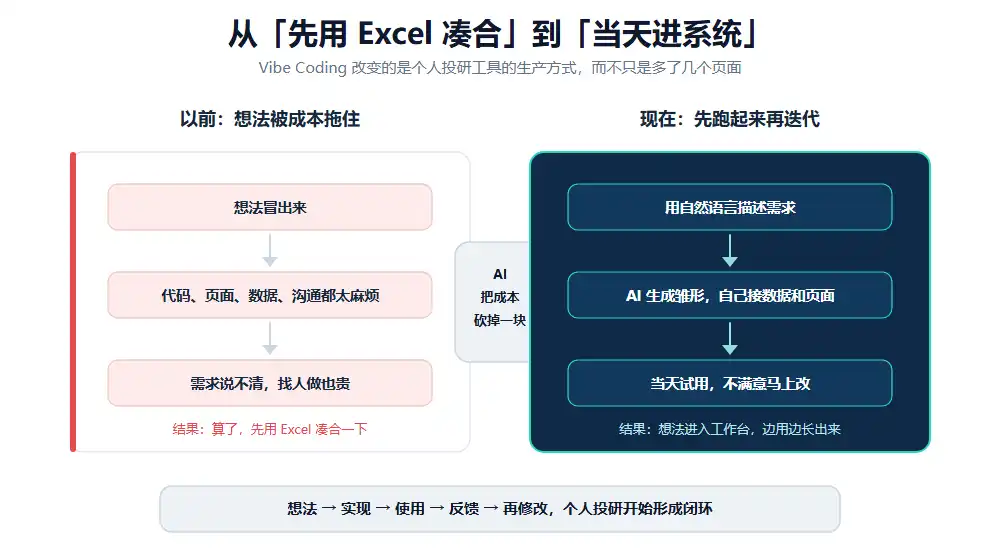
But after tinkering with Vibe Coding for these two weeks, I found this is truly different.

I started building some rough but practical tools for myself. An idea pops up, and it can be integrated into the system the same day, instead of being scattered across chat records, bookmarks, and my own mind.

Two: Four small tools I crafted in two weeks

I mainly built four things in these two weeks (other miscellaneous small tools don't count).

First, Cross-Market Asset Dashboard

The reason was very simple. My assets are scattered across several places: Hong Kong and US stocks in brokerage apps, Crypto on trading platforms, A-shares in another software.

Every day, wanting to see my overall situation meant opening each one, switching back and forth. After checking everything, I still couldn't piece together the full picture. So the first thing I did was stuff all my holdings into one page:

Top section shows total assets, daily P&L. Below, divided by market—one section for US stocks, one for Crypto, one each for HK and A-shares. At a glance, the state of my entire portfolio, who's up and who's down today, is crystal clear.
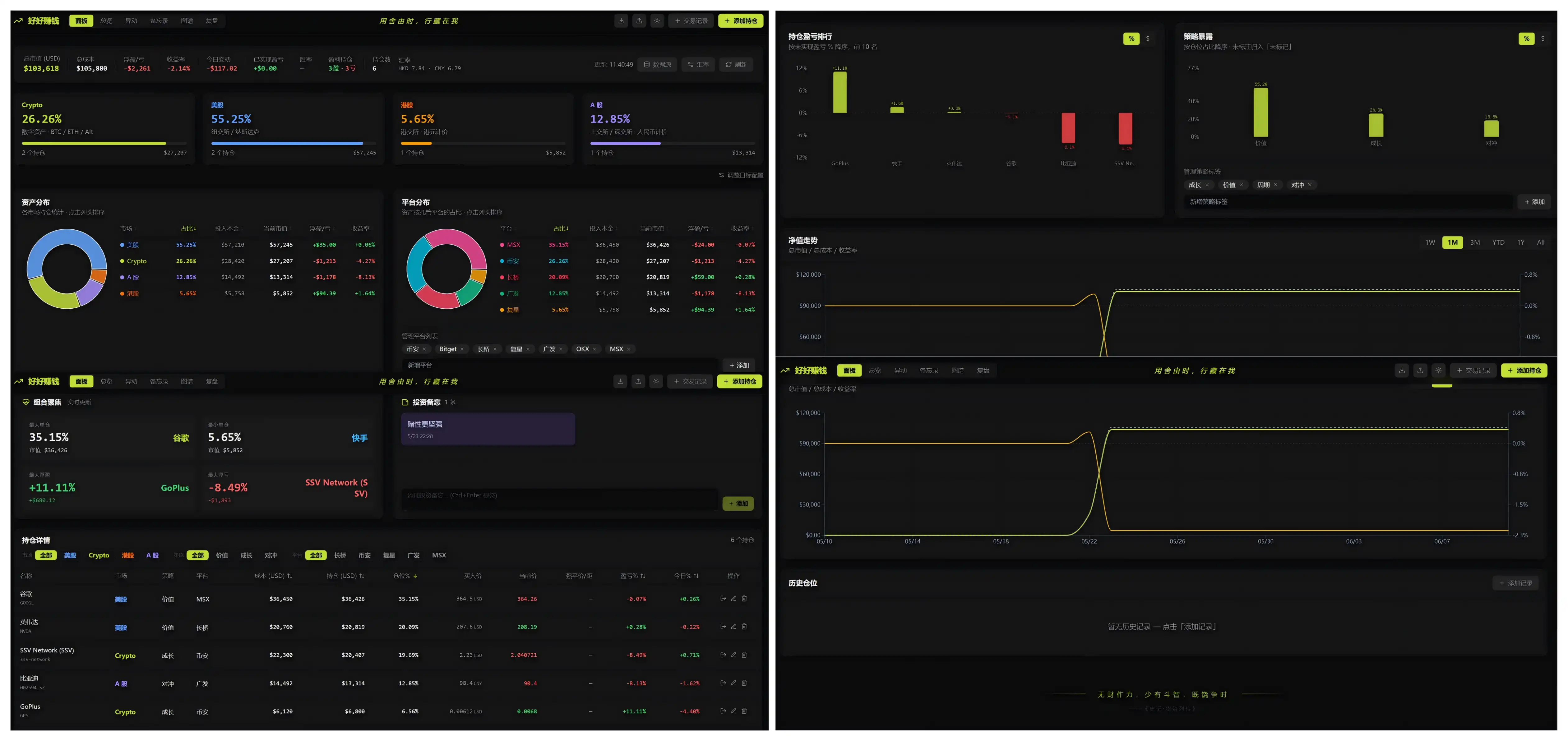
After finishing it, I found it quite useful, and couldn't help but keep adding Tab after Tab, because new needs kept emerging as I used it:

  • Anomaly Monitor: I pre-set the assets I care about and thresholds. If anyone suddenly surges or crashes, it highlights it for me, saving me from constantly watching the market.
  • Investment Map: When researching a sector, draw the upstream, downstream, beneficiaries, risk points, and related assets into a network, making it easier to trace capital flow chains and relationships.
  • Memo + Review: Jot down why I was bullish initially, what happened later, where my judgment was right or wrong, so I can look back later.
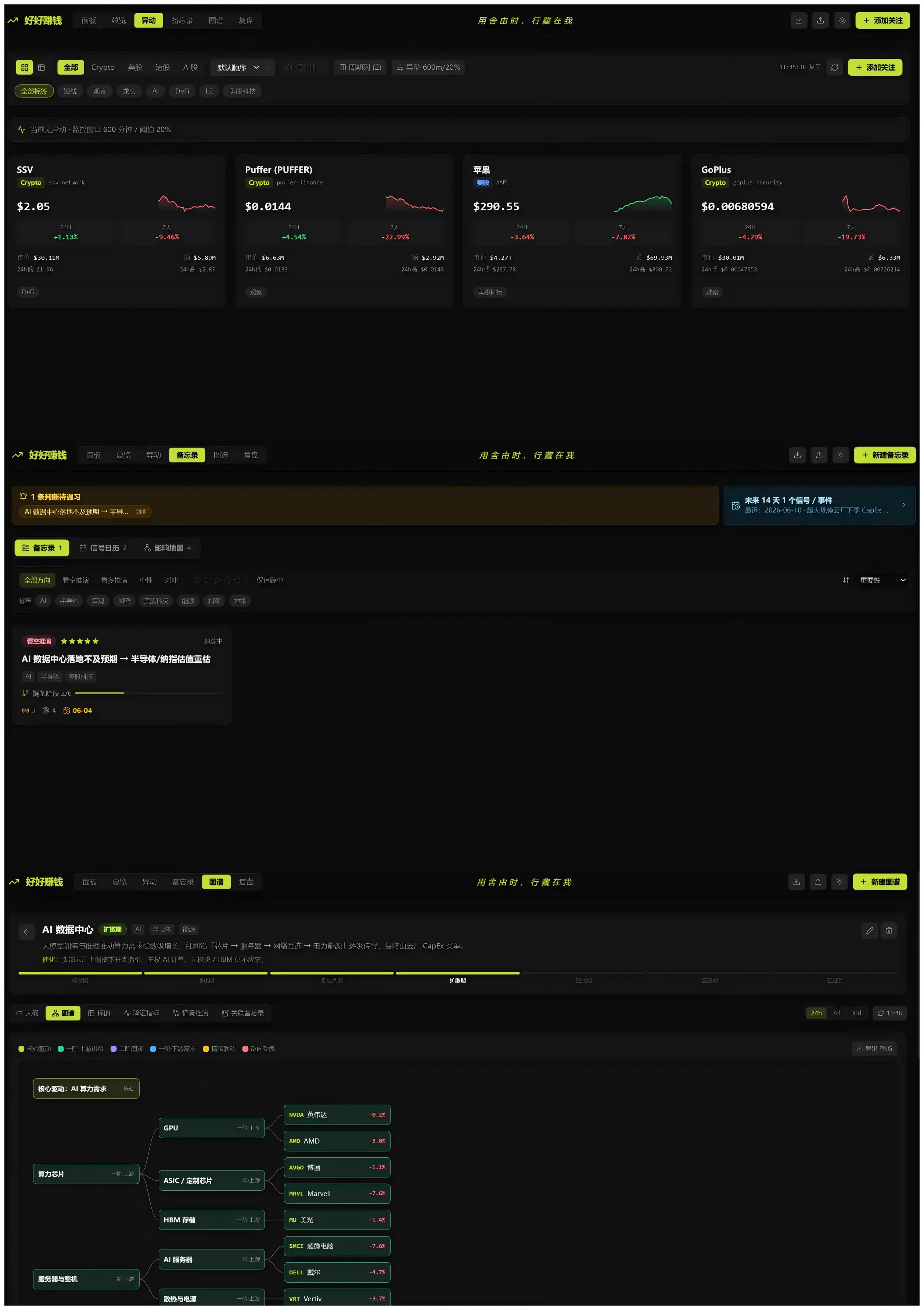
Since this dashboard contains all my real holdings, it's quite private, so I deployed it locally.

Second: PM Bet Monitor

This one is specifically for watching prediction markets.

To explain briefly, prediction markets (like PM) are where people use real money to bet on whether a future event will happen. The price itself represents the market's perceived probability—for example, a "yes" for "SpaceX market cap reaches $2 trillion by end of June" priced at 0.8 means the market thinks there's an 80% chance of it happening.

For the bets I care about, like "Will OpenAI/Anthropic's valuation go up by year-end?" "Will a certain market cap overtake event among the Magnificent Seven happen?", "Will xx and xx meet?", I used to have to check each one individually. Now I've centralized them into a single dashboard. I also compare probability changes alongside news events and secondary market fluctuations. Who moves first, who influences whom, becomes clear at a glance.
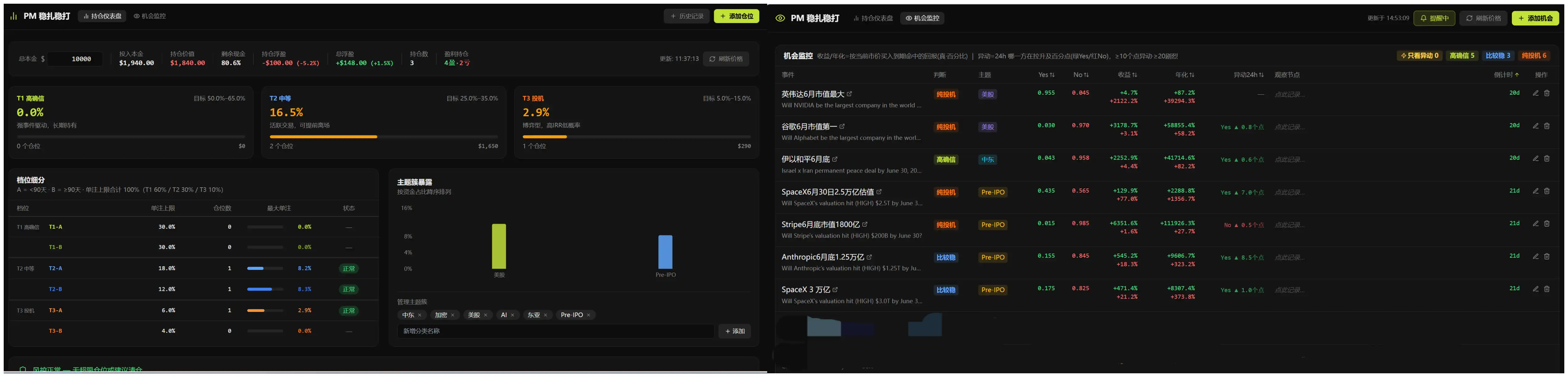
I also tiered these bets according to my own criteria (internally called T1 (high conviction) / T2 (relatively stable) / T3 (pure speculation)), sorted by expected return, so I can instantly distinguish which are just noise.

Honestly, a small edge I have in this market is Chinese information and East Asian political-economic dynamics—many are dominated by Western players, and pricing for this area is often half a step behind. Opportunities hide in this time gap.

Third: Small Operations Backend

This one isn't related to investment; it's for my own writing.

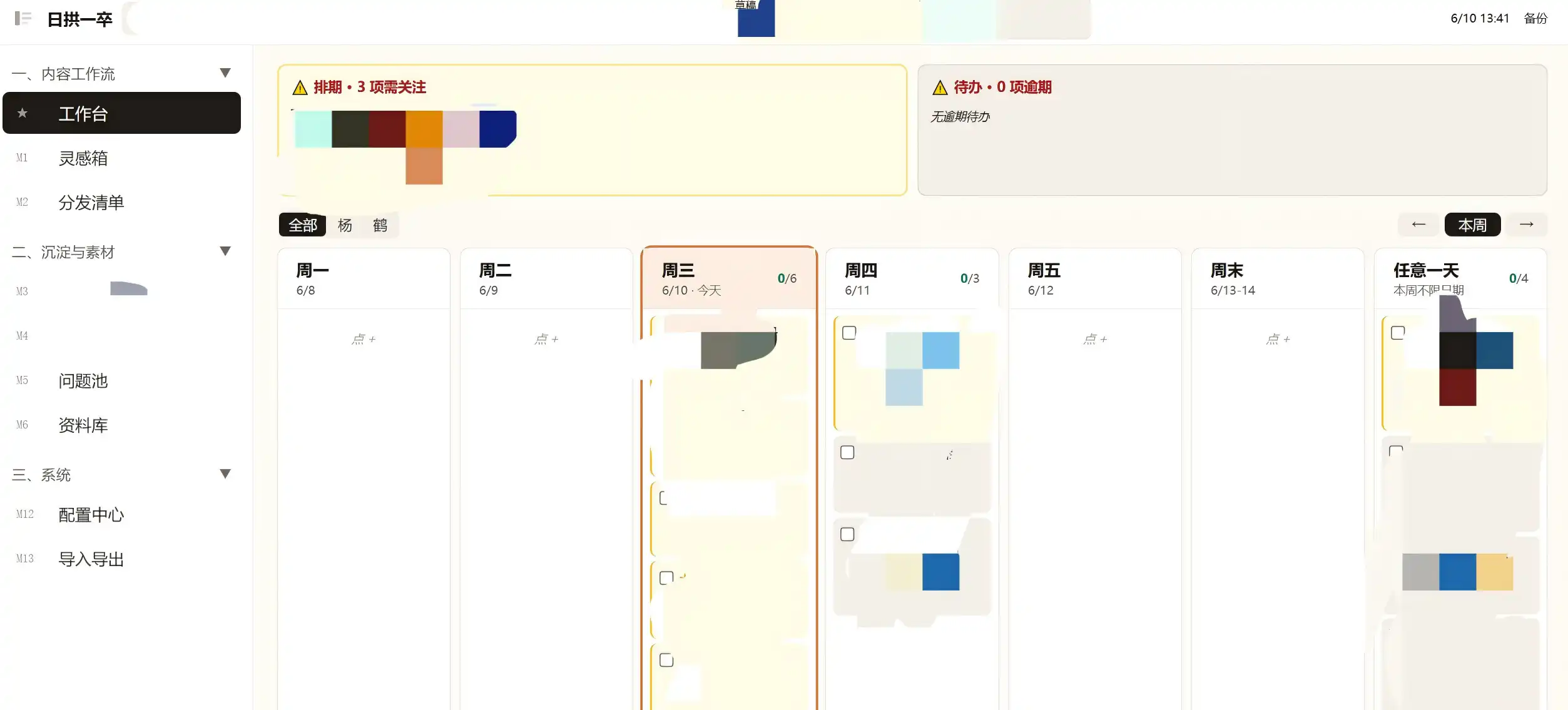
I usually manage topics, write articles, and publish on several platforms. Progress was all in my head or by digging through chat records, often messy. So I made a small backend to manage it, including a topic list, article progress, publishing platforms, and an inspiration box.

Since I might need to use this when I'm out, I didn't make it local, but deployed it to the cloud—using GitHub + Vercel. I can open it on my phone to view and edit, quite convenient.
Fourth: One-Click Formatting Tool

This was mainly to solve a personal minor need. After writing an article, I need to publish it on many platforms, especially for Web3 media. Each platform has different formatting rules, and manually adjusting each time is very time-consuming.

So I created a small tool. Paired with a browser Tampermonkey script I fine-tuned through coding, I throw in an original Markdown or Word document, and it automatically converts it into the corresponding format for each platform and directly inserts images. It's not particularly advanced, but it saves me some mechanical work every day.

To be honest, these four things are still very basic, even a bit ugly, and can't be considered mature products. But for me, they are already very useful because once an idea appears, I can immediately integrate it into the system, rather than letting it scatter and be forgotten.

This is the most important change I feel.

Three: Ordinary People's Investment Research Approach Has Really Changed

Because of this, I increasingly feel that ordinary people doing investment don't necessarily need to start with complex models, but should at least have a few of their own basic systems.

Because the change AI brings to ordinary people isn't suddenly turning you into a guru, but enabling you to first create a prototype for many things you "wanted to do but couldn't" before.

Especially for someone like me who watches the market daily, the feeling is particularly obvious. As long as you have an idea, every ordinary investor can gradually accumulate a few of their own basic systems:

  • Asset Observation System: What assets are you actually watching? Which market do they belong to? What recent changes have occurred?
  • Signal Monitoring System: Which events, once they happen, might indicate a change in market expectations?
  • Map Organization System: A sector isn't a point, but a network. Who's upstream, who's downstream, who benefits from sentiment, who from performance, who from capital flows. Especially over the past year-plus, AI sector stocks have almost rewarded those who could thoroughly understand a sector (from HPC to optical modules to the memory chain).
  • Review System: Why were you bullish initially? What happened later? What was right, what was wrong?
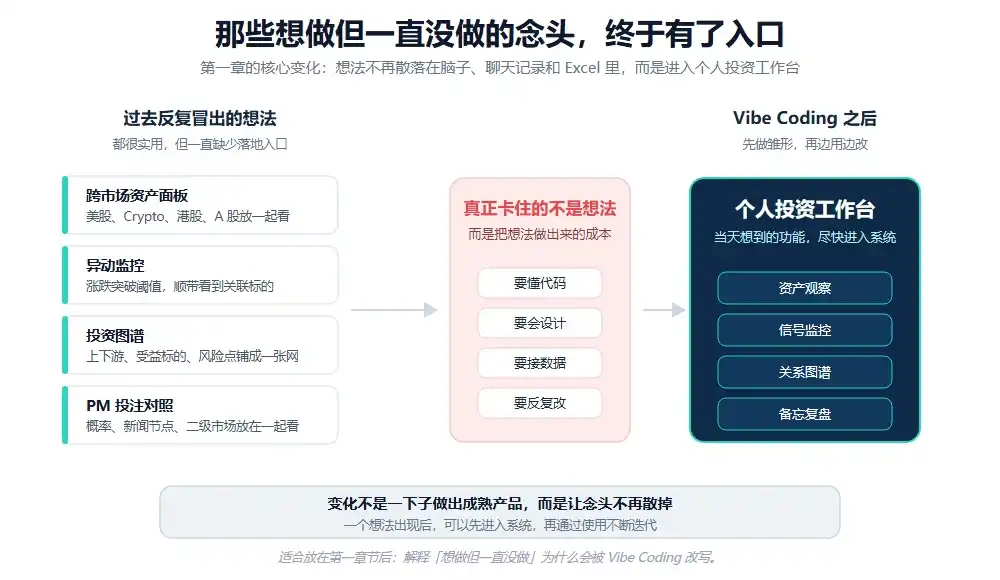
These things weren't impossible to do before, but they were too troublesome, hard to sustain. The biggest meaning of AI is that it cuts away a huge chunk of this "trouble."

You may not know how to code, but you can describe requirements, and slowly accumulate your own product design. And you don't have to finish it all at once; release the first version, and modify it while using it.

This is also the most attractive part of Vibe Coding for me: the feedback is so fast. In the past, the gap between an idea popping up and landing could be very long, so long you forgot why you wanted to do it in the first place.

Now, if I think of a feature today, I can try it the same day. If I'm not satisfied after trying, I modify it immediately. After using it for two days, new needs emerge, and I iterate further.

This closed loop of "idea—implementation—use—feedback—modify again," once it starts spinning, really makes you unable to stop.

In Conclusion

Consider this as the first record for the new phase of "太乐 Tyler."

Moving forward, I'll try to update regularly, recording my investment thoughts, tool tests, on-chain operations and arbitrage research, as well as some educational/introductory Web3 operations and investment knowledge points.

Welcome to follow, and feel free to communicate anytime.

相關問答

QWhat is Vibe Coding and how does the author use it?

AVibe Coding is using natural language to command AI to write code and build products. The author primarily uses Codex and the Claude Code client, switching to the CLI with DeepSeek API when limits are reached, to create personal tools based on their ideas.

QWhat are the four main tools the author built using Vibe Coding?

AThe author built: 1) A cross-market asset dashboard for viewing holdings across stocks and crypto. 2) A prediction market (PM) betting monitor. 3) A personal operations backend for managing writing tasks. 4) A one-click typesetting tool for formatting articles for different platforms.

QWhat advantage does the author claim to have in prediction markets?

AThe author claims a small advantage lies in having better access to Chinese information and East Asian political-economic dynamics. They state that pricing on these events in Western-dominated markets is often slow, creating opportunities in that time lag.

QAccording to the author, how has AI changed research and tool-building for ordinary investors?

AAI hasn't made ordinary investors experts overnight, but it allows them to create initial versions of tools they previously 'wanted to build but couldn't'. It significantly reduces the hassle, enabling a fast 'idea-implementation-use-feedback-modification' loop to build personal systems for observation, monitoring, and analysis.

QWhat systems does the author suggest ordinary investors should gradually build for themselves?

AThe author suggests building several personal foundational systems: an Asset Observation System, a Signal Monitoring System, a Map/Network Organization System for understanding industry sectors, and a Review/Post-mortem System to track reasoning and outcomes.

你可能也喜歡

Solana 隐私生态全景图,从计算到 AI 的完整隐私栈

Solana隐私生态仍处于早期阶段,但正在快速发展。其独特架构(如ZK压缩)有望实现无需持久Rollup的大规模可组合隐私协议。理想的“最终隐私栈”可能是全同态加密(FHE)与零知识证明(ZK)的结合。 目前隐私计算主要由Arcium和MagicBlock提供。Arcium利用多方计算(MPC)构建可定制的执行环境,处理加密数据并正在开发保密代币标准(C-SPL),应用场景包括私密支付、数据分析及医疗保健。MagicBlock则基于可信执行环境(TEE)创建私密临时Rollup,确保交易的机密性、可扩展性和可组合性。两者基础设施催生了诸多应用。 私密转账与余额方面,Umbra基于Arcium构建,提供加密代币账户,实现金额、余额和关联关系的隐私,并支持选择性审计。Privacy Cash采用类似Tornado的屏蔽池处理SOL,Hush则整合了质押收益和私密兑换功能。 为消除链上痕迹,encifherio通过包装代币和TEE保护兑换隐私;Vanish Trade利用屏蔽流动性路由隐藏交易策略;Darklake构建ZK原生流动性基础设施和暗池,防止前端运行。 更高级的应用如私密预测市场(如Melee Markets)利用Arcium加密订单簿,保护参与者策略。在私密AI领域,Loyal结合Magic Block和Arcium技术,在链上加密存储和处理用户数据、对话及交易,确保用户拥有数据控制权。 总体而言,Solana隐私生态正从基础计算层向复杂应用层构建,覆盖支付、DeFi、预测市场及AI等多个垂直领域。

Foresight News23 分鐘前

Solana 隐私生态全景图,从计算到 AI 的完整隐私栈

Foresight News23 分鐘前

交易

現貨
合約

熱門文章

什麼是 GROK AI

Grok AI: 在 Web3 時代革命性改變對話技術 介紹 在快速演變的人工智能領域,Grok AI 作為一個值得注意的項目脫穎而出,橋接了先進技術與用戶互動的領域。Grok AI 由 xAI 開發,該公司由著名企業家 Elon Musk 領導,旨在重新定義我們與人工智能的互動方式。隨著 Web3 運動的持續蓬勃發展,Grok AI 旨在利用對話 AI 的力量回答複雜的查詢,為用戶提供不僅具資訊性而且具娛樂性的體驗。 Grok AI 是什麼? Grok AI 是一個複雜的對話 AI 聊天機器人,旨在與用戶進行動態互動。與許多傳統 AI 系統不同,Grok AI 接納更廣泛的查詢,包括那些通常被視為不恰當或超出標準回應的問題。該項目的核心目標包括: 可靠推理:Grok AI 強調常識推理,根據上下文理解提供邏輯答案。 可擴展監督:整合工具協助確保用戶互動既受到監控又優化質量。 正式驗證:安全性至關重要;Grok AI 採用正式驗證方法來增強其輸出的可靠性。 長上下文理解:該 AI 模型在保留和回憶大量對話歷史方面表現出色,促進有意義且具上下文意識的討論。 對抗魯棒性:通過專注於改善其對操控或惡意輸入的防禦,Grok AI 旨在維護用戶互動的完整性。 總之,Grok AI 不僅僅是一個信息檢索設備;它是一個沉浸式的對話夥伴,鼓勵動態對話。 Grok AI 的創建者 Grok AI 的腦力來源無疑是 Elon Musk,這個名字與各個領域的創新息息相關,包括汽車、太空旅行和技術。在專注於以有益方式推進 AI 技術的 xAI 旗下,Musk 的願景旨在重塑對 AI 互動的理解。其領導力和基礎理念深受 Musk 推動技術邊界的承諾影響。 Grok AI 的投資者 雖然有關支持 Grok AI 的投資者的具體細節仍然有限,但公開承認 xAI 作為該項目的孵化器,主要由 Elon Musk 本人創立和支持。Musk 之前的企業和持股為 Grok AI 提供了強有力的支持,進一步增強了其可信度和增長潛力。然而,目前有關支持 Grok AI 的其他投資基金或組織的信息尚不易獲得,這標誌著未來潛在探索的領域。 Grok AI 如何運作? Grok AI 的運作機制與其概念框架一樣創新。該項目整合了幾種尖端技術,以促進其獨特的功能: 強大的基礎設施:Grok AI 使用 Kubernetes 進行容器編排,Rust 提供性能和安全性,JAX 用於高性能數值計算。這三者確保了聊天機器人的高效運行、有效擴展和及時服務用戶。 實時知識訪問:Grok AI 的一個顯著特點是其通過 X 平台(以前稱為 Twitter)訪問實時數據的能力。這一能力使 AI 能夠獲取最新信息,從而提供及時的答案和建議,而其他 AI 模型可能會錯過這些信息。 兩種互動模式:Grok AI 為用戶提供“趣味模式”和“常規模式”之間的選擇。趣味模式允許更具玩樂性和幽默感的互動風格,而常規模式則專注於提供精確和準確的回應。這種多樣性確保了根據不同用戶偏好量身定制的體驗。 總之,Grok AI 將性能與互動相結合,創造出既豐富又娛樂的體驗。 Grok AI 的時間線 Grok AI 的旅程標誌著反映其發展和部署階段的關鍵里程碑: 初始開發:Grok AI 的基礎階段持續了約兩個月,在此期間進行了模型的初步訓練和微調。 Grok-2 Beta 發布:在一個重要的進展中,Grok-2 beta 被宣布。這一版本推出了兩個版本的聊天機器人——Grok-2 和 Grok-2 mini,均具備聊天、編碼和推理的能力。 公眾訪問:在其 beta 開發之後,Grok AI 向 X 平台用戶開放。那些通過手機號碼驗證並活躍至少七天的帳戶可以訪問有限版本,使這項技術能夠接觸到更廣泛的受眾。 這一時間線概括了 Grok AI 從創建到公眾參與的系統性增長,強調其對持續改進和用戶互動的承諾。 Grok AI 的主要特點 Grok AI 包含幾個關鍵特點,促成其創新身份: 實時知識整合:訪問當前和相關信息使 Grok AI 與許多靜態模型區別開來,從而提供引人入勝和準確的用戶體驗。 多樣化的互動風格:通過提供不同的互動模式,Grok AI 滿足各種用戶偏好,邀請創造力和個性化的對話。 先進的技術基礎:利用 Kubernetes、Rust 和 JAX 為該項目提供了堅實的框架,以確保可靠性和最佳性能。 倫理話語考量:包含圖像生成功能展示了該項目的創新精神。然而,它也引發了有關版權和尊重可識別人物描繪的倫理考量——這是 AI 社區內持續討論的議題。 結論 作為對話 AI 領域的先驅,Grok AI 概括了數字時代轉變用戶體驗的潛力。由 xAI 開發,並受到 Elon Musk 願景的驅動,Grok AI 將實時知識與先進的互動能力相結合。它努力推動人工智能能夠達成的界限,同時保持對倫理考量和用戶安全的關注。 Grok AI 不僅體現了技術的進步,還體現了 Web3 環境中新對話範式的出現,承諾以靈活的知識和玩樂的互動吸引用戶。隨著該項目的持續演變,它成為技術、創造力和類人互動交匯處所能實現的見證。

762 人學過發佈於 2024.12.26更新於 2024.12.26

什麼是 GROK AI

什麼是 ERC AI

Euruka Tech:$erc ai 及其在 Web3 中的雄心概述 介紹 在快速發展的區塊鏈技術和去中心化應用的環境中,新項目頻繁出現,每個項目都有其獨特的目標和方法論。其中一個項目是 Euruka Tech,該項目在加密貨幣和 Web3 的廣闊領域中運作。Euruka Tech 的主要焦點,特別是其代幣 $erc ai,是提供旨在利用去中心化技術日益增長的能力的創新解決方案。本文旨在提供 Euruka Tech 的全面概述,探索其目標、功能、創建者的身份、潛在投資者以及它在更廣泛的 Web3 背景中的重要性。 Euruka Tech, $erc ai 是什麼? Euruka Tech 被描述為一個利用 Web3 環境提供的工具和功能的項目,專注於在其運作中整合人工智能。雖然有關該項目框架的具體細節仍然有些模糊,但它旨在增強用戶參與度並自動化加密空間中的流程。該項目的目標是創建一個去中心化的生態系統,不僅促進交易,還通過人工智能整合預測功能,因此其代幣被命名為 $erc ai。其目的是提供一個直觀的平台,促進更智能的互動和高效的交易處理,並在不斷增長的 Web3 領域中發揮作用。 Euruka Tech, $erc ai 的創建者是誰? 目前,關於 Euruka Tech 背後的創建者或創始團隊的信息仍然不明確且有些模糊。這一數據的缺失引發了擔憂,因為了解團隊背景通常對於在區塊鏈行業建立信譽至關重要。因此,我們將這些信息歸類為 未知,直到具體細節在公共領域中公開。 Euruka Tech, $erc ai 的投資者是誰? 同樣,關於 Euruka Tech 項目的投資者或支持組織的識別在現有研究中並未明確提供。對於考慮參與 Euruka Tech 的潛在利益相關者或用戶來說,來自知名投資公司的財務合作或支持所帶來的保證是至關重要的。沒有關於投資關係的披露,很難對該項目的財務安全性或持久性得出全面的結論。根據所找到的信息,本節也處於 未知 的狀態。 Euruka Tech, $erc ai 如何運作? 儘管缺乏有關 Euruka Tech 的詳細技術規範,但考慮其創新雄心是至關重要的。該項目旨在利用人工智能的計算能力來自動化和增強加密貨幣環境中的用戶體驗。通過將 AI 與區塊鏈技術相結合,Euruka Tech 旨在提供自動交易、風險評估和個性化用戶界面等功能。 Euruka Tech 的創新本質在於其目標是創造用戶與去中心化網絡所提供的廣泛可能性之間的無縫連接。通過利用機器學習算法和 AI,它旨在減少首次用戶的挑戰,並簡化 Web3 框架內的交易體驗。AI 與區塊鏈之間的這種共生關係突顯了 $erc ai 代幣的重要性,成為傳統用戶界面與去中心化技術的先進能力之間的橋樑。 Euruka Tech, $erc ai 的時間線 不幸的是,由於目前有關 Euruka Tech 的信息有限,我們無法提供該項目旅程中主要發展或里程碑的詳細時間線。這條時間線通常對於描繪項目的演變和理解其增長軌跡至關重要,但目前尚不可用。隨著有關顯著事件、合作夥伴關係或功能添加的信息變得明顯,更新將無疑增強 Euruka Tech 在加密領域的可見性。 關於其他 “Eureka” 項目的澄清 值得注意的是,多個項目和公司與 “Eureka” 共享類似的名稱。研究已經識別出一些倡議,例如 NVIDIA Research 的 AI 代理,專注於使用生成方法教導機器人複雜任務,以及 Eureka Labs 和 Eureka AI,分別改善教育和客戶服務分析中的用戶體驗。然而,這些項目與 Euruka Tech 是不同的,不應與其目標或功能混淆。 結論 Euruka Tech 及其 $erc ai 代幣在 Web3 領域中代表了一個有前途但目前仍不明朗的參與者。儘管有關其創建者和投資者的細節仍未披露,但將人工智能與區塊鏈技術相結合的核心雄心仍然是關注的焦點。該項目在通過先進自動化促進用戶參與方面的獨特方法,可能會使其在 Web3 生態系統中脫穎而出。 隨著加密市場的持續演變,利益相關者應密切關注有關 Euruka Tech 的進展,因為文檔創新、合作夥伴關係或明確路線圖的發展可能在未來帶來重大機會。當前,我們期待更多實質性見解的出現,以揭示 Euruka Tech 的潛力及其在競爭激烈的加密市場中的地位。

665 人學過發佈於 2025.01.02更新於 2025.01.02

什麼是 ERC AI

什麼是 DUOLINGO AI

DUOLINGO AI:將語言學習與Web3及AI創新結合 在科技重塑教育的時代,人工智能(AI)和區塊鏈網絡的整合預示著語言學習的新前沿。進入DUOLINGO AI及其相關的加密貨幣$DUOLINGO AI。這個項目旨在將領先語言學習平台的教育優勢與去中心化的Web3技術的好處相結合。本文深入探討DUOLINGO AI的關鍵方面,探索其目標、技術框架、歷史發展和未來潛力,同時保持原始教育資源與這一獨立加密貨幣倡議之間的清晰區分。 DUOLINGO AI概述 DUOLINGO AI的核心目標是建立一個去中心化的環境,讓學習者可以通過實現語言能力的教育里程碑來獲得加密獎勵。通過應用智能合約,該項目旨在自動化技能驗證過程和代幣分配,遵循強調透明度和用戶擁有權的Web3原則。該模型與傳統的語言習得方法有所不同,重點依賴社區驅動的治理結構,讓代幣持有者能夠建議課程內容和獎勵分配的改進。 DUOLINGO AI的一些顯著目標包括: 遊戲化學習:該項目整合區塊鏈成就和非同質化代幣(NFT)來表示語言能力水平,通過引人入勝的數字獎勵來激發學習動機。 去中心化內容創建:它為教育者和語言愛好者提供了貢獻課程的途徑,促進了一個有利於所有貢獻者的收益共享模型。 AI驅動的個性化:通過採用先進的機器學習模型,DUOLINGO AI個性化課程以適應個別學習進度,類似於已建立平台中的自適應功能。 項目創建者與治理 截至2025年4月,$DUOLINGO AI背後的團隊仍然是化名的,這在去中心化的加密貨幣領域中是一種常見做法。這種匿名性旨在促進集體增長和利益相關者的參與,而不是專注於個別開發者。部署在Solana區塊鏈上的智能合約註明了開發者的錢包地址,這表明對於交易的透明度的承諾,儘管創建者的身份未知。 根據其路線圖,DUOLINGO AI旨在演變為去中心化自治組織(DAO)。這種治理結構允許代幣持有者對關鍵問題進行投票,例如功能實施和財庫分配。這一模型與各種去中心化應用中社區賦權的精神相一致,強調集體決策的重要性。 投資者與戰略夥伴關係 目前,沒有與$DUOLINGO AI相關的公開可識別的機構投資者或風險投資家。相反,該項目的流動性主要來自去中心化交易所(DEX),這與傳統教育科技公司的資金策略形成鮮明對比。這種草根模型表明了一種社區驅動的方法,反映了該項目對去中心化的承諾。 在其白皮書中,DUOLINGO AI提到與未具名的「區塊鏈教育平台」建立合作,以豐富其課程提供。雖然具體的合作夥伴尚未披露,但這些合作努力暗示了一種將區塊鏈創新與教育倡議相結合的策略,擴大了對多樣化學習途徑的訪問和用戶參與。 技術架構 AI整合 DUOLINGO AI整合了兩個主要的AI驅動組件,以增強其教育產品: 自適應學習引擎:這個複雜的引擎從用戶互動中學習,類似於主要教育平台的專有模型。它動態調整課程難度,以應對特定學習者的挑戰,通過針對性的練習加強薄弱環節。 對話代理:通過使用基於GPT-4的聊天機器人,DUOLINGO AI為用戶提供了一個參與模擬對話的平台,促進更互動和實用的語言學習體驗。 區塊鏈基礎設施 建立在Solana區塊鏈上的$DUOLINGO AI利用了一個全面的技術框架,包括: 技能驗證智能合約:此功能自動向成功通過能力測試的用戶頒發代幣,加強了對真實學習成果的激勵結構。 NFT徽章:這些數字代幣標誌著學習者達成的各種里程碑,例如完成課程的一部分或掌握特定技能,允許他們以數字方式交易或展示自己的成就。 DAO治理:持有代幣的社區成員可以通過對關鍵提案進行投票來參與治理,促進一種鼓勵課程提供和平台功能創新的參與文化。 歷史時間線 2022–2023:概念化 DUOLINGO AI的基礎工作始於白皮書的創建,強調了語言學習中的AI進步與區塊鏈技術去中心化潛力之間的協同作用。 2024:Beta發佈 限量的Beta版本推出了流行語言的課程,作為項目社區參與策略的一部分,獎勵早期用戶以代幣激勵。 2025:DAO過渡 在4月,進行了完整的主網發佈,並開始流通代幣,促使社區討論可能擴展到亞洲語言和其他課程開發的問題。 挑戰與未來方向 技術障礙 儘管有雄心勃勃的目標,DUOLINGO AI面臨著重大挑戰。可擴展性仍然是一個持續的擔憂,特別是在平衡與AI處理相關的成本和維持響應靈敏的去中心化網絡方面。此外,在去中心化的提供中確保內容創建和審核的質量,對於維持教育標準來說也帶來了複雜性。 戰略機會 展望未來,DUOLINGO AI有潛力利用與學術機構的微證書合作,提供區塊鏈驗證的語言技能認證。此外,跨鏈擴展可能使該項目能夠接觸到更廣泛的用戶基礎和其他區塊鏈生態系統,增強其互操作性和覆蓋範圍。 結論 DUOLINGO AI代表了人工智能和區塊鏈技術的創新融合,為傳統語言學習系統提供了一種以社區為中心的替代方案。儘管其化名開發和新興經濟模型帶來某些風險,但該項目對遊戲化學習、個性化教育和去中心化治理的承諾為Web3領域的教育技術指明了前進的道路。隨著AI的持續進步和區塊鏈生態系統的演變,像DUOLINGO AI這樣的倡議可能會重新定義用戶與語言教育的互動方式,賦能社區並通過創新的學習機制獎勵參與。

683 人學過發佈於 2025.04.11更新於 2025.04.11

什麼是 DUOLINGO AI

相關討論

歡迎來到 HTX 社群。在這裡,您可以了解最新的平台發展動態並獲得專業的市場意見。 以下是用戶對 AI (AI)幣價的意見。

活动图片