Author:Zuo Ye
Looking back 500 years, the labor-capital contradiction within the capitalist system has always been marked by the continuous victory of capital.
On the production side, labor's participation has gradually shrunk to the level of operating machines; on the consumption side, user value lies in producing usage data for platforms.
The two forces combine to support corporate valuations in the capital markets.
But human organizational models have long resisted complete quantification. White-collar KPIs/OKRs are still variations of the hierarchical system; whether it's an annual salary of a million or piece-rate wages, they are all variants of Taylorism.
Without a clear formula, capital cannot value it, thereby affecting capital efficiency. Whether algorithmic stablecoins are the holy grail of DeFi remains unknown, but the computability of organizations is indeed the measuring cup for financial leverage.
Large models decided to use Token volume for brute-force cracking. The collapse of security SaaS is just the surface phenomenon; design products are also on the way.The key is to replace niche professional capabilities and scale them up, driving innovation into uncharted territory.
This brings us endless inspiration, especially at a time when DeFi's DAO model is gradually collapsing and token economics is failing.
In a nutshell, why are AI's organizational and Token models more efficient than DeFi's?
How did this all start?
"Token cheapening, Agent practicalization.
For 300% profit, capitalists would sell the rope to hang themselves;
To keep their current jobs, workers will write Skills for Agents.
At the capital level, Agents empowered by Skills hold a status as sacred as profit itself.
Agents represent the refinement of "human capabilities" into Skills. Moreover, human organization becomes an interactive ritual chain centered around Agents.
So-called Prompt, Context, and now Harness engineering are all about turning human organizational models into no-man's-land, or at least reducing human involvement.
Your next colleague isn't a robot; it could be an "ability" instinct.
This is not a fantasy. The Scaling Law at the data level is gradually failing, but data collection and production are no longer important. Before AGI succeeds, new valuation targets are needed.
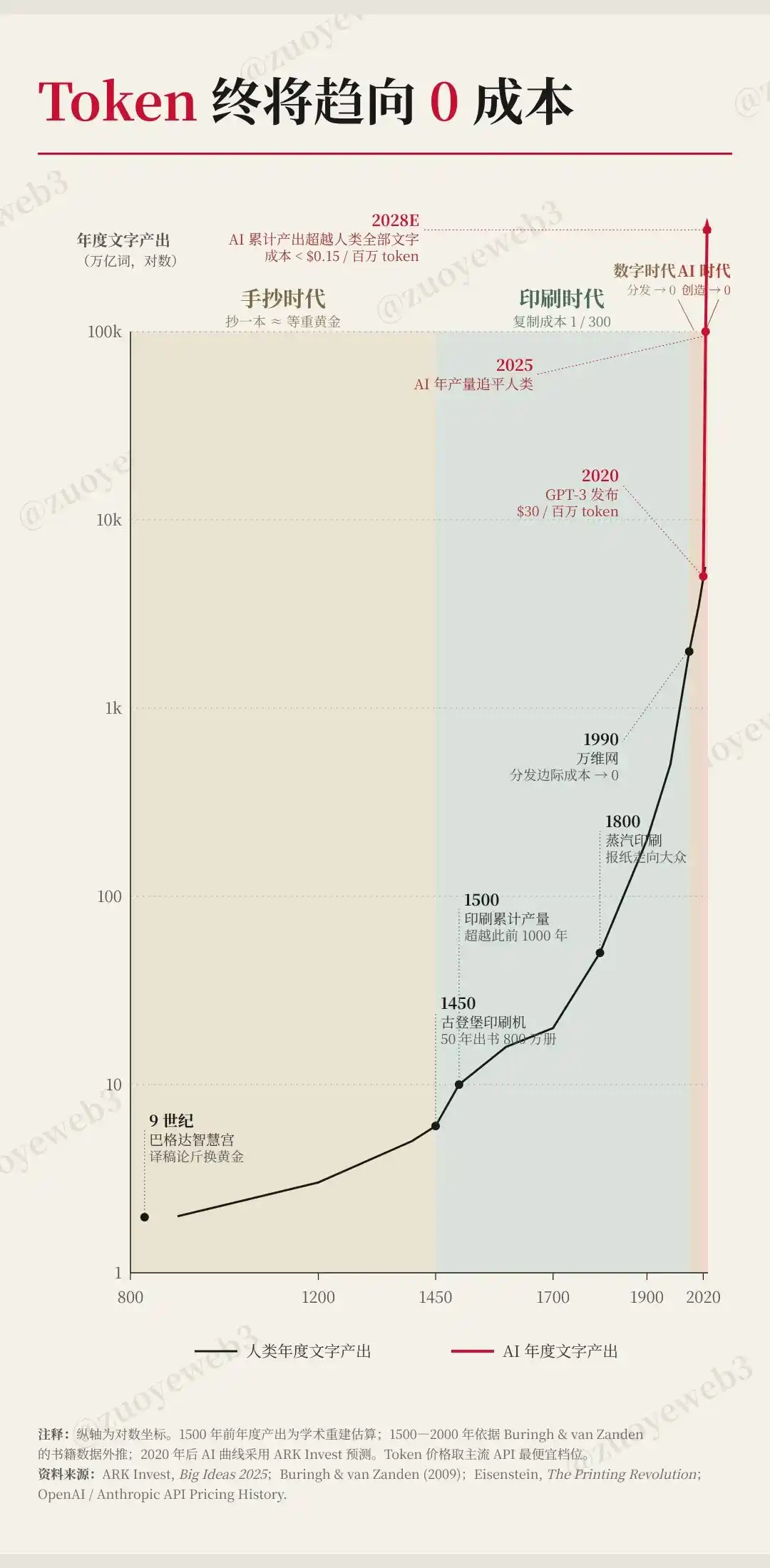
Caption: Content is no longer valuable
Composite Information:@ARKInvest
Starting with Claude's choice of the programming field to achieve the first step towards AGI, AI has moved beyond the entertainment mode of chatboxes to切入 (cut into) existing markets like programming, security, and the recently launched design.
Will this disruptive innovation ultimately create new economic growth, or pull the economy into a permanent low-employment model where Tokens get jobs and people get laid off? We are witnessing this process.
But the current cheapening of Tokens is decentralizing capabilities once monopolized by a few large corporations down to small and micro-enterprises, thereby creating super individuals. This is not a fantasy.
Taking China as an example, Token call volume went from 100 billion/day in 2024 --> 100 trillion/day by end of 2025 --> now 140 trillion/day. The production of content and data is about to enter a zero-cost era.
It's important to note that computing power shortage is a relative state. Large companies no longer monopolize "capabilities," but still try to maintain their existing advantages by monopolizing "computing power." However, they cannot stop the inevitable trend of overall Token cheapening.
There are various paradigms for evaluating base large models, but the evolutionary process of "how AI helps people" has long been overlooked.
In my view, Harness is a spatial form that allows Agents to focus on tasks within boundaries for the first time, adopting a depth-first strategy, distinct from the breadth-first approach of Q&A types.
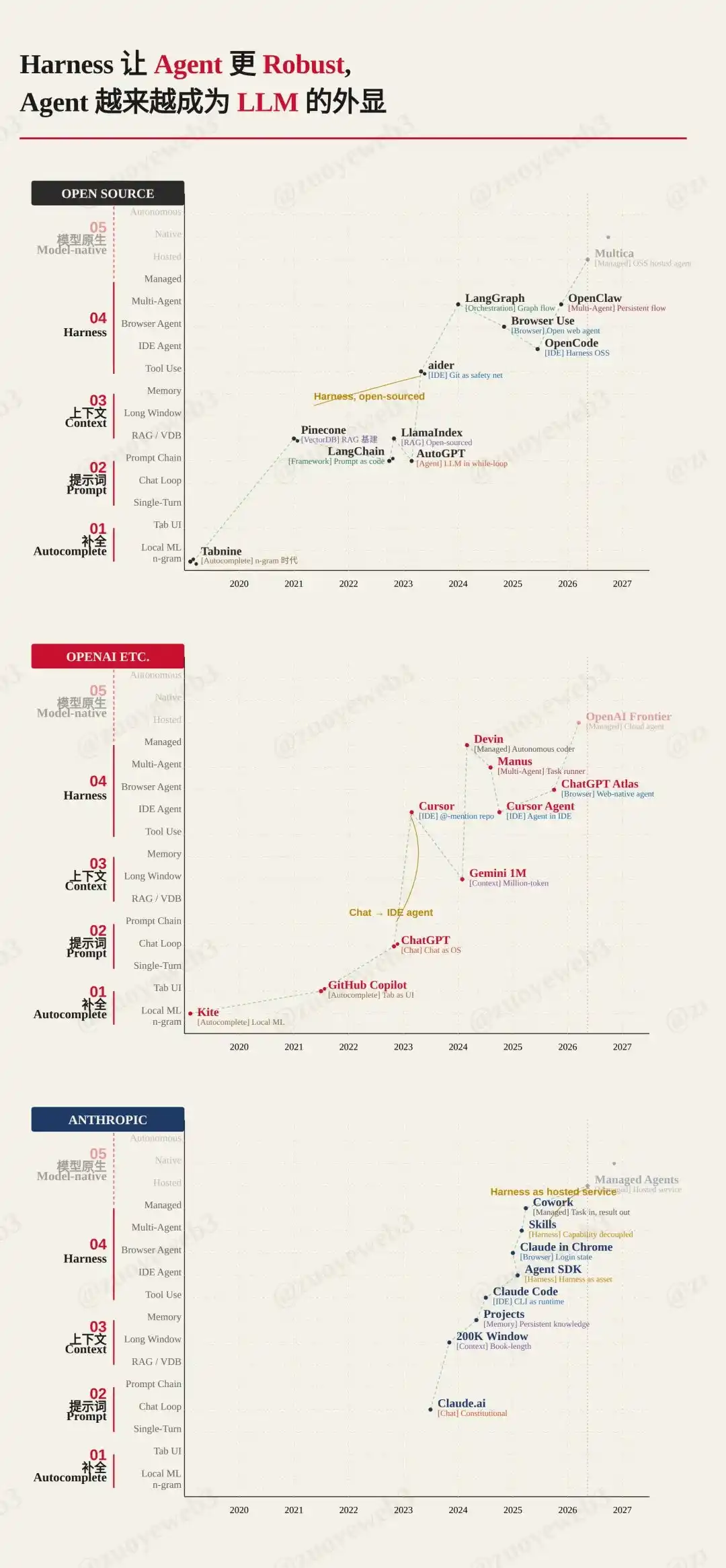
Caption: Agent Evolution History
Image Source:@zuoyeweb3
From the moment the Tab key was first used for code completion, it was only a matter of time before humans became the input layer for AI.
The cost of trial and error decreases exponentially, allowing for more interesting experiments in human collaboration models:
- Software: SaaS, where the source of human capability is no longer human, but Agent emergence
- Hardware: Compute cards + HBM, where data centers directly serve AI needs for the first time
- Space: Harness, not a physical space for human collaboration, but a digital space for Agent interaction
- Interaction: Doubao phone阵亡 (fell in battle), Google supports GUI Agent at the Android system底层 (bottom layer)
AI's ability to "say what" holds little commercial value; the cost of generating text is low even for humans. But "doing what" will cause Token consumption to surpass image and video generation, similar to how AWS sells not servers but usage time.
AI sells not Tokens, but "working capability." This is the root of the SaaS industry's fear. Unfortunately, DeFi has become SaaS, not a large model.
The SaaS-ification of DeFi Protocols
"DeFi is not outdated, but overly precocious.
AI is reinventing software engineering. It's not just SaaS being replaced, but SaaS is undoubtedly the most typical example.
Even the Bloomberg Terminal's most important commercial value lies not in its technological advancement, but in the authority of its information, an authority built on decades of industry connections, network links, and other non-standard data.
Agents offer an alternative: infer the future from data. Even a risky next step might outperform peers and yield small profits.
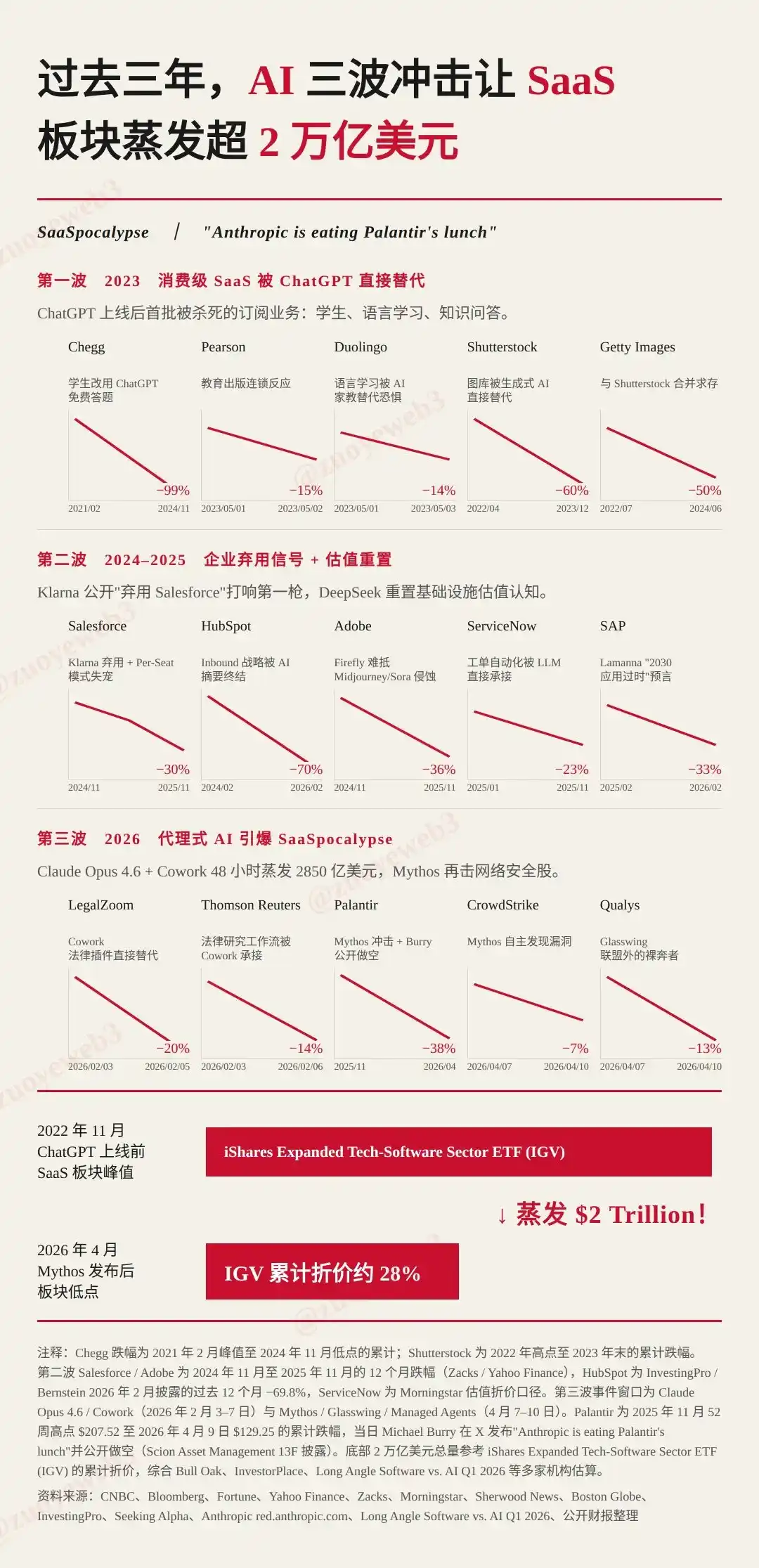
Caption: SaaS Crumbling
Image Source:@zuoyeweb3
You could say Agents cleverly exploit capital's profit-seeking nature. Sure, you can wait for complete Bloomberg Terminal information, or you can use patchy, inaccurate data to gamble for returns.
This is not new. Thomas Peterffy, founder of IBKR, was the first to "invent," or rather assemble, physical trading terminals in finance, which originated from an idle P101.
If a certain way of using data can generate more profit, then you get more data. The flywheel starts.
SaaS monopolizes the past, AI sells the future.
Unfortunately, we must approach DeFi from this angle. Remember Dune/DeFiLlama's API paywall? Sitting on a gold mine of data begging for food? Or the eventual shutdown of Arkham Exchange.
Data in the crypto industry has never been valuable.
But the crypto industry is also a direct open financial system. The data it generates can be learned from repeatedly. Even before AI, the speed of forking projects was reduced to months; PumpFun's Meme copycats can be compressed to seconds.
There is a counterintuitive inference: DeFi is the beta test server for the financial system. The AI+DeFi we are experimenting with today will become the template for future financial evolution.
-
For example, before the 2008 financial crisis, unsecured LIBOR transactions "triggered" the financial tsunami, later replaced by the SOFR indicator generated from Treasury trades. However, the over-collateralization mechanism ensures the finality of DeFi liquidations.
-
For example, large model manufacturers don't want to sell Tokens based on consumption volume; they must engage in tiered marketing, capability customization, and professional modification for them. Token economics has twisted "use value" into a pretzel.
Crypto Token is obsessed with use value, AI Token is obsessed with economic value.
From this perspective, DeFi hacks are just routine stress tests; open systems cannot internally repair the external entropy of bugs.
Similar to the black humor of Catch-22: without external signal system stimulation, crypto assumes the current environment is safe. Once a security crisis occurs, it collapses to a centralized processing system.
For example, in the Drift incident, the target of blame surprisingly became Circle for its slow freezing.
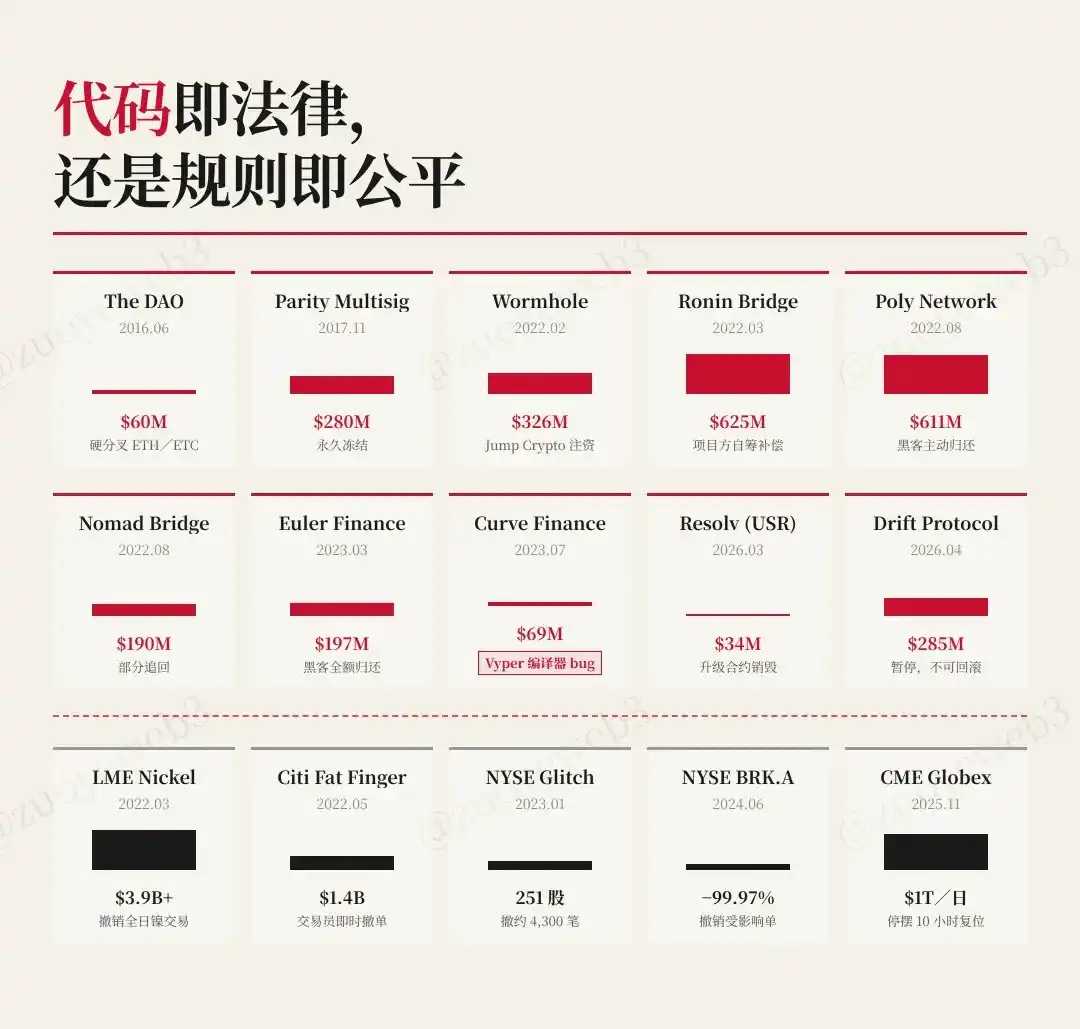
Caption: Code cannot solve security problems
Image Source:@zuoyeweb3
It can be said that before AI's capability leap, DeFi had already completed its SaaS-ification, only able to charge based on the number of transactions, unable to directly migrate "finance" on-chain.
RWA on-chain lacks liquidity, and DeFi has no good solution for this.
But the evolution of Agent capabilities seems to offer a glimmer of unclear dawn for rewriting the rules of DeFi.
-
Token Economics: Distribute usage volume through channels,投放 (allocate) based on "capital efficiency";
-
Rule Setting: Mythos provides security finality, AI defends against zero-day crises;
-
Human Organization: Great! DeFi has long been a few people managing hundreds of billions.
The Revival of the Engineering Narrative
"Where does security come from? The determinism of the Turing machine. Where does danger come from? Infinite possibility.
YC Garry Tan's "Fat Skill, Thin Harness" resonates deeply. It's essentially setting the basic rules well, a kind of "freedom based on order."
Turing machines can combine infinitely; the von Neumann architecture always has a time gap between storage and computation; large models cannot generate true random numbers either.
In a future where data is worthless, only human behavior can give value to the flow of money.
But human behavior still needs time to be thoroughly learned by AI and internalized into an engineered, codified expression.
Using the finite to pursue the infinite is ultimately futile. LLMs cannot completely eliminate hallucinations. They must approach the point of "this is beyond AI, and beyond human capability" before the market mechanism can price it, and we can truly trust smart contracts.
Current smart contracts can hardly be called successful. The DAO fork, Curve programming language bug, even Drift multisig, all prove that "humans have ultimate control over code."
Moral interrogation has no economic value. The reason the collaboration model in DeFi has collapsed from DAOs to foundations and "teams"归根到底 (boils down to) the practical needs for contract upgrades and business cooperation.
But humans simply cannot write code that is forever secure and dynamically upgradeable. Remember, it is永远不可能 (forever impossible).
If you never upgrade, then Curve's experience tells us that the technology dependency stack can also cause problems.
The present determines the past, the past determines the future.
From the Simons Medallion Fund to Numerai running AI strategies, AI is not uncommon in finance. Another counterintuitive case: trading signals反而 (instead) help AI evolve.
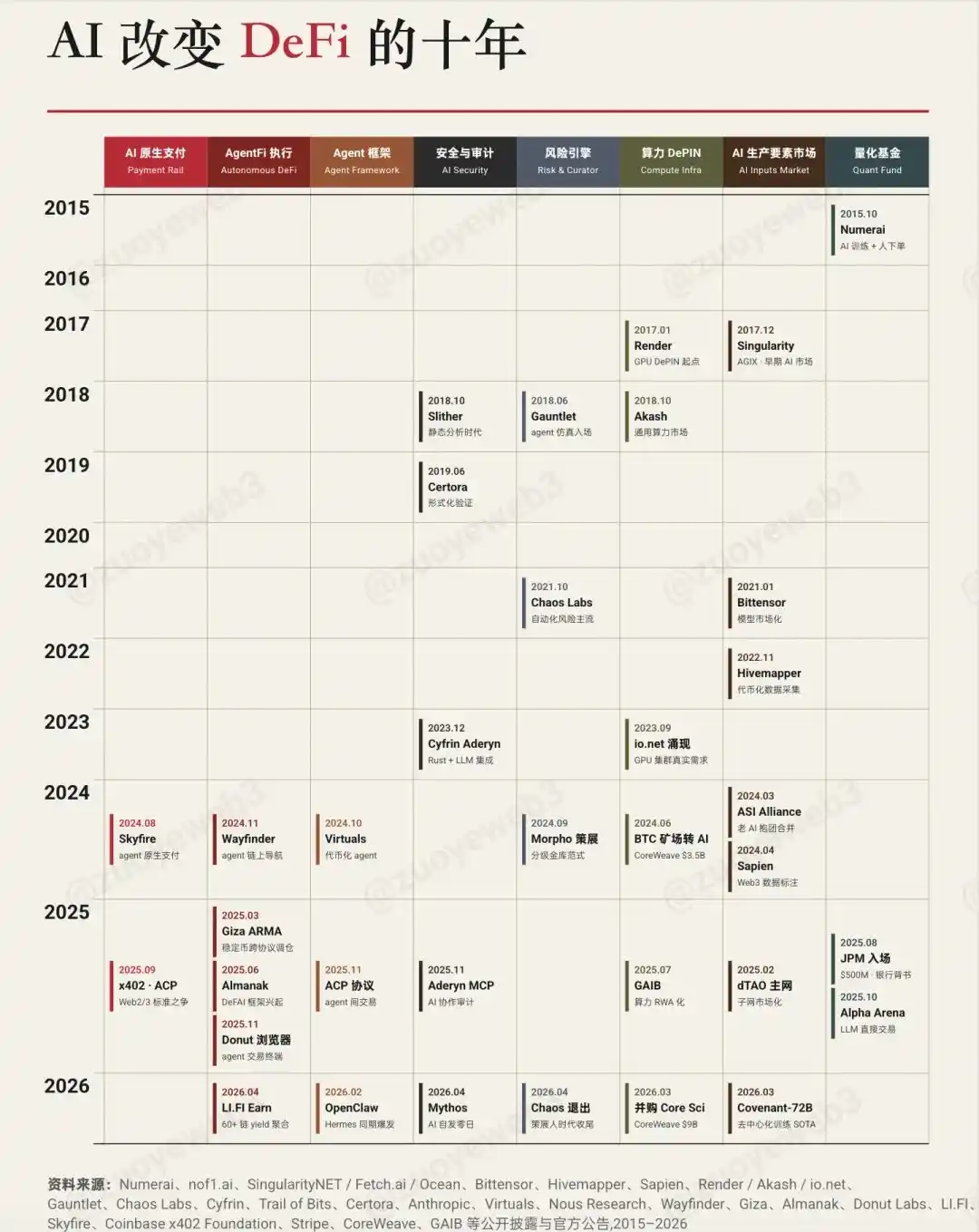
Caption: AI and DeFi 10 Years
Image Source:@zuoyeweb3
AI models are still computer paradigms, state machines that吞吐 (ingest/process) signals. Without external signals, they lack the ability to simulate the external world internally. The significance of Yang Lequn and Li Fei-Fei's bets on world models lies herein.
But from DeFi's perspective, for AI to trade autonomously, the prerequisite is that human intent is learned by Agents through behavior. This is also the importance of humans to AI; even if Agents replace manpower, they are imitating and summarizing human behavior.
Even humans cannot intentionally be random; tiny intentions have statistical patterns.甚至 (Even) human physiological特性 (characteristics) have randomness. For example, "I just physiologically prefer Ethena's market-making strategy and dislike XX's arbitrage strategy" carries a vague preference.
It is very certain that making blockchain/DeFi the infrastructure for AI has suffered a lamentable failure over the past decade. deAI/deAgent/deOpenclaw will all encounter similar situations.
Directly using the latest large models to改造 (transform) various structures of DeFi, for example, contracts tested by Mythos are secure by default, and any changes are detected in real-time, increasing the danger level.
In terms of human organization, AI's choice is "no people," only human "capabilities." DeFi is the most suitable industry for this, perhaps even without exception. After rules are designed, DeFi only improves capital efficiency under the premise of security. Referencing the L1/2/3/4分级 (grading) of autonomous driving, it will inevitably go through the process of information authorization --> limited fund usage rights --> comprehensive fund usage rights.
If Agents continuously learn the engineered capabilities of traders and Curator management skills, they will必然 (inevitably) surpass humans in trading and收益 (yield/profit)领域 (fields). But unfortunately, the accumulated DeFi data has not yet been systematically learned and trained by AI systems. The current coin circle AI is still in the money-grabbing stage.
But I am very confident that the actual use of funds is the next major wave of AI's transformation of DeFi,不可避免 (inevitable).
So, after security (contracts) and organization (humans) are upgraded, what form will token economics take?
-
PoW era Token was a proof of computational power consumption,基本一致 (basically consistent) with current AI Tokens;
-
PoS era Token is adiscounted凭证 (voucher) for expected returns, AI Token is evolving in this direction (providing capabilities that replace people is the AI expression of this economic value);
-
The Crypto Token of the AI era has already surpassed our engineering scope and can only be predicted irresponsibly based on theory.
Referencing Sky using token allocation to control APY across channels, Claude using Token consumption volume to price model capabilities, future Crypto Tokens will likely be a凭证 (voucher) for "capital return rate".
Note the distinction here: PoS era Tokens, likeETH etc., their expected return is an economic assumption, an empirical inference based on prior experience. But with AI's engineering design, DeFi's various parameters will infinitely approach reality; their return and risk rates are highly credible and verified in real-time.
甚至 (Even), users could determine the current price of a Token based on the large models and Agents used by the DeFi protocol, and its Harness optimization metric scores: buy if optimistic, sell if pessimistic.
Conclusion
"Countless unspeakable troubles and the unpredictable future of humanity.
DeFi's future is divided into economic and technical aspects. Token economics暂时 (temporarily) has no good solution, but there is a glimmer of hope for security. Claude Mythos can threaten the world; thinking反过来 (in reverse), it can manage money.
Scenarios like AlphaGo彻底解决 (completely solving) Go, Claude彻底解决 (completely solving) programming, will only become more common in the future. DeFi's contracts, human organization, even the unit of economic valuation, all have theoretical space for optimization.
At least, people need not worry about being completely replaced. In an era where data is worthless, behavior has its own meaning. At least for now, Agent's takeover of humans is still in "micro-tasks," "micro-payments," and other details—constant, repetitive details. We must make this repetitive, replicating behavior generate value. AI drives the value of data and content infinitely down, approaching zero cost, while the unit economic value (cost) of both AI Token and Crypto Token is constantly decreasing. This is the general direction.
甚至可以说 (It can even be said), this is the first time money has truly opened its doors to individuals, whether for AI work or Crypto consumption.