You've Been Training Google's AI for Free for 15 Years, Completely Unaware

marsbit发布于2026-03-18更新于2026-03-18

文章摘要

For 15 years, Google has leveraged reCAPTCHA to harness free human labor to train its AI, unbeknownst to users. Initially created to digitize books by having users transcribe distorted text, the system evolved under Google's ownership. With reCAPTCHA v2, users were tasked with identifying objects like traffic lights and crosswalks in images from Google Street View. This provided massive, free training data for Google's computer vision models, directly benefiting products like Google Maps and the autonomous vehicle company Waymo, valued at $45 billion. At its peak, 200 million reCAPTCHAs were solved daily, amounting to 500,000 hours of free human labor—worth an estimated $5 million per day at minimum wage. This data-labeling operation, embedded as a mandatory gateway to essential websites, was unparalleled in scale and cost-efficiency. The latest version, reCAPTCHA v3, invisibly analyzes user behavior to verify humanity, further feeding AI systems. The profound irony is that users spent years proving they were human by performing tasks AI couldn't do, thereby training the very systems that now make their contributions obsolete. Google never asked for consent, paid for this labor, or disclosed its purpose, turning the entire internet-using population into unwitting, unpaid trainers for its commercial AI empire.

Every day, about 500,000 hours of human labor are utilized for free by Google. And the people contributing this labor are simply trying to log into their online banking.

reCAPTCHA is the most successful covert data operation in internet history. At its peak, 200 million people completed the verification daily. But almost no one realized what each click truly meant.

Google's self-driving car company, Waymo, now has a market valuation of $45 billion. A significant portion of its core training data was provided for free by you while accessing various websites.

Here is the full story:

The Origin: A Clever Concept

In 2000, spam bots were destroying the internet. Forums were flooded, inboxes were clogged, and websites desperately needed a way to distinguish humans from machines.

Professor Luis von Ahn from Carnegie Mellon University solved this problem. He invented the CAPTCHA: a distorted text that only humans could read, which bots couldn't pass.

But von Ahn saw more. Millions of people were expending effort on these challenges. What if this effort could do two things at once?

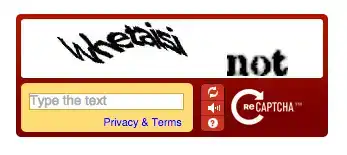
In 2007, he launched reCAPTCHA. Its brilliance lay in this: it no longer showed random gibberish, but two words. One was known to the system, the other was a real scanned word from books that computers couldn't yet recognize. Your response helped digitize these books.

These books came from The New York Times archives and Google Books, numbering up to 130 million volumes.

You thought you were just logging into a regular website, but you were actually doing OCR (Optical Character Recognition) for the world's largest digital library.

In 2009, Google officially acquired reCAPTCHA.
Later, Google Changed the Game

The era of "distorted text" ended around 2012.

Google faced a new challenge: its Street View cars had photographed every road globally, but the photos were just raw data. For AI to be useful, it needed to understand what it saw: road signs, crosswalks, traffic lights, storefronts.

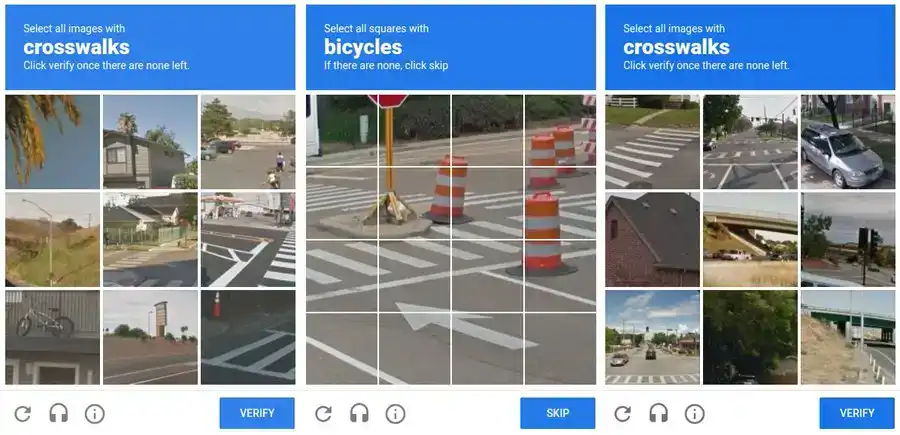
So Google redesigned reCAPTCHA v2. Instead of distorted text, there were grids of photos. "Click all squares with traffic lights." "Select every crosswalk." "Identify the storefront."

These images came directly from Google Street View. Your clicks were the labels.

Every selection was telling Google's computer vision model: this cluster of pixels is a traffic light, that shape is a crosswalk. You weren't passing a test; you were building a dataset.
A Scale Beyond Imagination

At its peak, 200 million reCAPTCHAs were solved daily. Each challenge took about 10 seconds, meaning 2 billion seconds of human labor were generated every day. That's: 500,000 hours per day.

Paid data annotation costs roughly $10 to $50 per hour. Using the lowest estimate: the value of labor extracted for free daily was a staggering $5 million.

And reCAPTCHA isn't just on one app. It's embedded in every bank, every government portal, every e-commerce site. You had no choice: want to log into your account? Label this dataset first. Google never asked for your consent, never paid a cent in wages, and never even told you about it.
What Did All This Create?

This data fed directly into two products:

- Google Maps: The world's most used navigation tool. Its ability to recognize road signs, stores, and urban geography is partly thanks to billions of human annotations made while logging into websites.

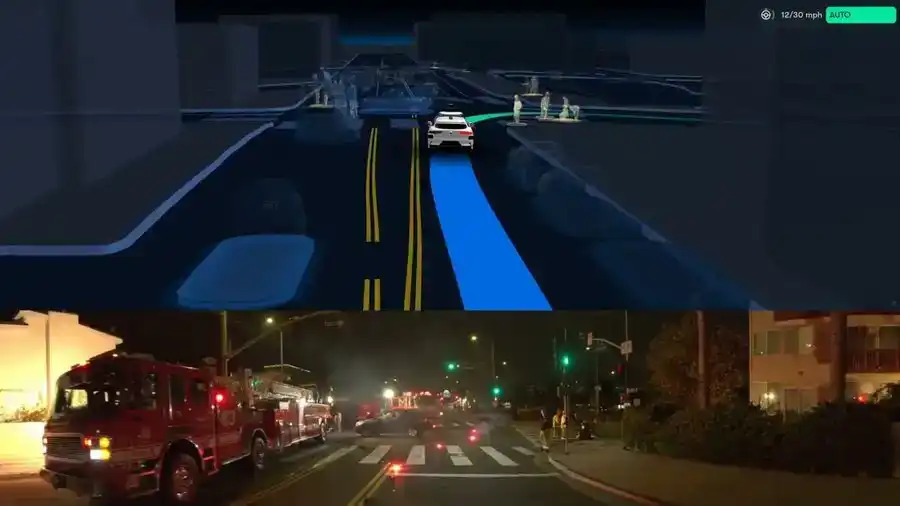
- Waymo: Google's self-driving project. To navigate, autonomous vehicles need near-perfect recognition of thousands of visual patterns.

The ground truth training data for that recognition work was precisely what millions of people labeled unknowingly through reCAPTCHA. Waymo completed over 4 million paid rides in 2024 and is valued at $45 billion. Its foundation was laid by "unpaid internet citizens" who just wanted to check their email.

Why Can't Anyone Replicate This Model?

Data annotation is extremely expensive. Companies like Scale AI, Appen, and Labelbox exist to solve this problem, employing hundreds of thousands of workers, sometimes for less than $1 per hour.

Google's solution was different: they made annotation mandatory. No payment, no consent required; it's the "ticket" to enter every corner of the internet. The result: billions of labeled images, global coverage, all-weather conditions, every city in the world. No annotation company could achieve this. The internet itself is the factory, and every netizen is an unsigned contract worker.
You Are Still Participating Today

reCAPTCHA v3, launched in 2018, doesn't even show a challenge. It observes how you move your mouse, your scrolling speed, your dwell time. Your behavioral fingerprint tells it if you're human. This behavioral data also feeds back into Google's AI systems.

You never actively opted in; there was never a checkbox for you to tick. But right now, on most websites you visit, you are still doing it.

The Disturbing Irony

Luis von Ahn's original intention was genius: to turn wasted human effort into useful output. But what Google did with this vision is another matter. They leveraged a security mechanism users had to use, deployed it across the entire web, and harvested the output to build commercial products worth hundreds of billions of dollars. The users gained nothing, and knew nothing.

The deepest irony is this: You spent years proving you were human by doing visual recognition work that AI couldn't yet do. And once AI learned it, human visual annotation was no longer needed.

You proved you were human, only to make yourself replaceable.

热门币种推荐

相关问答

QWhat was the original purpose of CAPTCHA and who invented it?

AThe original purpose of CAPTCHA was to distinguish humans from spam bots that were flooding forums and inboxes. It was invented by Professor Luis von Ahn from Carnegie Mellon University in 2000.

QHow did reCAPTCHA system, acquired by Google in 2009, utilize human effort beyond just verification?

AThe reCAPTCHA system displayed two words: one the system already knew and another from a real book that computers couldn't recognize. By solving these, users were unknowingly helping to digitize books from sources like The New York Times archive and Google Books, performing free Optical Character Recognition (OCR) labor.

QWhat major shift occurred with the introduction of reCAPTCHA v2 and what new type of data did it collect?

AreCAPTCHA v2 replaced distorted text with image grids from Google Street View. It asked users to identify objects like traffic lights, crosswalks, and storefronts. Each click labeled these images, providing massive amounts of training data for Google's computer vision models.

QAccording to the article, what is the estimated daily value of the free human labor extracted through reCAPTCHA at its peak?

AAt its peak, with 200 million reCAPTCHAs solved daily, taking 10 seconds each, it amounted to 500,000 hours of human labor per day. Valued at a minimum of $10 per hour for data labeling, this free labor was worth an estimated $5 million daily.

QWhich two major Google products directly benefited from the data collected via reCAPTCHA, as stated in the article?

AThe two major Google products that directly benefited from the reCAPTCHA data are Google Maps, which improved its ability to recognize signs, shops, and geography, and Waymo, Google's self-driving car project, which used the labeled visual data as foundational training for its autonomous vehicles.

你可能也喜欢

CPU杀回牌桌,一场1700亿美元的“上位”大戏开启

英伟达在2026年台北电脑展上首次发布独立CPU产品线Vera CPU,标志着其业务重心从GPU向更广阔的计算领域扩展。CEO黄仁勋指出,在AI智能体时代,CPU已成为数据中心性能的关键瓶颈。与此同时,AMD将服务器CPU市场规模预测大幅上调至1200亿美元以上,行业预测其潜在市场规模将在2030年达到约1700亿美元。 市场格局正在发生变化。2026年一季度,AMD在服务器CPU收入份额上逼近英特尔,显示出高核数产品的强大溢价能力。分析指出,AI发展正从训练转向推理和智能体阶段,后者需要频繁进行复杂控制流、工具调用和数据处理,这些任务严重依赖CPU而非GPU。在智能体任务中,GPU利用率可能低于50%,而CPU工作量占比可达七成以上。这导致CPU与GPU的配比从过去的1:8显著收敛至1:4甚至1:1。 需求变化直接推动了十多年来首次大规模涨价,英特尔和AMD服务器CPU价格普遍上涨10%-15%,且出现产能紧张。市场分化为配合GPU的高核数CPU和用于智能体任务编排的中核数批量CPU两类需求。 英伟达基于ARM架构的Vera CPU入局,进一步凸显了CPU的战略地位。这对中国CPU产业链既是机遇也是挑战。国产CPU厂商如海光信息、华为鲲鹏等,既受益于全球AI需求增长,也面临信创政策带来的国产替代窗口期。行业共识是,AI大规模落地的关键已从单芯片性能转向CPU与GPU的协同能力。

marsbit7小时前

CPU杀回牌桌,一场1700亿美元的“上位”大戏开启

marsbit7小时前

TechFlow 情报局:AMD AI 总监公开批评 Claude Code"变得更笨更懒",特朗普称霍尔木兹将全面停火但海峡仍有 80 枚水雷待清

**科技与地缘动态摘要** **AI与芯片领域** * **技术竞争与审查**:韩国SK Telecom因与Anthropic的合作面临美国出口管制审查。与此同时,中国Z.AI发布了不依赖英伟达芯片、性能对标Claude Opus的GLM-5.2大模型,引发关于技术围堵效果的讨论。 * **安全与伦理问题**:Google Gemini被曝在诈骗场景中提供误导建议,引发AI安全担忧。GitHub上发现上万个分发木马的仓库,开源供应链安全敲响警钟。 * **行业动态**:亚马逊正洽谈对外出售其自研AI芯片,意图进军市场。苹果据悉将为特殊版iPhone独享台积电最新制程工艺。0G Labs宣布其链上AI推理总量突破重要里程碑。 * **争议与监管**:AMD AI总监公开批评Claude Code性能下降。多名亚马逊工程师因批评公司AI数据中心扩张的环境影响遭内部调查。微软、亚马逊云服务或面临欧盟严厉反垄断审查。 **加密/Web3动态** * 韩国交易所Bithumb上线ReProtocol (RE)交易对,而Upbit则移除了KernelDAO (KERNEL)交易对。 **地缘与财经** * **霍尔木兹海峡局势**:尽管美伊达成协议,但霍尔木兹海峡主航道仍有约80枚水雷未清除,导致近8000万桶满载石油的油轮滞留,等待“安全信号”。伊朗取消了赴瑞士外交行程,和谈前景不明。特朗普称协议是伊朗“无条件投降”,并宣称总统拥有无限权力。 * **美股表现**:美股半导体板块大涨,英特尔因与苹果合作传闻暴涨10.6%,而SpaceX股价下跌3.5%。 **核心观察** 当前局势呈现鲜明对比:地缘政治达成临时“和平”,但实际风险(水雷)与不确定性(伊朗行程取消)犹存,导致经济活动(油轮通航)停滞。与此同时,科技领域的竞争与重构却在加速进行,从芯片自主研发、AI模型突破到供应链安全,科技公司正以另一种方式重塑全球格局。

marsbit7小时前

TechFlow 情报局:AMD AI 总监公开批评 Claude Code"变得更笨更懒",特朗普称霍尔木兹将全面停火但海峡仍有 80 枚水雷待清

marsbit7小时前

交易

现货
合约

热门文章

如何购买S

欢迎来到HTX.com!我们已经让购买Sonic(S)变得简单而便捷。跟随我们的逐步指南,放心开始您的加密货币之旅。第一步:创建您的HTX账户使用您的电子邮件、手机号码注册一个免费账户在HTX上。体验无忧的注册过程并解锁所有平台功能。立即注册第二步:前往买币页面,选择您的支付方式信用卡/借记卡购买:使用您的Visa或Mastercard即时购买Sonic(S)。余额购买:使用您HTX账户余额中的资金进行无缝交易。第三方购买:探索诸如Google Pay或Apple Pay等流行支付方法以增加便利性。C2C购买:在HTX平台上直接与其他用户交易。HTX场外交易台(OTC)购买:为大量交易者提供个性化服务和竞争性汇率。第三步:存储您的Sonic(S)购买完您的Sonic(S)后,将其存储在您的HTX账户钱包中。您也可以通过区块链转账将其发送到其他地方或者用于交易其他加密货币。第四步:交易Sonic(S)在HTX的现货市场轻松交易Sonic(S)。访问您的账户,选择您的交易对,执行您的交易,并实时监控。HTX为初学者和经验丰富的交易者提供了友好的用户体验。

2.6k人学过发布于 2025.01.15更新于 2026.06.02

如何购买S

相关讨论

欢迎来到HTX社区。在这里,您可以了解最新的平台发展动态并获得专业的市场意见。以下是用户对S(S)币价的意见。

活动图片