By: Thejaswini M A
Compiled by: Saoirse, Foresight News
The simplest way to control other people's money is to wait for them to let their guard down and pay less attention. A significant portion of financial institutions' profits is built purely on people's procrastination and inertia.
Years ago, two economists, Richard Thaler and Shlomo Benartzi, concluded that trying to persuade others through argument is futile. Rather than striving to win a debate, it's better to design rules that leverage the inertia of people's inaction to change their choices. Clearly, most people are too lazy to actively check an 'opt-out' box.
If signing up for a retirement savings plan required manually filling out forms, participation rates would be less than half. But once enrollment is set as the default, and opting out requires manual action, participation instantly surpasses 90%. The same logic applies to auto-renewing subscriptions: over half of paying users don't even use the service they're subscribed to. Last week, I subscribed to watch the FIFA World Cup, knowing full well I'd completely forget about the service after the tournament ended.
A key premise of this mechanism is that the fund holder and the person who designs the product allocation must be two different individuals. The employer selects the optional fund pool for the 401(k) pension, and the employee passively enters this allocation system.
On June 18th, Franklin Templeton filed an application to launch two ETFs, embedding this 'default allocation' logic into Bitcoin investment.
Looking at the broader capital landscape, the capital moat these products can create is actually minuscule.
Making the decision to buy Bitcoin itself is a major barrier hindering widespread adoption. Even though Trump's appearance at a Bitcoin industry conference briefly alleviated public concerns, this barrier still objectively exists.
Financial advisors need to actively allocate Bitcoin, explain the decision to clients and compliance departments, and bear all the loss risk if the price halves. Due to professional risk considerations, the vast majority of advisors deliberately avoid it and simply won't recommend Bitcoin to their clients.
Financial advisors build standardized portfolio models, independently select underlying funds, and clients passively hold the allocated assets. When clients review their holdings statements, they only see broad labels like 'US Large Cap Stocks, 40%' and don't delve into what assets are actually held. If the advisor uses this dividend reinvestment version of the fund, clients unknowingly hold Bitcoin.
This product is not designed to trick ordinary retail investors—institutions know retail investors actively check their holdings. This underlying architecture is actually tailor-made for financial advisors.
This is the core playbook of Wall Street. The massive $4 trillion target-date fund industry also grew using this logic: the default allocation itself is the product. As long as users choose inaction, they automatically hold the asset. Investors who manually enter codes to pick their own stocks are not covered by this logic, and Franklin isn't counting on these retail investors. The funds are truly targeting capital managed downstream by other professionals.
Dividend Reinvestment Plans (DRIPs) are the most effortless 'set-and-forget' tool in investing: when a stock pays a dividend, the money doesn't go into your account but automatically buys more of the same stock. You continuously add to what you already hold, with almost no effort required to manage it. That's what DRIP means.
Franklin has reversed this mechanism: its two funds—the Franklin U.S. Equity Bitcoin Dividend Reinvestment Index ETF and the Franklin U.S. Innovative Sectors Bitcoin Dividend Reinvestment Index ETF—will not use dividends to buy more stocks but will directly purchase Bitcoin.
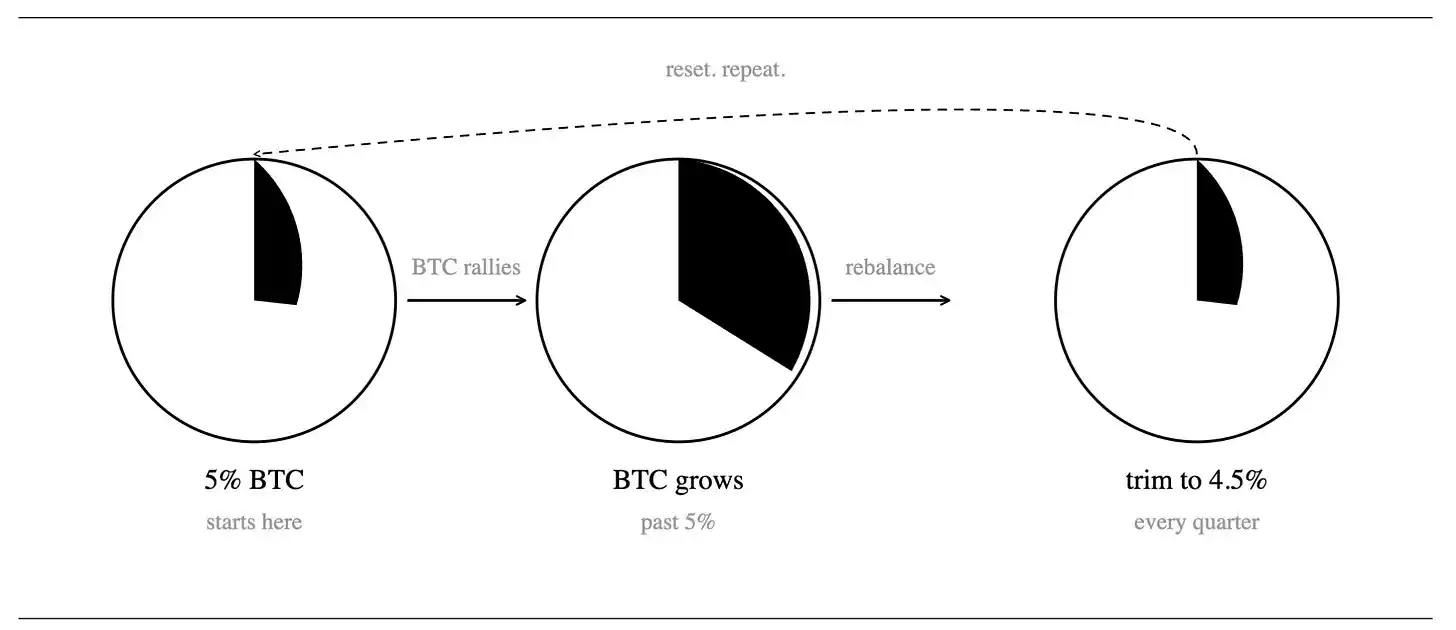
For the Bitcoin allocation, the funds plan to hold spot Bitcoin ETFs, Bitcoin futures, and options. The products feature asymmetric quarterly rebalancing rules: if Bitcoin rises significantly and its weight exceeds the 5% target line, it will be reduced to 4.5% during the next quarterly rebalance. A hard cap is also set, with Bitcoin holdings never exceeding 20% of the fund's total assets.
The initial allocation is 95% stocks and 5% Bitcoin. All dividends paid out quarterly will be used to increase the Bitcoin position. If the Bitcoin price rises and its allocation inflates, part of the Bitcoin will be sold during the quarterly rebalancing to bring the allocation back down to 4.5%, with the proceeds from the sale flowing back into stock assets.
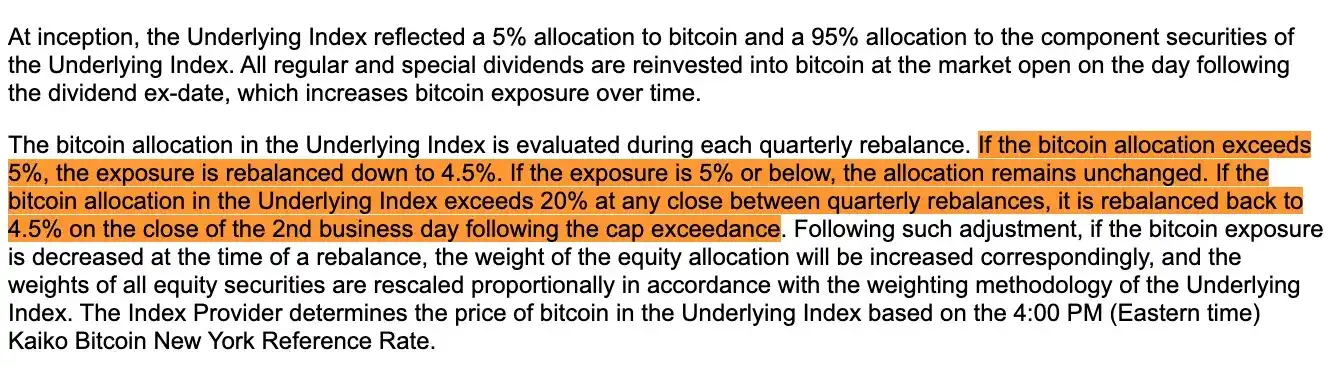
Even if Bitcoin's price surges between two rebalancing periods, its share in the fund will never break through the 20% red line.
To bypass numerous regulatory processes, all Bitcoin held by the fund will be custodied by a wholly-owned Franklin subsidiary in the Cayman Islands, with that subsidiary handling the configuration using spot cryptocurrencies, futures, and options.
Both funds track custom indices designed by VettaFi. Franklin plans to launch them officially on September 1st; the fee section in the filing is blank, and the management fee has not been announced yet.
Setting Aside Rosy Expectations, Facing Reality
While it seems to connect to the Wall Street system, adding stable Bitcoin buyers with bright prospects, calculating the real numbers reveals that the so-called incremental buying is merely a trickle.
The annualized dividend yield for a broad US stock index is 1.05%, while for the innovative sectors index, it's only 0.52%. Both funds start with a 95% stock + 5% Bitcoin allocation, and only dividends from the stock portion are used to buy Bitcoin. In simple terms, the broad-based fund can only allocate about 1% of its total assets annually to buy Bitcoin, and the innovative fund only 0.5%.
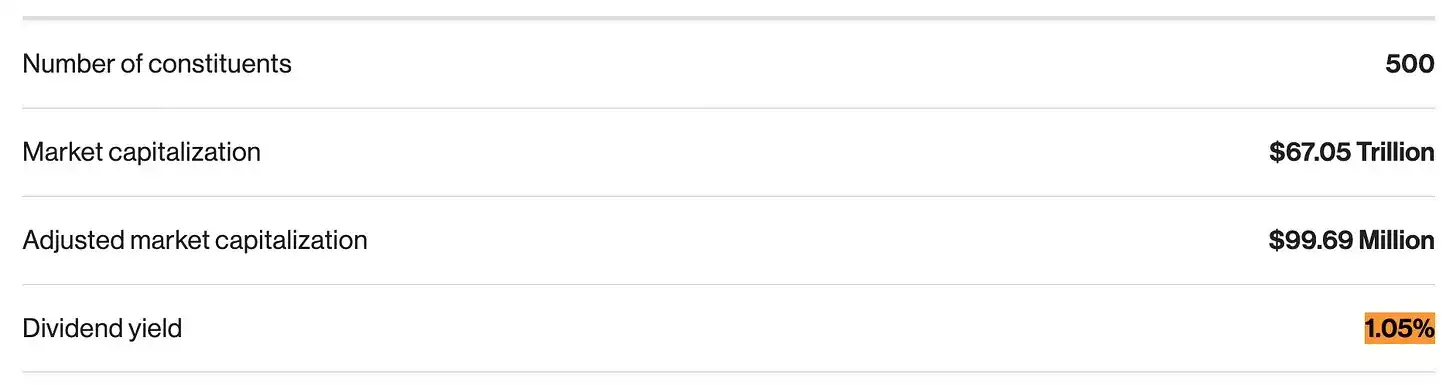
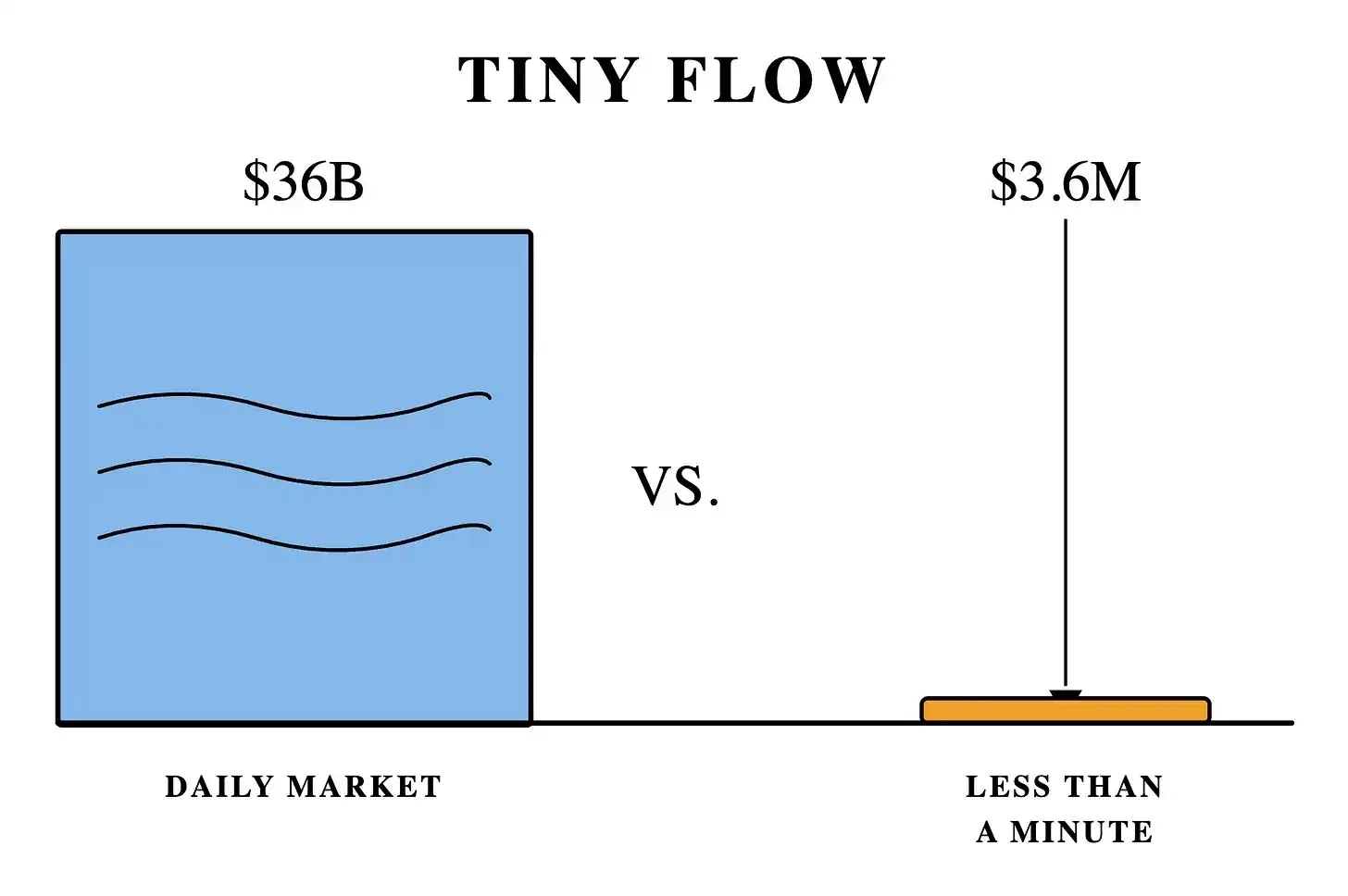
Based on Franklin's existing Bitcoin ETF (size $359 million), the corresponding annual incremental buying power for Bitcoin is only $3.6 million. With Bitcoin's average daily trading volume around $36 billion, the fund's entire year of buying can be absorbed by the market in less than a minute.
The design of the innovative sectors fund harbors deeper flaws: it holds heavy positions in stocks like Nvidia, Apple, and Microsoft, which pay very low or no dividends. The fund relies entirely on stock dividends to buy Bitcoin, meaning it lacks a steady cash flow for continuous accumulation. Coupled with the reverse mechanism of quarterly rebalancing, once Bitcoin's share exceeds 5%, it must be reduced to 4.5%. The higher Bitcoin rises, the harder the fund sells. In a bull market, the selling pressure from continuous sales would easily offset the tiny buying increment from meager dividends. This product, by its underlying design, is destined to struggle with holding an appreciating asset long-term.
On days when Bitcoin performs well, this fund becomes a passive seller instead.
Why? Index funds are forced into passive trading by the market. Traders know the fixed times and targets for index buying and selling, allowing them to front-run for profit. Franklin's two funds恰恰 create the opposite situation: they are programmed, passive, continuous selling tools. The funds are fixed to buy Bitcoin the day after dividends are received and sell uniformly each quarter during rebalancing. Short-term traders can accurately predict these operational nodes, harvesting profits from the fund on both the buy and sell sides.
The selling pressure from a single fund of similar size is minuscule, like a mosquito bite. But once a whole category of similar products forms, the cumulative selling pressure becomes significant. If a large amount of similar capital floods the market, every Bitcoin price rise would encounter continuous selling, creating a difficult-to-break price ceiling.
Beyond this core 'default allocation' playbook, the filing also cleverly hides three other design elements:
- Compliance avoidance. Many financial institutions' internal rules prohibit crypto allocation, but this fund is externally labeled merely as a 'US large-cap equity product.' Advisors can allocate it for clients compliantly, indirectly achieving Bitcoin exposure.
- Offshore structure compliance solution. Bitcoin is custodied by a wholly-owned Cayman Islands subsidiary, a common compliance method for public funds holding commodity-like assets. It doesn't breach the fund's original tax qualifications, is legal, and widely used in the industry.
- Tax legacy issue. Dividends are automatically converted into Bitcoin before they reach you, but those dividends are still taxable. The money is already locked into crypto assets, forcing you to use your own cash to pay taxes on dividends that never landed in your account.
For this model to truly take shape, such funds must become the default allocation for pensions or be positioned right next to the default asset pool. After the 2006 Pension Protection Act, employers gained legal support to auto-enroll employees with default allocations to corresponding funds.
Back then, only 5% of 401(k) plans offered target-date funds; now coverage is 96%, with total industry assets exploding from $100 billion to $4 trillion.
In August 2025, Trump signed an executive order officially lifting restrictions, allowing 401(k) pensions to allocate to cryptocurrencies. In March 2026, the U.S. Department of Labor released a draft rule stating that if plan fiduciaries include alternative assets like cryptocurrencies in the pension's optional list, they can enjoy liability protection.
The public comment period for the draft ended on June 1st. For a final rule to be enacted by the end of this year, the process must be completed before then. Compared to adding optional crypto products for investors, directly setting crypto assets as the pension default allocation faces higher implementation hurdles. Therefore, regardless of the final rule's text, corporate legal counsel generally believes most employers will choose to wait and see, acting only after court precedents confirm the safe harbor liability protection clause.
The core of this system was never to convince anyone to actively buy Bitcoin. Human attention is the world's scarcest resource. Any model that saves thinking and runs automatically on inertia will ultimately win.
The whole system just needs to leverage people's inertia.