Ethereum Needs Better Decentralized Stablecoins, Buterin Says

bitcoinist发布于2026-01-12更新于2026-01-12

文章摘要

Vitalik Buterin argues that Ethereum needs better decentralized stablecoins, highlighting three key challenges: the need for a stablecoin not solely pegged to the USD long-term due to inflation risks; the necessity of uncapturable oracles to avoid exploitative governance; and the issue of staking yield competing with stablecoins for capital, creating a usability penalty. He suggests potential solutions like reducing staking yields or creating new staking mechanisms without slashing risk. Buterin's comments coincide with broader critiques that Ethereum represents a "contrarian bet" against mainstream VC-backed crypto trends like gambling and centralized finance.

Ethereum needs “better decentralized stablecoins,” Vitalik Buterin said this weekend, arguing that the next iteration has to solve three design constraints that today’s models keep skirting. His comments landed alongside a broader claim from MetaLeX founder Gabriel Shapiro that Ethereum is increasingly a “contrarian bet” versus what much of the venture-backed crypto stack is optimizing for.

Shapiro framed the split in ideological terms, saying it is “increasingly obvious that Ethereum is a contrarian bet against most of what crypto VCs are betting on,” listing “gambling,” “CeDeFi,” “custodial stablecoins,” and “’neo-banks’” as the center of gravity. By contrast, he argued, “Ethereum is tripling down on disrupting power to enable sovereign individuals.”

Why Ethereum Lacks A Decentralized Stablecoin

Buterin’s stablecoin critique starts with what to stabilize against. He said “tracking USD is fine short term,” but suggested that a long-horizon version of “nation state resilience” points to something that is not dependent on a single fiat “price ticker.”

“Tracking USD is fine short term, but imo part of the vision of nation state resilience should be independence even from that price ticker,” Buterin wrote. “On a 20 year timeline, well, what if it hyperinflates, even moderately?”
That premise shifts the stablecoin problem from simply maintaining a peg to building a reference index that can plausibly survive macro regime changes. In Buterin’s framing, that is “problem” one: identifying an index “better than USD price,” at least as a north star even if USD tracking remains expedient near term.

The second issue is governance and oracle security. Buterin argued that a decentralized oracle must be “not capturable with a large pool of money,” or the system is forced into unattractive tradeoffs that ultimately land on users.

“If you don’t have (2), then you have to ensure cost of capture > protocol token market cap, which in turn implies protocol value extraction > discount rate, which is quite bad for users,” he wrote. “This is a big part of why I constantly rail against financialized governance btw: it inherently has no defense/offense asymmetry, and so high levels of extraction are the only way to be stable.”

He tied that to a longer-running discomfort with token-holder-driven control structures that resemble markets for influence. In his view, “financialized governance” trends toward systems that must continuously extract value to defend themselves, rather than relying on a structural advantage that makes attacks meaningfully harder than normal operation.

The third problem is mechanical: staking yield competes with decentralized stablecoins for capital. If stablecoin users and collateral providers are implicitly giving up a few percentage points of return relative to staking ETH, Buterin called that “quite bad,” and suggested it becomes a persistent headwind unless the ecosystem changes how yield, collateral, and risk interact.

He laid out what he described as a map of the “solution space,” while stressing it was “not endorsement.” Those paths ranged from compressing staking yield toward “hobbyist level,” to creating a staking category with similar returns but without comparable slashing risk, to making “slashable staking compatible with usability as collateral.”

Buterin also sharpened what “slashing risk” actually means in this context. “If you’re going to try to reason through this in detail,” he wrote, “remember that the ‘slashing risk’ to guard against is both self-contradiction, and being on the wrong side of an inactivity leak, ie. engaging in a 51% censorship attack. In general, we think too much about the former and not enough about the latter.”

The constraint bleeds into liquidation dynamics as well. He noted that a stablecoin “cannot be secured with a fixed amount of ETH collateral,” because large drawdowns require active rebalancing, and any design that sources yield from staking must reckon with how that yield turns off or changes during stress.

At press time, ETH traded at $3,118.
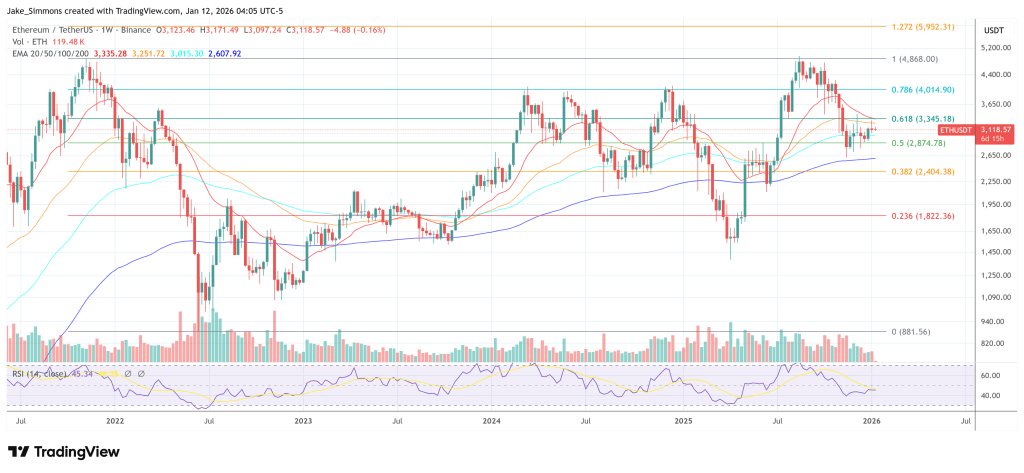
ETH remains between the 0.5 and 0.618 Fib, 1-week chart | Source: ETHUSDT on TradingView.com

相关问答

QWhat are the three main design constraints that Vitalik Buterin says the next iteration of decentralized stablecoins on Ethereum must solve?

AThe three main design constraints are: 1) Identifying a stable index 'better than USD price' for long-term resilience, 2) Ensuring oracle security that is 'not capturable with a large pool of money', and 3) Solving the mechanical issue where staking yield competes with decentralized stablecoins for capital.

QAccording to Gabriel Shapiro, what is Ethereum increasingly a 'contrarian bet' against?

AAccording to Gabriel Shapiro, Ethereum is increasingly a 'contrarian bet' against what most crypto VCs are betting on, which he lists as 'gambling,' 'CeDeFi,' 'custodial stablecoins,' and 'neo-banks'.

QWhy does Buterin argue that 'financialized governance' is problematic for stablecoins?

AButerin argues that financialized governance is problematic because it has no defense/offense asymmetry, meaning it inherently trends toward systems that must continuously extract high levels of value from users to defend themselves, as the cost of capture must be greater than the protocol token's market cap to be stable.

QWhat two specific risks does Buterin highlight when discussing 'slashing risk' in the context of staking?

AButerin highlights that 'slashing risk' includes the risk of self-contradiction and the risk of being on the wrong side of an inactivity leak, which means engaging in or being affected by a 51% censorship attack.

QWhat is one potential solution Buterin maps out in the 'solution space' for the staking competition problem?

AOne potential solution Buterin maps out is compressing staking yield toward a 'hobbyist level' to reduce its competition with decentralized stablecoins for capital.

你可能也喜欢

SharpLink CEO:如何理解以太坊开发者刚刚突破 100 万?

作者Joseph Chalom从亚洲之行中感受到以太坊生态的活力与建设者的雄心。他指出,Electric Capital数据显示以太坊历史开发者总数已突破100万,其中约23.2万人在过去一年保持活跃,这是加密领域最大的技术人才库。 Chalom认为,加密领域的核心问题并非哪条链最快,而是顶尖建设者选择在哪里长期建设。以太坊的显著优势源于十年积累的制度、文化、经济和生态结构,使其成为可编程金融和互联网原生资本形成的默认操作系统。 这百万建设者正致力于解决行业最难的问题:核心协议的可扩展性、隐私、抗量子能力及智能体系统。例如,2026年预计进行的Glamsterdam升级将在不破坏核心原则下提升性能;同步可组合性技术让众多Rollup能像一条链般运作;以太坊在抗量子准备上也处于明显领先地位。 以太坊的深层护城河在于开发者聚集产生的复利效应,以及由此强化的可组合性、共享标准(如EVM和Solidity)和信任。其可信中立性(由超90万验证者保障)、模块化架构(如Base、Arbitrum等Rollup)以及吸引顶尖研究人员的文化,共同巩固了其作为大型机构首选互联网原生金融协调层的地位。Chalom坚信,以太坊的生态系统优势及其汇聚的人才,将持续推动下一代金融基础设施的变革。

marsbit34分钟前

SharpLink CEO:如何理解以太坊开发者刚刚突破 100 万?

marsbit34分钟前

SharpLink CEO:如何理解以太坊开发者刚刚突破 100 万?

SharpLink CEO分享了其对以太坊开发者总数突破100万的见解。根据Electric Capital数据,以太坊历史开发者总数已达1,012,824人,其中约23.2万人在过去一年保持活跃,构成了加密领域最庞大的技术人才库。 作者认为,加密领域的核心竞争并非单纯追求速度与低费用,而是顶尖建设者的选择。以太坊凭借十年积累的制度、文化、经济与生态结构,形成了难以复制的综合优势,已成为可编程金融和互联网原生资本的默认操作系统。 这百万开发者正致力于攻克行业最前沿的挑战:通过预计2026年的Glamsterdam升级提升核心协议可扩展性;通过同步可组合性技术让众多Rollup如一条链般协同工作;以及积极布局抗量子能力,以太坊基金会已成立专门团队推进,目标是2029年前完成迁移。 更深层的护城河在于网络效应:以太坊的可组合性让应用像乐高积木一样互操作,EVM和Solidity技能在数百个网络中通用,形成了“更多开发者→更多工具与流动性→更多应用”的飞轮。此外,由超90万验证者保障的可信中立性、模块化扩展架构以及顶尖的研究与文化氛围,共同巩固了其作为大型机构首选信任层的地位。 作者在访问亚洲以太坊社区后强调,以太坊的竞争优势在于汇聚了改变未来金融的建设者,其生态不仅是链上活跃,更在成为互联网原生金融的长期协调层。

链捕手38分钟前

SharpLink CEO:如何理解以太坊开发者刚刚突破 100 万?

链捕手38分钟前

从身份协议到AI入口,World的野心有多大?

近期,加密市场中的WLD成为焦点,其价格持续上涨,市值突破30亿美元。这一热度源于World项目正式进入“The Simple Plan”第三阶段,其发展逻辑正从早期的代币激励转向实用驱动。World的核心目标是构建全球“人格证明”网络,通过扫描虹膜的World ID解决互联网中验证真实人类身份的关键问题。随着生成式AI爆发,区分真人与AI变得日益紧迫。 World的落地场景正在拓宽,覆盖企业端、个人端及AI Agent端。企业方面,与Zoom等公司合作应对深度伪造;个人层面,瞄准社交与票务等场景的真人验证需求;AI Agent端则推出AgentKit,旨在建立人与AI间的可信授权框架,为未来AI经济奠定信任基础。 市场上涨背后是对“真人身份”稀缺价值的重估。在AI内容成本趋近零的未来,真人身份与行为可能成为稀缺资源。World的运营策略也更聚焦,资源集中于高价值城市以构建网络效应,同时下一代Orb设备将实现自助化以降低扩张成本。 宏观来看,World可能推动加密叙事从金融扩展到身份基础设施,身份或成为可组合资产。它也有望成为AI Agent经济的关键入口,解决Agent归属、可信与验证问题。World ID 4.0引入的费用机制开启了协议的收入来源,使其商业模式更趋清晰。 总之,WLD的上涨反映了市场对World在AI时代定位的认可——其野心是成为验证人类身份的关键入口。随着AI与人的界限模糊,掌握人格证明网络可能意味着掌握下一代互联网的重要枢纽。

marsbit1小时前

从身份协议到AI入口,World的野心有多大?

marsbit1小时前

交易

现货
合约

热门文章

加密市场宏观研报:美国“加密货币周”来袭,ETH开启机构军备赛高潮

本周,加密市场迎来两股重磅催化——华盛顿“加密货币周”的立法攻势与以太坊机构布局的密集爆发,共同构成加密行业2025年下半年的“政策拐点”与“资金拐点”。这一轮加密周期的深层逻辑,正从比特币转向以太坊、稳定币及链上金融基础设施。我们认为:美国的政策明朗化+以太坊的机构化扩展,标志着加密行业正进入结构性转正阶段,市场配置的重心亦应逐步从“价格博弈”过渡至“规则+基础设施的制度红利捕捉”。

1.8k人学过发布于 2025.07.17更新于 2025.07.17

加密市场宏观研报:美国“加密货币周”来袭,ETH开启机构军备赛高潮

相关讨论

欢迎来到HTX社区。在这里,您可以了解最新的平台发展动态并获得专业的市场意见。以下是用户对ETH(ETH)币价的意见。

活动图片