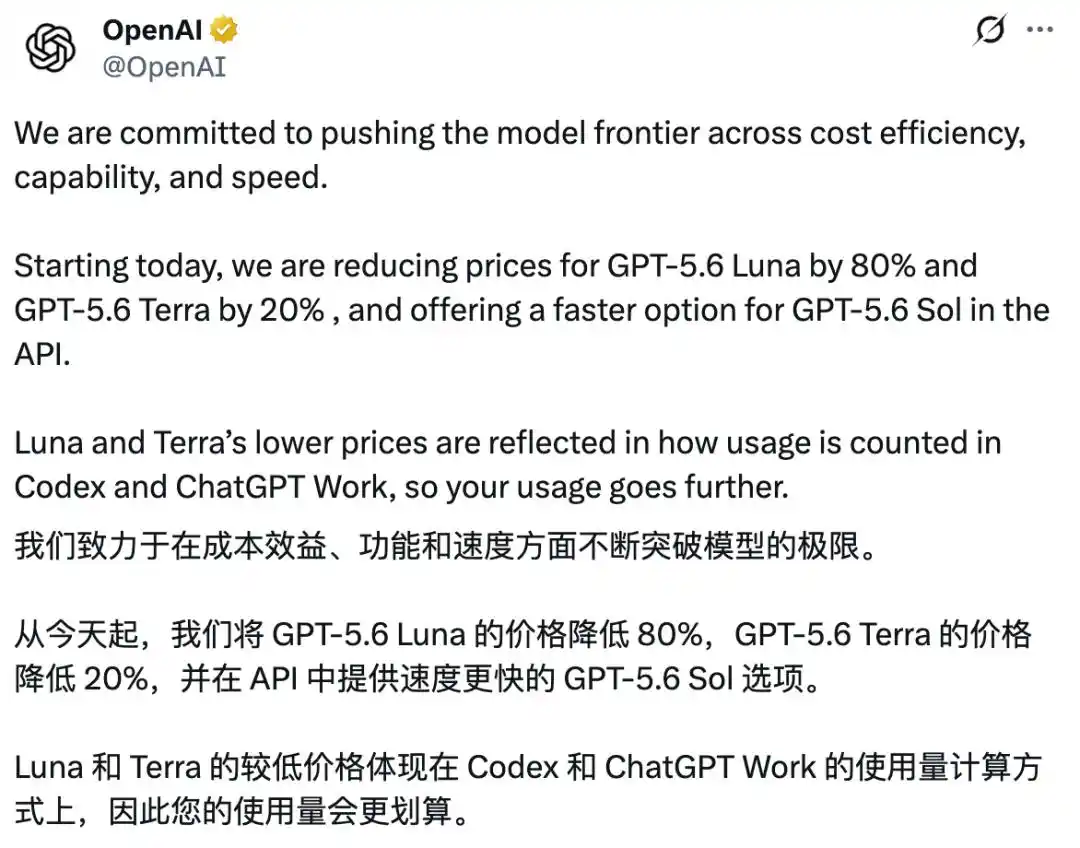
Breaking: GPT-5.6 Prices Slashed Effective Today

marsbit发布于2026-07-31更新于2026-07-31

文章摘要

OpenAI has announced significant price cuts for its GPT-5.6 model API, effective immediately. The entry-level **GPT-5.6 Luna** sees the most drastic reduction, with input prices dropping 80% to $0.20 per million tokens and output prices falling to $1.20 per million tokens. The mid-tier **GPT-5.6 Terra** is reduced by 20%, now costing $2.00 (input) and $12.00 (output) per million tokens. The flagship **GPT-5.6 Sol** maintains its original price but introduces a new **Fast mode**, offering speeds up to 2.5 times faster for double the cost. The company attributes these price reductions to efficiency gains achieved through **GPT-5.6 Sol's own involvement in optimizing its production systems**. The model assisted in rewriting GPU kernels and improving speculative decoding, leading to a 20% reduction in end-to-end service costs and over 15% improvement in token generation efficiency. OpenAI emphasizes this process remained human-led. A key focus of the降价 is to lower the barrier for running **AI agent workflows**. By making the capable, tool-calling Luna model significantly cheaper, OpenAI aims to enable more frequent use in cost-sensitive, high-volume tasks like code review and monitoring. This creates a potential feedback loop: model-assisted efficiency gains lead to lower costs, which enables broader agent deployment, which in turn drives further optimization. The new pricing and features will also apply to Codex and ChatGPT Work subscriptions. The changes intensify competitio...

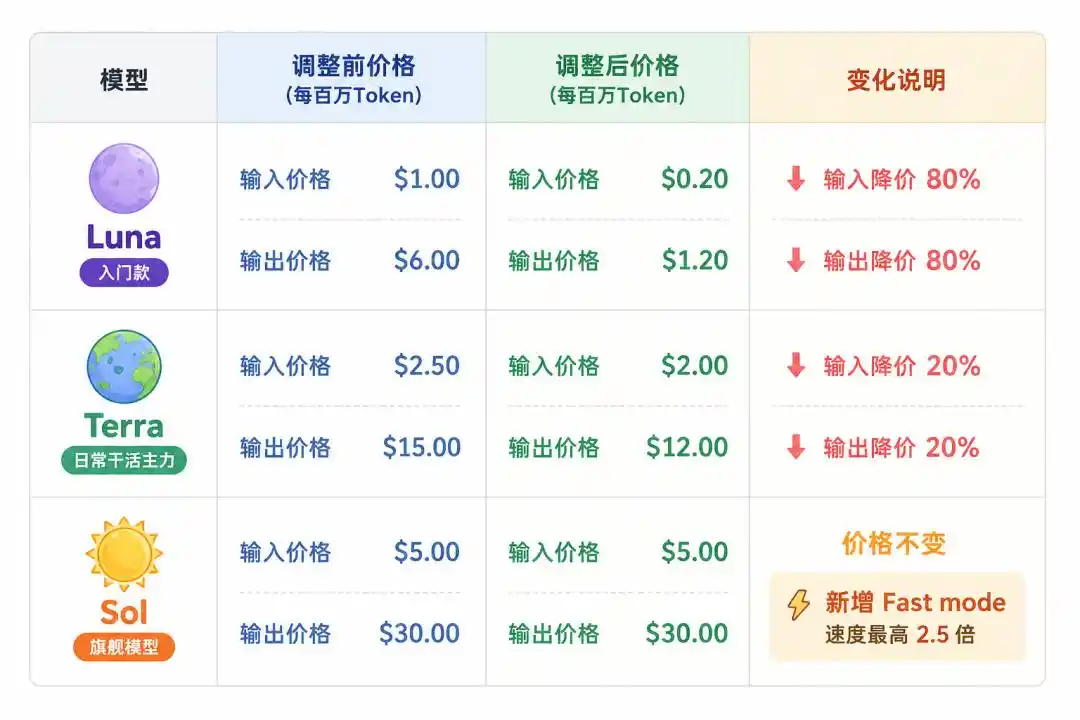
The entry-level Luna model has seen a massive price cut, with input price dropping from $1 to $0.2 per million tokens, and output price falling from $6 to $1.2 per million tokens.

Converted to RMB, this is equivalent to input price dropping from about 6.8 yuan to 1.35 yuan, and output price from about 40.6 yuan to 8.1 yuan.

The Terra model, positioned as the "daily workhorse," also saw a 20% price reduction, with input and output prices dropping to $2 and $12 per million tokens respectively.

Converted to RMB, this is approximately 13.5 yuan and 81.2 yuan respectively.

Only the flagship model, Sol, remains at its original price, but it introduces a Fast mode with speeds up to 2.5 times that of the standard mode, offering acceleration at no extra cost.
Following the aggressive reset of usage in Codex, OpenAI has promptly arranged for price cuts... who are you trying to out-compete?

The price war has directly escalated to a white-hot level.

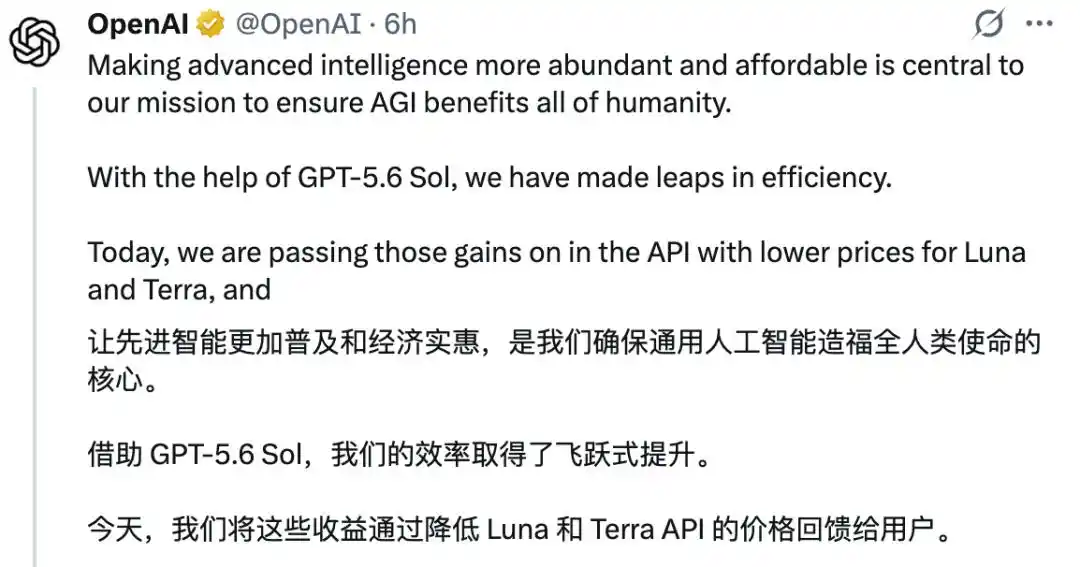
OpenAI stated that the price reduction is because GPT-5.6 Sol helped save its own costs.

GPT-5.6 Sol participated in its own improvement, achieving a leap in efficiency, hence this special feedback for our new and existing users~

So OpenAI is also playing the game of "stepping on one's own feet to ascend on the spot."

.

Two Models Get Cheaper, One Gets Faster

Currently, the API prices for the three GPT-5.6 models are:

GPT-5.6 Luna: $0.2 per million tokens input, $1.2 per million tokens output;

GPT-5.6 Terra: $2 per million tokens input, $12 per million tokens output;

GPT-5.6 Sol: $5 per million tokens input, $30 per million tokens output.
After the price cut, Luna has taken a major plunge.

Its input price is now on par with the previous generation GPT-5.4 nano, and its output price is even $0.05 cheaper.

However, the two models don't handle exactly the same tasks. GPT-5.4 nano is mainly for simple, high-frequency tasks like classification, information extraction, and ranking.

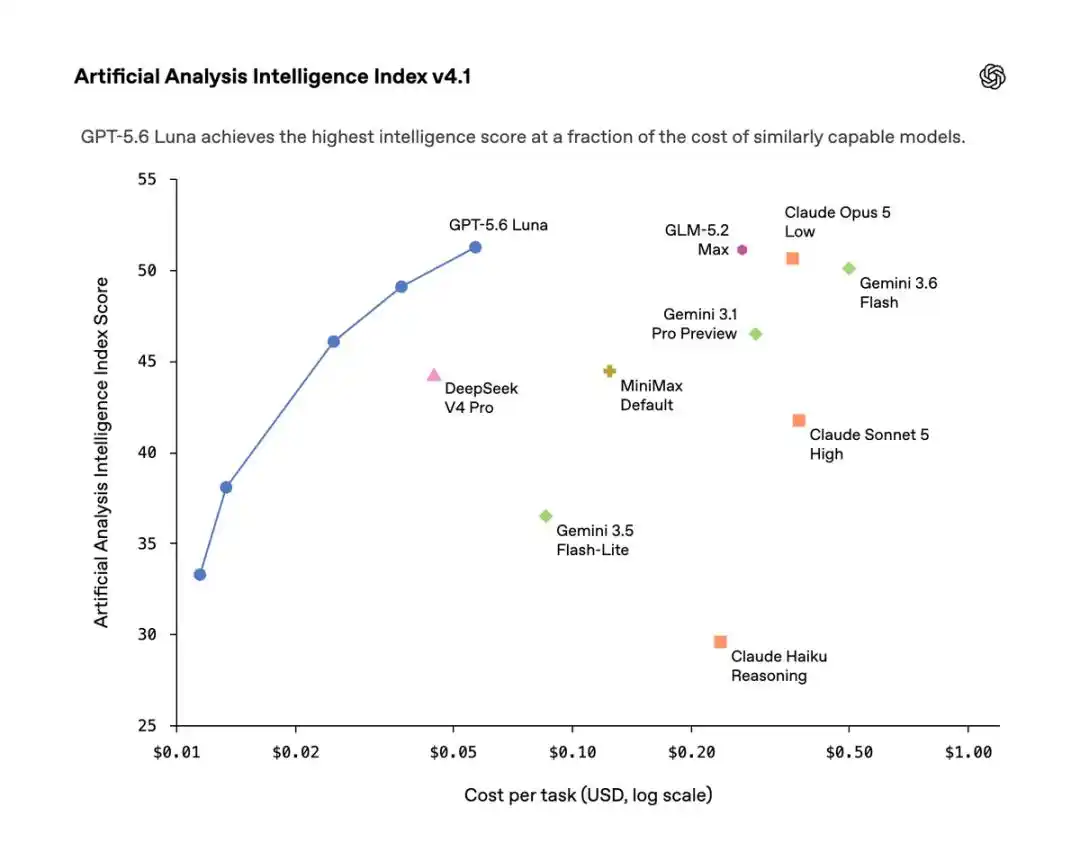
GPT-5.6 Luna is positioned by OpenAI as a model for cost-sensitive workloads, capable of calling tools, handling long contexts, and executing multi-step workflows.

Simply put, OpenAI is selling the model that powers Agents at the price point of past simple small models.

Terra's reduction is relatively more restrained, at 20%.

Sol maintains its original price but adds Fast mode, which can reach speeds up to 2.5 times the standard mode, priced at 2 times the standard mode, with no change in model intelligence.

It will also replace the previous Priority Processing. API requests originally using the priority tag can automatically switch to Fast mode.

Officials stated that this round of adjustments will also be applied to Codex and ChatGPT Work.

Subscription prices will not be lowered, and users' total quota will not increase, but when calling Terra and Luna, the quota consumed will be correspondingly reduced.

The same subscription fee can allow the model to perform more tasks.

OpenAI also casually switched the Auto-review model in ChatGPT and Codex CLI from GPT-5.4 to GPT-5.6 Luna.

Auto-review is responsible for checking code and modification results in the background, a typical high-frequency Agent task.

Combined with the model upgrade and Luna's price cut, OpenAI expects its cost to drop to about one-tenth of the original.

Cheap models are no longer only responsible for traditional "miscellaneous tasks" like classification and extraction, but are starting to enter areas like code review and backend monitoring, which require judgment and tool calling.

Currently, the positioning of the three models is:

Budget-sensitive, high-volume tasks go to Luna;

Regular daily work goes to Terra;

High-difficulty tasks continue with Sol;

If even waiting is too slow, pay double for speed.

GPT-5.6 Begins Participating in Its Own Cost Reduction

Why the sudden price drop?

OpenAI stated the reason is that GPT-5.6 Sol participated in optimizing its own production system.

The efficiency it improved then translated into discounted numbers on the price list.

Specifically, GPT-5.6 Sol rewrote and optimized some production environment GPU kernels, designed and ran hundreds of token generation experiments, and participated in monitoring training, intervening when issues arose.

The final results were also impressive: production GPU kernel optimization reduced GPT-5.6 end-to-end service costs by 20%; improved speculative decoding increased token generation efficiency by over 15%.
A GPU Kernel can be understood as the underlying program that executes specific computing tasks for the model on the GPU.

The model itself doesn't need to change; as long as these programs are written more efficiently, the same GPU can complete calculations faster, handle more requests, and the cost per call also drops.

Speculative decoding involves "guessing" the next possible tokens in bulk when generating answers, then having the main model verify them. The more accurate the guesses, the fewer steps are needed for individual generation and waiting.

Both optimizations do not reduce model capability but allow the same model to run faster and cheaper.

However, this is not GPT-5.6 fully autonomously upgrading itself.

OpenAI specifically emphasized that the entire process remains human-led.

The model can write code, run experiments, and monitor anomalies, but defining goals, deciding if results are usable, and whether code enters the production environment still require "Human in the Loop."

OMT

Finally, there's one more new development.

This price cut has a very specific focus: Agent workflows.

The most heavily discounted Luna is not just a traditional small model for classification and extraction.

According to OpenAI's positioning, it can call tools and execute multi-step tasks, mainly targeting high-frequency, cost-sensitive workloads.

Therefore, Luna's 80% price cut also serves to lower the barrier for long-running Agents.

It makes review, verification, and monitoring tasks, which were previously too costly to perform frequently, feasible as regular steps in workflows.

Combined with GPT-5.6 participating in optimizing its own production system, a new cycle emerges:

The model participates in improving operational efficiency, costs drop; after prices decrease, the model enters more high-frequency workflows; increased call volume then drives the next round of efficiency optimization.

OpenAI's price reduction flywheel is taking shape.

After this series of maneuvers, the pressure is now directly on A-She (Anthropic?):

"Your turn."

Reference links:[1]https://x.com/OpenAI/status/2082878156483219672[2]https://x.com/sama/status/2082880720989532597

This article is from the WeChat public account "QbitAI," author: Follow Frontier Technology

热门币种推荐

相关问答

QWhat are the key pricing changes for GPT-5.6 Luna announced in the article?

AThe price for GPT-5.6 Luna has been dramatically reduced. The input cost per million tokens dropped from $1 to $0.2, and the output cost per million tokens dropped from $6 to $1.2.

QWhat is the new 'Fast mode' introduced for GPT-5.6 Sol?

AGPT-5.6 Sol now offers a 'Fast mode' that can reach speeds up to 2.5 times faster than the standard mode. It costs twice as much as the standard mode but maintains the same level of model intelligence.

QWhat are the primary reasons OpenAI gives for the price reductions according to the article?

AOpenAI states the price reductions are due to efficiency gains achieved by GPT-5.6 Sol participating in its own improvement. Specifically, it optimized production GPU kernels (reducing service costs by 20%) and improved speculative decoding (increasing token generation efficiency by over 15%).

QHow is the role of GPT-5.6 Luna described, and what is the strategic goal of its price cut?

AGPT-5.6 Luna is described as a model for cost-sensitive workloads that can call tools, handle long contexts, and execute multi-step workflows. Its significant price cut aims to lower the barrier for running AI Agents in long-term, high-frequency tasks like code review and monitoring.

QWhat is the core concept of the 'price reduction flywheel' mentioned in the article's conclusion?

AThe 'price reduction flywheel' refers to a self-reinforcing cycle where: the model helps improve its own operational efficiency, leading to cost reductions; lower prices allow the model to be used in more high-frequency workflows; increased usage scale then drives the next round of efficiency optimization.

你可能也喜欢

奥特曼承认:高估了AI抢饭碗!黄仁勋:失业论完全搞反了

2025年10月,OpenAI CEO山姆·奥特曼曾预言可能出现由AI管理的大公司。然而在2026年7月的播客中,他改口称人们“并不真正想要一个AI CEO”,因为公司决策需要明确的责任归属和真人间的信任。他承认自己高估了AI消灭初级白领岗位的速度,“就业末日”大概率不会到来。 几乎同时,英伟达CEO黄仁勋在YC创业课上指出,“AI毁掉工作”的叙事完全搞反了。他认为,AI替代的是工作中的具体“任务”,而非整个“工作”。例如放射科医生和软件工程师,虽然AI承担了更多读片和写代码任务,但这些岗位的数量反而在增长,因为效率提升后业务规模扩大,产生了更多对沟通、判断、协调等AI无法替代的人类技能的需求。 马里兰大学与LinkUp的数据显示,截至2025年第四季度,美国整体招聘需求未被AI压垮,明确面向应届生的岗位比例甚至有所回升。报告指出,年轻员工可能更受益于AI工具,它能快速提供经验,使其变得“便宜又好用”。 然而,挑战依然存在:AI最先接管的正是数据录入、基础分析等标准化入门任务,这使得新人积累初期经验的传统路径变窄,入门台阶正在升高。 两位领袖的观点共同揭示了一个趋势:AI越强大,人类工作的核心价值就越向承担责任、建立信任、做出最终判断等层面集中。这些无法被机器替代的部分,构成了个人真正的职业护城河。

marsbit1小时前

奥特曼承认:高估了AI抢饭碗!黄仁勋:失业论完全搞反了

marsbit1小时前

每周编辑精选 Weekly Editor's Picks(0725-0731)

**每周编辑精选(0725-0731)摘要** 本文筛选深度分析,滤除资讯噪音,带来一周核心洞察。 **宏观局势**:美联储迎来近年“最不确定”会议。尽管经济数据为等待提供空间,但高通胀、地缘风险及官员鹰派表态,令市场无法完全排除加息风险,并已为此付费。 **投资与创业**: * 加密投资是长期心态博弈,获胜者需看清资产本质、确信趋势并能承受深度回撤。建议长线布局比特币与优质公链。 * 全球股市(尤科技股)呈现“币圈化”:叙事压倒估值,杠杆放大情绪,社交媒介加速共识极端化。 * Hyperliquid、Polymarket等龙头平台的跨界尝试遇阻,核心难点在于复制原有赛道的用户习惯与流动性深度。 * 多个加密协议收入增长但代币价格不涨,原因在于内部抛压、负面情绪及竞争。好协议不等于好代币,需审视收入、分配与释放机制。 **AI与存储**: * 英伟达信用违约率暴涨,反映市场对AI云设施扩张风险的定价。中国芯片产业崛起正撼动全球存储定价逻辑。 * 存储板块“一夜惊魂”是基本面与预期面脱节,市场已开始为2027年潜在供给过剩提前定价。 * AI烧钱凶猛,市场耐心受考验。多空分歧在于:需求真实但供给受限 vs. 未来回报可见度低。 * SK海力士虽录得史上最赚钱季度,但股价仍“不及预期”,显示市场对其未来增长空间的定价存在分歧。 **政策与稳定币**:美国《Clarity法案》推进至最后阶段,但道德条款等关键分歧仍存,且需与其他争议法案争夺有限表决时间,年内落地概率被下调。若未通过,对加密市场冲击或有限,但将增加未来立法难度。 **CeFi & DeFi**:Ondo代币近期上涨,源于其在链上交易美股主线动作密集,既占据上游代币化资产份额,又向下游拓展保证金应用。但受制于整体市场颓势,涨势更多是短期资金博弈。 **以太坊与扩容**:Lido正启动将800多万枚ETH迁移至Pectra升级后的新型验证器架构,这代表了staking资本管理效率的结构性提升,但不会直接降低用户Gas费用。当前ETH价格走弱,部分源于投资者对其价值增长逻辑感到困惑。 **其他要点**:TradeXYZ平台对A股新股定价展现高精准度;Pons平台币半月暴涨登顶Robinhood Chain;币印破产案例警示平台钱包并非资产托管;一周热点还包括美联储按兵不动、MiCA落地欧洲、长鑫科技上市创纪录、OpenAI称未来12个月将“震撼世界”等。

marsbit1小时前

每周编辑精选 Weekly Editor's Picks(0725-0731)

marsbit1小时前

少投入不是苹果的免死金牌

《少投入不是苹果的免死金牌》一文指出,虽然苹果在AI浪潮中因资本开支克制而一度受到市场青睐,但其面临的挑战正在显现。 文章首先描述了市场的反差:当Meta、谷歌等巨头因巨额AI投入引发担忧时,苹果在AI领域的迟缓进展反而被视为“亮点”,其股价一度上涨。然而,这种“全靠同行衬托”的领先难以持续。 随后,文章分析了苹果最新财报。尽管2026财年第三财季营收与净利润均创同期历史新高,主要得益于iPhone和Mac的强劲销售,但财报发布后股价却大幅下跌。原因在于苹果对下一季度的增长指引低于市场预期。 核心问题在于供应链。AI热潮导致内存和芯片需求激增、价格上涨及产能紧张,严重波及苹果。其Mac产品线已因高端芯片供应不足而受限,并被迫提价。外界预测iPhone新品也将大幅涨价,这可能影响未来销量。为应对供应链风险,苹果库存大幅增加,并寻求与中企合作采购内存芯片,但此举面临政治阻力。 与其他科技巨头动辄数千亿美元的AI资本开支相比,苹果的资本开支不仅未增,反而下降,这使其保持了健康的现金流。但同时,苹果研发费用大幅增长,却未能在AI领域取得显著成果,形成反差。 文章总结,苹果虽未在AI烧钱竞赛中陷得太深,却无法避免由这场竞赛引发的供应链与成本冲击。即将卸任的库克对公司未来表示信心,但苹果能否在AI时代保持领先,仍存疑问。

marsbit2小时前

少投入不是苹果的免死金牌

marsbit2小时前

交易

现货

热门文章

什么是 $LUNA

Luna28 ($$LUNA):一个月球启发的加密项目 介绍 在不断发展的加密货币世界中,创新是关键。Luna28脱颖而出,不仅拥抱技术,还将其与宇宙周期的神秘交织在一起。受月亮28天周期的启发,Luna28 ($$LUNA)旨在为其社区创造一个独特且引人入胜的体验,融合代币经济学和以月亮为主题的非同质化代币(NFT)。该项目的核心采用了一种独特的代币燃烧机制,与月食和日食相一致,在加密领域树立了新的先例。 Luna28是什么? Luna28是一个建立在以太坊区块链上的基于代币的加密项目。它旨在通过一系列创新功能为用户提供宇宙互动的结合。其身份的关键在于推出以月亮为主题的NFT,增强社区互动,同时庆祝月亮的文化意义。 该项目旨在加深其社区成员与宇宙之间的联系。通过一个精心设计的生态系统,这种联系得以实现,利用月亮主题、代币燃烧以及与天体事件相关的动态活动。其目标不仅仅是提升代币价值,还在于在社区内培养归属感和乐趣。 Luna28的创造者 Luna28的创造者的具体信息仍然大多未知。这一缺乏信息的状态为该项目增添了一丝神秘感,进一步增加了其独特性。其创作的匿名性质反映了加密行业的一个更广泛的趋势,即关注项目及其社区,而非个人资料。 Luna28的投资者 目前,关于支持Luna28的具体投资基金或组织没有公开信息。这一方面可能表明这是一个草根发起的项目,社区在项目的发展和增长中发挥着至关重要的作用。缺乏知名投资者有时能够创造一个更加分散和独立的项目,从而促进社区的有机参与和参与。 Luna28如何运作? Luna28最引人注目的方面之一是其运营方式,特别是其独特的功能使其与其他加密货币项目有所区别。 1. 月食和日食代币燃烧 Luna28结合了一种特殊的代币燃烧机制,其中在月食和日食期间定期燃烧一部分其代币供应。这一方法不仅在天体事件中创造了兴奋感,还基于增加稀缺性的基本原则。通过燃烧减少总体代币供应,剩余的代币有潜力增加价值,惠及所有持有者。 2. 代币经济学 Luna28的经济结构经过精心设计,以确保可持续性和增长。每笔交易都需支付4.4%的税: 2%用于月周期基金,每28天的满月时燃烧。 剩下的2.4%用于开发和营销,促进项目的扩展和持续改进。 该税收结构建立了稳定的资金流,同时维护了能够增强代币价值主张的通缩方法。 3. 100%燃烧流动性 在任何加密项目中,安全性和信任至关重要。Luna28通过将其流动性池代币锁定在一个燃烧钱包中来解决这些问题。这确保了流动性得到永久保障,增强了社区在使用平台时的信心。 4. NFT发售 进一步增强社区互动,Luna28计划发布以月亮为主题的NFT。这些数字收藏品不仅作为乐趣和创意的来源,还为用户提供与更大月亮主题相关的独特资产。NFT的引入反映了加密领域中的一个日益增长的趋势,将传统的艺术表达形式与创新技术相结合。 5. 超级通缩代币 Luna28被归类为超级通缩代币,强调其通过系统化燃烧实现代币供应减少的承诺。这种设计鼓励长期持有,社区成员期待因稀缺性而带来的潜在价值增长。 6. 首次购买者激励 为推动积极参与,Luna28提供独特的首次购买者激励。在每次天体燃烧事件后,市场上的第一位参与者将获得该事件中燃烧的10%代币作为奖励。这鼓励人们立即参与,并对每个重要的天体现象产生兴趣。 7. 可持续税结构 该项目的税收模型专门设计以促进可持续增长,平衡项目开发的需要与提升代币价值的目标。这种创新的税收结构不仅支持社区的利益,还为项目维持健康的生态系统。 Luna28的时间线 清晰规划的时间线有助于理解Luna28的进展和里程碑。以下是该项目历史上重要事件的摘要: 隐秘启动: 该项目以隐秘的方式进入加密领域,吸引了大量社区的关注,并在首次上市时取得了惊人的1792%的增长。这一初始增长表明社区的强烈反响,为未来的增长奠定了坚实基础。 代币燃烧: 承诺采取独特的方法,Luna28计划在三年内燃烧28%的代币供应,特别是在月食和日食期间。社区成员热切期待参与这些事件的机会。 社区参与: 强调透明性和社区反馈的重要性,Luna28计划提前通知用户即将到来的代币燃烧事件。这种参与方式鼓励积极参与,培养强烈的社区感。 主要特点 Luna28独特的特点增强了其在加密货币领域的吸引力: 超级通缩的性质:该项目专注于超级通缩机制,旨在战略性地减少供应,以增强价值保留。 早期参与奖励:该项目为早期参与者提供直接的好处,从而培养一个积极主动的社区,积极贡献。 对社区发展的承诺:可持续的税收模型不仅确保项目的增长,而且积极让社区参与塑造其未来方向。 结论 Luna28代表了技术、社区参与和天体启发在加密货币领域的独特融合。通过在天文事件期间整合代币燃烧等创新机制,并创建引人入胜的月亮主题NFT,该项目在其细分市场中脱颖而出,成为开拓者。 作为一个社区驱动的项目,Luna28承诺不仅提供另一种加密货币,还提供一种将宇宙魅力与区块链技术结合的体验。凭借其创新的功能和对社区参与的高度重视,Luna28有潜力在数字货币的世界中创造持久的影响。它在用户与宇宙之间建立的联系不仅代表了一项创造性努力,还体现了一项精明计算的商业战略,准备迎接增长。 随着我们观察Luna28的演变,很明显它不仅仅是一种代币;它是一个鼓励其社区仰望宇宙并思考自己在其中位置的概念,同时在激动人心的加密货币世界中航行。Luna28的未来看起来光明而充满潜力,热切期待下一个月亮周期的到来。

321人学过发布于 2024.04.01更新于 2024.12.03

什么是 $LUNA

如何购买LUNA

欢迎来到HTX.com!我们已经让购买Terra(LUNA)变得简单而便捷。跟随我们的逐步指南,放心开始您的加密货币之旅。第一步:创建您的HTX账户使用您的电子邮件、手机号码注册一个免费账户在HTX上。体验无忧的注册过程并解锁所有平台功能。立即注册第二步:前往买币页面,选择您的支付方式信用卡/借记卡购买:使用您的Visa或Mastercard即时购买Terra(LUNA)。余额购买:使用您HTX账户余额中的资金进行无缝交易。第三方购买:探索诸如Google Pay或Apple Pay等流行支付方法以增加便利性。C2C购买:在HTX平台上直接与其他用户交易。HTX场外交易台(OTC)购买:为大量交易者提供个性化服务和竞争性汇率。第三步:存储您的Terra(LUNA)购买完您的Terra(LUNA)后,将其存储在您的HTX账户钱包中。您也可以通过区块链转账将其发送到其他地方或者用于交易其他加密货币。第四步:交易Terra(LUNA)在HTX的现货市场轻松交易Terra(LUNA)。访问您的账户,选择您的交易对,执行您的交易,并实时监控。HTX为初学者和经验丰富的交易者提供了友好的用户体验。

1.5k人学过发布于 2024.12.12更新于 2026.06.02

如何购买LUNA

什么是 TERRA

探索 Terra 生态系统:全面概述 介绍 在区块链技术和加密货币不断演变的背景下,Terra 生态系统作为一个雄心勃勃的项目应运而生,旨在促进去中心化金融系统的发展。这个创新平台专注于创建稳定且可扩展的算法稳定币,旨在推动加密货币的广泛采用。在本文中,我们将深入探讨 Terra 生态系统的基础方面,探索其运营机制、创始人、投资者、显著组成部分以及其发展时间线。 什么是 Terra 生态系统? Terra 生态系统成立于 2018 年,是一个旨在提供高效可靠支付平台的第一层区块链。Terra 的核心使命是创建一种既去中心化又适合日常使用的优选货币。生态系统的核心是其原生算法稳定币 TerraUSD(UST),该稳定币通过一种创新的算法机制与美元挂钩。这种独特的方法解决了加密货币领域一个普遍关注的问题:数字资产常伴随的波动性。 Terra 生态系统旨在通过创建一个数字货币与传统货币功能相似的环境来增强加密货币的可用性。通过用户友好和稳定,Terra 旨在吸引加密社区以外的用户,最终促进大众采用。 Terra 生态系统的创始人 Terra 生态系统在其联合创始人 Daniel Shin 和 Do Kwon 的指导下诞生。两位创始人在创业和技术领域拥有丰富的经验,成立了 Terraform Labs 来引领这一开创性项目。Daniel Shin 是韩国科技界的知名人物,曾共同创办多家科技公司,而 Do Kwon 在计算机科学和工程方面有着广泛的背景。他们的合作在引导 Terra 生态系统的发展和增长轨迹中至关重要。 Terra 生态系统的投资者 虽然关于具体投资者的详细信息仍然有限,但普遍认为 Terraform Labs 获得了来自多位天使投资者和风险投资公司的大量财务支持。这种支持为 Terra 生态系统的持续发展和扩展提供了必要的资源。对多元化投资来源的重视反映了加密货币社区对该项目潜力的强烈信心。 Terra 生态系统如何运作? Terra 生态系统功能的核心在于其创新的权益证明(PoS)共识机制。这使得 LUNA 代币的持有者能够参与网络的治理和运营。双代币结构使 Terra 与许多其他项目区分开来,其中 LUNA 既作为验证者的质押代币,也作为治理代币。 该机制以独特的方式运作,LUNA 的供应量支持稳定币 UST。如果 UST 的需求增加,算法会自动调整 LUNA 的供应量,以维持 UST 与美元的稳定挂钩。用户可以将 1 UST 兑换为等值的 LUNA,确保需求波动不会影响挂钩。这种创新的方法使 Terra 生态系统能够保持价格稳定,这是其主要目标之一。 Terra 生态系统的发展时间线 Terra 生态系统的发展历程标志着几个重要的里程碑: 2018 年:Daniel Shin 和 Do Kwon 成立 Terraform Labs,为 Terra 生态系统奠定基础。 2019 年 4 月:Terra 区块链的初始发布,开启了其在更广泛加密货币领域的旅程。 2021 年:随着其锁定总价值(TVL)达到新高,Terra 体验到显著增长,成为去中心化金融(DeFi)领域的主导参与者。 2022 年 5 月:随着 UST 和 LUNA 的崩溃,Terra 区块链暂时停止,导致市场认知和市值受到重大影响。 2024 年 1 月:Terraform Labs 申请破产,标志着该项目历史上的另一个关键事件,引发了关于生态系统可持续性和未来的讨论。 Terra 生态系统的关键组成部分 多种功能共同构成了 Terra 生态系统的独特功能: 核心功能 Terra 生态系统包括管理交易费用、监控价格波动和维护交易历史余额等基本功能,这些功能对于确保用户体验和运营完整性至关重要。 应用程序 Terra 生态系统的一大旗舰特性是其多样化的应用程序。这包括: Anchor Protocol:一个货币市场协议,为寻求最大化投资回报的用户提供高稳定币收益和代币化质押。 Mirroring Technology:使用户能够创建与现实世界资产和交易相对应的资产,从而允许更广泛的用例和应用。 Chai:一个支付平台,旨在利用 Terra 的稳定币技术促进日常交易。 交换和交易所 该生态系统提供无缝资产交换的功能。显著特性包括原生交换能力和 Terraswap 等平台,使用户能够高效地交换 Terra 资产,同时享受竞争性汇率。 治理 治理在 Terra 生态系统的去中心化特性中发挥着关键作用。代币持有者使用他们的 LUNA 代币提出变更或对影响网络的提案进行投票,确保集体决策和社区参与生态系统的发展。 Terra 生态系统中的显著项目 除了核心功能外,Terra 生态系统还拥有一些显著项目,进一步增强其能力: Terraswap:这个去中心化交易所(DEX)旨在促进 Terra 资产的轻松交换,从而在生态系统内促进活跃的交易环境。 Astroport:另一个以高锁定总价值而闻名的 DEX,Astroport 为用户提供了更多的交易机会和流动性。 Loop Markets:这个集成交易中心为用户提供一系列交易工具和服务,显著提升了 Terra 平台的用户体验。 结论 Terra 生态系统在区块链和加密货币领域中占据着重要地位,旨在创建一个稳定且可扩展的金融平台,以促进加密货币的广泛采用。尽管生态系统面临着戏剧性的挑战,特别是其稳定币 UST 和 LUNA 代币的崩溃,但它仍然在逆境中不断适应和发展。随着项目未来的发展,它仍然致力于其基础愿景,即构建可供更广泛受众使用的实用产品,从而增强去中心化金融的潜力。 Terra 生态系统凭借其强大的功能和创新的方法,展现出重新定义数字货币使用格局的潜力,继续成为热衷者和投资者在区块链技术持续演变中的焦点。

826人学过发布于 2024.12.17更新于 2024.12.17

什么是 TERRA

相关讨论

欢迎来到HTX社区。在这里,您可以了解最新的平台发展动态并获得专业的市场意见。以下是用户对LUNA(LUNA)币价的意见。

活动图片














