1 Billion DOT Minted Out of Thin Air, Yet Hacker Only Made $230,000

marsbit发布于2026-04-13更新于2026-04-13

文章摘要

On April 13, a security breach occurred involving the Polkadot bridge on the Ethereum network, where an attacker exploited a replay vulnerability in the MMR proof mechanism of Hyperbridge’s ISMP protocol. By reusing a historically valid proof and pairing it with a malicious request, the attacker bypassed verification and gained admin and minting rights over the wrapped DOT contract on Ethereum. They then minted 1 billion wrapped DOT tokens—2,805 times the existing supply—and attempted to liquidate them. However, due to extremely low liquidity in the wrapped DOT market, the massive sell-off crashed the token’s price by 99.98%, from $1.22 to approximately $0.000128. The attacker ultimately exchanged the tokens for only about 108.2 ETH (worth roughly $237,000), with gas costs as low as $0.74. The same exploit had been used previously in attacks on MANTA and CERE tokens, resulting in a total loss of around $242,000. Polkadot confirmed that the incident only affected DOT bridged via Hyperbridge to Ethereum and did not impact the native Polkadot network or DOT on other bridges. Exchanges including Upbit and Bithumb temporarily suspended DOT deposits and withdrawals as a precaution. The event highlights ongoing vulnerabilities in cross-chain infrastructure and the critical role of liquidity in limiting actual damages during large-scale exploits. It also reflects a broader trend of increasing DeFi security incidents in early 2026.

Author: Zhou, ChainCatcher


On the morning of April 13th Beijing time, on-chain monitoring platforms issued alerts one after another: abnormal issuance of Polkadot bridged assets was detected on the Ethereum network.

According to CertiK's analysis, the attacker submitted a carefully crafted cross-chain request to the HandlerV1 contract on the Ethereum side via Hyperbridge's ISMP protocol, and paired it with a real MMR proof that had been historically accepted by the system, successfully bypassing the verification mechanism.
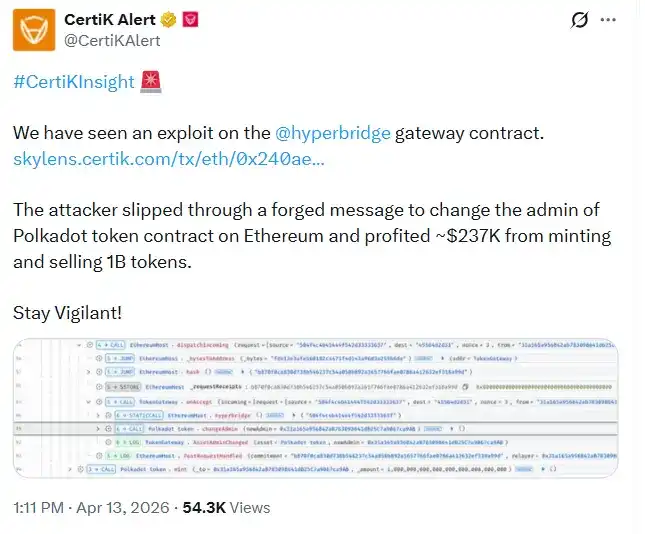
BlockSec Phalcon subsequently issued a technical alert, characterizing this vulnerability as an MMR proof replay vulnerability. According to their analysis, the root cause of the vulnerability lies in the fact that the replay protection of the HandlerV1 contract only verifies whether the hash of a request has been used before, but the proof verification process did not bind the submitted request payload to the proof being verified.

This logical flaw allowed the attacker to replay a historically valid proof and pair it with a newly constructed malicious request, thereby executing the ChangeAssetAdmin operation via the TokenGateway.onAccept() path, transferring the admin and minting permissions of the wrapped DOT contract on Ethereum (address: 0x8d...8F90b8) to an address controlled by the attacker.

On-chain data shows that after obtaining minting permissions, the attacker minted 1 billion wrapped DOT tokens, a quantity approximately 2805 times the reported circulating supply of about 356,000 tokens on Ethereum at the time.

Subsequently, the attacker exchanged the entire amount for approximately 108.2 ETH via Odos Router and Uniswap V4 liquidity pools, and transferred it to the attacker's external account, profiting about $237,000 at the time, with the gas cost for the entire attack being only about $0.74.

BlockSec Phalcon also mentioned that a previous attack using the same method had occurred, targeting MANTA and CERE tokens, resulting in a loss of about $12,000. The total combined loss from both attacks is approximately $242,000.

Following the incident, major South Korean exchanges Upbit and Bithumb announced the suspension of deposit and withdrawal services for DOT and the AssetHub Polkadot network to prevent potential fake deposit risks.

Polkadot officials stated that this vulnerability only affects DOT bridged to Ethereum via Hyperbridge, and does not affect DOT assets within the Polkadot ecosystem, nor DOT transferred via other bridges. Polkadot and its parachains, as well as native DOT, remain secure and unaffected. Hyperbridge has currently been suspended to investigate the issue.

It is worth mentioning that despite the minting scale reaching 1 billion tokens, the actual loss is far lower than the theoretical figure.Due to the extremely limited on-chain liquidity of wrapped DOT on Ethereum, the concentrated sell-off of 1 billion tokens instantly crashed the price of wrapped DOT from $1.22 to $0.00012831, a drop of 99.98%, rendering the vast majority of tokens unable to be effectively liquidated.

According to CoinMarketCap data, the price of native DOT tokens was also briefly dragged down by market sentiment, falling nearly 5%.

Users on X bluntly stated, who would have thought that DOT, once a cross-chain myth alongside Ethereum, would引爆 social media in this way. Cross-chain bridges have once again become the "Achilles' heel" of the crypto world. The once-deserted quiet has now turned into a scene of devastation and sighing. When 1 billion DOT appeared out of thin air, all technical indicators became worthless.

Other users jokingly remarked that low liquidity "saved Polkadot" in this incident by意外, limiting the actual loss to about $237,000.

However, while the low liquidity of bridged assets limited the hacker's profit, it exposed the potential fragility of the cross-chain interoperability layer.

It is reported that Hyperbridge, developed by Polytope Labs, is a cross-chain interoperability project within the Polkadot ecosystem, long positioning itself as trust-minimized cross-chain infrastructure with its core security mechanism relying on cryptographic proofs instead of multi-signature committees. The project had previously emphasized its resistance to common bridge attacks.
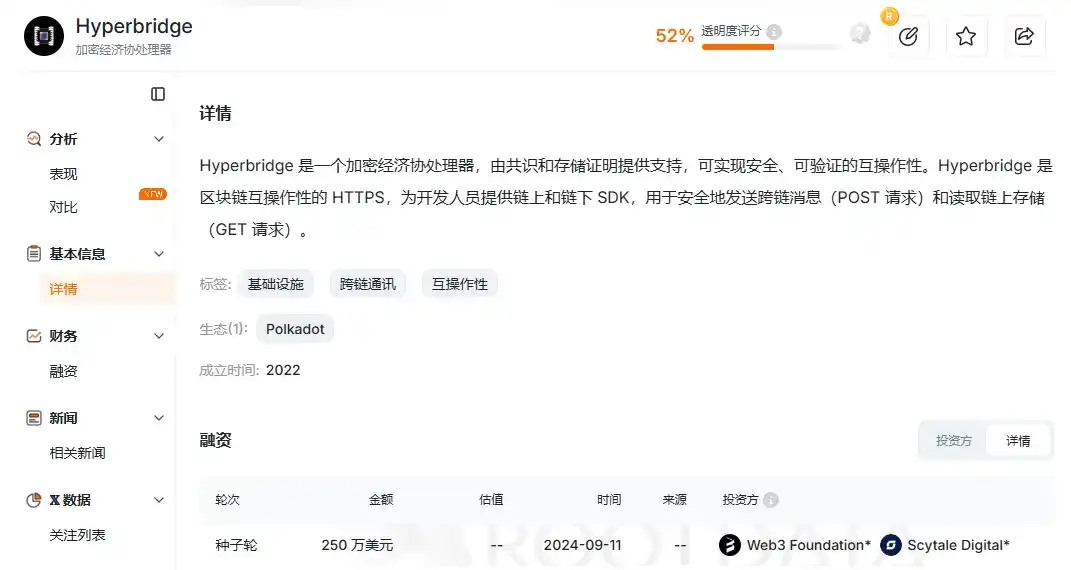
But this incident perhaps indicates that the integrity of the cryptographic proof mechanism itself is not sufficient to guarantee security; the specific implementation logic of the Gateway contract on the Ethereum side also constitutes an attack surface.

From a more macro perspective, this incident is a microcosm of the持续严峻 DeFi security landscape in 2026. Since the beginning of the year, several major attacks have occurred, including Venus generating $2.15 million in bad debt due to price manipulation, Resolve over-minting 80 million USR, and Drift losing over $285 million in assets. The attack methods varied and involved diverse areas.

Taking over minting rights for无限增发 is not a new attack模式. However, Hyperbridge's损失 was意外压低 due to its extremely shallow liquidity.

According to CertiK data, March alone recorded 46 security incidents, with total losses of approximately $39.8 million, the highest monthly record since November 2024. CertiK also pointed out that the increased frequency of code vulnerability exploits may be related to the rise of AI-assisted vulnerability mining tools.

The rise in attack frequency is also pushing the industry to重新审视 the boundaries of security and regulation. Circle's Chief Strategy Officer Dante Disparte previously, in response to the Drift Protocol theft, called for protocols, wallets, exchanges, and stablecoin issuers to treat security and accountability as a shared obligation. He suggested that DeFi protocols could develop on-chain technical protection measures参考 traditional market circuit breakers, and promote relevant legislation to enshrine property rights and financial privacy protection standards into law before the next major incident occurs.


热门币种推荐

相关问答

QWhat was the core vulnerability exploited in the Hyperbridge attack on April 13th?

AThe attack exploited an MMR proof replay vulnerability. The flaw was in the HandlerV1 contract, where the replay protection only checked if a request's hash had been used before, but the proof verification process did not bind the submitted request payload to the proof being validated. This allowed the attacker to replay a historically valid proof with a new, forged request.

QHow much wrapped DOT did the attacker mint, and why was the actual financial gain so low compared to the amount minted?

AThe attacker minted 1 billion wrapped DOT tokens. However, the actual financial gain was only about $237,000 because the on-chain liquidity for wrapped DOT on Ethereum was extremely limited. The massive sell-off crashed the token's price by 99.98%, from $1.22 to approximately $0.00012831, making it impossible to liquidate the vast majority of the tokens.

QWhich other tokens were previously targeted using the same attack method mentioned in the article?

AAccording to the article, the same attack method was previously used against MANTA and CERE tokens, resulting in losses of approximately $12,000.

QWhat was the official response from Polkadot regarding the scope and impact of this incident?

APolkadot official stated that the vulnerability only affected DOT that was bridged to Ethereum via Hyperbridge. It did not affect DOT within the Polkadot ecosystem, DOT bridged through other bridges, or native DOT. They confirmed that Polkadot, its parachains, and native DOT remained secure and unaffected. Hyperbridge was paused for investigation.

QWhat broader trend in DeFi security does this event represent, according to the article?

AThe article states this event is a reflection of the increasingly severe DeFi security landscape in 2026. It cites other major incidents like the Venus protocol ($2.15M in bad debt), Resolve (80M USR over-minted), and the Drift Protocol hack (over $285M). It also notes a rise in code vulnerability exploits, potentially linked to the emergence of AI-assisted bug-finding tools, with March alone seeing 46 security incidents totaling ~$39.8M in losses.

你可能也喜欢

奥特曼承认:高估了AI抢饭碗!黄仁勋:失业论完全搞反了

2025年10月,OpenAI CEO山姆·奥特曼曾预言可能出现由AI管理的大公司。然而在2026年7月的播客中,他改口称人们“并不真正想要一个AI CEO”,因为公司决策需要明确的责任归属和真人间的信任。他承认自己高估了AI消灭初级白领岗位的速度,“就业末日”大概率不会到来。 几乎同时,英伟达CEO黄仁勋在YC创业课上指出,“AI毁掉工作”的叙事完全搞反了。他认为,AI替代的是工作中的具体“任务”,而非整个“工作”。例如放射科医生和软件工程师,虽然AI承担了更多读片和写代码任务,但这些岗位的数量反而在增长,因为效率提升后业务规模扩大,产生了更多对沟通、判断、协调等AI无法替代的人类技能的需求。 马里兰大学与LinkUp的数据显示,截至2025年第四季度,美国整体招聘需求未被AI压垮,明确面向应届生的岗位比例甚至有所回升。报告指出,年轻员工可能更受益于AI工具,它能快速提供经验,使其变得“便宜又好用”。 然而,挑战依然存在:AI最先接管的正是数据录入、基础分析等标准化入门任务,这使得新人积累初期经验的传统路径变窄,入门台阶正在升高。 两位领袖的观点共同揭示了一个趋势:AI越强大,人类工作的核心价值就越向承担责任、建立信任、做出最终判断等层面集中。这些无法被机器替代的部分,构成了个人真正的职业护城河。

marsbit2小时前

奥特曼承认:高估了AI抢饭碗!黄仁勋:失业论完全搞反了

marsbit2小时前

每周编辑精选 Weekly Editor's Picks(0725-0731)

**每周编辑精选(0725-0731)摘要** 本文筛选深度分析,滤除资讯噪音,带来一周核心洞察。 **宏观局势**:美联储迎来近年“最不确定”会议。尽管经济数据为等待提供空间,但高通胀、地缘风险及官员鹰派表态,令市场无法完全排除加息风险,并已为此付费。 **投资与创业**: * 加密投资是长期心态博弈,获胜者需看清资产本质、确信趋势并能承受深度回撤。建议长线布局比特币与优质公链。 * 全球股市(尤科技股)呈现“币圈化”:叙事压倒估值,杠杆放大情绪,社交媒介加速共识极端化。 * Hyperliquid、Polymarket等龙头平台的跨界尝试遇阻,核心难点在于复制原有赛道的用户习惯与流动性深度。 * 多个加密协议收入增长但代币价格不涨,原因在于内部抛压、负面情绪及竞争。好协议不等于好代币,需审视收入、分配与释放机制。 **AI与存储**: * 英伟达信用违约率暴涨,反映市场对AI云设施扩张风险的定价。中国芯片产业崛起正撼动全球存储定价逻辑。 * 存储板块“一夜惊魂”是基本面与预期面脱节,市场已开始为2027年潜在供给过剩提前定价。 * AI烧钱凶猛,市场耐心受考验。多空分歧在于:需求真实但供给受限 vs. 未来回报可见度低。 * SK海力士虽录得史上最赚钱季度,但股价仍“不及预期”,显示市场对其未来增长空间的定价存在分歧。 **政策与稳定币**:美国《Clarity法案》推进至最后阶段,但道德条款等关键分歧仍存,且需与其他争议法案争夺有限表决时间,年内落地概率被下调。若未通过,对加密市场冲击或有限,但将增加未来立法难度。 **CeFi & DeFi**:Ondo代币近期上涨,源于其在链上交易美股主线动作密集,既占据上游代币化资产份额,又向下游拓展保证金应用。但受制于整体市场颓势,涨势更多是短期资金博弈。 **以太坊与扩容**:Lido正启动将800多万枚ETH迁移至Pectra升级后的新型验证器架构,这代表了staking资本管理效率的结构性提升,但不会直接降低用户Gas费用。当前ETH价格走弱,部分源于投资者对其价值增长逻辑感到困惑。 **其他要点**:TradeXYZ平台对A股新股定价展现高精准度;Pons平台币半月暴涨登顶Robinhood Chain;币印破产案例警示平台钱包并非资产托管;一周热点还包括美联储按兵不动、MiCA落地欧洲、长鑫科技上市创纪录、OpenAI称未来12个月将“震撼世界”等。

marsbit2小时前

每周编辑精选 Weekly Editor's Picks(0725-0731)

marsbit2小时前

交易

现货

热门文章

如何购买DOT

欢迎来到HTX.com!我们已经让购买Polkadot(DOT)变得简单而便捷。跟随我们的逐步指南,放心开始您的加密货币之旅。第一步:创建您的HTX账户使用您的电子邮件、手机号码注册一个免费账户在HTX上。体验无忧的注册过程并解锁所有平台功能。立即注册第二步:前往买币页面,选择您的支付方式信用卡/借记卡购买:使用您的Visa或Mastercard即时购买Polkadot(DOT)。余额购买:使用您HTX账户余额中的资金进行无缝交易。第三方购买:探索诸如Google Pay或Apple Pay等流行支付方法以增加便利性。C2C购买:在HTX平台上直接与其他用户交易。HTX场外交易台(OTC)购买:为大量交易者提供个性化服务和竞争性汇率。第三步:存储您的Polkadot(DOT)购买完您的Polkadot(DOT)后,将其存储在您的HTX账户钱包中。您也可以通过区块链转账将其发送到其他地方或者用于交易其他加密货币。第四步:交易Polkadot(DOT)在HTX的现货市场轻松交易Polkadot(DOT)。访问您的账户,选择您的交易对,执行您的交易,并实时监控。HTX为初学者和经验丰富的交易者提供了友好的用户体验。

1.8k人学过发布于 2024.03.29更新于 2026.06.02

如何购买DOT

相关讨论

欢迎来到HTX社区。在这里,您可以了解最新的平台发展动态并获得专业的市场意见。以下是用户对DOT(DOT)币价的意见。

活动图片