Solana RWA holders jump 440% YoY – Can it bridge gap to Ethereum’s XAUT?

ambcrypto发布于2026-04-06更新于2026-04-06

文章摘要

Solana's RWA ecosystem is experiencing explosive growth, with a 440% year-over-year surge in holders, totaling 218,000. This positions Solana as a major hub for tokenized real-world assets, which now have a total on-chain market cap of $24 billion. While Tether Gold (XAUT) on Ethereum leads the RWA market at $3.3 billion, Solana is gaining momentum through its strong focus on tokenized U.S. Treasuries. These assets, which make up over 50% of the RWA market, could generate revenue to strengthen Solana's digital asset treasuries (DATs) and support long-term network growth. The IMF has warned that the rapid growth of on-chain RWAs could disrupt traditional finance. Solana's expansion in this sector suggests it could become a viable alternative to Ethereum for institutional capital seeking tokenized assets.

When the International Monetary Fund (IMF) sounds the alarm, it signals that the threat is real.

Recently, the IMF has been pointing out how fast the Real World Asset (RWA) market is growing on-chain, warning that TradFi players could fall behind if this keeps up.

The logic is simple: More real-world capital is moving onto blockchain, which could change how central banks manage money and financial stability.

Notably, the numbers back it up.

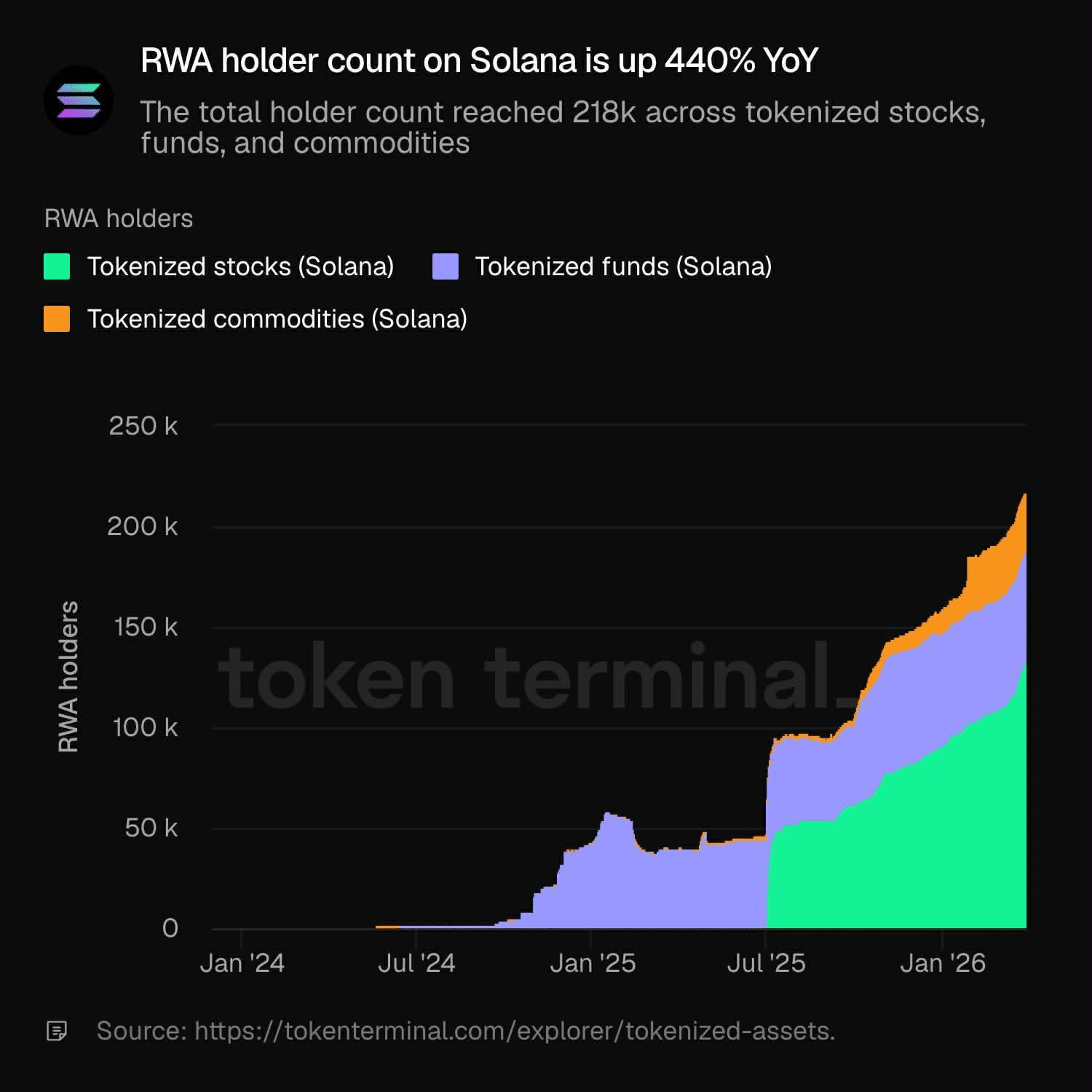
The on-chain market cap of total RWAs has just hit a new all-time high of $24 billion, with Tether Gold [XAUT] leading the pack at $3.3 billion. What’s really interesting is how the market reacted immediately, with much of the momentum flowing toward Solana [SOL] as more investors look to take advantage of its growing RWA ecosystem.
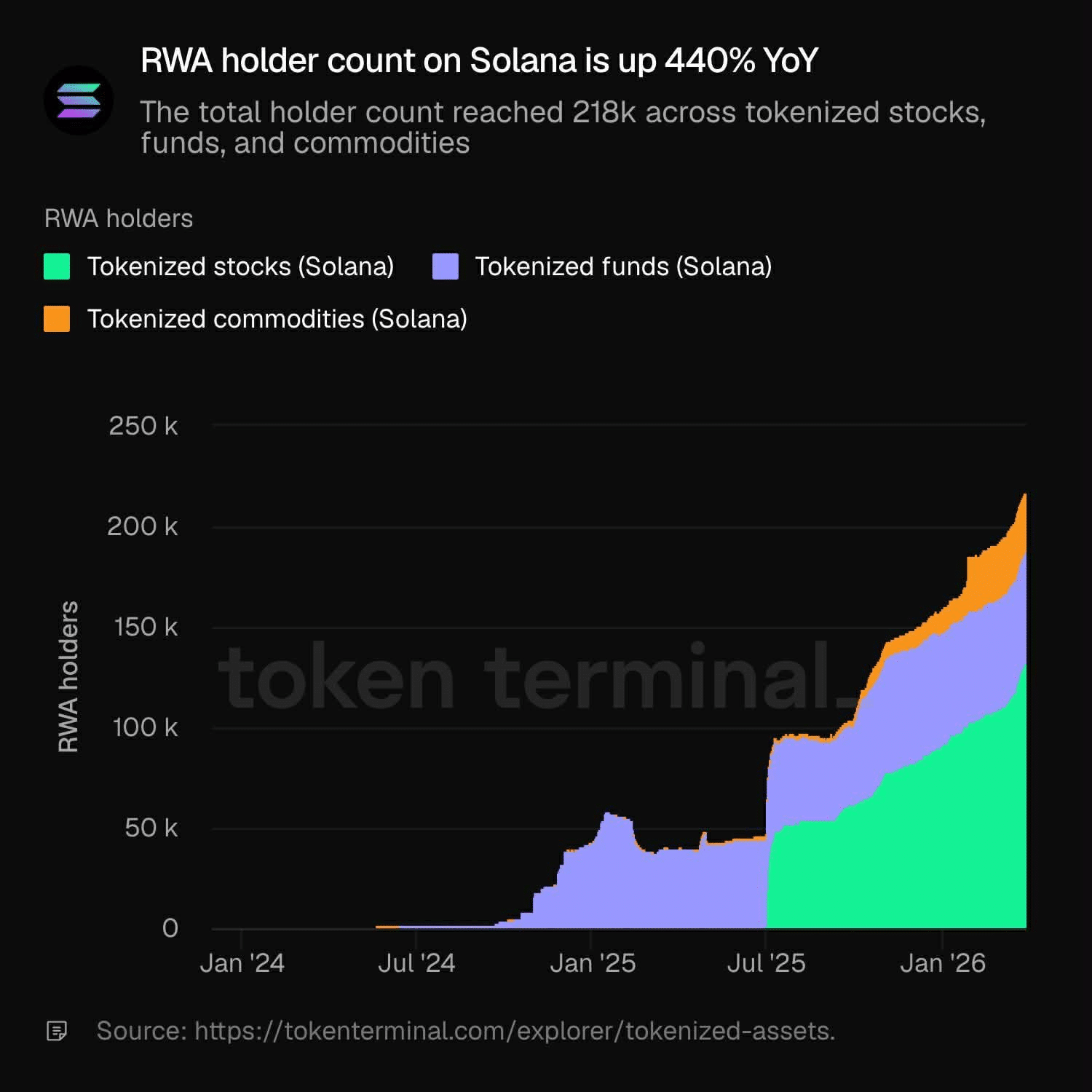
Source: Token Terminal

The real story? Solana’s RWA holder count.

As the chart showed, the number of RWA holders on Solana was up 440% year-over-year, totaling 218,000 across tokenized stocks, funds, and commodities.

This surge signals more than hype.

Instead, it’s a clear sign that Solana is becoming a go-to network for tokenized real-world assets.

Against this backdrop, the IMF’s raising alarms starts to make sense.

XAUT’s lead in the RWA space is particularly noteworthy. Its growth comes at a time of heightened geopolitical tensions, which usually push capital into traditional safe havens.

But instead of sticking to the old playbook, investors are flowing into a tokenized version of gold, showing how RWAs are changing the way capital moves.

That said, this also complicates the narrative around Solana as the go-to network for RWAs.

XAUT currently trades only on Ethereum [ETH], raising the question: Can Solana capture this momentum indirectly, or does it need its own tokenized gold options to really cement its position in the RWA space?

Solana’s long road to dominating tokenized real-world assets

At the aggregate level, the RWA market is over 50% made up of U.S. Treasury assets.

Solana is clearly positioning itself to capture a slice of this momentum.

According to RWA.xyz, after stablecoins, Solana’s most concentrated RWAs are U.S. Treasuries, essentially tokenized versions of government debt that allow investors to hold U.S. debt on-chain and earn routine interest.

This is significant for a few reasons. Solana treasury companies are showing weak price action. Every small pump gets retraced, signaling that market confidence in treasuries hasn’t caught up with on-chain growth yet.

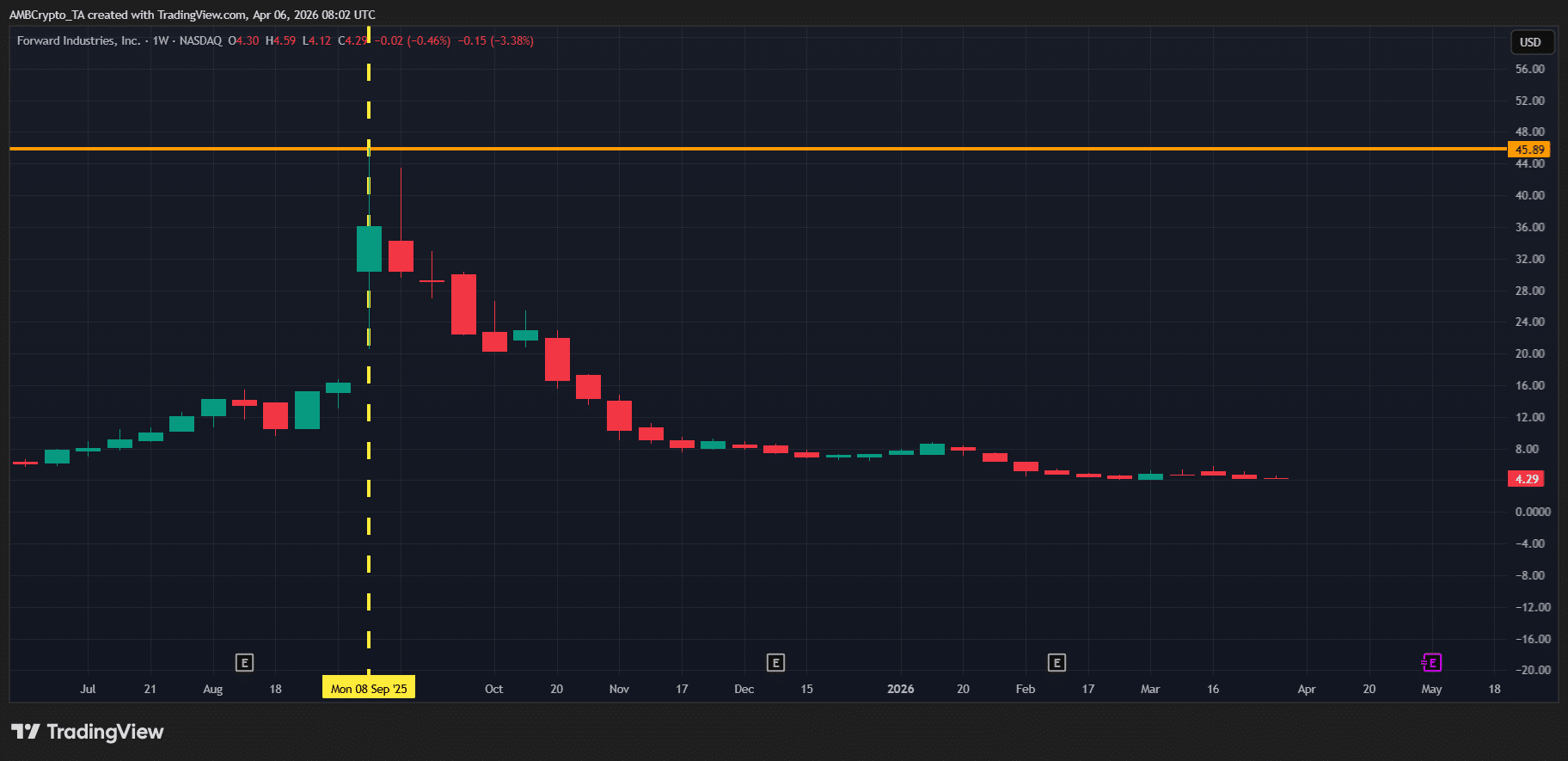
Take the largest SOL DAT, Forward Industries (NASDAQ: FWDI), for instance. It’s still over 80% below its pre-October crash levels.
Source: TradingView (FWDI/USD)

Against this backdrop, Solana’s RWA flows act as a key catalyst.

On a macro level, tokenized U.S. Treasuries could generate revenue for Digital Asset Treasuries (DATs), which can then be used to stockpile more SOL.

With Solana already holding a strong position in tokenized bonds, this is a tangible strategy that can strengthen treasuries and support long-term network growth.

Looking at the bigger picture (RWA market growth, Solana’s rising RWA holder count, and strong capital flows into U.S. Treasuries), Solana could emerge as a viable alternative to Ethereum’s XAUT play.

If the network continues to expand its RWA ecosystem, it has the potential to establish itself as a leading hub for tokenized assets, attracting substantial institutional capital in the process.


Final Summary

  • Solana is emerging as a major hub for on-chain RWAs, with a 440% YoY increase in holders.
  • Strong flows into tokenized U.S. Treasuries could make Solana a viable alternative to Ethereum’s XAUT, offering a pathway to strengthen DATs.


热门币种推荐

相关问答

QWhat is the year-over-year growth in the number of RWA holders on the Solana network, and what does this surge signify?

AThe number of RWA holders on Solana grew by 440% year-over-year, totaling 218,000. This surge is more than just hype; it's a clear sign that Solana is becoming a go-to network for tokenized real-world assets.

QWhich token is the on-chain RWA market cap leader, and on which blockchain does it currently trade?

ATether Gold (XAUT) is the on-chain RWA market cap leader with $3.3 billion. It currently trades only on the Ethereum blockchain.

QAccording to the article, what is the primary component (over 50%) of the aggregate RWA market?

AU.S. Treasury assets make up over 50% of the aggregate RWA market.

QWhat potential strategy is mentioned for Solana's Digital Asset Treasuries (DATs) to strengthen themselves and support long-term network growth?

ATokenized U.S. Treasuries could generate revenue for Digital Asset Treasuries (DATs), which can then be used to stockpile more SOL, thereby strengthening the treasuries and supporting long-term network growth.

QWhat key concern does the International Monetary Fund (IMF) raise regarding the article's subject matter?

AThe IMF warns that the fast-growing Real World Asset (RWA) market on-chain could cause traditional finance (TradFi) players to fall behind, potentially changing how central banks manage money and financial stability.

你可能也喜欢

HIVE首席执行官:用于AI的GPU每小时收入比挖矿业务高10倍

加拿大上市公司HIVE首席执行官近期指出,人工智能(AI)计算业务的经济效益已远超比特币挖矿。据其透露,公司部署在曼尼托巴省贝尔加拿大AI基础设施中的504块NVIDIA B200 GPU集群,每小时每GPU收入约2.90美元,而比特币挖矿设备每小时仅产生约0.12美元,前者收益是后者的20倍以上。 基于此,HIVE将下半年战略重点转向更高收益的AI基础设施投资,同时维持其比特币挖矿业务。2026财年,公司比特币平均算力达22.2 EH/s,同比增长290%,占全网算力约3%,共开采2,885枚BTC。全年总收入达2.978亿美元,其中比特币挖矿收入增长164%,而专注于AI与高性能计算(HPC)的BUZZ HPC部门收入为1950万美元,同比增长94%。 HIVE的转型始于三年前对NVIDIA芯片的7000万美元投资,这使其在AI计算需求激增时占据了先机。公司近期获得了Chardan Capital的“买入”评级及7.50美元目标价,并与贝尔及AI初创公司Cohere签署了价值约2.2亿美元的GPU云服务协议,同时通过债券融资7500万美元用于进一步发展AI基础设施。 其最雄心勃勃的项目是多伦多地区在建的320兆瓦AI数据中心,预计2027年下半年全面运营后可容纳超10万块GPU,实现约3.6亿美元的年经常性收入。HIVE并非孤例,竞争对手如MARA、Hut 8和Terawulf也纷纷将有限电力资源转向利润更高的AI与HPC合约,这反映了在比特币挖矿利润缩减的背景下,上市矿企的普遍战略转移。 HIVE的近期目标是在本财年末将AI与HPC业务年收入提升至当前水平的十倍,这很大程度上取决于多伦多数据中心及后续GPU云服务合约能否按时推进。

cryptonews.ru32分钟前

HIVE首席执行官:用于AI的GPU每小时收入比挖矿业务高10倍

cryptonews.ru32分钟前

灰度认为,3000个链上金库管理着超过70亿美元资产,将成为加密货币领域的下一个突破

灰度(Grayscale)认为,区块链“金库”(Vaults)有望成为加密货币领域的下一项突破性创新,并进入主流应用。金库通过汇集投资者资金,将其配置于产生收益的策略中,类似于传统金融中的担保贷款凭证(CLO),但关键区别在于其基于区块链的基础设施。 传统CLO依赖托管人、受托人等中介机构,而区块链金库利用以太坊、Base和Solana等网络上的智能合约直接管理资产和处理交易。这种架构为投资者提供了实时投资组合和交易状态的可视性,有可能降低管理成本、提高流动性,并实现“完全的透明度、运营效率和潜在的更高流动性”。 目前该市场仍处于早期阶段。据灰度估算,已有超过3000个金库持有约70亿美元的资产,由57名管理者(策展人)运营,其中79%的策略专注于稳定币。相比之下,全球CLO市场规模约为1.5万亿美元。 报告指出,主要障碍在于监管不确定性。如果金库的策展人在策略选择、资产分配或风险管理方面拥有自主权,可能引发美国证券法、投资公司法规方面的审查。机构投资者在投入大额资金前,需要明确的托管、合规和投资者保护标准。 尽管存在挑战,灰度认为金库潜力巨大,其成功将取决于行业能否在保持智能合约效率的同时,满足传统金融的法律和运营标准。

cryptonews.ru35分钟前

灰度认为,3000个链上金库管理着超过70亿美元资产,将成为加密货币领域的下一个突破

cryptonews.ru35分钟前

交易

现货

热门文章

相关讨论

欢迎来到HTX社区。在这里,您可以了解最新的平台发展动态并获得专业的市场意见。以下是用户对XAUT(XAUT)币价的意见。

活动图片