Prediction markets, the current hot topic. But when you dive deep, every time you press Yes/No, the gears of fate begin to turn.
This article attempts to analyze controversial topics on prediction markets (primarily Polymarket), exploring their manipulability within binary博弈 (game theory of binary outcomes).
Case Selection
Who will HBO identify as Satoshi?
How many gifts will Santa deliver in 2025
Israel strikes Gaza by...?
And attempts to discuss potential market intervention methods from perspectives like psychology/group effects/house game theory/mass communication.
"Who is Satoshi" Bet: The Market Refuses to Believe the Truth
Around the release of HBO's "Money Electric: The Bitcoin Mystery," a contract on Polymarket became a classic example of "narrative diverging from fact": "Who will HBO identify as Satoshi?" (October 2024).
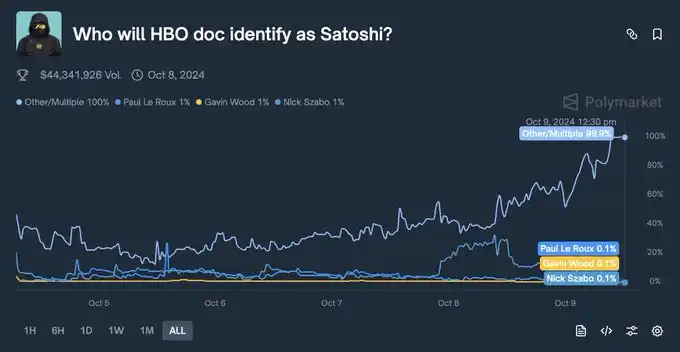
On the surface, this was a collective guessing game about the crypto world's ultimate unsolved case, with participants trying to bet on who the documentary would name as Bitcoin's creator: Len Sassaman, Hal Finney, Adam Back, or Peter Todd, who never appeared on any long conspiracy theory list.
The vast majority of cryptocurrency community members, KOLs, and media firmly believed HBO would reveal the late cryptographer Len Sassaman. Because Len's life story fit the characteristics of Satoshi, and his tragic, legendary image aligned with HBO's narrative aesthetic.
And Len Sassaman's probability (Yes) soared to 68% - 70%.

The key lies in the timeline.
Some journalists and insiders who were invited to early media screenings began leaking clips on Twitter and dark web forums. The leaked clips and screenshots clearly showed director Cullen Hoback questioning another developer, Peter Todd, and attempting to portray him as Satoshi.
Peter Todd himself even posted on Twitter mocking the director, indirectly confirming he was a main subject of the documentary. At the same time, preview articles and headlines from multiple media outlets already used phrases like "doc identifies Peter Todd as Satoshi".

Despite this, the most fascinating part emerged. Even with screenshots out, the price for Len Sassaman on Polymarket didn't crash, still holding at a high of 40%-50%!
Because the community refused to believe. People brainwashed each other in the comments: "This is just an HBO red herring," "Peter Todd is just a supporting character, the final big twist will definitely be Len."
At this point, opportunity arose. The odds for Peter Todd / Other options were extremely attractive (at one point only 10%-20%).
This was like "picking gold bars from the bargain bin."
——When and only when fact contradicts desire, Alpha is greatest.
People wanted it to be Len Sassaman so badly (because he is deceased, wouldn't dump Bitcoin, and has a poignant story). This emotional preference blinded rational judgment. In prediction markets, never bet on what you "hope" will happen, only bet on facts.
And the rules themselves stated: "who will HBO identify as Satoshi", not "who really is Satoshi".
Media narrative + emotional resonance. Just give the market a compelling enough story, and the price will willingly deviate from fact.
"Santa Code Gate": When Hardcoding Becomes an Option
The second incident seemed more lighthearted: the NORAD Santa Tracker project. Every Christmas, NORAD displays the "number of gifts Santa delivers" on a dedicated website. In 2025, this fun project became a guessing subject on Polymarket: "How many gifts will Santa deliver in 2025?"
Then, someone opened the browser console.
Technical traders found a hardcoded value precise to the single digit: 8,246,713,529 in the front-end JS/JSON files of noradsanta.org. This number was logically similar to the "gift count" from previous years, yet significantly lower than the reasonable range projected based on historical growth rates (8.4–8.5B), more like a temporary script filled in by a programmer rushing to meet a deadline.
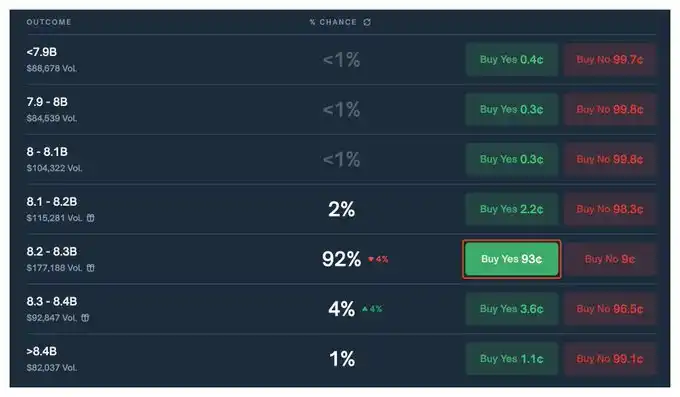
In the market's eyes, this hardcode was quickly interpreted as the "ultimate answer":
- The corresponding "8.2–8.3B" range contract price surged from around 60% to over 90%;
- Substantial funds saw this as cashing in on an "information advantage," treating the remaining few percentage points as arbitrage for the taking.
But the真正微妙的地方在于: once the leak was widely used by traders, the hardcode itself became a triggerable variable.
The NORAD website is centrally maintained; the developers have full authority to override the pre-written value at the last moment; when "lazy developer" and "hardcode fraud" become part of the social舆论 (public opinion), the maintainers even have an incentive to change the value in real-time to prove they are not a slapdash organization.

This means that for those who bought large positions in the "8.2–8.3B=Yes" at 0.93, what they were truly betting against was not how many gifts Santa "delivered," but whether a developer would change that string of numbers in the final commit before going live.
Structurally, this market allows multiple "intervention methods" to exert significant leverage on the price.
The NORAD website is centrally maintained; the developers have full authority to override the pre-written value at the last moment. When "lazy developer" and "hardcode fraud" become part of the social narrative, the maintainers even have an incentive to change the value in real-time to prove they are not a slapdash organization.
This means that for those who bought large positions in the "8.2–8.3B=Yes" at 0.93, what they were truly betting against was not how many gifts Santa "delivered," but whether a developer would change that string of numbers in the final commit before going live.
Here, the prediction market is no longer "predicting an objective random variable," but provides a derivative field for a small group controlling the system's switches to "bet on how their actions will be interpreted by the outside world." The person writing the front-end code naturally possesses the dual power of "spoiler +随时篡改 (tampering at any time)."
Technical players deploying code crawlers early can establish positions before most people are even aware the hardcode exists; media or influencers can indirectly influence whether the maintainers adjust their strategy by amplifying the narrative of the "hardcode scandal."
Here, the prediction market is no longer about predicting an objective random variable, but provides a derivative field for a small group controlling the system's switches to bet on how their actions will be interpreted by the outside world.
"Gaza Strike" Contract: The Scripted Kill in the Pre-Dawn Market
The third incident had the most real-world impact. Thanks to @ec_unoxx's summary, the trader is @poliedge100, Teacher Little Alligator.
A contract centered on "whether Israel would strike Gaza before a specific deadline"上演了一场 (staged) an extremely "scripted" price washout in the tail-end phase临近到期 (approaching expiration).
Initially, the market widely believed the probability of a large-scale strike before the deadline was limited, with the "No" price staying in the high range of 60%–80% for a long time. As time passed, "nothing happening" itself seemed to continuously reinforce the validity of "No".
Then came the familiar rhythm: pre-dawn hours +舆论攻势 (public opinion offensive) + panic selling.
- In the platform's comments section, the "Yes" side began密集张贴 (intensively posting) unverified screenshots, local media links, even old news, creating a narrative atmosphere of "the strike has already happened, just the major media is slow to react."
- Simultaneously, large sell orders appeared on the order book, actively breaking through (smashing through) the support for "No", pushing the price down to the "junk zone" of 1%–2%.
For holders极度依赖情绪 (extremely reliant on emotion) for information, this series of actions was enough to create an "endgame illusion":
"Since someone is selling off to escape, and the comments are all saying it happened, it must be that I missed the news."
While this panic was being manufactured, a small group of people坚持做事实核查 (persisting in fact-checking) came to a completely different conclusion from another direction:
- Before the preset deadline, there was no sufficiently clear, consistently recognized by authoritative media, and符合合约规则定义的 (meeting the contract rule definition) evidence of an "airstrike";
- From a textual rule perspective, "No" still had a high probability of being the final legitimate settlement result.
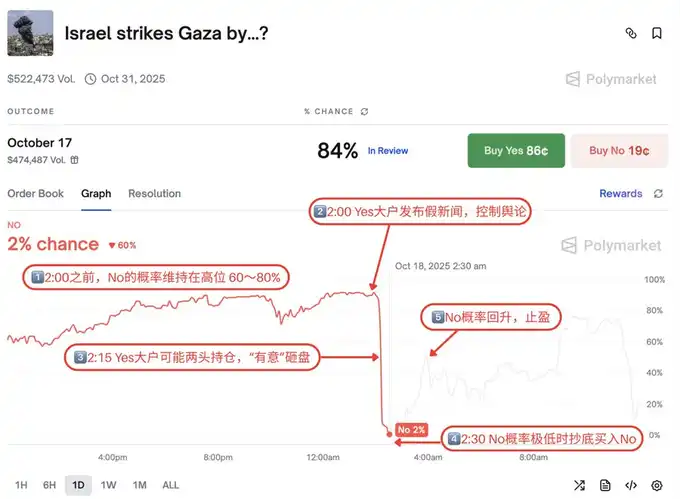
Thus, an asymmetric lottery ticket appeared again structurally:
- The market price treated "No" as a 1% minor probability;
- Textual evidence and rule interpretation suggested a现实概率 (realistic probability) far higher than 1%.
What truly sparked controversy was the scene after settlement:
- After the tail-end session, someone proposed settling as "Yes", entering a limited dispute period;
- Due to procedural reasons or insufficient resources from participating parties, this settlement direction was ultimately not successfully overturned;
- The contract was最终锁定 (finally locked) as "Yes", and many who insisted on a textual rule interpretation could only argue afterwards "whether this conformed to the original rule design," but couldn't change the flow of funds.
This accident exposed the "greenhouse effect" of prediction markets极为赤裸 (extremely赤裸裸, nakedly):
- Public opinion can cause price collapses in a short time;
- Capital can create the false appearance of "smart money retreating" through self-directed selling;
- Ultimate settlement power often lies in the hands of a very few parties with resources and organizational capacity.
This is no longer "deviation of collective wisdom," but a manipulation space formed by the amalgamation of narrative, capital, and rule interpretation power.
To summarize, in the three cases above, prediction markets present another picture:
- For news initiators and media
Every prediction market can be seen as a real-time thermometer for narrative influence.
Documentary directors, PR teams, topic creators can all adjust their output rhythm by observing the order book: which candidates to continue hyping, which plots need more drama.
In some extreme cases, content creators can even "reverse" utilize the order book, writing market preferences back into the script.
- For project parties / platforms
The ambiguity of rules, the choice of settlement sources, the design of dispute mechanisms, all directly affect "who profits from tail-end events."
Ambiguous oracles, broad discretionary power, equate to reserving a "gray space" that can be used by organized forces.
In this space, prediction markets are no longer passive "result registries," but active tools for liquidity momentum building.
- For participants (retail investors / KOLs / communities)
Comment sections, social media, and various secondary interpretations constitute a整套 (complete set) of psychological leverage that can be exploited.
By集中发布 (centrally publishing) "seemingly authoritative" screenshots, links, out-of-context news headlines, actors can push prices from rational ranges into panic or frenzy zones in a short time.
In this structure, those with stronger discourse power (KOLs, big Vs, research accounts) naturally possess the ability to manipulate narratives.
- For hackers and "system players"
Monitoring front-end code, data source updates, news APIs, even oracle mechanisms本身就可以成为 (can themselves become) systematic strategies.
Capturing hardcodes, configuration errors, rule edge cases in advance, and then building positions before the market reacts, is a form of high-leverage "structured alpha."
More aggressive players will directly research: how to legally or "edge" influence settlement information sources, making the world "appear" consistent with their position direction for a short time.
Finally, quoting @LeotheHorseman Teacher Horse Man's x pinned tweet:
The truthfulness of information feels irrelevant now (in both epistemological and practical senses), what people are willing to pay for is reality. Perhaps the most important proposition of the current era is how the pricing of information and the information of pricing interact with each other.