Vitalik Buterin pitches ZK-proofs to audit X algorithm and rankings

cointelegraphОпубликовано 2025-12-15Обновлено 2025-12-15

Введение

Vitalik Buterin, co-founder of Ethereum, has proposed that social media platform X use zero-knowledge proofs (ZK-proofs) and blockchain technology to make its content-ranking algorithm transparent and verifiable. He argues this would prove the fairness of algorithmic decisions, prevent censorship, and ensure data integrity by timestamping content on-chain. Buterin also suggests publishing the full algorithm code with a 1-2 year delay. His comments follow criticism of Elon Musk’s leadership and X’s opaque content policies. The proposal aligns with broader SocialFi and decentralized social media principles, emphasizing the need for transparency amid growing regulatory scrutiny, such as the EU’s Digital Services Act, which recently fined X for non-compliance. Buterin’s stance highlights concerns about social media’s impact on free speech and misinformation.

Ethereum co-founder Vitalik Buterin is calling for social media platforms to use cryptography and blockchain tools to make their content-ranking systems more transparent and verifiable.

In a Monday X post, Buterin argued that X should use zero-knowledge proofs (ZK-proofs) and blockchain to prove the fairness of the algorithm that determines the reach of content on the platform. He raised an issue with how X operates on Dec. 9, claiming that its owner Elon Musk’s way of leading it is harmful:

“Elon Musk I think you should consider that making X a global totem pole for free speech, and then turning it into a death star laser for coordinated hate sessions, is actually harmful for the cause of free speech.“

Ethereum Foundation AI lead Davide Crapis reacted to this initial idea by saying, “If you want to claim X is the platform for free speech, you should disclose your algorithm optimization targets.” He added that “it should be legible to the users, and tweakable.”

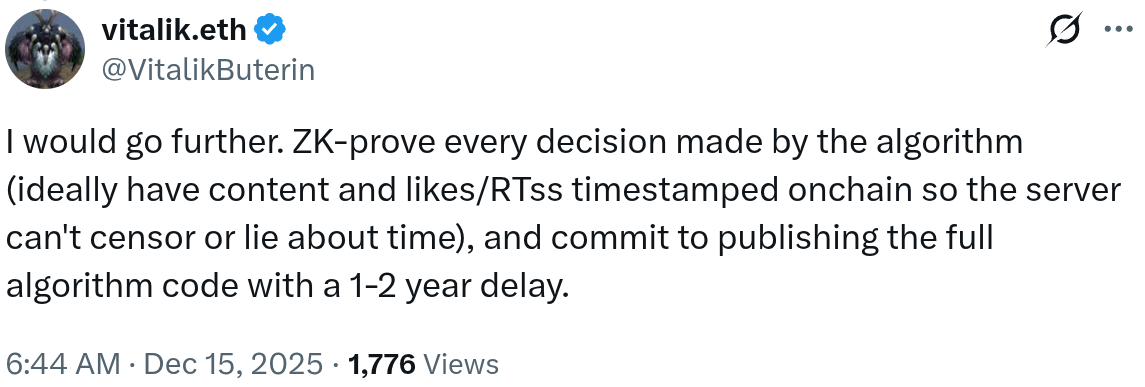
Buterin suggested a verifiable system that employs ZK-proofs for every decision made by the algorithm and timestamps all content, likes, and retweets on a blockchain “so the server can’t censor or lie about time.” The platform should also “commit to publishing the full algorithm code with a 1-2 year delay.”

Source: Vitalik Buterin

ZK-proofs are a cryptographic way to prove that something is true without revealing the underlying data — for instance, proving that you are over 18 without sharing your full name. Buterin did not go into detail about what proofs would demonstrate in his suggested solution, but they would likely show that algorithmic decisions followed certain constraints without sharing sensitive details.

Related: Sunlight is more effective than censorship

Crypto takes on social media

Buterin’s post echoed the sentiment behind some decentralized social media platforms known as SocialFi. Such initiatives, despite none having reached mainstream adoption, appear to be taken seriously by their traditional centralized equivalents.

In early 2025, Meta, the parent company of Facebook and Instagram, blocked links to a decentralized Instagram competitor called Pixelfed. All links to the platform were labeled as “spam” and removed immediately. Others claimed that Facebook competitors, including Mastodon, were given the same treatment.

The crypto community — with its tendency to be wary of centralized control — has raised concerns about the potential impact of decisions made by social media platform leadership in the past. When Musk announced in early January that X would prioritize promoting content deemed informative or educational over other types of content, many were not convinced.

Critics questioned who would decide what qualifies and whether the policy could become a vehicle for suppressing certain viewpoints. Musk has also been accused by critics of limiting access to premium features for users who disagreed with him.

Buterin also chimed in at the time. He urged Musk to remain committed to free speech on the platform and not ban users for disagreements or expressing views.

Related: Buterin says X’s new location feature ‘risky’ as crypto users flag privacy concerns

The impact of social media on society

Research has long shown that social media has an outsized impact on society and the functioning of democratic processes. A paper published in 2024 suggested that “access to Facebook may increase belief in misinformation.”

Reuters also reported last month that recent court filings suggested that Meta shut down internal research into the mental health effects of Facebook after finding causal evidence that its products harmed users’ mental health. The study found that “people who stopped using Facebook for a week reported lower feelings of depression, anxiety, loneliness, and social comparison.”

The European Union attempted to tackle the issue with its Digital Services Act, which requires transparency on the main algorithm parameters and requires platforms to assess the risk and disclose the findings on the potential negative impact of their operations. Impacts considered explicitly include “negative effects on civic discourse and electoral processes, and public security.”

The Digital Services Act also requires that vetted researchers be given access to platform data to study their systemic risk independently. A lack of compliance by X with this specific requirement is among the reasons cited by the European Commission for imposing a 120 million euro fine earlier this month.

Other reasons include a lack of transparency on X’s ads repository and the platform’s blue checkmark purportedly deceiving users since “anyone can pay to obtain the ‘verified’ status without the company meaningfully verifying who is behind the account.”

Похожее

Google and Amazon Simultaneously Invest Heavily in a Competitor: The Most Absurd Business Logic of the AI Era Is Becoming Reality

In a span of four days, Amazon announced an additional $25 billion investment, and Google pledged up to $40 billion—both direct competitors pouring over $65 billion into the same AI startup, Anthropic. Rather than a typical venture capital move, this signals the latest escalation in the cloud wars. The core of the deal is not equity but compute pre-orders: Anthropic must spend the majority of these funds on AWS and Google Cloud services and chips, effectively locking in massive future compute consumption. This reflects a shift in cloud market dynamics—enterprises now choose cloud providers based on which hosts the best AI models, not just price or stability. With OpenAI deeply tied to Microsoft, Anthropic’s Claude has become the only viable strategic asset for Google and Amazon to remain competitive. Anthropic’s annualized revenue has surged to $30 billion, and it is expanding into verticals like biotech, positioning itself as a cross-industry AI infrastructure layer. However, this funding comes with constraints: Anthropic’s independence is challenged as it balances two rival investors, its safety-first narrative faces pressure from regulatory scrutiny, and its path to IPO introduces new financial pressures. Globally, this accelerates a "tri-polar" closed-loop structure in AI infrastructure, with Microsoft-OpenAI, Google-Anthropic, and Amazon-Anthropic forming exclusive model-cloud alliances. In contrast, China’s landscape differs—investments like Alibaba and Tencent backing open-source model firm DeepSeek reflect a more decoupled approach, though closed-source models from major cloud providers still dominate. The $65 billion bet is ultimately about securing a seat at the table in an AI-defined future—where missing the model layer means losing the cloud war.

marsbit30 мин. назад

Google and Amazon Simultaneously Invest Heavily in a Competitor: The Most Absurd Business Logic of the AI Era Is Becoming Reality

marsbit30 мин. назад

Computing Power Constrained, Why Did DeepSeek-V4 Open Source?

DeepSeek-V4 has been released as a preview open-source model, featuring 1 million tokens of context length as a baseline capability—previously a premium feature locked behind enterprise paywalls by major overseas AI firms. The official announcement, however, openly acknowledges computational constraints, particularly limited service throughput for the high-end DeepSeek-V4-Pro version due to restricted high-end computing power. Rather than competing on pure scale, DeepSeek adopts a pragmatic approach that balances algorithmic innovation with hardware realities in China’s AI ecosystem. The V4-Pro model uses a highly sparse architecture with 1.6T total parameters but only activates 49B during inference. It performs strongly in agentic coding, knowledge-intensive tasks, and STEM reasoning, competing closely with top-tier closed models like Gemini Pro 3.1 and Claude Opus 4.6 in certain scenarios. A key strategic product is the Flash edition, with 284B total parameters but only 13B activated—making it cost-effective and accessible for mid- and low-tier hardware, including domestic AI chips from Huawei (Ascend), Cambricon, and Hygon. This design supports broader adoption across developers and SMEs while stimulating China's domestic semiconductor ecosystem. Despite facing talent outflow and intense competition in user traffic—with rivals like Doubao and Qianwen leading in monthly active users—DeepSeek has maintained technical momentum. The release also comes amid reports of a new funding round targeting a valuation exceeding $10 billion, potentially setting a new record in China’s LLM sector. Ultimately, DeepSeek-V4 represents a shift toward open yet realistic infrastructure development in the constrained compute landscape of Chinese AI, emphasizing engineering efficiency and domestic hardware compatibility over pure model scale.

marsbit1 ч. назад

Computing Power Constrained, Why Did DeepSeek-V4 Open Source?

marsbit1 ч. назад

Торговля

Спот
Фьючерсы

Популярные статьи

Как купить ZK

Добро пожаловать на HTX.com! Мы сделали приобретение ZKsync (ZK) простым и удобным. Следуйте нашему пошаговому руководству и отправляйтесь в свое крипто-путешествие.Шаг 1: Создайте аккаунт на HTXИспользуйте свой адрес электронной почты или номер телефона, чтобы зарегистрироваться и бесплатно создать аккаунт на HTX. Пройдите удобную регистрацию и откройте для себя весь функционал.Создать аккаунтШаг 2: Перейдите в Купить криптовалюту и выберите свой способ оплатыКредитная/Дебетовая Карта: Используйте свою карту Visa или Mastercard для мгновенной покупки ZKsync (ZK).Баланс: Используйте средства с баланса вашего аккаунта HTX для простой торговли.Третьи Лица: Мы добавили популярные способы оплаты, такие как Google Pay и Apple Pay, для повышения удобства.P2P: Торгуйте напрямую с другими пользователями на HTX.Внебиржевая Торговля (OTC): Мы предлагаем индивидуальные услуги и конкурентоспособные обменные курсы для трейдеров.Шаг 3: Хранение ZKsync (ZK)После приобретения вами ZKsync (ZK) храните их в своем аккаунте на HTX. В качестве альтернативы вы можете отправить их куда-либо с помощью перевода в блокчейне или использовать для торговли с другими криптовалютами.Шаг 4: Торговля ZKsync (ZK)С легкостью торгуйте ZKsync (ZK) на спотовом рынке HTX. Просто зайдите в свой аккаунт, выберите торговую пару, совершайте сделки и следите за ними в режиме реального времени. Мы предлагаем удобный интерфейс как для начинающих, так и для опытных трейдеров.

450 просмотров всегоОпубликовано 2024.06.17Обновлено 2025.03.21

Как купить ZK

Обсуждения

Добро пожаловать в Сообщество HTX. Здесь вы сможете быть в курсе последних новостей о развитии платформы и получить доступ к профессиональной аналитической информации о рынке. Мнения пользователей о цене на ZK (ZK) представлены ниже.

活动图片