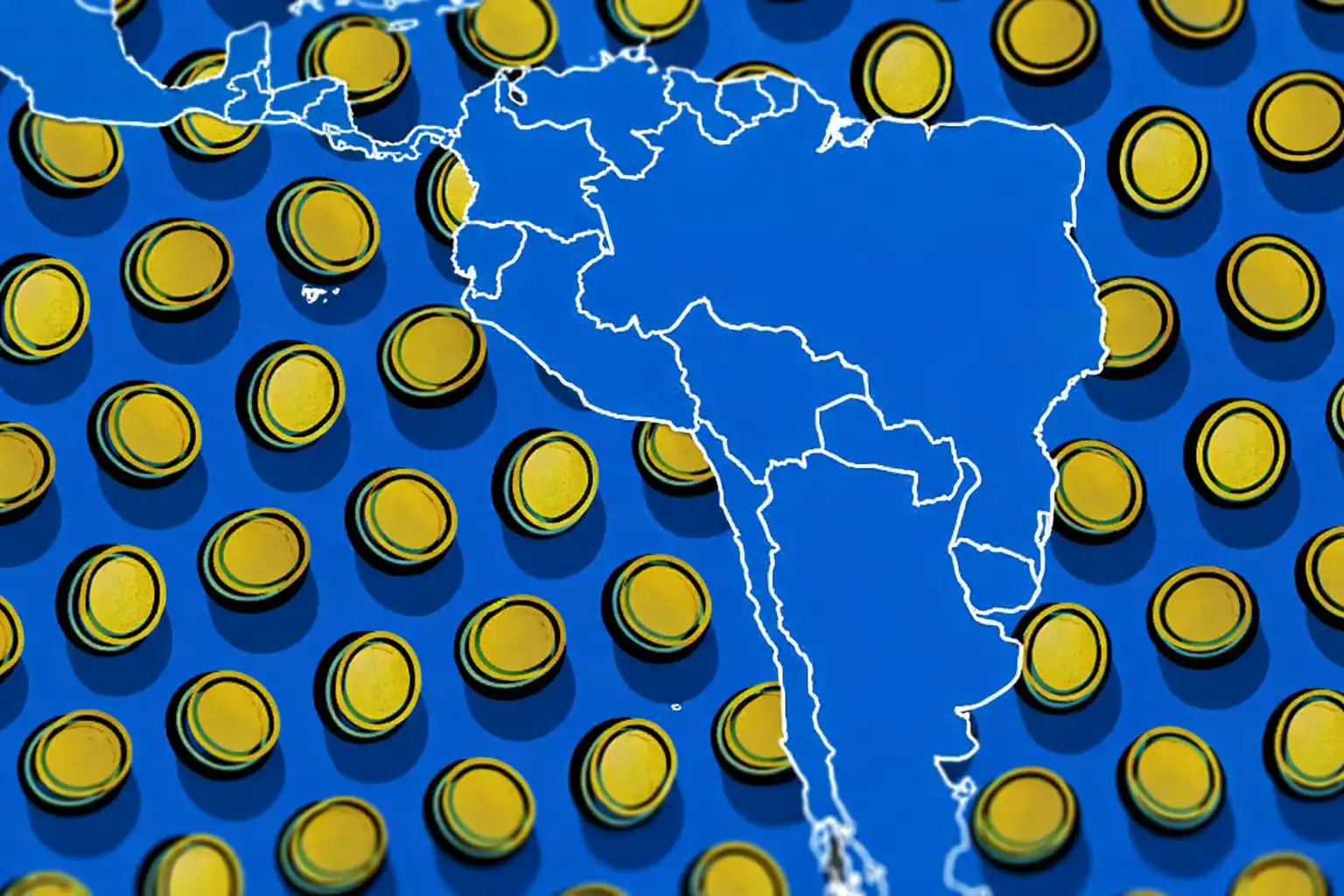
US Capital Bets Big on Latin America: Wagering Not on Growth, but on the 'Key Nodes' of the Financial System

marsbitОпубликовано 2026-03-19Обновлено 2026-03-19

Введение

U.S. capital is increasingly investing in Latin America, focusing not on traditional growth but on controlling key nodes in the financial system. The region’s financial friction—high inflation, costly cross-border payments, and underdeveloped banking infrastructure—has created strong demand for digital payment and dollarized solutions. Stablecoins like USDC and USDT are being used to facilitate low-cost remittances, hedge against currency devaluation, and enable faster enterprise transactions. For instance, in Argentina, users leverage stablecoins for arbitrage amid tight currency controls, while in Mexico, families receive remittances via WhatsApp in minutes at under 1% cost. Major players like Visa are acquiring local payment platforms, and venture firms like ARQ are building bridges between traditional banking and crypto-based systems. With high digital payment adoption but persistent gaps in cross-border and dollar services, Latin America offers both proven demand and growth potential. However, the market requires deep local expertise and regulatory navigation, making it a complex but high-value opportunity for those who can build scalable, compliant financial infrastructure.

Author: Zen, PANews

Stockbroker Ruben López from Buenos Aires spends a few minutes every morning completing a special "daily operation": he exchanges his Argentine pesos for US dollars at the official exchange rate, then immediately converts the dollars into the US dollar-pegged stablecoin USDC on a trading platform, and finally exchanges the stablecoin back to pesos using the parallel market exchange rate.

Coinciding with the approaching Argentine mid-term elections, Argentine President Javier Milei tightened foreign exchange controls to support the peso exchange rate. Yet, Ruben spends no more than 10 minutes each day to steadily earn an arbitrage profit of about 4%.

Meanwhile, Mexican immigrants living in the US open WhatsApp, send a few messages, attach the stablecoin USDC, and their families in Guanajuato can receive the funds settled in Mexican pesos on their phones within two minutes.

Over the past few years, Latin America, long regarded as a region of high volatility, high risk, and high uncertainty, is increasingly being seen by US payment giants, venture capital funds, and stablecoin startups as a crucial battleground for the next round of financial infrastructure restructuring.

In February 2026, Visa announced its acquisition of the Argentine payment platforms Prisma and Newpay from Advent International to strengthen its digital payment and infrastructure capabilities in Argentina. In March, ARQ, a Latin American financial application focused on stablecoins, disclosed the completion of a $70 million funding round with participation from Sequoia Capital and Founders Fund, among others. ARQ has built infrastructure connecting traditional banking networks with stablecoin-based payment systems, enabling users to hold and transact in foreign currencies.

Looking at these cases together, it's clear that US capital is not just focusing on a single high-growth company, but is preemptively occupying the key nodes in the restructuring of Latin America's financial system: whoever controls the payment entry points, clearing networks, account relationships, and dollarized store-of-value tools will have a better chance of gaining the initiative in the next phase of competition.

Financial Friction Pain Points Underpin Latin America's High-Growth Potential

The fundamental reason why Latin America has become a key market for fintech and stablecoin companies is that financial friction here is not an abstract concept, but a collection of real-world problems repeatedly confirmed by macroeconomic indicators, payment scenarios, and on-chain activity. The financial needs here are not singular but exhibit a clear hierarchical structure.

In economies with relatively controlled inflation, such as Brazil and Mexico, the most direct pain point for users is often not currency devaluation, but high payment costs, slow cross-border transfers, and inefficient account services. A World Bank report shows that in Q1 2025, the average global cost of sending $200 in remittances remained as high as 6.49%, with the average cost for digital channels also around 5%. In a typical US-Mexico remittance scenario, traditional channel fees are as high as 5%-7%. For such markets, the value of fintech is first manifested in making payments, clearing, and cross-border remittances cheaper, faster, and smoother.

On the other hand, in high-inflation economies like Argentina, the issue is not just payment efficiency, but how to preserve the value of capital itself. For users in high-inflation markets, fintech and stablecoins primarily solve not an experience optimization problem, but a value storage problem. That is, how to more conveniently hold relatively stable assets and conduct cross-border US dollar settlements with lower friction.

Besides inflation divergence and cross-border remittance costs, another notable feature of Latin American financial markets is that users have been extensively educated in recent years to embrace the digital payment system, but this still-imperfect system has not fully resolved cross-border, value preservation, and "dollarization" issues.

World Bank Global Findex and related public materials show that digital payment penetration rates are already at relatively high levels in many Latin American countries. Taking Brazil as an example, World Bank documents indicate that 70% of adults made digital payments in 2024; Argentina's related proportion under the previous Findex口径 had also reached about 72%. This indicates that many core markets in Latin America no longer need user education from scratch but have entered a stage of competition centered on efficiency, cost, and scenario depth.

Taking Brazil's Pix as an example, it has evolved from a transfer tool into a de facto social-level payment infrastructure. Public data compiled by the European Payments Council stated that as of March 2024, Pix had approximately 153 million individual users and 15 million business users; in 2023, it processed about 42 billion transactions with a value of approximately 17.2 trillion reais.

However, although local digital payment networks can function, they do not satisfy all user financial needs. For users in this market, local transfers can become increasingly smooth, but once it involves cross-border settlement, US dollar storage, hedging against local currency depreciation, or low-cost global payments and collections, the friction in the original system remains significant.

It is precisely here that stablecoins begin to transform from crypto assets into practical financial tools. A highly persuasive case is the US-Mexico remittance corridor. Research from Mizuho Bank shows that through platforms like Bitso's partnership with Félix Pago, the cost of remittances using stablecoins like USDT and USDC has dropped to below 1%. Currently, Bitso handles stablecoin flows of $6.5 billion for US-Mexico transactions, capturing 10% of the $63 billion annual US-Mexico remittance market.

This on-chain data already shows that Latin American users are not experimenting sporadically with stablecoins; they are using them as practical dollarization tools that combine cross-border US dollar liquidity and value storage functions. The International Monetary Fund (IMF) estimates that, as a percentage of GDP, "Latin America and the Caribbean" is one of the most significant for stablecoin usage globally, at approximately 7.7%.

Furthermore, the Chainalysis 2025 Latin America report shows that from July 2022 to June 2025, the cumulative crypto transaction volume in Latin America approached $1.5 trillion. Among these, Brazil is the largest regional market, receiving approximately $318.8 billion in crypto assets, Argentina about $93.9 billion, and Mexico about $71.2 billion. Regarding the proportion of stablecoin trading volume, the Chainalysis 2024 report indicates: Argentina's stablecoin trading volume share was 61.8%, Brazil's was 59.8%, both significantly higher than the global average of 44.7%.

Certainty and Growth Potential in Financial Markets

In Latin America, demand has already materialized, transactions are being formed, and data can be verified, but the digitization of payments, accounts, and fund management is still in an upward phase, with significant room for improvement in market penetration. Therefore, the market structure foundation determines that Latin America offers not just a growth story, but a rare combination of certainty and growth potential.

In terms of certainty, the aforementioned market-side data is sufficient to demonstrate that real demand exists. The growth potential stems from the medium to long-term trend of payment and account digitization.

McKinsey pointed out in its Latin American payments research that in its sample of Spanish-speaking countries, debit cards replaced cash as consumers' most preferred payment method within just two years, and mobile payments are also rapidly popularizing. Even though cash still holds a considerable share in many markets, consumer payment preferences have clearly shifted towards non-cash instruments.

From a more macro perspective, payment digitization is not just a convenience upgrade on the consumer side; it is also driving the restructuring of corporate fund processes. A report from the Inter-American Development Bank shows that the share of digital payments in offline consumption scenarios in Latin America increased from about 11% in 2020 to 30% in 2024. At the same time, over 70% of enterprises in Latin America and the Caribbean have already conducted digital procurement.

This indicates that digitization has not only penetrated personal transfers and payments but has also extended to corporate payment collections, reconciliation, fund pooling, and procurement management. For fintech companies, this brings a larger addressable market. For instance, Payoneer recently enhanced its local collection capabilities in Mexico, helping global sellers receive payments directly in Mexican pesos from local e-commerce platforms, reducing exchange costs; while Jeeves launched a stablecoin-supported corporate card for Latin American businesses, aiming to shorten cross-border settlement times from days to minutes.

The emergence of stablecoins further strengthens this combination of certainty and growth potential. For Latin America, the importance of stablecoins lies not primarily in their investment attributes, but in their role as a technological tool to address US dollar needs and cross-border settlement problems.

Remittance volumes remain persistently high, and cross-border payment costs exhibit long-term rigidity. This makes the integration of stablecoins with local payment rails more akin to filling a structural gap in the real financial system rather than providing a short-term speculative tool.

Stablecoin payment services have already begun initial implementation in Argentina. For example, Takenos, an Argentine fintech company backed by Variant Fund and Lattice Capital, announced that as of March this year, its Solana blockchain-based stablecoin solution had processed over $500 million in cross-border payments, serving 500,000 users across 20 Latin American countries, primarily for salary disbursements and corporate transactions.

Why Latin America is the New Bet for US Capital

Compared to the highly mature, giant-filled, and long-educated US market, many fintech and crypto finance sectors in Latin America are still in a phase where infrastructure is forming but the landscape is not yet finalized. For VCs, this usually represents a better entry point.

In recent years, financing in Latin America has continued to grow, with capital flowing more towards mature companies that have adapted to market changes and have more robust models. Local capital still tends to favor early stages, while foreign capital, represented by US investors, prefers to enter when companies are more mature and scalable, acting as an amplifier after the model is initially validated and expansibility becomes apparent.

Compared to Latin America, user education in the US was completed early, infrastructure is long mature, and the division of labor among leading platforms and existing financial institutions is more solidified. Latecomers can either only target very niche segments, face extremely high customer acquisition costs, or must wrestle market share from existing giants. In contrast, financial service boundaries in Latin America are being redefined; even if some segments already have leaders, overall penetration, product depth, and regional expansion are still ongoing.

Many fintech and crypto companies in the US face a more mature and crowded存量 financial system. What they are competing for is not just users, but payment entry points, account relationships, clearing paths, and regulatory definition power.

The repeated setbacks of the US crypto market structure bill in 2026 illustrate this point. The resistance comes both from ongoing disagreements within Congress over stablecoin yields, token classification, and regulatory jurisdiction, and from the banking system's wariness towards stablecoins, trust charters, and the deposit substitution effect.

But companies entering Latin America are helping the market leap from an inefficient old system to a new one. Users have stronger reasons to migrate, and the growth space comes more from new penetration and structural upgrades. These two scenarios have completely different capital pricing logics. The former is more like competing for存量, the latter more like capturing增量.

However, reward always coexists with risk. What truly attracts US financial institutions to Latin America is never low risk, but high value density. But the other side of high value density is often more complex regulation, foreign exchange, and macro environments.

For US financial institutions, the opportunity here does not lie in simply replicating domestic products, but in whether they can truly build payment, clearing, dollarized storage, and compliance capabilities into infrastructure within a high-friction market. But this path is also fraught with thorns. As Ripio CEO Sebastián Serrano said, "Financial services are highly localized." Therefore, even a crypto giant like Coinbase paused its services in Argentina due to various internal considerations.

Precisely because of this, Latin America is not an easy arbitrage game, but more like an endurance race with higher requirements for execution, risk control, license understanding, and localized operations.

In this race, we have already seen concrete现实切面: from street vendors in Rio de Janeiro displaying Pix QR codes for收款, to families in Mexico City receiving USDC remittances from Chicago via WhatsApp, to freelancers in Buenos Aires receiving salaries for remote work in USDT.

Whoever can transform these real, existing financial pain points into sustainable, replicable, and cross-regionally expandable service capabilities will be the ultimate winner.


Трендовые криптовалюты

Связанные с этим вопросы

QWhy is Latin America considered a key battleground for the next round of financial infrastructure restructuring by US payment giants, venture capital funds, and stablecoin startups?

ALatin America is seen as a key battleground due to its high financial friction, including issues like high payment costs, slow cross-border transfers, inefficient account services, and the need for dollar-denominated value storage in high-inflation economies. The region has a high digital payment adoption rate but the existing system hasn't fully solved cross-border, value preservation, and 'dollarization' problems, creating a significant opportunity for new financial infrastructure.

QWhat specific financial pain points in Latin America are creating opportunities for fintech and stablecoin companies?

AThe financial pain points are layered. In economies like Brazil and Mexico, the main issues are high costs for payments and cross-border remittances, and inefficient account services. In high-inflation economies like Argentina, the primary problem is the need for value preservation and convenient access to hold stable assets and conduct low-friction cross-border dollar settlements.

QHow do stablecoins function as a practical financial tool in Latin America, particularly in the US-Mexico remittance corridor?

AStablecoins like USDT and USDC are used as practical dollarization tools for cross-border dollar liquidity and value storage. In the US-Mexico remittance corridor, platforms using stablecoins have reduced transfer costs to under 1%, compared to 5%-7% for traditional channels. For example, Bitso processes $6.5 billion in stablecoin flows, capturing 10% of the $63 billion annual remittance market between the US and Mexico.

QWhat combination of market factors makes Latin America attractive to US capital, beyond just growth potential?

AUS capital is attracted by the combination of certainty and growth potential. Certainty comes from verified, real demand and existing transaction data. Growth potential comes from the ongoing upward trend in payment and account digitization, with significant room for increased market penetration. The region is in a phase of infrastructure formation where the competitive landscape is not yet finalized, offering a better entry point for venture capital compared to the saturated US market.

QWhat are the major risks and challenges for US financial institutions and companies operating in the Latin American market?

AThe major risks and challenges include complex regulatory environments, foreign exchange volatility, and macroeconomic instability. Success requires strong execution, risk management capabilities, a deep understanding of local licensing, and effective localized operations, rather than simply replicating products from the US market. It is a demanding endurance race, not a simple arbitrage opportunity.

Похожее

Индекс Sci-Tech Innovation 50 вырос на 10.73%: почему китайские акции показали «V-образный разворот»?

После нескольких дней снижения китайский фондовый рынок продемонстрировал сильный отскок. 21 июля основные индексы пережили V-образный разворот и резко выросли. Индекс STAR 50 подскочил на 10.73%, достигнув максимального однодневного роста за год. Шанхайский композитный индекс вырос на 1.79%, индекс Shenzhen Component — на 4.81%, а индекс ChiNext — на 7.05%. Объем сделок на трех биржах составил 2.97 трлн юаней. Более 3100 акций выросли в цене, свыше 100 достигли лимита роста. Ведущей силой восстановления стал сектор полупроводников, где активно росли акции компаний, занимающихся оборудованием, памятью, кремниевыми пластинами и HBM. Соответствующие тематические ETF также показали резкий рост. Сильный отскок рынка объясняется сочетанием трех факторов. Во-первых, на рынок вышли различные источники финансирования, включая "государственные фонды", страховые компании, а также выкуп акций компаниями и управляющими фондами. Это укрепило ликвидность и доверие инвесторов. Во-вторых, регуляторы, в частности председатель Комиссии по ценным бумагам Китая, заявили о приверженности поддержанию стабильности рынка. В-третьих, стабилизация и восстановление зарубежных рынков, особенно в Южной Корее, создали благоприятную внешнюю среду. Аналитики полагают, что наиболее паническая фаза для технологического сектора, вероятно, уже позади. Хотя краткосрочные колебания могут сохраниться, фундаментальные тренды, такие как спрос на вычисления для ИИ и импортозамещение в полупроводниковой отрасли, остаются неизменными. Среднесрочная динамика будет зависеть от новых отраслевых стимулов и подтверждения результатов компаний во время сезона отчетности.

marsbit37 мин. назад

Индекс Sci-Tech Innovation 50 вырос на 10.73%: почему китайские акции показали «V-образный разворот»?

marsbit37 мин. назад

Акции технологических компаний с импульсом показали крупнейший в истории рост за один день, но завершился ли обвал?

Технологические акции с высоким моментом (momentum stocks) в США продемонстрировали рекордно сильный однодневный рост во вторник, 21 июля. Индекс модности TMT Morgan Stanley вырос более чем на 12%, что стало самым большим суточным скачком в истории, превысив даже показатели периода пузыря доткомов в 2000 году. Ключевым драйвером выступили полупроводники: индекс Philadelphia Semiconductor Index подскочил на 4,6%. Этот резкий отскок произошел после трехдневного падения и кумулятивного снижения акций с моментом на 33%, которое стало одним из самых сильных со времен краха доткомов. Основной причиной роста стала "паническая скупка" (short squeeze), когда инвесторы, игравшие на понижение, были вынуждены закрывать свои позиции, создавая восходящую спираль. Однако внутренняя структура рынка остается слабой: объемы торгов были низкими, а в индексе S&P 500 количество падающих акций превышало количество растущих, что указывает на узкий, а не широкий характер восстановления. Мнения аналитиков разделились. Стратег BTIG Джонатан Крински предупреждает, что рост достиг ключевого уровня сопротивления, и рекомендует фиксировать прибыль, ожидая скорой остановки ралли. С другой стороны, аналитики Goldman Sachs и UBS считают, что распродажа активов с моментом подходит к концу, и видят возможность для постепенного увеличения позиций, особенно в акциях, связанных с ИИ. Дальнейшая динамика будет сильно зависеть от сезона корпоративных отчетов, ключевым событием которого станут результаты Alphabet (GOOGL) и ее ориентиры по капитальным затратам. Потенциальной угрозой для рынка акций остается рынок облигаций: доходности гособлигаций США растут, отчасти из-за роста цен на нефть, и их дальнейший рост может оказать давление на фондовый рынок. Таким образом, несмотря на впечатляющий однодневный рост, сохраняется значительная неопределенность относительно того, закончилась ли коррекция.

marsbit44 мин. назад

Акции технологических компаний с импульсом показали крупнейший в истории рост за один день, но завершился ли обвал?

marsbit44 мин. назад

Акции технологического импульса в США установили рекордный однодневный рост, но закончился ли обвал?

Акции технологических компаний с высоким импульсом («моментум») на рынке США показали рекордный рост во вторник, 21 июля. Индекс TMT-моментум Morgan Stanley вырос более чем на 12%, что стало самым большим однодневным скачком в истории. Причиной столь резкого роста стал эффект «сжатия коротких позиций» (short squeeze), когда продавцы, открывшие короткие позиции на фоне предыдущего падения импульсных акций на 33%, были вынуждены их закрывать, подпитывая восходящую динамику. Однако аналитики отмечают, что внутренняя структура рынка остается слабой: объемы торгов были низкими, а при общем росте индекса S&P 500 количество падающих акций превышало количество растущих. Это указывает на то, что восстановление затронуло лишь узкий круг наиболее популярных бумаг, таких как акции полупроводниковых компаний (индекс Philadelphia Semiconductor Index вырос на 4.6%). Стратеги разделились в оценках перспектив. BTIG советует сокращать позиции на росте, считая, что индекс импульсных акций уперся в ключевой уровень сопротивления. Напротив, Goldman Sachs и UBS полагают, что волна распродаж близка к завершению, и рекомендуют постепенно наращивать позиции. Ключевым фактором для определения устойчивости восстановления станут корпоративные отчеты. Особое внимание рынка приковано к отчету Alphabet (GOOGL) и новым прогнозам по капитальным затратам, которые дадут сигнал о перспективах инвестиций в ИИ. Одновременно фондовый оптимизм омрачается ростом доходности гособлигаций США и цен на нефть, что создает макроэкономические риски. Таким образом, несмотря на впечатляющий однодневный отскок, волатильность на рынке, вероятно, сохранится.

链捕手46 мин. назад

Акции технологического импульса в США установили рекордный однодневный рост, но закончился ли обвал?

链捕手46 мин. назад

Bitcoin подает 3 сигнала макро-дна — Но сможет ли BTC достичь $70 тыс.?

Рынок переходит от обсуждения локального дна к поиску макро-дна для биткоина. Аналитик Али Мартинес указывает на появление трех технических сигналов, исторически совпадавших с макро-низами циклов: месячный RSI около 43.65, осциллятор Чанде (CMO) на уровне -71 и цена рядом со скользящей средней за 50 месяцев. Эта комбинация наблюдалась в 2015, 2019 и 2022 годах, каждый раз предшествуя масштабным ралли. Несмотря на прорыв выше $66 000 и оптимистичные технические сигналы, ключевым испытанием остается ликвидность. Доминирование стейблкоинов растет, но их общая капитализация снизилась более чем на $10 млрд за месяц. Данные показывают отток стейблкоинов с бирж в течение 35 дней подряд при отсутствии значительного накопления биткоина на спотовом рынке. Таким образом, хотя техническая картина указывает на формирование макро-дна, для уверенного движения к $70 000 требуется приток свежей ликвидности, который пока отсутствует.

ambcrypto50 мин. назад

Bitcoin подает 3 сигнала макро-дна — Но сможет ли BTC достичь $70 тыс.?

ambcrypto50 мин. назад

Вечно вместе и снова порознь: Когда L1 становится собственным Rollup, что ждет Ethereum в финале?

Стремясь решить проблему масштабируемости, Ethereum изначально принял стратегию, где L1 выступает в качестве безопасного, но дорогого уровня расчетов, а Rollup на L2 предоставляют дешевое пространство для выполнения транзакций. Однако по мере того, как L1 сам развивает свои возможности (увеличение лимита газа, безсостоятельность, zkEVM), его пропускная способность значительно возрастает. Это ставит под вопрос уникальную ценность L2, основанную лишь на низкой стоимости транзакций. В ответ Ethereum пересматривает отношения между L1 и L2. L1 должен стать мощным, устойчивым глобальным хабом для расчетов, общего состояния и ликвидности. Роль L2 смещается от простого расширения к предоставлению дифференцированных функций, таких как оптимизация под конкретные приложения, конфиденциальность или гибкие модели управления, формируя спектр сред выполнения с разной степенью наследования безопасности Ethereum. Ключевой вызов фрагментированной многокомпонентной экосистемы — взаимодействие. Улучшение пользовательского опыта сосредоточено на нативной абстракции аккаунтов (например, EIP-7702) и межоперабельности. Цель — позволить Ethereum «снова ощущаться как единый блокчейн». Это включает в себя фреймворки интентов (intents), такие как Open Intents Framework, и протоколы межоперабельности (Ethereum Interop Layer), которые упрощают кросс-чейн взаимодействия. Сокращение времени финализации транзакций на L1 с минут до секунд также критически важно для эффективной работы мостов и приложений. Интригующая перспектива, выдвинутая исследователями, — это возможная конвергенция архитектур L1 и L2. С внедрением систем доказательств (например, zkEVM) на основном уровне, валидаторы L1 могут начать проверять состояние с помощью доказательств, а не повторного выполнения, что делает сам Ethereum в некотором роде «своим собственным Rollup». Одновременно концепция Native Rollup предполагает более тесную интеграцию проверки L2 в протокол L1. Это может привести к размытию четких границ между уровнями, превратив Ethereum в единую систему консенсуса с множеством специализированных сред выполнения (доменов), которые разделяют общую основу безопасности, ликвидность и надежную синхронизацию состояния. Таким образом, эволюция Ethereum движется от разделения выполнения для масштабирования к повторной интеграции разрозненных компонентов в единую, но разнородную экосистему. Итогом может стать не иерархия L1/L2, а сеть взаимосвязанных сред, которые вместе образуют целостный и мощный Ethereum.

链捕手1 ч. назад

Вечно вместе и снова порознь: Когда L1 становится собственным Rollup, что ждет Ethereum в финале?

链捕手1 ч. назад

Торговля

Спот

Популярные статьи

Как купить ZEN

Добро пожаловать на HTX.com! Мы сделали приобретение Horizen (ZEN) простым и удобным. Следуйте нашему пошаговому руководству и отправляйтесь в свое крипто-путешествие.Шаг 1: Создайте аккаунт на HTXИспользуйте свой адрес электронной почты или номер телефона, чтобы зарегистрироваться и бесплатно создать аккаунт на HTX. Пройдите удобную регистрацию и откройте для себя весь функционал.Создать аккаунтШаг 2: Перейдите в Купить криптовалюту и выберите свой способ оплатыКредитная/Дебетовая Карта: Используйте свою карту Visa или Mastercard для мгновенной покупки Horizen (ZEN).Баланс: Используйте средства с баланса вашего аккаунта HTX для простой торговли.Третьи Лица: Мы добавили популярные способы оплаты, такие как Google Pay и Apple Pay, для повышения удобства.P2P: Торгуйте напрямую с другими пользователями на HTX.Внебиржевая Торговля (OTC): Мы предлагаем индивидуальные услуги и конкурентоспособные обменные курсы для трейдеров.Шаг 3: Хранение Horizen (ZEN)После приобретения вами Horizen (ZEN) храните их в своем аккаунте на HTX. В качестве альтернативы вы можете отправить их куда-либо с помощью перевода в блокчейне или использовать для торговли с другими криптовалютами.Шаг 4: Торговля Horizen (ZEN)С легкостью торгуйте Horizen (ZEN) на спотовом рынке HTX. Просто зайдите в свой аккаунт, выберите торговую пару, совершайте сделки и следите за ними в режиме реального времени. Мы предлагаем удобный интерфейс как для начинающих, так и для опытных трейдеров.

623 просмотров всегоОпубликовано 2024.04.02Обновлено 2026.06.02

Как купить ZEN

Обсуждения

Добро пожаловать в Сообщество HTX. Здесь вы сможете быть в курсе последних новостей о развитии платформы и получить доступ к профессиональной аналитической информации о рынке. Мнения пользователей о цене на ZEN (ZEN) представлены ниже.

活动图片












