The Most Short-Sell Targeted Company on Wall Street: How to Play 'Digital Credit' with Bitcoin?

比推Опубликовано 2026-02-27Обновлено 2026-02-27

Введение

Financial Times' Alphaville column reported that MicroStrategy holds the highest short interest (14% of market cap) among S&P 500 companies, ranking as Wall Street's most shorted stock. Despite crypto's mainstream adoption, critics like former Merrill Lynch executive Craig Coben argue that MicroStrategy’s business model—aggressively buying Bitcoin using raised capital and issuing high-yield perpetual preferred shares ("digital credit")—lacks sustainable cash flow and depends entirely on continuous financing and Bitcoin's perpetual appreciation. CEO Michael Saylor positions Bitcoin as "digital capital," the foundation for a broader monetary system including digital credit and currency. The company claims it can sustain this model unless Bitcoin falls below $8,000 for 4-5 years—a scenario that would cripple the entire crypto industry. While short-term liquidity isn’t imminently at risk, skeptics view MicroStrategy as an ideal hedge against Bitcoin downside. Saylor’s ambition to build a new monetary system using the very dollar he aims to disrupt illustrates the paradoxical nature of the strategy, which remains deeply tied to Bitcoin’s volatile price movements.

Author: Eric, Foresight News

Original Title: The Most Short-Sell Targeted Company on Wall Street Turns Out to Be a Leading Cryptocurrency Stock


On February 24, the Financial Times' Alphaville column published an article titled "Mirror mirror on the wall, what is the most shorted stock of them all?" providing some very interesting data.

The article shows that the median short interest in S&P 500 index constituents has climbed to 2.7%, reaching one of the highest levels in nearly a decade. Among all the constituents, Strategy tops the list with a short interest accounting for 14% of its market value, while Coinbase ranks fourth with 11%. This means that among all U.S. listed companies with a market cap exceeding $25 billion, Strategy is the least favored.

Articles published in the Alphaville column do not represent the views of the Financial Times. Its style is known for being sharp-tongued and unsparing. Even as cryptocurrencies gradually move into the mainstream, articles about cryptocurrencies in the Alphaville column still spare no effort in criticizing them. Whether Bitcoin is $10 or $100,000, they consistently believe that cryptocurrencies are meaningless.

On February 2, Craig Coben, a seasoned investment banker who previously served as Vice Chairman of Global Capital Markets at Merrill Lynch and Head of Global Equity Capital Markets, also published an article in the Alphaville column criticizing Strategy's model.

Craig Coben's views are not extreme; he also believes that Strategy does not face a "run" risk in the short term and currently has no liquidity crisis. However, he pointed out some core issues, such as the fact that hoarding Bitcoin does not generate cash flow, requiring continuous financing and diluting common shareholders' equity. Additionally, Strategy's tendency to buy when market sentiment is high and Bitcoin prices are elevated is a systemic and unsolvable problem.

Regarding Strategy's high short interest, some analysts believe that not all short positions are "naked shorts" against the company; some may be used by hedge funds to hedge their Bitcoin spot holdings. Nevertheless, it still indicates that many are bearish on Strategy, at least believing that if Bitcoin falls, Strategy cannot remain unscathed.

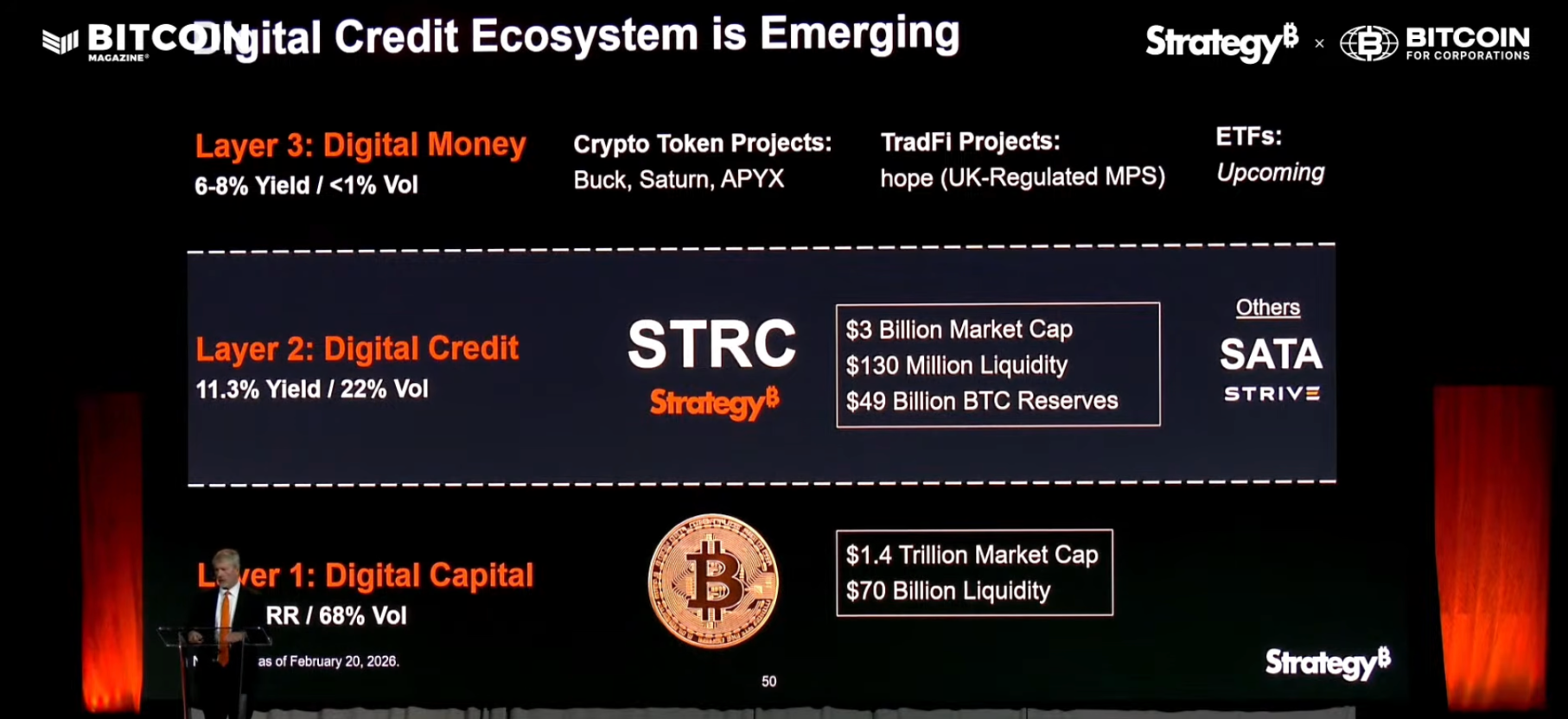
In Craig Coben's article, he mentioned that Strategy refers to its five types of perpetual preferred stock as "digital credit," a concept that Michael Saylor has been emphasizing since the end of last year.

In this concept, the first layer, "digital capital," is Bitcoin. The second layer, "digital credit (or digital lending)," consists of the various perpetual preferred stocks issued by Strategy. These preferred stocks come with high yields, and Strategy must pay corresponding interest to holders annually.

The third layer is "digital currency," which includes stablecoins and other currencies issued based on the financial products in the second layer for trading purposes. For example, Saturn in the above image plans to issue USDat, a stablecoin based on STRC and U.S. Treasury bonds. This project has also received investment from YZi Labs.

If this logic is unclear, you can draw an analogy with the United States. The U.S. continuously issues Treasury bonds based on its influence, only needing to pay interest before maturity and using new debt to repay old debt upon maturity. As long as the international influence of the U.S. and the status of the dollar do not weaken, this game can continue indefinitely. For Strategy, Bitcoin is equivalent to U.S. influence, and digital credit is equivalent to Treasury bonds. Strategy also needs to borrow new debt to pay the annual interest on preferred stocks. However, as long as the price of Bitcoin continues to rise in the long term and drives up Strategy's stock price, the company can continuously issue new shares to raise funds, buy more Bitcoin, and pay interest, continuing this cycle indefinitely.

Michael Saylor is a firm believer that Bitcoin will change everything. In his view, Bitcoin's infinite rise is a more reliable bet than the U.S. always winning, so he is more willing to issue currency based on an asset that is "destined" to continuously appreciate, much like how the U.S. dollar was initially pegged to gold.

Strategy's strategy is not new. It only needs to ensure sufficient cash to pay interest, enabling it to continuously finance and buy Bitcoin. Like U.S. Treasury bonds, this is a game that everyone knows will eventually end but cannot determine how long it will last. Strategy's current financial reserves are also ample. Its CEO stated that Strategy would only be forced to sell Bitcoin if the price remains below $8,000 for 4 to 5 consecutive years.

If this extreme condition were to materialize, not only Strategy but the entire Web3 industry might disappear.

Even a traditional banker like Craig Coben must admit that Strategy will not face financial problems in the short term. However, for hedge funds, Strategy is an excellent tool to hedge against Bitcoin declines. For short sellers, it is reasonable to short a system that relies on Bitcoin's rise to function properly during a cryptocurrency downturn. At least for now, there are not many reasons to be bullish on Strategy.

Michael Saylor's attempt to launch a new currency using Bitcoin is itself interesting. U.S. dollars are used to buy Bitcoin, and U.S. dollars are used to pay interest. The goal of building a system with billions of U.S. dollars is ultimately to destroy the very bricks that built it. Perhaps Wall Street elites are also chuckling; after all, they have no interest in studying whether Strategy can truly become a century-old company. They only care about when your stock price will rise and when it will fall.

Michael Saylor believes that Bitcoin will inevitably continue to hit new highs, so he uses it as the foundation for everything. Holders and users of the U.S. dollar believe that the U.S. will continue to prosper, so they tolerate the continuous raising of the debt ceiling. Both are acts of belief—so who is to say which is superior?


Twitter:https://twitter.com/BitpushNewsCN

Bitpush TG Discussion Group:https://t.me/BitPushCommunity

Bitpush TG Subscription: https://t.me/bitpush

Original link:https://www.bitpush.news/articles/7615105

Связанные с этим вопросы

QAccording to the article, which company has the highest short interest as a percentage of market cap among S&P 500 constituents, and what is the figure?

AMicroStrategy has the highest short interest at 14% of its market capitalization.

QWhat are the three layers in Michael Saylor's 'Digital Credit' concept as described in the article?

AThe three layers are: 1. 'Digital Capital' (Bitcoin), 2. 'Digital Credit' (various perpetual preferred shares issued by MicroStrategy), and 3. 'Digital Currency' (currencies, including stablecoins, issued for transaction purposes and based on the second-layer financial products).

QWhat extreme condition would force MicroStrategy to sell its Bitcoin holdings, according to its CEO?

AThe CEO stated that MicroStrategy would only be forced to sell its Bitcoin if the price remained below $8,000 for a sustained period of 4 to 5 years.

QWhy do some analysts believe the high short interest in MicroStrategy might not be entirely a bearish bet?

ASome analysts suggest that not all of the short positions are 'naked shorts' and that some may be used by hedge funds to hedge their spot Bitcoin holdings.

QHow does the article compare MicroStrategy's strategy to the United States' financial system?

AThe article compares Bitcoin to the influence of the United States, MicroStrategy's 'digital credit' (its perpetual preferred shares) to U.S. Treasury bonds, and explains that the company plans to continuously issue new debt (shares) to pay interest on the old ones, relying on the long-term appreciation of Bitcoin, similar to how the U.S. manages its debt based on the continued strength of the dollar.

Похожее

Торговля

Спот
Фьючерсы

Популярные статьи

Тест по Bitcoin Биткоина

HTX Learn: Изучите Bitcoin halving и Заработаете Токены USDT

3.0k просмотров всегоОпубликовано 2024.04.16Обновлено 2024.04.16

Тест по Bitcoin  Биткоина

Что такое $BITCOIN

ЦИФРОВОЕ ЗОЛОТО ($BITCOIN): Комплексный анализ Введение в ЦИФРОВОЕ ЗОЛОТО ($BITCOIN) ЦИФРОВОЕ ЗОЛОТО ($BITCOIN) — это проект на основе блокчейна, работающий в сети Solana, который стремится объединить характеристики традиционных драгоценных металлов с инновациями децентрализованных технологий. Хотя он носит имя Биткойн, часто называемого “цифровым золотом” из-за его восприятия как средства хранения ценности, ЦИФРОВОЕ ЗОЛОТО является отдельным токеном, предназначенным для создания уникальной экосистемы в ландшафте Web3. Его цель — позиционировать себя как жизнеспособный альтернативный цифровой актив, хотя детали его применения и функциональности все еще развиваются. Что такое ЦИФРОВОЕ ЗОЛОТО ($BITCOIN)? ЦИФРОВОЕ ЗОЛОТО ($BITCOIN) — это токен криптовалюты, специально разработанный для использования в блокчейне Solana. В отличие от Биткойна, который выполняет широко признанную роль хранения ценности, этот токен, похоже, сосредоточен на более широких приложениях и характеристиках. Примечательные аспекты включают: Инфраструктура блокчейна: Токен построен на блокчейне Solana, известном своей способностью обрабатывать высокоскоростные и недорогие транзакции. Динамика предложения: ЦИФРОВОЕ ЗОЛОТО имеет максимальное предложение, ограниченное 100 квадриллионами токенов (100P $BITCOIN), хотя детали о его обращающемся предложении в настоящее время не раскрыты. Утилита: Хотя точные функциональные возможности не описаны, есть указания на то, что токен может быть использован для различных приложений, потенциально связанных с децентрализованными приложениями (dApps) или стратегиями токенизации активов. Кто создатель ЦИФРОВОГО ЗОЛОТА ($BITCOIN)? На данный момент личность создателей и команды разработчиков, стоящих за ЦИФРОВЫМ ЗОЛОТОМ ($BITCOIN), остается неизвестной. Эта ситуация типична для многих инновационных проектов в области блокчейна, особенно тех, которые связаны с децентрализованными финансами и феноменом мем-криптовалют. Хотя такая анонимность может способствовать культуре, ориентированной на сообщество, она усиливает опасения по поводу управления и ответственности. Кто инвесторы ЦИФРОВОГО ЗОЛОТА ($BITCOIN)? Доступная информация указывает на то, что у ЦИФРОВОГО ЗОЛОТА ($BITCOIN) нет известных институциональных спонсоров или значительных венчурных капиталовложений. Проект, похоже, функционирует по модели пирингового взаимодействия, сосредоточенной на поддержке и принятии сообществом, а не на традиционных путях финансирования. Его активность и ликвидность в основном сосредоточены на децентрализованных биржах (DEX), таких как PumpSwap, а не на устоявшихся централизованных торговых платформах, что еще больше подчеркивает его подход, ориентированный на grassroots. Как работает ЦИФРОВОЕ ЗОЛОТО ($BITCOIN) Операционные механизмы ЦИФРОВОГО ЗОЛОТА ($BITCOIN) можно подробно описать на основе его дизайна блокчейна и характеристик сети: Механизм консенсуса: Используя уникальный механизм доказательства истории (PoH) Solana в сочетании с моделью доказательства доли (PoS), проект обеспечивает эффективную валидацию транзакций, что способствует высокой производительности сети. Токеномика: Хотя конкретные дефляционные механизмы не были подробно описаны, большое максимальное предложение токенов подразумевает, что оно может быть предназначено для микротранзакций или нишевых случаев использования, которые еще предстоит определить. Интероперабельность: Существует потенциал для интеграции с более широкой экосистемой Solana, включая различные платформы децентрализованных финансов (DeFi). Однако детали относительно конкретных интеграций остаются неуточненными. Хронология ключевых событий Вот хронология, которая подчеркивает значимые вехи, касающиеся ЦИФРОВОГО ЗОЛОТА ($BITCOIN): 2023: Первоначальное развертывание токена происходит в блокчейне Solana, отмеченное его адресом контракта. 2024: ЦИФРОВОЕ ЗОЛОТО приобретает видимость, когда оно становится доступным для торговли на децентрализованных биржах, таких как PumpSwap, позволяя пользователям обменивать его на SOL. 2025: Проект наблюдает спорадическую торговую активность и потенциальный интерес к инициативам, возглавляемым сообществом, хотя на данный момент не зафиксировано никаких значительных партнерств или технических достижений. Критический анализ Сильные стороны Масштабируемость: Основная инфраструктура Solana поддерживает высокие объемы транзакций, что может повысить полезность $BITCOIN в различных сценариях транзакций. Доступность: Потенциально низкая цена торговли за токен может привлечь розничных инвесторов, способствуя более широкому участию благодаря возможностям дробного владения. Риски Отсутствие прозрачности: Отсутствие публично известных спонсоров, разработчиков или процесса аудита может вызвать скептицизм относительно устойчивости и надежности проекта. Волатильность рынка: Торговая активность сильно зависит от спекулятивного поведения, что может привести к значительной волатильности цен и неопределенности для инвесторов. Заключение ЦИФРОВОЕ ЗОЛОТО ($BITCOIN) является интригующим, но неоднозначным проектом в быстро развивающейся экосистеме Solana. Хотя он пытается использовать нарратив “цифрового золота”, его отход от установленной роли Биткойна как средства хранения ценности подчеркивает необходимость более четкого различения его предполагаемой утилиты и структуры управления. Будущее принятие и усвоение, вероятно, будут зависеть от решения текущей непрозрачности и более четкого определения его операционных и экономических стратегий. Примечание: Этот отчет охватывает синтезированную информацию, доступную на октябрь 2023 года, и с тех пор могут произойти события.

99 просмотров всегоОпубликовано 2025.05.13Обновлено 2025.05.13

Что такое $BITCOIN

Fractal Bitcoin: масштабирование Биткоина с помощью рекурсивной системы

Fractal Bitcoin — масштабное Layer-1-решнение, созданное на базе кода Биткоина, позволяющего достигать бесконечного масштабирования с помощью рекурсивного подхода.

2.2k просмотров всегоОпубликовано 2025.06.30Обновлено 2025.06.30

Fractal Bitcoin: масштабирование Биткоина с помощью рекурсивной системы

Обсуждения

Добро пожаловать в Сообщество HTX. Здесь вы сможете быть в курсе последних новостей о развитии платформы и получить доступ к профессиональной аналитической информации о рынке. Мнения пользователей о цене на BTC (BTC) представлены ниже.

活动图片