The $33 Billion Inundation: Ethereum Inflows Hit a 15-Month High As Price Teeters At $1,955

bitcoinistОпубликовано 2026-02-24Обновлено 2026-02-24

Введение

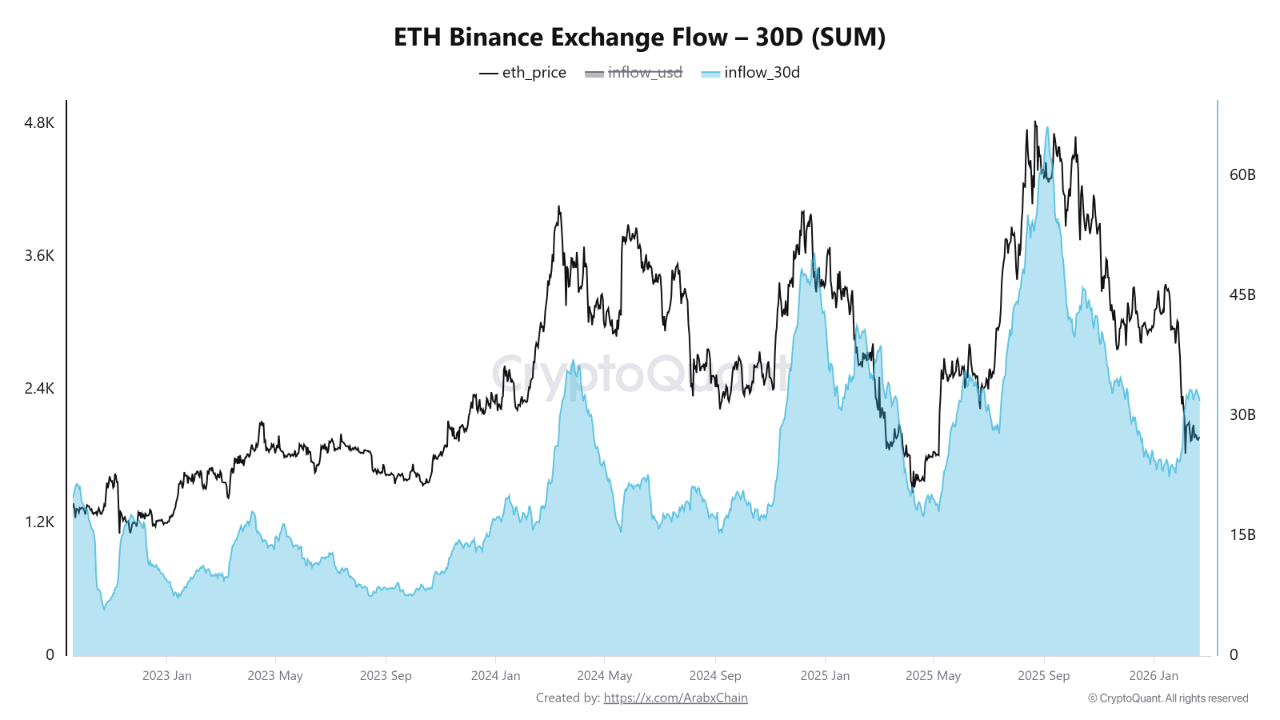
Ethereum is struggling to hold above the key $2,000 level amid broader market weakness, with recent price action subdued and investor sentiment turning cautious. A CryptoQuant report reveals a significant surge in Ethereum inflows to Binance, hitting $33.3 billion over the past 30 days—the highest since last November—as ETH trades near $1,955. While large exchange inflows often signal increased selling supply and potential volatility, they may also reflect strategic repositioning rather than outright bearish intent. If demand absorbs this liquidity, the market could stabilize; if not, downside risks may persist. The reaction to these flows will be critical for near-term direction.

Ethereum is struggling to hold above the $2,000 level as the broader crypto market enters a more fragile phase marked by persistent selling pressure, fading momentum, and elevated uncertainty. Despite several rebound attempts in recent weeks, price action has remained subdued, with liquidity conditions tightening and investor sentiment turning increasingly cautious. The inability to secure sustained acceptance above this psychological threshold has reinforced the perception that the market is still navigating a corrective environment rather than transitioning into a clear recovery phase.

A recent CryptoQuant report provides additional context by highlighting a sharp increase in exchange activity. According to the data, total Ethereum inflows to Binance over the past 30 days reached roughly $33.3 billion — the highest level recorded since last November. This surge comes as ETH trades near $1,955 after a gradual but persistent decline in recent weeks.

Historically, rising inflows to major exchanges tend to indicate a growing supply of assets available for trading. When substantial volumes of Ethereum move onto platforms like Binance, they may be used for spot sales, derivatives collateral, or portfolio rebalancing. Consequently, this spike in inflows signals heightened market activity and potentially increased short-term volatility.

While the recent surge in Ethereum inflows to Binance may initially appear bearish, the report emphasizes that this development should not automatically be interpreted as a negative signal. Elevated exchange inflows can sometimes reflect strategic repositioning rather than immediate selling intent. Investors may be preparing to actively trade, hedge exposure, or adjust portfolio allocations, particularly during periods of heightened volatility when liquidity access becomes more critical.

Ethereum Binance Exchange Flow | Source: CryptoQuant

In addition, strong inflow phases have occasionally preceded periods of price stabilization. When additional supply entering exchanges is met by sufficient demand, markets can transition into consolidation rather than extended declines. This dynamic often depends on broader liquidity conditions, derivatives positioning, and macro sentiment rather than inflows alone.

That said, registering the highest inflow level since last November places Ethereum in a structurally sensitive phase. The market’s reaction to these flows will likely provide clearer directional signals in the coming weeks. If the added supply translates into persistent sell-side pressure, downside risks could remain elevated. Conversely, if demand absorbs this liquidity effectively, the current phase may represent redistribution ahead of a more constructive move rather than sustained weakness.

Связанные с этим вопросы

QWhat is the current price of Ethereum mentioned in the article and what key level is it struggling to hold?

AEthereum is currently trading near $1,955 and is struggling to hold above the $2,000 psychological level.

QAccording to the CryptoQuant report, what was the value of Ethereum inflows to Binance over the past 30 days and why is this significant?

AThe value of Ethereum inflows to Binance over the past 30 days was approximately $33.3 billion, which is the highest level recorded since last November, indicating a sharp increase in exchange activity.

QWhat are two possible interpretations of the large Ethereum inflows to exchanges, according to the article?

AThe inflows could indicate either bearish selling intent or a more neutral strategic repositioning, such as investors preparing to trade actively, hedge exposure, or adjust portfolio allocations.

QWhat potential market outcome can occur if the new supply of Ethereum on exchanges is met with sufficient demand?

AIf the additional supply entering exchanges is met by sufficient demand, the market can transition into a period of price stabilization and consolidation rather than extended declines.

QWhat will the market's reaction to the high inflows likely provide in the coming weeks, according to the article?

AThe market's reaction to these high inflows will likely provide clearer directional signals on whether the market will face sustained selling pressure or if demand-driven consolidation will occur.

Похожее

The Tao (τ) Law Makes EDA Go Viral

In May 2026, Huawei's semiconductor division introduced the "Tao (τ) Law" at IEEE ISCAS, shifting the industry focus from Moore's Law's geometric scaling to "time scaling." Unlike traditional approaches relying on transistor miniaturization, τ Law optimizes the time constant (τ) across device, circuit, chip, and system levels to improve information processing speed and efficiency. Huawei has already applied this principle, mass-producing 381 chips across various applications, with a target to achieve performance equivalent to 1.4nm technology by 2031. The implementation of τ Law, involving techniques like Chiplet, 3DIC, and Logic Folding, places new demands on EDA tools, highlighting gaps in current offerings. Traditional 2D or pseudo-3D EDA flows lack native support for true 3D design, cross-layer co-optimization (STCO), and coupled multi-physics analysis (thermal, power, stress), which are crucial for advanced integration. Chinese EDA companies, such as Empyrean Software, Primarius Technologies, and Xpeedic, are evolving from point-tool specialists to providing full-flow, system-level solutions. For instance, Peking University has developed a prototype "true 3D" EDA tool showing significant improvements in wirelength and timing. Empyrean Software has also launched a comprehensive 3DIC design and verification platform. The τ Law framework presents an opportunity for the domestic EDA industry to transition from achieving basic functionality to developing robust, integrated toolsets essential for next-generation chip design.

marsbit2 ч. назад

The Tao (τ) Law Makes EDA Go Viral

marsbit2 ч. назад

It's Not Jensen Huang Who Wants to Change the PC, But the PC That's Revolting Against Itself

The 40-year-old PC industry is undergoing a fundamental transformation, driven by the rise of AI PCs. At the GTC Taipei 2026 event, NVIDIA, backed by Microsoft and major PC OEMs, announced the RTX Spark super chip for Windows PCs, marking its official entry into the PC core processor market. This move aims to redefine the AI PC by shifting its core from the CPU to an AI-focused SoC (System on Chip). NVIDIA envisions the PC evolving from a personal computer to a "personal AI"—a platform where local AI Agents can autonomously perform tasks. While Intel pioneered the AI PC concept earlier in 2026, NVIDIA's aggressive push, leveraging its vast CUDA developer ecosystem of 6 million, positions it to potentially reshape the industry's long-standing Wintel (Windows-Intel) power structure. NVIDIA's strategy extends beyond hardware; it's about embedding its CUDA, RTX, and AI software stack into the PC platform itself. The article identifies key shifts: 1) The move from a CPU-centric to an AI SoC-centric architecture, similar to Apple's approach with its M-series chips. 2) The PC's evolution from a human-operated tool to a platform for human-Agent collaboration. 3) The extension of NVIDIA's data center-centric CUDA ecosystem to personal devices via RTX Spark. Ultimately, the change is driven by the broader trend of AI moving to personal devices. Companies like Intel, AMD, Qualcomm, and Apple are all participating in this shift. NVIDIA's entry accelerates the competition, but the core driver is the technology itself finding its optimal expression in the PC. The industry is reinventing itself, with the outcome hinging on execution, ecosystem development, and the creation of compelling local AI applications.

marsbit4 ч. назад

It's Not Jensen Huang Who Wants to Change the PC, But the PC That's Revolting Against Itself

marsbit4 ч. назад

Торговля

Спот
Фьючерсы

Популярные статьи

Manyu: восходящая мем-звезда на Ethereum, готовая открыть новую эру культуры Shiba

Manyu - это мемтокен на Ethereum, который приносит децентрализованную культурную и развлекательную ценность через вирусное влияние в соцсетях и вовлечённость сообщества.

2.0k просмотров всегоОпубликовано 2025.11.27Обновлено 2025.11.27

Manyu: восходящая мем-звезда на Ethereum, готовая открыть новую эру культуры Shiba

Неделя обучения по популярным токенам 14: Glamsterdam — самое ожидаемое обновление Ethereum в 2026 году

Ordinals/Runes по-прежнему стимулируют доходы от комиссий за блоки и активность разработчиков, рассматриваются как отправная точка «нативной эмиссии активов» в сети.

1.5k просмотров всегоОпубликовано 2026.04.29Обновлено 2026.04.29

Неделя обучения по популярным токенам 14: Glamsterdam — самое ожидаемое обновление Ethereum в 2026 году

Обсуждения

Добро пожаловать в Сообщество HTX. Здесь вы сможете быть в курсе последних новостей о развитии платформы и получить доступ к профессиональной аналитической информации о рынке. Мнения пользователей о цене на ETH (ETH) представлены ниже.

活动图片