# Сопутствующие статьи по теме SK Hynix

Новостной центр HTX предлагает последние статьи и углубленный анализ по "SK Hynix", охватывающие рыночные тренды, новости проектов, развитие технологий и политику регулирования в криптоиндустрии.

“Why Didn’t You Buy 2x Long SK Hynix?”

The article discusses the immense popularity of the "2x Long SK Hynix ETF" (07709.HK) in Hong Kong, which became the world's largest single-stock leveraged ETF by May 2026. Launched in October 2025, the ETF's net value soared over 1000% in seven months, significantly outperforming the 324% gain of SK Hynix's underlying stock, driven by the AI boom and a critical shift in industry demand from computing power to memory. It highlights the mechanics and risks of daily-rebalanced leveraged ETFs. In a smooth bullish market, they generate amplified returns, but during volatile periods—exemplified by market swings during geopolitical tensions in the Strait of Hormuz in March-April 2026—they suffer severe "volatility decay," where choppy price action can cause losses far exceeding twice the drop of the underlying asset. The piece frames SK Hynix, as NVIDIA's primary HBM supplier, within the classic cycle of the memory chip industry—a commoditized sector prone to boom-and-bust cycles of shortage, price hikes, overcapacity, and crashes. While current AI-driven demand and high margins (Q1 2026毛利率~79%) create a "super cycle," the article questions its sustainability. It warns that extreme profits will inevitably tempt competitors like Samsung and Micron to ramp up HBM production, potentially eroding scarcity. Furthermore, the entire narrative remains tethered to the massive AI capital expenditure of tech giants. In conclusion, the ETF's trajectory symbolizes the accelerated, all-in nature of the current AI revolution, where timeframes are compressed and market moves are extreme. However, it also underscores that while industry trends define ultimate returns, macro-geopolitical risks dictate the volatile and uncertain path to get there.

marsbit05/16 05:06

“Why Didn’t You Buy 2x Long SK Hynix?”

marsbit05/16 05:06

The AI Bull Market Revalues Everything, Including the 'Male Valuation System' in the Dating Market

AI Bull Market Reprices Everything, Including the "Male Valuation System" in the Dating Market A new hierarchy is emerging in dating markets, driven by the AI boom. Men working for AI infrastructure and core companies are now considered top prospects. The article presents a "Dating Desirability Ranking" for men in the AI era. **Top Tier ("Extremely Hot"): NVIDIA & SK Hynix Employees** NVIDIA, viewed as the "oil" of AI, and SK Hynix, a leading HBM memory maker, are in a league of their own. SK Hynix employees, in particular, have become highly sought-after in South Korea's matchmaking scene due to their massive performance bonuses, which averaged ~$65,000 per employee last year and are projected to reach millions. This has led to increased interest in office romances for "economic synergy." **High Tier ("Hot"): Anthropic & OpenAI Employees** Employees at these leading AI labs have seen significant wealth realization through large-scale employee stock sales. Unlike the paper wealth of the dot-com era, substantial amounts have been cashed out, placing their actual wealth far above traditional tech workers. They are considered high-growth, high-volatility assets. **Elite Tier ("Top Tier"): DeepSeek & ByteDance AI Team Members** Fierce competition for AI talent has made employees at these companies highly valuable. ByteDance's valuation has soared with its massive AI investment, leading to significant employee stock appreciation. DeepSeek is also fighting to retain core talent with substantial funding rounds. Being on the "main stage" of AI makes these individuals extremely scarce. **Mid Tier ("NPC"): Samsung & Tencent Employees** Once dominant, these companies are now seen as playing catch-up in the AI race. Samsung has lost ground to SK Hynix in the HBM market, leading to employee strikes demanding better bonuses. Tencent's more cautious AI investment, compared to ByteDance's aggressive spending, and slowing traditional growth raise questions about its future in AI. **Bottom Tier ("Fallen Off"): Traditional Finance Bros & Crypto Bros** Their appeal has diminished as the core wealth distribution shifts to AI. Compared to the massive bonuses and stock windfalls in AI, the traditional allure of finance and the fading "get-rich-quick" narrative of crypto have lost their luster in the current dating market. The AI revolution is not just reshaping industries and stock prices, but also the social and economic perceptions that influence personal markets like dating.

marsbit05/13 13:00

The AI Bull Market Revalues Everything, Including the 'Male Valuation System' in the Dating Market

marsbit05/13 13:00

AI Bull Market Reprices Everything, Including the 'Male Valuation System' in the Marriage Market

The AI boom is redefining value across markets, including the male "valuation system" in the dating scene. A new hierarchy is emerging, based on company valuation, employee income, and industry status within the AI sector. At the top are NVIDIA and SK Hynix employees, dubbed the "T0 version." NVIDIA is the AI world's cash machine, while SK Hynix employees are seeing astronomical bonuses due to HBM demand, making them highly sought-after "AI concept stocks" in Korea's dating market. Next are OpenAI and Anthropic staff, representing the "new elite." Unlike the paper wealth of the past internet boom, these employees are actively realizing significant wealth through stock sales, though their status is considered more volatile. DeepSeek and ByteDance AI team members are rated as "top-tier." Their companies are engaged in fierce talent wars with massive investments, making these employees scarce, high-value players. Samsung and Tencent employees are seen as "NPCs" still searching for their AI "ticket." Samsung has been outpaced by SK Hynix in the memory race, while Tencent's more cautious AI investment contrasts with ByteDance's aggressive strategy, raising questions about their future position. Finally, traditional finance and crypto men are rated at the bottom ("pulled"). Their once-dominant wealth and status are being eclipsed by the new AI-driven economic order and its redistribution of value and opportunity.

Odaily星球日报05/13 12:53

AI Bull Market Reprices Everything, Including the 'Male Valuation System' in the Marriage Market

Odaily星球日报05/13 12:53

SK Hynix's Trillion-Won Empire: The Successors

"SK Hynix's Trillion-Won Empire and Its Heirs" explores the unconventional succession narrative within SK Group, South Korea's second-largest conglomerate, following SK Hynix's dramatic market rise. Unlike traditional chaebol scripts prioritizing the eldest son, ownership, and political marriages, Chairman Choi Tae-won's three children from his first marriage are charting distinct paths. The eldest daughter, Choi Yun-jeong, is considered the most visible candidate. With a background in biology, consulting, and a PhD, she holds executive roles at SK Bioscience and SK Inc.'s growth strategy unit, focusing on biopharma and new businesses. Her marriage is to an AI infrastructure entrepreneur, not a traditional chaebol heir. The second daughter, Choi Min-jeong, took a unique route by voluntarily serving as a South Korean naval officer, including a tour in the Gulf of Aden. She later worked on policy and strategy for SK Hynix in Washington D.C. before co-founding an AI-driven healthcare startup in San Francisco. She married a former U.S. Marine Corps officer, connecting the family to U.S. defense and policy networks. The son, Choi In-geun, who has Type 1 diabetes, followed a more classic preparatory path with a physics degree and a stint at SK E&S but left to join McKinsey's Seoul office. He remains publicly silent and holds no SK shares, defying the traditional "crown prince" archetype. Their paths unfold against the backdrop of their parents' high-profile, contentious divorce and a record-setting asset division lawsuit. The article argues that as SK Hynix becomes a geopolitical asset in the AI era, the conventional rules of chaebol inheritance are changing. The heirs are being groomed not simply to take over, but to navigate a complex global landscape defined by AI, biotech, geopolitics, and policy, forging legitimacy through their own expertise and networks rather than birth order alone.

marsbit05/12 04:01

SK Hynix's Trillion-Won Empire: The Successors

marsbit05/12 04:01

The King of Blind Date Attire in Korea: How SK Hynix Made a Comeback Against Samsung?

In South Korea's dating scene, SK Hynix employees are now highly sought after, a status shift fueled by the company's astronomical profits and employee bonuses, projected to reach up to 6.1 million RMB per person by 2027. This marks a dramatic reversal for the long-time second-place player in memory semiconductors, which has now surpassed its rival Samsung in annual operating profit. The turnaround story began in 2008 when a struggling Hynix, emerging from bankruptcy restructuring, took a risky bet by agreeing to develop High Bandwidth Memory (HBM) with AMD. At the time, HBM had no clear market beyond high-end graphics cards and was a costly, complex technology. Major players like Samsung, pursuing its own HMC technology, declined. For Hynix, with only memory as its core business, it was a gamble born of necessity. The pivotal moment came in 2012 when SK Group Chairman Chey Tae-won acquired Hynix. Defying industry downturns, he invested heavily in R&D and fabrication, sustaining the HBM project through over a decade of commercial uncertainty and internal challenges. A key break occurred around 2016-2017 when Samsung faced production issues supplying HBM2 for Google's TPU, allowing SK Hynix to gain a crucial foothold in the data center market. The AI explosion post-ChatGPT in 2022 was the catalyst, turning HBM into a critical bottleneck for AI accelerators like NVIDIA's GPUs. By 2025, SK Hynix captured 62% of the global HBM market, leaving Samsung at 17%. For the first time, its annual operating profit exceeded Samsung's. Analysts point to the "innovator's dilemma" to explain Samsung's miss: its vast, successful business portfolio made it risk-averse, preventing an all-in bet on the initially niche HBM technology. In contrast, SK Hynix, as a challenger with its back against the wall, had no choice but to commit fully. The story highlights how Korea's chaebol system allows for ultra-long-term bets beyond quarterly pressures. However, SK Hynix's lead isn't guaranteed. Samsung is aggressively catching up on HBM4, and challenges like customer concentration (heavy reliance on NVIDIA) and technical hurdles in advanced packaging remain. The narrative underscores a market truth: the greatest alpha often comes from betting on uncertain, long-term directions others dismiss, much like HBM in 2008.

marsbit05/11 11:08

The King of Blind Date Attire in Korea: How SK Hynix Made a Comeback Against Samsung?

marsbit05/11 11:08

Beaten SK Hynix Employees in China: Year-end Bonus Less Than 5% of Korean Staff's

"SK Hynix Chinese Staff Hit Hard: Bonuses Less Than 5% of Korean Counterparts" Driven by the AI boom, South Korea's SK Hynix is experiencing record performance, with media reports predicting massive year-end bonuses for its employees, making them highly desirable in the matchmaking market. However, this prosperity starkly contrasts with the situation for the company's Chinese employees. According to reports, SK Hynix operates under a rule allocating 10% of operating profit for employee bonuses. While projections suggest Korean employees could receive bonuses reaching millions of RMB, a Chinese employee with over a decade of technical experience revealed the disparity: "If they get 3 million, Chinese staff get less than 5% of that." After adjustments based on KPI ratings, this employee's highest bonus was slightly over 100,000 RMB. Bonuses are paid annually in Korea but semi-annually in China. During the industry downturn in 2023-2024, Chinese employees received no bonus at all. The gap extends beyond bonuses. Recruitment posts for SK Hynix's Chinese factories (in Wuxi, Dalian, Chongqing) show engineer monthly salaries ranging from 10,000 to 35,000 RMB, with a 13th-month salary promised. Chinese employees also receive standard benefits like annual leave but lack stock incentives, which are reportedly unavailable to them. Furthermore, management positions in China are predominantly held by Korean personnel, though industry observers note a gradual increase in local middle managers over time. SK Hynix has confirmed the 10% bonus rule but cautioned that specific future bonus amounts remain unpredictable. The company forecasts strong demand for HBM and other high-value enterprise products for the next 2-3 years, driven by AI infrastructure investment. This focus on business-to-business markets may continue to constrain supply for consumer products, potentially prolonging price increases for components like memory.

链捕手05/11 06:12

Beaten SK Hynix Employees in China: Year-end Bonus Less Than 5% of Korean Staff's

链捕手05/11 06:12

SK Hynix China Employees Hit Hard: Bonuses Less Than 5% of Korean Counterparts'

"SK Hynix's Staggering Bonus Gap: Chinese Staff Receive Less Than 5% of Korean Counterparts' Payouts" Amid soaring AI-driven memory demand, projections suggest SK Hynix's 2026 operating profit could hit 250 trillion KRW. Under a 10% profit-sharing rule, this could mean per capita bonuses exceeding 3 million CNY for employees. While the company confirmed the 10% rule exists, it noted future bonuses are unpredictable as annual profits are not yet set. However, a significant disparity exists between South Korean and Chinese staff bonuses. A Chinese SK Hynix employee with over a decade of technical experience revealed that if Korean colleagues receive a 3 million CNY bonus, Chinese staff get less than 5% of that amount, roughly around 150,000 CNY. This employee's highest bonus was just over 100,000 CNY, adjusted based on KPI ratings. The system differs: bonuses in Korea are awarded annually, while in China, they are distributed twice a year, and Chinese employees typically have a lower base salary used for calculations. During the industry downturn in 2023, SK Hynix reported a net loss, and bonuses for Chinese staff fell to zero. Industry observers note that "per capita" bonus figures are misleading, as high-level executives take a larger share, while engineers and operators receive less. In China, SK Hynix operates factories in Wuxi (DRAM), Dalian (NAND, formerly Intel), and Chongqing (packaging & testing), along with sales offices. Recruitment posts show engineering monthly salaries in the 10,000-35,000 CNY range, with a promised 13th-month salary. Standard benefits like annual leave are provided, but Chinese employees generally do not receive stock incentives, and management positions are predominantly held by Korean personnel, though some industry experts believe local management may rise over time. Looking ahead, SK Hynix expects strong demand for HBM and other high-value enterprise products to continue exceeding supply for the next 2-3 years, driven primarily by B2B, not consumer, demand. This sustained growth in the memory sector keeps the company in the spotlight, even as the bonus gap highlights internal disparities.

marsbit05/11 05:52

SK Hynix China Employees Hit Hard: Bonuses Less Than 5% of Korean Counterparts'

marsbit05/11 05:52

From 6000 Points to Two Circuit Breakers: A Missile Exposes South Korea's Stock Market Weakness

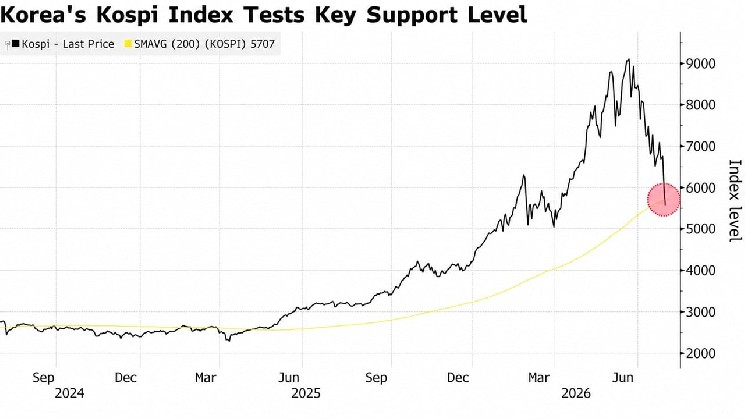
The South Korean Stock Exchange (KOSPI) experienced two consecutive trading halts (circuit breakers) on March 3 and 4, 2026, plunging nearly 13% from a recent high of 6,244 points. This sharp decline, triggered by escalating U.S.-Iran tensions and the closure of the Strait of Hormuz, exposed the extreme vulnerability of South Korea's stock market, which is heavily reliant on semiconductor stocks, particularly Samsung Electronics and SK Hynix. These two companies, dominating the global HBM (high-bandwidth memory) market crucial for AI and GPUs, had driven KOSPI's 75.6% surge in 2025. However, the market's concentration on chip exports, which account for over a third of total exports, became its Achilles' heel. The closure of the Strait of Hormuz—a vital shipping route for liquefied natural gas (LNG), which fuels nearly a third of Korea's power generation—threatened energy supplies and semiconductor manufacturing costs. While defense stocks surged on geopolitical tensions, foreign investors sold a record $8.5 billion in Korean shares over two days, highlighting the market's liquidity and its status as a prime target for rapid capital flight during global panic. Retail investors attempted to buy the dip, but were overwhelmed by the sell-off. The crash underscored deeper structural risks beyond corporate governance reforms: South Korea's market is exceptionally exposed to a single industry dependent on imported energy and vulnerable to global shocks. The incident demonstrated that while fundamentals may drive long-term growth, sentiment and geopolitics can erase gains rapidly.

比推03/04 13:31

From 6000 Points to Two Circuit Breakers: A Missile Exposes South Korea's Stock Market Weakness

比推03/04 13:31

South Korean Youth Trading Stocks Overnight, Diving Headfirst into Samsung and SK Hynix

The article details a significant shift in South Korea's investment landscape, where young retail investors are moving from volatile cryptocurrencies to the booming semiconductor stocks, particularly Samsung Electronics and SK Hynix. This transition is driven by the explosive demand for AI-related chips, specifically High Bandwidth Memory (HBM), where these two Korean giants hold a near-oligopoly alongside Micron. Due to unprecedented demand from cloud providers, AI firms, and electronics manufacturers, HBM supply is critically low, with SK Hynix's inventory at a historic low of just four weeks. This scarcity has led to massive price increases for HBM and DRAM chips, fueling a dramatic surge in the companies' stock prices—SK Hynix's stock is up sixfold and Samsung's has quadrupled since early 2025. This rally has propelled the Korean KOSPI index past 6000 points, making it a top-performing global market. The piece explains that the AI era has inverted the traditional tech profit structure. HBM, now a critical and irreplaceable component for advanced GPUs, has given upstream memory suppliers unprecedented pricing power over downstream customers like NVIDIA. This has led to a fundamental "re-rating" of these semiconductor stocks. Consequently, online forums once dominated by crypto talk are now focused on "AI semiconductor concept stocks." Trading volume on crypto exchanges has plummeted, while stock market activity has soared. This shift is further encouraged by government policies aimed at strengthening the stock market and retaining domestic capital. The trend is so powerful that crypto exchanges have begun offering leveraged perpetual contracts on Korean stocks, symbolizing that in the AI age, semiconductors have become a more compelling investment than cryptocurrencies.

marsbit02/27 13:21

South Korean Youth Trading Stocks Overnight, Diving Headfirst into Samsung and SK Hynix

marsbit02/27 13:21

活动图片