# Сопутствующие статьи по теме Rollup

Новостной центр HTX предлагает последние статьи и углубленный анализ по "Rollup", охватывающие рыночные тренды, новости проектов, развитие технологий и политику регулирования в криптоиндустрии.

When Migration Becomes the Norm: Why 'Your Own EVM Chain' Is Becoming Standard

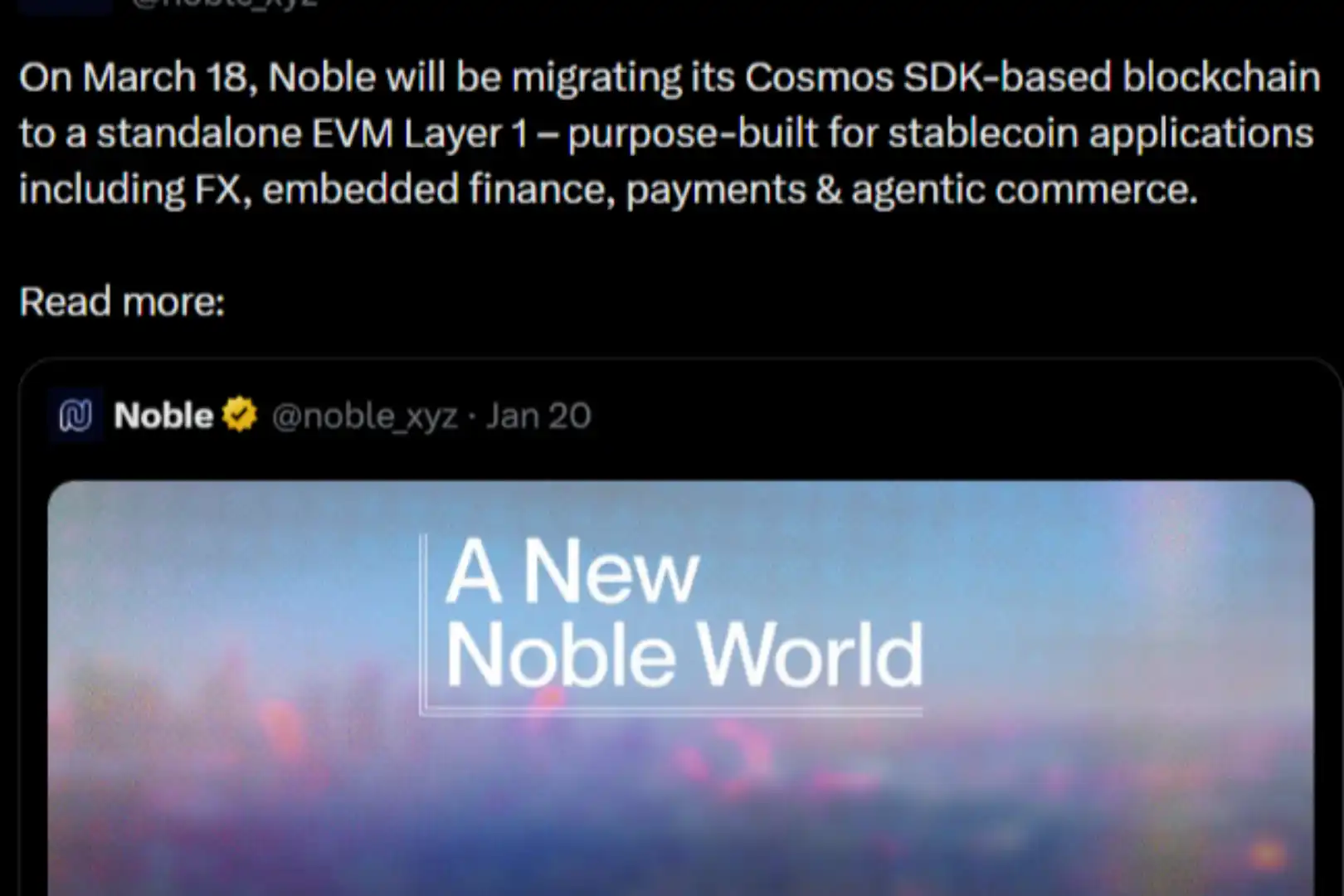
In the past year, the industry's real "voting" has shifted from governance forums to deployment scripts, migration plans, and budgets. Projects are choosing ecosystems through action, not words—migrating mainnets, prioritizing tool stacks, and betting on networks with stronger market effects. A prime example is Noble, a leading stablecoin infrastructure in Cosmos, which moved to its own EVM L1, signaling that the main battleground for stablecoins and app distribution remains in EVM ecosystem due to its mature developer tools, wallet/dApp ecosystem, and concentrated liquidity. The trend toward "having your own EVM chain" is becoming standard. While EVM offers clear advantages in assets, integrations, and tools, generic chains come with constraints like fee volatility, congestion, and shared sequencing. Application chains/rollups allow teams to internalize these constraints—tailoring block times, execution models, and infrastructure to their business needs, and aligning transaction revenue with growth incentives. Rollup-as-a-Service (RaaS) platforms like Caldera are reducing the high costs and complexity of building and maintaining chains, turning "chain-as-a-product" into a replicable strategy. They focus not just on deployment but also on solving interoperability challenges—e.g., via Caldera's Metalayer, which standardizes cross-chain bridging and integration to reduce friction for users and developers. As migration to EVM continues, the focus shifts from "which chain to choose" to "how to control growth." Owned EVM chains/rollups offer more stable fees, better performance, and tighter integration of incentives and revenue. With RaaS lowering build costs and interoperability layers reducing cross-chain friction, having a dedicated execution environment is becoming a scalable, standard solution for projects aiming to master their own growth.

marsbit02/05 08:39

When Migration Becomes the Norm: Why 'Your Own EVM Chain' Is Becoming Standard

marsbit02/05 08:39

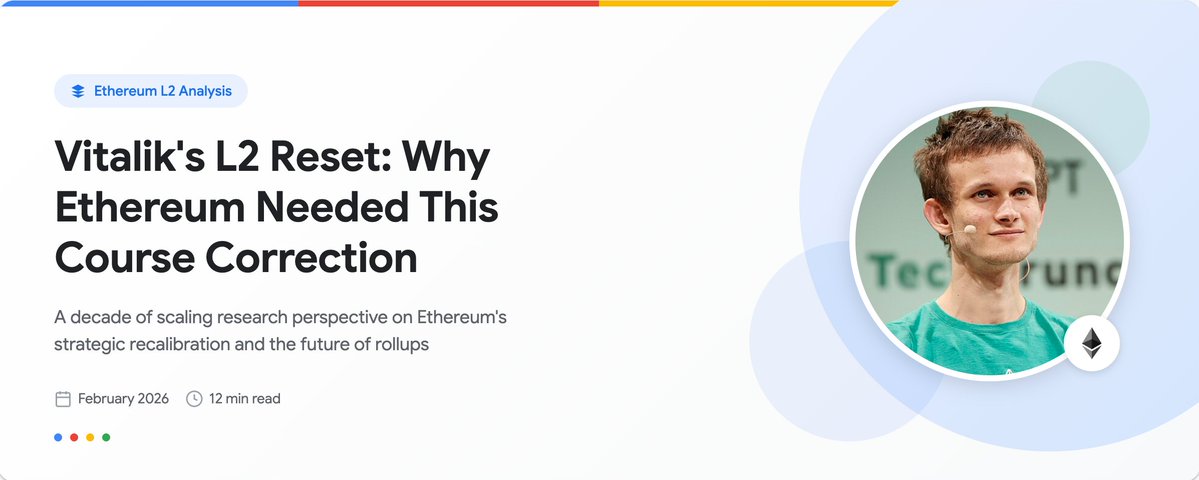
Vitalik's Layer2 Reset: Can It Save Ethereum?

Vitalik Buterin's recent post recalibrates Ethereum's Layer2 (L2) strategy, acknowledging that the original 2020 "rollup-centric" roadmap—based on L2s acting as "branded shards" of Ethereum—no longer aligns with reality. Two key issues are identified: L2 decentralization has progressed slower than expected, with only a few major L2s reaching Stage 1 decentralization, and Ethereum L1 has scaled beyond initial projections, reducing L2s' necessity for scalability. The core conceptual shift introduces a "trust spectrum" framework, recognizing that L2s serve diverse purposes and may legitimately operate at varying decentralization levels (e.g., Stage 0 or 1) without being deemed failures. This allows L2s to pursue different economic and regulatory goals, such as compliant chains with asset-freezing capabilities. Technically, Vitalik proposes a "native rollup precompile" to simplify L2 infrastructure by embedding EVM execution verification directly into Ethereum, reducing audit burdens and improving security. Additionally, a mechanism for "synchronous composability" is outlined, enabling atomic cross-layer transactions between L1 and L2. Responses from L2 teams like Arbitrum, Base, Linea, and Optimism reflect strategic diversity, validating the trust spectrum approach. The post implicitly acknowledges L2s' economic realities, such as sequencer revenue and regulatory constraints, and suggests differentiation strategies for L2s in a cheaper L1 environment. This update demonstrates adaptive leadership, prioritizing realistic evolution over outdated assumptions, and provides a clearer path forward for Ethereum's ecosystem.

marsbit02/05 06:00

Vitalik's Layer2 Reset: Can It Save Ethereum?

marsbit02/05 06:00

Five Years Later, Vitalik Overturns the Future He Set for Ethereum

Five years after championing Layer 2 (L2) scaling as Ethereum's future, Vitalik Buterin has dramatically reversed his position, declaring that L2s have largely failed to fulfill their original vision of "branded sharding." In a pivotal post, he argued that most L2 solutions remain highly centralized, reliant on multi-signature bridges and sequencers, and thus are not truly extending Ethereum's security or decentralization. The initial push for L2s was a survival response to Ethereum's cripplingly high fees and congestion during the 2021 DeFi and NFT boom, when competitors like Solana gained traction. However, despite massive venture funding—with projects like Arbitrum, Optimism, and Starknet raising billions—progress toward full decentralization (Stage 2) has been slow. Many operate more like centralized databases, prioritizing control and regulatory compliance over Ethereum's core values. Meanwhile, Ethereum itself has scaled significantly. Through upgrades like EIP-4844 and increased gas limits, L1 transaction fees have plummeted by over 99%, often costing just cents. This reduces L2's cost advantage and exposes their drawbacks: bridge vulnerabilities, fragmented liquidity, and complex user experiences. Vitalik now urges L2s to pivot from mere scaling to providing unique functional value—like privacy, ultra-fast finality, or application-specific optimizations—that L1 cannot easily offer. He reframes L2s as a spectrum of specialized "plugins" rather than essential scaling layers. This shift signals a market consolidation where only L2s with genuine utility and decentralization will survive, ending an era of inflated valuations and "ghost chain" projects. Ethereum is reclaiming its sovereignty by becoming scalable on its own terms.

marsbit02/04 05:52

Five Years Later, Vitalik Overturns the Future He Set for Ethereum

marsbit02/04 05:52

Penetrating the Noise of Ethereum's 'Degeneration': Why is 'Ethereum Values' the Widest Moat?

Amidst recent debates questioning Ethereum's perceived "regression" compared to high-performance blockchains, this article argues that Ethereum’s core strength lies in its foundational values—decentralization, censorship resistance, and long-term reliability—rather than short-term efficiency. While other chains prioritize speed through centralized trade-offs, Ethereum emphasizes resilience under worst-case conditions. It has never experienced a full-network outage or rollback in nearly a decade of operation. This resilience stems from deliberate design choices: avoiding hardware centralization, maintaining low node operation costs, and ensuring ordinary users can verify the chain. The concept of "Ethereum Alignment" is clarified not as blind loyalty but as a multidimensional social contract involving technical alignment (using Ethereum’s consensus and open standards), economic alignment (value accrual to ETH), and ideological alignment (public good over extractive growth). Ethereum’s slower evolution reflects a conscious trade-off: performance improvements must integrate with existing security assumptions without compromising decentralization or censorship resistance. Despite criticism, growing ETH staking numbers indicate continued trust in its model. In essence, Ethereum’s “conservative” is strategic—prioritizing sustainable trust over temporary gains, making its value proposition the widest moat in Web3.

marsbit01/09 10:40

Penetrating the Noise of Ethereum's 'Degeneration': Why is 'Ethereum Values' the Widest Moat?

marsbit01/09 10:40

活动图片