When Migration Becomes the Norm: Why 'Your Own EVM Chain' Is Becoming Standard

marsbitОпубликовано 2026-02-05Обновлено 2026-02-05

Введение

In the past year, the industry's real "voting" has shifted from governance forums to deployment scripts, migration plans, and budgets. Projects are choosing ecosystems through action, not words—migrating mainnets, prioritizing tool stacks, and betting on networks with stronger market effects. A prime example is Noble, a leading stablecoin infrastructure in Cosmos, which moved to its own EVM L1, signaling that the main battleground for stablecoins and app distribution remains in EVM ecosystem due to its mature developer tools, wallet/dApp ecosystem, and concentrated liquidity. The trend toward "having your own EVM chain" is becoming standard. While EVM offers clear advantages in assets, integrations, and tools, generic chains come with constraints like fee volatility, congestion, and shared sequencing. Application chains/rollups allow teams to internalize these constraints—tailoring block times, execution models, and infrastructure to their business needs, and aligning transaction revenue with growth incentives. Rollup-as-a-Service (RaaS) platforms like Caldera are reducing the high costs and complexity of building and maintaining chains, turning "chain-as-a-product" into a replicable strategy. They focus not just on deployment but also on solving interoperability challenges—e.g., via Caldera's Metalayer, which standardizes cross-chain bridging and integration to reduce friction for users and developers. As migration to EVM continues, the focus shifts from "which chain to c...

Over the past year, the most genuine "voting" in the crypto industry has increasingly occurred not in governance forums, but in deployment scripts, migration plans, and budget sheets. Project teams no longer express their stance through slogans; instead, they choose ecosystems through actions: where to migrate their mainnet, which toolstack to prioritize for the next phase of product adaptation, and which network effect-stronger market to bet their liquidity and partnerships on.

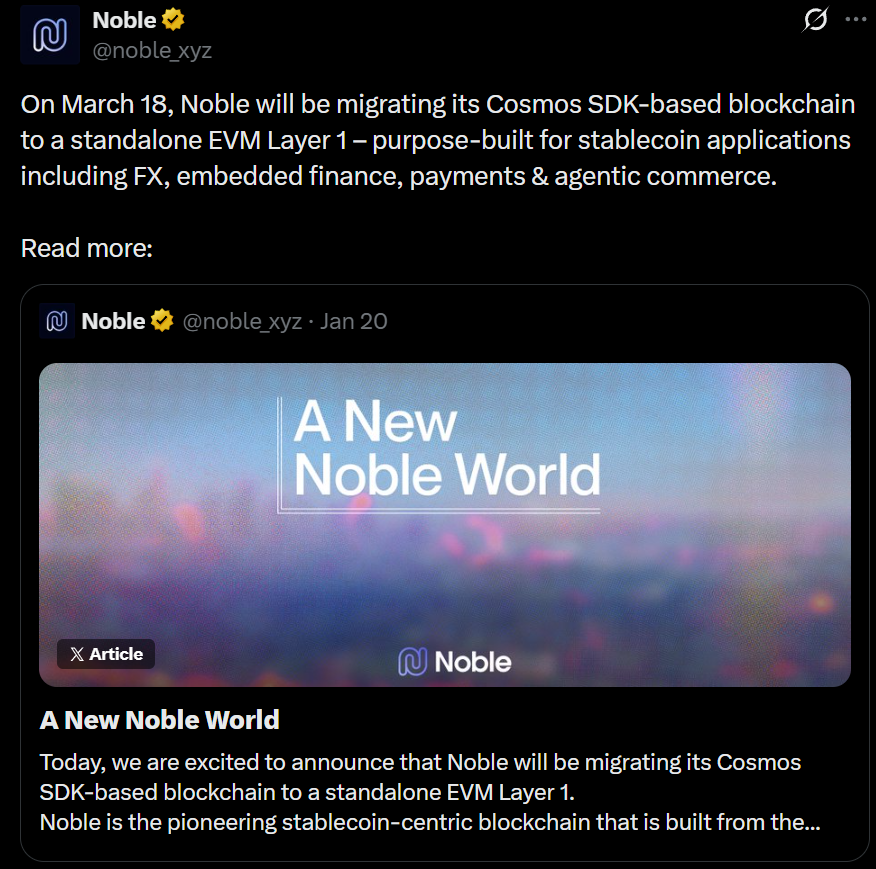
Noble's pivot is a typical case. As one of the most successful stablecoin infrastructures in the Cosmos ecosystem, it once handled the issuance and cross-chain distribution of native USDC and connected numerous chains and stablecoin settlement scenarios via IBC. But when it announced its migration to an independent EVM L1 and deeply tied its stablecoin products and network value capture mechanisms, the signal was clear enough: the main battlefield for stablecoins, settlement, and application distribution remains in EVM. Stablecoin market share is highly concentrated in EVM, and developer tools and wallet/dApp ecosystems are more mature. But this doesn't mean that "going EVM" equals "squeezing into some general-purpose chain" and everything is settled. On the contrary, while more and more teams are moving towards EVM, they are beginning to redefine a question: are we choosing a chain, or are we choosing a growth method?

Why Will 'Your Own EVM Chain' Become More Common?

First, the advantages of EVM remain clear: larger stablecoin and asset volume, more comprehensive integration targets, and more mature developer tools. This determines that many applications ultimately still want to complete their growth and distribution within EVM. But on the other hand, on general-purpose chains, applications often have to accept a series of exogenous constraints: fee volatility, congestion, shared sequencing environment, unified upgrade schedules, and the resulting uncontrollable user experience. The appeal of appchains/rollups lies in "internalizing" these constraints—teams can choose block times, execution models, RPC, and infrastructure configurations more suitable for their business characteristics, and more tightly bind transaction revenue and incentive design to their own network and product growth.

In other words, the industry is shifting from "choosing a chain and adapting to it" to "choosing an architecture and shaping it." When the cost of this path is significantly reduced, "having your own EVM chain" becomes more like a replicable product strategy rather than a high-stakes gamble.

Rollup as a Service Is Turning 'Building Your Own Chain' from a Heavy Asset into a Standard Move

What hinders the adoption of the appchain model is not "unclear value," but "construction and operation are too expensive." From chain setup, security, operation, monitoring, to cross-chain, bridging, message passing, and user onboarding paths, each item implies high human and time costs. For most teams, even if they recognize "chain as a product," they might be deterred by engineering complexity. This is also the background against which Rollup as a Service (RaaS) comes to the forefront: it productizes deployment, hosting, maintenance, and part of the security engineering, allowing teams to focus their energy back on the application itself—functionality, ecosystem partnerships, growth, and commercialization.

Taking Caldera as an example, its core narrative and roadmap are quite typical: early on, it lowered the barrier to rollup deployment to a more affordable level through its Rollup Engine; and after the number of rollups grew rapidly, it further focused on "how to smooth out fragmentation." Caldera calls this layer the Metalayer: hoping to equip new chains with more complete interconnection capabilities from the start, including fast bridging, aggregation, and developer SDKs, reducing the integration and time costs teams would otherwise spend separately connecting with multiple suppliers. Behind this is a very realistic judgment: the real bottleneck of the appchain model is not "whether a chain can be built," but "does having your own chain impact user experience?" If user onboarding, cross-chain, and interaction paths are smooth enough, the sovereignty and controllable experience of appchains/rollups become more attractive; conversely, interoperability and liquidity fragmentation will offset the benefits of "lower gas fees and higher performance."

After the Distribution Logic Changes, 'Interconnection' Becomes Growth Infrastructure

When the barrier to "building your own chain" is lowered by RaaS, a new problem becomes more prominent: chains can be created more easily, but users and funds may not come in more easily. For most applications, the real growth loss often occurs before use—how many steps for onboarding, how long to wait for cross-chain, whether fees are transparent, what to do if it fails. Funds are scattered across Ethereum mainnet, various L2s, exchanges, and other ecosystems; user entry points also come from wallets, aggregators, centralized channels, or dApp jumps. In this distribution landscape, cross-chain and onboarding paths are essentially part of the conversion funnel; the greater the friction, the more likely new users are consumed "before reaching the product."

Precisely because interconnection begins to affect conversion and retention, the competitive focus of RaaS is shifting from "can you launch a chain with one click" to "can you prevent the chain from becoming an island." Some infrastructure teams are also extending their focus from deployment capabilities to the productization of the interconnection layer: taking Caldera as an example, in addition to providing rollup deployment and operation capabilities, it has also made interconnection one of its core directions by launching Metalayer, hoping to preemptively and standardize the integration of cross-chain, bridging, and related toolchains as much as possible, so that new chains are equipped with smoother asset entry and cross-network flow paths from the start, rather than patching them up sporadically after launch. For project teams, this means fewer vendor assemblies, shorter integration cycles, and more controllable user experiences; for users, it means fewer "multiple-choice questions" and less operational friction. Only after interconnection friction decreases can the sovereignty and controllable experience of appchains/rollups not be offset by cross-chain complexity, making it easier to replicate success on a larger scale.

The Next Generation Standard Is Not 'Where to Migrate To,' but 'Taking Growth into Your Own Hands'

As more and more projects move closer to EVM, the industry's decision-making focus is also changing: from "which chain to choose to side with" to "choosing a more effective growth and delivery method." EVM's advantages as a distribution market still hold, but if a business remains on a general-purpose chain long-term, key experiences become more dependent on the external environment: fee volatility caused by congestion, queuing and failure rates due to shared execution, and upgrade and parameter constraints under unified schedules. In the early stages, these uncertainties are acceptable; once entering the scaling phase, they directly impact conversion and commercialization, making growth more like "depending on market conditions."

The reason why "your own EVM chain/rollup" is increasingly becoming a standard is not that all project teams want to do infrastructure, but because it makes growth variables more controllable: fees and performance are more stable, confirmation and execution environments are more tailored to the business, upgrade schedules can follow the product, and it's easier to form a closed loop between chain-layer revenue, incentives, resource investment, and product operation. More importantly, RaaS lowers the cost of building and operating chains, and interconnection layers like Metalayer reduce cross-chain and integration friction, making "having your own execution environment" no longer equal to "sacrificing distribution and liquidity." When these two types of costs decrease simultaneously, owning an EVM chain/rollup transforms from a customized option for a few leading projects into a replicable standard solution for more applications in the scaling phase.

Связанные с этим вопросы

QWhat is the main reason why projects are choosing to build their own EVM chains or rollups?

AThe main reason is to gain greater control over their growth and user experience. On a shared, general-purpose chain, projects are subject to external constraints like fee volatility, network congestion, and a shared upgrade schedule. By having their own EVM-compatible chain or rollup, they can tailor the execution environment to their specific business needs, stabilize fees and performance, and create a closed loop between chain-level revenue, incentives, and product growth.

QWhat role does Rollup as a Service (RaaS) play in the trend of 'owning your own EVM chain'?

ARollup as a Service (RaaS) is a key enabler by significantly lowering the barriers to entry. It productizes the complex processes of chain deployment, hosting, maintenance, and security engineering. This allows development teams to focus their resources on the application itself—such as functionality, ecosystem partnerships, and growth—rather than the heavy lifting of building and operating the underlying infrastructure, making 'owning your own chain' a more standard and accessible strategy.

QAccording to the article, what is the new bottleneck for application-specific chains/rollups after deployment becomes easier?

AThe new bottleneck is not the ability to create a chain, but ensuring it is not an isolated island. The major challenge is facilitating smooth user and capital inflow. Friction in processes like cross-chain bridging, asset onboarding, and user interaction paths can create a significant conversion funnel, potentially losing new users before they even reach the application. Therefore, seamless interoperability has become a critical growth infrastructure.

QHow does the article describe the shift in the industry's decision-making focus?

AThe industry's decision-making focus is shifting from 'choosing which chain to align with' to 'choosing a more effective method for growth and product delivery.' It's less about picking a side in an ecosystem and more about selecting an architectural strategy—like an app-specific rollup—that allows a project to shape its own environment and control the key variables that affect its growth and user experience.

QWhat is the purpose of an 'interoperability layer' or 'Metalayer' as mentioned in the context of RaaS providers like Caldera?

AThe purpose of an interoperability layer or 'Metalayer' is to reduce the friction of cross-chain interactions and integration from the very beginning. It provides standardized tools for bridging, aggregation, and developer SDKs, allowing a new chain to launch with pre-built, smooth pathways for assets to enter and flow across networks. This minimizes the need for projects to assemble solutions from multiple vendors post-launch, reduces integration time, and provides a more controlled and frictionless user experience.

Похожее

After the Passage of the GENIUS Act and the CLARITY Act, What Is the Correct Architecture for On-Chain Yield?

The article discusses the evolution of on-chain credit, distinguishing three markets: overcollateralized crypto lending, unsecured lending (largely unsuccessful), and asset-backed credit (ABC). ABC, backed by identifiable real-world collateral with legal recourse, is identified as the fastest-growing category and the only one credibly addressing adverse selection—the core problem in credit where the riskiest borrowers self-select. Current growth in on-chain Real World Assets (RWAs), particularly tokenized private credit funds (e.g., Maple Finance, Centrifuge), is substantial but often merely "wraps" existing fund structures, inheriting their risks rather than solving adverse selection at the protocol level. The regulatory landscape is a key driver, with the US GENIUS Act (prohibiting stablecoin issuers from paying yield) and the proposed CLARITY Act (closing loopholes on indirect yield) set to redefine permissible yield-bearing products. This makes vaults (like ERC-4626) the critical architecture—they become the primary compliant vehicle for delivering yield, functioning as issuance, disclosure, distribution, and recovery mechanisms. The author's thesis is that the correct post-GENIUS/CLARITY architecture involves building ABC solutions where credit assessment, structure, and recovery are encoded directly into the smart contract vault layer, moving beyond mere tokenized fund wrappers to solve adverse selection fundamentally and ensure regulatory compliance.

Foresight News25 мин. назад

After the Passage of the GENIUS Act and the CLARITY Act, What Is the Correct Architecture for On-Chain Yield?

Foresight News25 мин. назад

TechFlow Intelligence Bureau: Anthropic's New Model Fable Sparks Controversy by Restricting Biosafety Research, US CPI Soars to 4.2%, a Three-Year High

**Summary of TechFlow Intelligence Report:** The newsletter covers several key tech and finance developments. In AI, Anthropic's new Fable model faced backlash for secretly limiting biomedical research capabilities and enforcing a 30-day data retention policy, prompting the company to promise more transparent adjustments. In a related story, Anthropic's founder revealed his departure from OpenAI was due to dishonesty from Sam Altman, not safety concerns. Meanwhile, OpenAI is considering significant price cuts to compete with Anthropic, potentially sparking a price war. In crypto/Web3, BlackRock filed a new amendment for a yield-generating Bitcoin ETF, while Bank of America's CEO warned that stablecoin yields could drain trillions from traditional banks. U.S. Senator Cynthia Lummis advocated for the U.S. to officially accumulate Bitcoin reserves. In hardware, Nvidia released the DiffusionGemma-2-6B image model optimized for efficient inference, and AMD promoted its unified memory architecture to challenge Nvidia's dominance. TSMC's CFO hinted at possible price increases due to soaring AI chip demand. A major legal ruling in Germany held Google legally responsible for inaccurate information generated by its AI Overviews feature. Google Chrome also moved to fully block ad-blocker workarounds like uBlock Origin. Macroeconomic headlines included U.S. CPI rising to 4.2% (a 3-year high) and Iran's complete closure of the Strait of Hormuz, raising oil price and inflation fears. South Korean markets saw continued volatility with massive foreign capital outflow. Other notable stories: Microsoft expanded its Copilot AI assistant "Mico" globally; a study found r/wallstreetbets users' stock picks outperformed Wall Street; a fully autonomous drone killed a human soldier for the first time, raising AI ethics concerns; and a Chinese hospital used brain-computer interface technology to help a blind person "see." The overarching theme connects debates over AI boundaries and responsibility (Anthropic's restrictions, Google's liability, lethal autonomous drones) with real-world economic and geopolitical turmoil (inflation, Strait of Hormuz closure, market instability), highlighting the tense interplay between technological advancement and global chaos.

marsbit38 мин. назад

TechFlow Intelligence Bureau: Anthropic's New Model Fable Sparks Controversy by Restricting Biosafety Research, US CPI Soars to 4.2%, a Three-Year High

marsbit38 мин. назад

Alibaba's Yet Another New Business Division: What Signal Does It Send?

Alibaba has established a new "Token Foundry" business unit, merging its Tongyi large model division and Future Life Lab. Led directly by Group CEO Wu Yongming, this marks the company's third significant AI organizational reshuffle in 2026, following the creation of the Alibaba Token Hub (ATH) and a Group Technology Committee. The move signals a strategic shift from consolidating AI resources to accelerating productization and commercialization. The "Token Foundry" name reflects Alibaba's ambition to become a foundational supplier in the AI era, focusing on model development and commercial application. Key teams, including those behind the high-performing HappyHorse video generation model, have been integrated into the new unit. Concurrently, Zhou Jingren, architect of the Qwen model series, has been appointed Group Chief Scientist to lead a new AI Future Research Institute, focusing on long-term technological breakthroughs like Agent capabilities. This restructuring creates a clear four-layer AI architecture within Alibaba: the research institute for frontier exploration, Token Foundry for core models and commercialization, MaaS for platform services, and business units like Qianwen (C端) and Wukong (B端) for end-user applications. The adjustments align with a global trend among tech giants like Google and Microsoft to centralize AI leadership under the CEO and deeply integrate research with business units. The urgency is driven by a narrowing competitive window. Alibaba has announced its AI business is now entering a commercialization phase, with AI-related revenue seeing triple-digit growth for eleven consecutive quarters. The company faces intense competition in the MaaS (Model-as-a-Service) sector from rivals like ByteDance and Tencent. The Token Foundry initiative represents Alibaba's effort to streamline execution and enhance competitiveness in this critical, fast-evolving landscape.

marsbit1 ч. назад

Alibaba's Yet Another New Business Division: What Signal Does It Send?

marsbit1 ч. назад

From Return to Resignation: Chen Hang's 437 Days at DingTalk

The 437-Day Return and Departure of Chen Hang at DingTalk This article chronicles the 437-day period from March 31, 2025, to June 11, 2026, when Chen Hang (also known as "No Move") returned as CEO of DingTalk, the enterprise communication platform he originally founded, only to later step down. Chen Hang, the creator of DingTalk in 2015, was brought back by Alibaba in 2025 after the company acquired his subsequent startup, HHO. His return was driven by Alibaba's renewed focus on AI and DingTalk's strategic role as its key to-B AI application. However, his aggressive management style, marked by strict work policies like mandatory clock-ins and extended hours, quickly caused internal friction and was criticized as being at odds with Alibaba's culture. Despite the internal turmoil, Chen Hang drove significant product launches. In August 2025, he unveiled "AI DingTalk 1.0," featuring new products like the AI-native entry point "DingTalk ONE." By March 2026, he announced "Wukong," touted as the world's first enterprise-grade AI-native work platform, representing a fundamental rebuild of DingTalk's architecture. The turning point came in early June 2026. A detailed internal post criticizing DingTalk's work culture went viral, followed by a public critique from a former executive. This prompted an unprecedented public rebuke from the Alibaba Partners Committee, which stated such management was not aligned with company values. One day later, on June 11, Alibaba announced Chen Hang's departure. He was succeeded by Chen Yusen, a 32-year-old technical expert known for founding cybersecurity firm Changting Technology. While Chen Hang's tenure laid the technical foundation for DingTalk's AI transformation with "Wukong," his leadership style ultimately led to his replacement as the company seeks a new direction under younger leadership.

marsbit1 ч. назад

From Return to Resignation: Chen Hang's 437 Days at DingTalk

marsbit1 ч. назад

Торговля

Спот
Фьючерсы
活动图片