Solana Labs CEO Says Ethereum-Style ‘Walkaway’ Thinking Is a Death Wish

bitcoinistОпубликовано 2026-01-19Обновлено 2026-01-19

Введение

Solana Labs CEO Anatoly Yakovenko disagrees with Ethereum co-founder Vitalik Buterin's call for Ethereum to "ossify," arguing that continuous protocol iteration is essential for Solana's survival. Buterin had stated that Ethereum should reach a state where it remains functional even without ongoing updates, passing what he calls the "walkaway test." In contrast, Yakovenko believes that stopping innovation would cause Solana to lose relevance. He emphasizes that the network must constantly adapt to developer and user needs to avoid stagnation, though upgrades shouldn't rely on any single entity. Both share skepticism toward central dependency but differ on long-term upgrade philosophy.

Over the weekend, Solana Labs CEO Anatoly Yakovenko pushed back on Vitalik Buterin’s latest case for Ethereum “ossification,” arguing that for Solana, continuous protocol iteration is not optional, it is survival.

The exchange was sparked by a Jan. 12 post in which Buterin said “Ethereum itself must pass the walkaway test,” framing Ethereum as a base layer that should remain usable even if the community largely stops making substantive protocol changes.

“It must support applications that are more like tools [...] than like services that lose all functionality once the vendor loses interest in maintaining them,” Buterin wrote. “But building such applications is not possible on a base layer which itself depends on ongoing updates from a vendor in order to continue being usable [...] Hence, Ethereum itself must pass the walkaway test.”

Why Solana Can’t Afford To Ossify

Yakovenko replied that he “actually think[s] fairly differently on this,” laying out a philosophy that treats adaptability as core to Solana’s value proposition. “Solana needs to never stop iterating,” he wrote. “It shouldn’t depend on any single group or individual to do so, but if it ever stops changing to fit the needs of its devs and users, it will die.” In Yakovenko’s framing, the risk is not merely technical stagnation; it is a network losing relevance to the people building and transacting on it.

Buterin’s “walkaway test” rests on the idea that Ethereum should reach a point where its usefulness does not “strictly depend on any features that are not in the protocol already,” even if the ecosystem continues improving via client optimizations and limited parameter changes. He also sketched a set of medium-term protocol objectives, ranging from quantum resistance and scalable architecture to long-lived state design and decentralization safeguards, aimed at making Ethereum robust “for decades” and reducing the need for frequent disruptive upgrades.

Yakovenko’s critique is less about those specific goals than the premise that a base layer should aspire to being able to “ossify if we want to.” In his view, ossification is not a neutral milestone; it risks locking in a protocol that can’t keep pace with developer and user demands. “To not die requires to always be useful,” he wrote. “So the primary goal of protocol changes should be to solve a dev or user problem.” At the same time, he emphasized prioritization over maximalism: “That doesn’t mean solve every problem, in fact, saying no to most problems is necessary.”

A key overlap in both positions is a skepticism toward dependence on a single “vendor,” though they operationalize it differently. Buterin wants Ethereum’s base layer to become sufficiently complete that it can remain dependable even if the upgrade cadence slows dramatically. Yakovenko, by contrast, argues that Solana should assume upgrades will keep coming, but not necessarily from any one core team.

“You should always count on there being a next version of solana, just not necessarily from Anza or Labs or fd,” he wrote, referencing major entities in Solana’s development orbit. He then pointed to a future where governance and funding mechanisms could directly underwrite that work, suggesting “we are likely to end up in a world where a SIMD vote pays for the GPUs that write the code,” a nod to both on-chain coordination and the growing role of AI-assisted development.

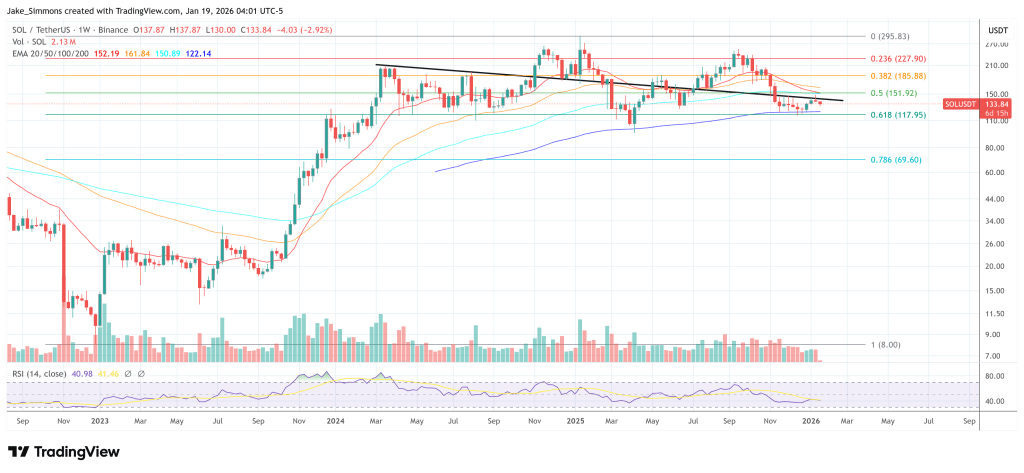
At press time, SOL traded at $133.84.

SOL remains below the black trendline, 1-week chart | Source: SOLUSDT on TradingView.com

Связанные с этим вопросы

QWhat is the core disagreement between Solana Labs CEO Anatoly Yakovenko and Ethereum's Vitalik Buterin regarding blockchain development?

AAnatoly Yakovenko believes continuous protocol iteration is essential for survival and relevance, arguing that a blockchain must constantly adapt to developer and user needs. In contrast, Vitalik Buterin advocates for Ethereum's 'ossification,' where the base layer becomes so complete and stable that it remains usable even if major protocol updates cease.

QAccording to Vitalik Buterin, what is the 'walkaway test' and why is it important for Ethereum?

AButerin's 'walkaway test' is the idea that Ethereum's base layer should reach a state where its usefulness does not depend on ongoing updates or features not already in the protocol. It is important because it ensures applications built on Ethereum remain functional like tools, not services that fail if the vendor stops maintaining them, making the network robust for decades.

QWhy does Anatoly Yakovenko argue that Solana 'needs to never stop iterating'?

AYakovenko argues that if Solana ever stops changing to fit the needs of its developers and users, it will die. He views continuous adaptation as core to its survival and value proposition, preventing technical stagnation and loss of relevance, rather than seeing ossification as a neutral or positive milestone.

QHow do Buterin and Yakovenko differ in their views on dependence on a single 'vendor' or development team?

ABoth express skepticism toward dependence on a single vendor, but operationalize it differently. Buterin wants Ethereum's base layer to become complete enough to be dependable with minimal upgrade cadence. Yakovenko agrees upgrades shouldn't depend on one team, but assumes upgrades will keep coming from a decentralized set of contributors, not necessarily a core entity like Anza or Solana Labs.

QWhat future development mechanism does Yakovenko hint at for sustaining Solana's iteration?

AYakovenko hints at a future where on-chain governance and funding mechanisms, such as a SIMD (Solana Improvement Document) vote, could directly pay for development work, potentially even utilizing AI-assisted coding, ensuring continuous innovation without reliance on a single central team.

Похожее

Has the 'Digital Gold' Narrative for BTC Failed?

**Title: Has the "Digital Gold" Narrative for Bitcoin Failed?** The article argues that Bitcoin's "digital gold" narrative remains valid despite a recent sharp price decline (from a peak near $126k in Oct 2025 to briefly under $61k in Feb 2026). It presents a long-term investment framework based on three core points: **1. Viewing Bitcoin as an Asset:** Bitcoin is presented as a superior potential store of value compared to gold. Key arguments are its absolute scarcity (21 million cap), superior portability, and transparent auditability via its public ledger. While acknowledging its current use in early, volatile stages (~3-4% global adoption), the author draws parallels to the early, disruptive phases of the internet and e-commerce. **2. Understanding the Recent Downturn:** The current ~50% correction is framed as a predictable, consensus-driven cycle following its post-halving peak (the 2024 halving preceded the Oct 2025 high). A crucial factor is a historic "changing of hands": the influx of new institutional buyers via ETFs allowed early, low-cost holders (miners, OG believers) to take profits. The author notes that while severe, Bitcoin's historical drawdowns (e.g., 93% in 2011, 77% in 2021-22) have been progressively smaller, suggesting maturing holder structure and decreasing volatility over time. **3. The Long-Term Perspective:** The long-term thesis hinges on Bitcoin capturing a portion of gold's market value. With Bitcoin's market cap at ~$1.4 trillion (at $70k) versus gold's ~$20 trillion, significant upside potential exists if the "digital gold" narrative is partially realized. However, the author strongly cautions that short-term risks remain, the bottom is unpredictable, and high volatility is inherent. The real risk is not Bitcoin failing but poor personal position management (over-leverage, wrong capital) and a lack of deep understanding, which can force investors out during severe downturns. The conclusion uses Amazon's 95% crash post-2000 dot-com bubble and subsequent 42x recovery as an analogy. The ultimate question is not if Bitcoin's price will rise, but if an investor's strategy and conviction can withstand the volatility to see the long-term play out. The recent divergence (gold up, Bitcoin down) is posed not as a narrative failure, but as potential evidence of this ongoing, painful transition from a speculative asset to a mainstream allocation.

marsbit7 ч. назад

Has the 'Digital Gold' Narrative for BTC Failed?

marsbit7 ч. назад

Has BTC's 'Digital Gold' Narrative Failed?

The article discusses Bitcoin's "digital gold" narrative, its recent price drop, and long-term outlook through the perspective of "Jason". It argues the narrative is not a failure but that Bitcoin represents a superior, new asset class due to its fixed supply (21 million), portability, and auditability. The piece compares its current ~3-4% global adoption rate to early internet/e-commerce, suggesting significant growth potential. Regarding the 2025-2026 price decline (from ~$126k to briefly under $61k), the author views it as a predictable, consensus-driven sell-off within Bitcoin's ~4-year cycle post-halving, exacerbated by a major "handover" from early, low-cost holders to new institutional buyers via ETFs. A key observation is that historical peak-to-trough drawdowns have lessened over time (e.g., 93% in 2011 to ~50% in 2026), indicating maturing volatility as holder structure changes. For the long term, the author uses a simple framework: Bitcoin's total market cap (~$1.4T at $70k) is only about 7% of gold's (~$20T). Even capturing 30-50% of gold's value would imply substantial upside. However, the article strongly cautions against viewing this as investment advice, emphasizing extreme volatility and the critical importance of risk management, position sizing, and deep fundamental understanding to survive severe drawdowns. It concludes by drawing a parallel to Amazon's 95% crash in 2000 and subsequent 42x recovery, stressing that the key is surviving market cycles to realize long-term potential.

链捕手7 ч. назад

Has BTC's 'Digital Gold' Narrative Failed?

链捕手7 ч. назад

From Code to Cognition: A Ten-Thousand-Word Guide to the Evolution of the Robot Brain

"From Code to Cognition: The Evolution of Robot Brains" The journey of robotic intelligence has shifted dramatically from manually coded systems to AI-driven brains. For decades, robots relied on layered software stacks—perception, state estimation, planning, control—each handcrafted. While predictable, they lacked adaptability. The 2010s saw deep learning revolutionize perception (e.g., object detection) and control (via reinforcement learning), but learned skills remained narrow. The arrival of Large Language Models (LLMs) marked a turning point. LLMs acted as high-level planners, interpreting natural language instructions and generating sequences of actions for traditional robotic systems to execute. However, true integration came with Visual-Language-Action (VLA) models, which fused vision, language, and motion prediction into a single network. Pioneered by models like RT-2 and open-source projects like OpenVLA, VLAs enable robots to reason and act directly from visual input and commands. The most advanced humanoid robots now employ a "dual-brain" architecture: a slow-thinking, large VLA (System 2) for reasoning and planning, and a fast-reacting, small network (System 1) for high-frequency motion control, sometimes with an even lower-level System 0 for balance. This split balances cognition with the physics of real-time movement. Computation is split between onboard hardware (e.g., NVIDIA Jetson) for safety-critical control loops and cloud/edge servers for non-critical tasks like learning and interfaces. A crucial driver is the open-source ecosystem—models like GR00T and OpenVLA allow startups to build upon pre-trained brains and fine-tune them with their own data, accelerating development. Despite progress, current systems struggle with recovery from errors, sample inefficiency, and long-horizon tasks. This has spurred the rise of **World Models**—neural networks that predict the consequences of actions. By simulating possible futures before acting (like NVIDIA Cosmos or Meta V-JEPA), robots can plan, recover, and generalize better. This represents the next frontier: shifting intelligence from learned reactions to an internal model of physics and cause-and-effect. The field is rapidly evolving. While not yet at its "ChatGPT moment," the convergence of cheaper hardware, scalable simulation, and world models points toward robots that are increasingly capable, adaptive, and useful. The question is shifting from "what can robots do?" to "what *should* they do?"

marsbit7 ч. назад

From Code to Cognition: A Ten-Thousand-Word Guide to the Evolution of the Robot Brain

marsbit7 ч. назад

Торговля

Спот
Фьючерсы

Популярные статьи

Manyu: восходящая мем-звезда на Ethereum, готовая открыть новую эру культуры Shiba

Manyu - это мемтокен на Ethereum, который приносит децентрализованную культурную и развлекательную ценность через вирусное влияние в соцсетях и вовлечённость сообщества.

1.9k просмотров всегоОпубликовано 2025.11.27Обновлено 2025.11.27

Manyu: восходящая мем-звезда на Ethereum, готовая открыть новую эру культуры Shiba

Неделя обучения по популярным токенам 14: Glamsterdam — самое ожидаемое обновление Ethereum в 2026 году

Ordinals/Runes по-прежнему стимулируют доходы от комиссий за блоки и активность разработчиков, рассматриваются как отправная точка «нативной эмиссии активов» в сети.

1.5k просмотров всегоОпубликовано 2026.04.29Обновлено 2026.04.29

Неделя обучения по популярным токенам 14: Glamsterdam — самое ожидаемое обновление Ethereum в 2026 году

Обсуждения

Добро пожаловать в Сообщество HTX. Здесь вы сможете быть в курсе последних новостей о развитии платформы и получить доступ к профессиональной аналитической информации о рынке. Мнения пользователей о цене на ETH (ETH) представлены ниже.

活动图片