Solana Emerges As The Most Active Blockchain Ahead Of Major Chains By Daily Transactions

bitcoinistОпубликовано 2026-03-03Обновлено 2026-03-03

Введение

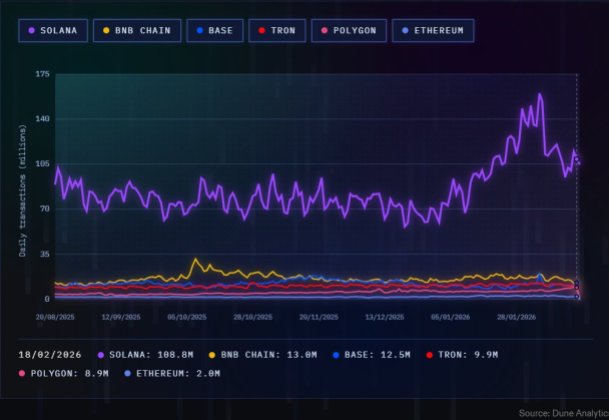
Solana has emerged as the most active blockchain by daily transaction volume, significantly outperforming other major chains. As the SOL price rebounded toward $90, the network processed approximately 108.8 million daily transactions—nearly ten times more than its closest competitor, BNB Chain, which recorded 13.0 million. Other networks, including Base, TRON, Polygon, and Ethereum, trailed further behind. This surge is attributed to Solana’s high-speed infrastructure, low fees, and growing activity in DeFi, NFTs, and consumer applications. Additionally, Solana dominated in decentralized exchange (DEX) volume throughout February and continued strongly into March, with over $200 billion in DEX volume recorded in just the first two days. This reflects deeper on-chain strength and sustained user engagement, signaling a shift in liquidity toward faster and more cost-effective blockchain networks.

As Monday drew to a close, the Solana price witnessed a bounce, bringing it closer to the $90 mark, which has ignited bullish sentiment among investors. The SOL’s price rebound coincides with a significant uptick in the network’s activity and performance, with SOL emerging as the No. 1 blockchain among all major chains.

Daily Transaction Count Puts Solana On Top

Solana’s price action and network performance appear to be moving in a similar direction, with the price briefly bouncing as network activity explodes. Once again, the network has proven its position as a leader in the blockchain sector, becoming the most go-to chain in the sector on a daily basis.

Founder and Chief Executive Officer (CEO) of Sensei Holding and Namaste Group, Solana Sensei, shared on X that the SOL network has surged ahead of competition in terms of transaction volume. The report shows that SOL tops the charts in daily on-chain transactions count across all major blockchain networks.

Fueled by its high-speed infrastructure, cheap fees, and growing activity across DeFi, NFTs, and consumer-facing applications, Solana is processing more transactions per day than its closest competitors. SOL’s dominance in this area marks a notable achievement, highlighting the network’s expanding role as a high-throughput hub for on-chain operations.

Source: Chart from Solana Sensei on X

Solana Sensei highlighted that the SOL network is currently processing nearly 10 times or more transactions than other major chains, reflecting sustained user engagement and increasing ecosystem maturity. Taking a look at the chart, SOL recorded daily transactions of approximately 108.8 million, with BNB Chain coming in second position with over 13.0 million daily transfers.

Meanwhile, leading networks like Base, TRON, Polygon, and Ethereum recorded 12.5 million, 9.9 million, 8.9 million, and 2.8 million, respectively. As developers continue to release new apps and users migrate to more affordable platforms, SOL’s transaction leadership demonstrates a wider change in where blockchain activity is concentrating in the current market cycle.

SOL DEX Volume Expands Beyond Other Chains

In another X post, Solana Sensei revealed that SOL is rapidly asserting dominance in the decentralized trading arena. According to the expert, SOL’s DEX volume has skyrocketed beyond that of competing blockchain networks. The increase in decentralized exchange activity is indicative of a larger shift in liquidity toward quicker, more affordable networks.

In the entire month of February, the SOL network dominated all major chains to secure the top spot in DEX volume. Such an increase in DEX volume indicates deeper on-chain strength, market infrastructure, and ongoing user participation rather than just transient speculation.

This notable DEX performance from SOL is starting to unfold this new month. Just 2 days into the month of March, the total Solana DEX volume has exceeded $200 billion, further reinforcing the network’s leading role in the evolving on-chain financial landscape.

SOL trading at $85 on the 1D chart | Source: SOLUSDT on Tradingview.com

Связанные с этим вопросы

QAccording to the article, which blockchain has the highest number of daily on-chain transactions?

ASolana has the highest number of daily on-chain transactions, with approximately 108.8 million.

QWhat are the key factors mentioned that are fueling Solana's high transaction volume?

AThe key factors are its high-speed infrastructure, cheap fees, and growing activity across DeFi, NFTs, and consumer-facing applications.

QHow does Solana's daily transaction count compare to its closest competitor, BNB Chain?

ASolana's daily transaction count of 108.8 million is nearly 10 times that of BNB Chain, which recorded over 13.0 million.

QWhat achievement did Solana secure in the decentralized exchange (DEX) volume for the month of February?

ASolana secured the top spot in DEX volume among all major chains for the entire month of February.

QWhat was the total Solana DEX volume just two days into the month of March, as stated in the article?

AThe total Solana DEX volume exceeded $200 billion just two days into the month of March.

Похожее

When AI Begins to Audit the World: From Claude Discovering the ZEC Vulnerability, Watching the Encryption Industry Enter the 'Recursive Security Era'

**When AI Audits the World: From Claude's Discovery of a ZEC Vulnerability, Viewing the Crypto Industry Entering a "Recursive Security Era"** This article examines a pivotal shift in the blockchain security landscape, triggered by the convergence of two events: Anthropic's research on AI's "Recursive Self-Improvement" and Claude Opus 4.8's discovery of a critical vulnerability in Zcash's code. Traditionally, crypto security has relied on human experts and automated tools for periodic audits. However, the article argues AI is transitioning from a mere tool to an active participant in understanding and analyzing complex systems. Claude's ability to identify a subtle flaw in Zcash's zero-knowledge proof system demonstrates AI's potential to dramatically lower the cost and time required for risk discovery. This goes beyond finding a single bug; it signals a change in the very mechanism of how vulnerabilities are found. The core thesis introduces the concept of "Recursive Security," drawing a parallel to Anthropic's "Recursive Self-Improvement." Just as AI can accelerate its own development through feedback loops, security systems are evolving towards a continuous cycle of analysis, risk identification, remediation, and re-analysis. Security is becoming a persistent, evolving capability integrated into a system's lifecycle, rather than a one-time pre-launch audit. This shift is particularly urgent for the crypto industry, where system complexity from Layer-2 networks, modular architectures, and ZK-proofs is growing faster than human analysis capacity. AI excels at the pattern recognition and contextual understanding needed to navigate this complexity. Importantly, the article cautions that AI augments both defenders and potential attackers, accelerating the entire threat landscape. The future competitive advantage may not lie in having zero vulnerabilities, but in having the fastest risk discovery, validation, and response capabilities. The Claude-Zcash incident is thus an early signal of an era where AI-driven, recursive security systems become essential for managing risk in an increasingly complex digital world.

marsbit1 ч. назад

When AI Begins to Audit the World: From Claude Discovering the ZEC Vulnerability, Watching the Encryption Industry Enter the 'Recursive Security Era'

marsbit1 ч. назад

From MSTR to STRC+: Where Is the Limit of the Strategy Universe?

From MSTR to STRC+: The Evolution and Limits of the Strategy Universe This article examines the transformation of Strategy (formerly MicroStrategy) from a simple "Bitcoin treasury" company into a complex financial engineering firm building a BTC-backed credit system. **Core Thesis:** Strategy's true significance lies not just in its massive BTC holdings (~844k BTC), but in its attempt to transform this static reserve into a multi-layered credit curve within traditional capital markets and, subsequently, into on-chain yield infrastructure. **The MSTR Flywheel:** The initial model was a reflexive loop: BTC price rises → MSTR stock rises → company raises capital (debt/equity) at a premium → buys more BTC → increases per-share BTC exposure → MSTR premium grows. This "amplified Bitcoin" equity (MSTR) thrives on bullish momentum but is vulnerable to tightening premiums and rising funding costs. **Building the Credit Curve:** Strategy's innovation is slicing its single BTC balance sheet into different risk/return profiles via specialized securities: * **MSTR:** High-volatility equity layer absorbing full BTC upside/downside. * **STRC:** Key product. A perpetual preferred stock designed as "short duration high yield credit," offering ~11.5% floating monthly dividends. It attracts fixed-income investors seeking yield without direct BTC exposure, funding Strategy's operations. * **STRD/STRK/STRF:** Other preferred/share classes with varying durations, conversion rights, and fixed dividends. **Risks of the STRC Model:** STRC's high yield is not risk-free. Its stability depends on: 1) Sufficient BTC asset coverage, 2) Strategy's continued ability to pay dividends, and 3) Market faith in the MSTR/STRC funding flywheel. Stress points include deep BTC price declines eroding the asset buffer, rising dividend costs if STRC trades below par, and a broken flywheel if MSTR's premium (mNAV) falls persistently. **On-Chain Expansion: STRC+:** Projects like **Saturn** and **Apyx** aim to package STRC's (and other DAT preferred stock) cash flows into on-chain stablecoin yield (e.g., sUSDat, apyUSD). They offer DeFi a new yield source distinct from trading fees or incentives—cash dividends from traditional securities. However, this introduces compounded risks: off-chain custody, issuer credit risk, BTC volatility, and protocol execution risk. **Conclusion: The Ultimate Boundary** Strategy's endgame is not infinite BTC accumulation. It is the market's long-term acceptance of a new credit system where BTC serves as collateral for tradable securities whose cash flows can power on-chain financial applications. Its "universe" expands if this BTC-native credit curve gains legitimacy, but contracts if these instruments are repriced purely as high-risk, yield-bearing credit assets without stablecoin mythology.

marsbit1 ч. назад

From MSTR to STRC+: Where Is the Limit of the Strategy Universe?

marsbit1 ч. назад

Торговля

Спот
Фьючерсы

Популярные статьи

Обсуждения

Добро пожаловать в Сообщество HTX. Здесь вы сможете быть в курсе последних новостей о развитии платформы и получить доступ к профессиональной аналитической информации о рынке. Мнения пользователей о цене на SOL (SOL) представлены ниже.

活动图片