Saylor Bought 1,550 BTC, But This Might Be Strategy's Worst Trade Recently

marsbitОпубликовано 2026-06-09Обновлено 2026-06-09

Введение

Saylor purchased 1,550 BTC, but this may be one of MicroStrategy's worst recent trades for its MSTR shareholders. The article explains that for MSTR to increase its Bitcoin-per-share (BPS) metric, it must issue new shares at an mNAV (market cap to net asset value) ratio above a "breakeven" level, calculated here as 1.30. In this transaction, MSTR raised $181 million via an ATM offering and used only $101.3 million to buy Bitcoin, with the rest reportedly added to its dollar reserves. Crucially, the author argues the shares were likely sold below the 1.30 mNAV threshold. This combination—selling below breakeven mNAV and not deploying all proceeds into Bitcoin—resulted in a slight dilution of BPS, estimated at a 0.19% decrease. The trade is framed as a sacrifice of MSTR shareholder value (BPS) to extend the dollar reserve runway for its Sustainable Treasury Reserve Coin (STRC) subsidiary from 6.3 to 7 months. The author concludes that Strategy is gambling that this move will improve market sentiment for STRC and MSTR, allowing future value-accretive fundraising. If it fails, the company may face the difficult choice of further diluting MSTR or delaying STRC dividends.

Author:100y

Compiled by: Deep Tide TechFlow

Deep Tide Intro: While Saylor is shouting about increasing the BTC per share, he is issuing shares below the break-even point and only using half of the raised money to buy BTC—this is not bottom fishing, this is using MSTR shareholders' interests to subsidize STRC's sustainability. For investors holding MSTR, understanding the logic behind this trade is more important than focusing on how much BTC was bought.

Saylor first sold 32 BTC, then turned around and bought 1,550 BTC today.

I don't want Strategy to fail. But some things must be made clear.

This is one of the worst trades.

On the surface, this trade looks beautiful. Strategy bought a large amount of BTC near recent lows and even increased its dollar reserve for preferred stock dividends from $900 million to $1 billion.

Is this Strategy's revival?

If you think this is positive, it means you don't fully understand Strategy yet.

1. You Need to Understand the Break-Even mNAV

One of Strategy's core objectives is to increase the BTC per share (BPS) for MSTR shareholders.

The method to increase BPS is simple: issue common stock at a premium and use the raised funds to buy BTC.

So, how high a premium does MSTR need to issue shares via ATM offerings to truly increase BPS?

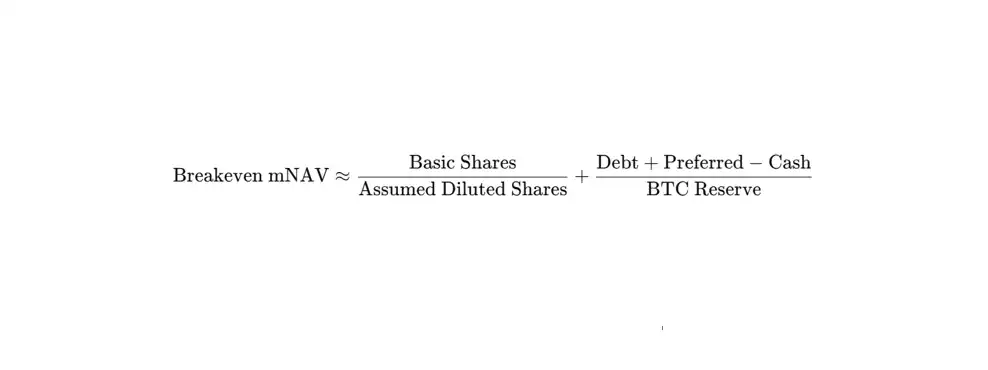
According to the 2026 Q1 earnings call, the mNAV needs to be above 1.22.

This is the so-called "break-even mNAV."

This concept comes from a simple condition: the amount of BTC that can be bought by selling 1 share of MSTR must be greater than the BTC amount corresponding to each existing MSTR share.

The complete derivation process can be referred to in my previous article.

In the end, the break-even mNAV is calculated as follows:
By the way, the current break-even mNAV is no longer 1.22.

Based on the data before this purchase of 1,550 BTC, my calculated result is 1.30.

2. The Worst Trade
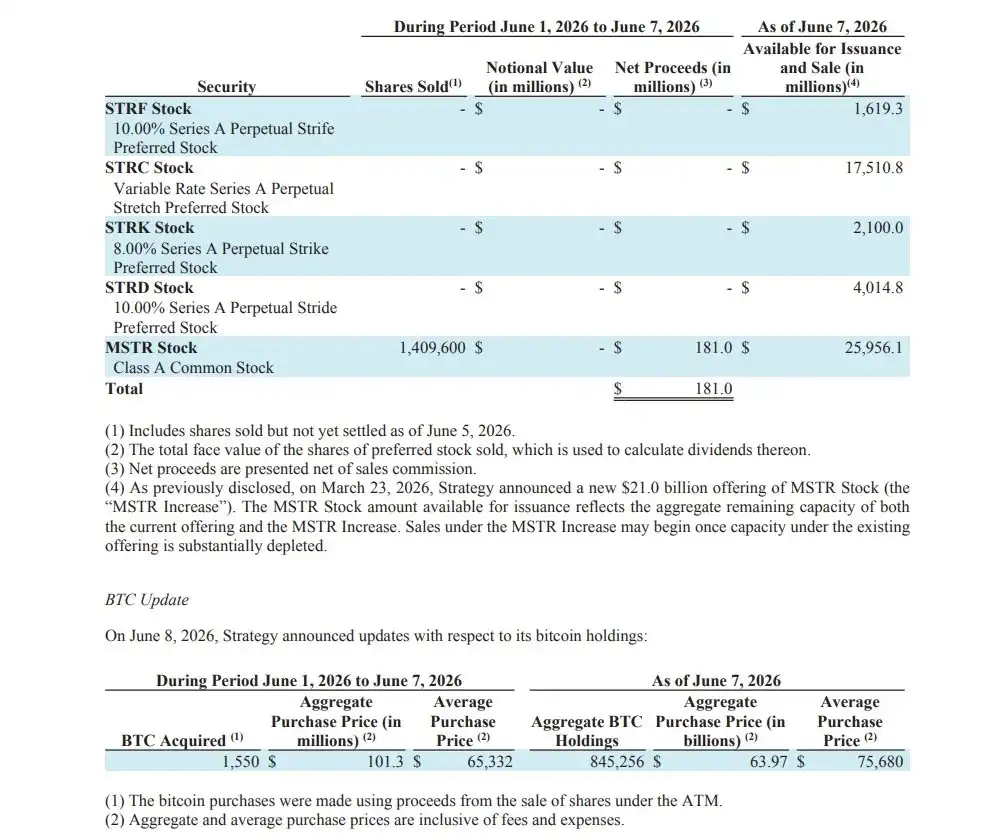
Now back to Strategy's purchase of these 1,550 BTC.

Strategy raised $181 million through MSTR's ATM offering, of which $101.3 million was used to purchase 1,550 BTC.

There are two issues here:

First, MSTR's ATM offering seems to have been conducted at an mNAV below 1.30. Selling shares to buy BTC below the break-even mNAV is not increasing BPS; it's diluting it.

Second, and this is the key point: not all ATM-raised funds were used to buy BTC. The entire concept of break-even mNAV is based on the premise that 100% of the raised funds are used to buy BTC. Even if the mNAV is high enough, if only part of the funds flows into BTC, this trade can still lower BPS.

Strategy seems to have added the remaining unused funds to the dollar reserve.

In other words: Strategy sacrificed MSTR shareholders' shares and BPS to maintain STRC's sustainability.

In fact, after this trade, Strategy's BPS decreased by approximately 0.19% compared to before the trade.

What did they gain in return?

The available time for the dollar reserve was extended from about 6.3 months to 7 months.

3. Strategy's Bet

"Our goal is to drive the BTC per share up, and we are doing everything we can to drive the BTC per share up."

These are the words of Michael Saylor in the 2026 Q1 earnings call.

But in this trade, Strategy sacrificed MSTR's BPS for STRC.

Strategy has rolled the dice.

If sacrificing BPS can reverse market sentiment, restore STRC's price, and pull the mNAV back up, then Strategy can continue raising funds through MSTR and STRC's ATM offerings.

But what if sentiment doesn't improve?

Then Strategy may have no choice but to continue sacrificing MSTR.

In the worst-case scenario, either delaying STRC's dividend payments...

Or slowly bleeding out.

Pray for BTC, MSTR, and STRC to recover.

Amen.

Связанные с этим вопросы

QAccording to the author, why is Saylor's recent purchase of 1,550 BTC potentially a bad deal for MSTR shareholders?

AThe author argues it's a bad deal because the shares were likely sold via MSTR's ATM offering at an mNAV below the breakeven point of 1.30, and only part of the raised funds were used to buy BTC. This dilutes the Bitcoin per Share (BPS) for MSTR shareholders while using the remaining capital to shore up the STRATOS (STRC) sustainability fund.

QWhat is the 'breakeven mNAV' and why is it important for MSTR's strategy?

AThe 'breakeven mNAV' is the minimum premium to MicroStrategy's Bitcoin holdings (mNAV) at which the company can issue new shares via its ATM program and use the proceeds to buy Bitcoin *without* diluting the Bitcoin per Share (BPS) for existing shareholders. It's crucial because MSTR's core goal is to increase BPS.

QWhat specific negative outcome for MSTR shareholders resulted from the 1,550 BTC purchase transaction?

AAs a result of this transaction, the author calculates that MSTR's Bitcoin per Share (BPS) decreased by approximately 0.19%.

QWhat trade-off did Strategy (the company) make in this transaction, according to the article?

AStrategy traded off and sacrificed the Bitcoin per Share (BPS) of MSTR shareholders in order to maintain the sustainability of its STRATOS (STRC) project by extending its dollar reserve runway.

QWhat does the author suggest is Strategy's underlying gamble with this move?

AThe author suggests Strategy is gambling that sacrificing MSTR's BPS in the short term will help restore market sentiment, recover the STRC token price, and pull the mNAV premium back up. This would then allow them to resume successful fundraising through ATM offerings for both MSTR and STRC in the future.

Похожее

The More It Rises, the More Dangerous? The Systemic Risks Behind SpaceX's Soaring Valuation

Summary: The article raises concerns about the systemic risks posed by SpaceX's skyrocketing valuation, arguing that modern market mechanics, rather than fundamentals, are driving its price discovery. Following SpaceX's market capitalization surpassing $3 trillion in after-hours trading, the author contends that the market is no longer functioning properly. The core issue is not SpaceX's business prospects but the unhealthy market structure surrounding it. With limited float and the imminent launch of options trading, the stage is set for a potential "gamma squeeze"—a feedback loop where market makers hedging call options are forced to buy shares, pushing the price higher and attracting more speculative momentum traders. This mechanism, seen previously with Tesla and meme stocks, can decouple valuation from financial reality. The danger escalates as extreme valuations force passive funds, ETFs, pensions, and major indices to hold the stock. If SpaceX grows large enough—hypothetically reaching $5 or even $10 trillion—its performance would increasingly dictate broader market indices, embedding systemic risk. The author warns that when price appreciation itself becomes the primary bullish thesis, the market transforms from a capital allocation mechanism into a self-reinforcing speculative machine, endangering the retirement savings of ordinary investors tied to passive strategies. The piece questions whether such a system can still perform its fundamental role of price discovery.

marsbit3 мин. назад

The More It Rises, the More Dangerous? The Systemic Risks Behind SpaceX's Soaring Valuation

marsbit3 мин. назад

How Much of the Subscription Fee You Pay to Claude Can Optical Module Companies Get?

How much of your $20 Claude Pro subscription actually goes to AI model companies like Anthropic? A viral breakdown image highlights the fundamental valuation challenge for AI applications versus traditional SaaS. Unlike SaaS with high software margins, AI subscriptions face variable "inference costs": every user query consumes GPU time, power, and cloud resources. This creates a tension between fixed subscription fees and usage-driven expenses. While the specific dollar splits are illustrative, the core question is whether AI revenue can achieve SaaS-like margins as usage scales. Currently, infrastructure providers (cloud platforms, GPU makers like Nvidia, HBM suppliers, power/data centers) capture more certain revenue from growing AI usage. Their financials reflect pricing power and faster earnings validation. The bullish case hinges on efficiency improvements: model optimization, caching, smaller models, and custom chips could lower per-token costs over time. The key debate is whether cost declines can outpace increases in user workload complexity and volume. Ultimately, for AI companies to command high SaaS-like valuations, they must demonstrate not just user growth but also improving gross margins after accounting for inference costs. Investors will scrutinize not just subscriber numbers, but usage patterns, enterprise pricing tiers, and real efficiency gains.

marsbit13 мин. назад

How Much of the Subscription Fee You Pay to Claude Can Optical Module Companies Get?

marsbit13 мин. назад

OpenAI's Hyperliquid Pre-IPO Pricing Venture: Why Did It Last Only Half a Year?

The article discusses the rise and fall of Pre-IPO pricing markets on the Hyperliquid blockchain. Trade.xyz, an anonymous team, successfully built the largest pre-market for SpaceX (SPCX) by launching a contract with a clear anchor: the eventual Nasdaq listing price. This provided inherent price stability and validation. In contrast, Ventuals, a team backed by Paradigm, failed despite holding exclusive contracts for highly sought-after companies like OpenAI and Anthropic. Its key mistake was its pricing mechanism. For companies with no near-term IPO date, Ventuals' oracle relied partly on opaque private market transactions and, critically, partly on its own contract's moving average price. This created a self-referential feedback loop where prices were artificially propped up and detached from genuine supply and demand, leading to illiquid markets. Ventuals shut down after nine months, settling positions at final prices of $1,341.80 for OpenAI and $1,618.90 for Anthropic. Ironically, some employees and late-stage investors of these very companies reportedly used these flawed Ventuals prices for valuation reference, highlighting the acute demand for any price signal in illiquid private markets. The article concludes that while demand for pre-IPO trading is real and growing, with players like Coinbase now entering the space, the fundamental challenge remains: without a public listing to provide a definitive price anchor, these markets struggle to establish truly accurate and liquid pricing. The need for a transparent, self-correcting market is the critical lesson from Ventuals' failure.

marsbit29 мин. назад

OpenAI's Hyperliquid Pre-IPO Pricing Venture: Why Did It Last Only Half a Year?

marsbit29 мин. назад

With Daily Active Users Reaching 3-4 Times That of the Industry's Second Place, Which Crack in the Office Agent Market Has Tencent's WorkBuddy Torn Open?

Tencent's AI office assistant, WorkBuddy, has achieved daily active users (DAU) 3-4 times that of the industry's second-place product, primarily driven by non-technical users like HR, operations, and administrative staff. Its rapid growth, starting with a public beta in March 2026, highlights a key strategic divergence from competitors like OpenAI's Codex and Anthropic's Claude Code. Unlike those tools, which originated as developer-focused assistants (in command lines or IDEs) and are now expanding towards office scenarios, WorkBuddy was built from the ground up for non-technical office workers. Its development was user-driven, initiated after腾讯云's team observed non-technical employees using their CodeBuddy coding tool for general tasks. WorkBuddy's design is defined by three core decisions aimed at lowering barriers: 1) Using natural language instead of technical concepts, so users describe their goal without needing to understand prompts or agents. 2) Providing pre-packaged "Skill" templates for common office tasks like data processing, content creation, and research. 3) Natively integrating into existing腾讯 ecosystems like腾讯 Docs and WeChat, making the agent a seamless part of the user's workflow rather than a separate tool. This "scenario encapsulation" approach, prioritizing the shortest path for users to get work done, contrasts with the "underlying capability" focus of Codex and Claude, which offer more flexibility but require more technical setup. Analysts confirm WorkBuddy's leading market position in China by mid-2026, with massive user and request growth following its launch. Recognizing the same trend of surging non-technical adoption, OpenAI and Anthropic are now pivoting their products with features like role-based plugins (Codex) and a simplified desktop interface (Claude Cowork). However, adapting tools built for developers requires significant changes to interaction models and integrations. WorkBuddy currently holds an estimated six-month lead in delivering a complete solution for non-technical office users. Its recently launched enterprise version aims to solidify this advantage. The competition underscores two valid paths: embedding agent capabilities directly into familiar work environments versus building powerful, general-purpose agents that users must learn to access. WorkBuddy's early success demonstrates the effectiveness of the former strategy for mainstream office adoption.

marsbit38 мин. назад

With Daily Active Users Reaching 3-4 Times That of the Industry's Second Place, Which Crack in the Office Agent Market Has Tencent's WorkBuddy Torn Open?

marsbit38 мин. назад

Торговля

Спот
Фьючерсы

Популярные статьи

Тест по Bitcoin Биткоина

HTX Learn: Изучите Bitcoin halving и Заработаете Токены USDT

3.1k просмотров всегоОпубликовано 2024.04.16Обновлено 2024.04.16

Тест по Bitcoin  Биткоина

Что такое $BITCOIN

ЦИФРОВОЕ ЗОЛОТО ($BITCOIN): Комплексный анализ Введение в ЦИФРОВОЕ ЗОЛОТО ($BITCOIN) ЦИФРОВОЕ ЗОЛОТО ($BITCOIN) — это проект на основе блокчейна, работающий в сети Solana, который стремится объединить характеристики традиционных драгоценных металлов с инновациями децентрализованных технологий. Хотя он носит имя Биткойн, часто называемого “цифровым золотом” из-за его восприятия как средства хранения ценности, ЦИФРОВОЕ ЗОЛОТО является отдельным токеном, предназначенным для создания уникальной экосистемы в ландшафте Web3. Его цель — позиционировать себя как жизнеспособный альтернативный цифровой актив, хотя детали его применения и функциональности все еще развиваются. Что такое ЦИФРОВОЕ ЗОЛОТО ($BITCOIN)? ЦИФРОВОЕ ЗОЛОТО ($BITCOIN) — это токен криптовалюты, специально разработанный для использования в блокчейне Solana. В отличие от Биткойна, который выполняет широко признанную роль хранения ценности, этот токен, похоже, сосредоточен на более широких приложениях и характеристиках. Примечательные аспекты включают: Инфраструктура блокчейна: Токен построен на блокчейне Solana, известном своей способностью обрабатывать высокоскоростные и недорогие транзакции. Динамика предложения: ЦИФРОВОЕ ЗОЛОТО имеет максимальное предложение, ограниченное 100 квадриллионами токенов (100P $BITCOIN), хотя детали о его обращающемся предложении в настоящее время не раскрыты. Утилита: Хотя точные функциональные возможности не описаны, есть указания на то, что токен может быть использован для различных приложений, потенциально связанных с децентрализованными приложениями (dApps) или стратегиями токенизации активов. Кто создатель ЦИФРОВОГО ЗОЛОТА ($BITCOIN)? На данный момент личность создателей и команды разработчиков, стоящих за ЦИФРОВЫМ ЗОЛОТОМ ($BITCOIN), остается неизвестной. Эта ситуация типична для многих инновационных проектов в области блокчейна, особенно тех, которые связаны с децентрализованными финансами и феноменом мем-криптовалют. Хотя такая анонимность может способствовать культуре, ориентированной на сообщество, она усиливает опасения по поводу управления и ответственности. Кто инвесторы ЦИФРОВОГО ЗОЛОТА ($BITCOIN)? Доступная информация указывает на то, что у ЦИФРОВОГО ЗОЛОТА ($BITCOIN) нет известных институциональных спонсоров или значительных венчурных капиталовложений. Проект, похоже, функционирует по модели пирингового взаимодействия, сосредоточенной на поддержке и принятии сообществом, а не на традиционных путях финансирования. Его активность и ликвидность в основном сосредоточены на децентрализованных биржах (DEX), таких как PumpSwap, а не на устоявшихся централизованных торговых платформах, что еще больше подчеркивает его подход, ориентированный на grassroots. Как работает ЦИФРОВОЕ ЗОЛОТО ($BITCOIN) Операционные механизмы ЦИФРОВОГО ЗОЛОТА ($BITCOIN) можно подробно описать на основе его дизайна блокчейна и характеристик сети: Механизм консенсуса: Используя уникальный механизм доказательства истории (PoH) Solana в сочетании с моделью доказательства доли (PoS), проект обеспечивает эффективную валидацию транзакций, что способствует высокой производительности сети. Токеномика: Хотя конкретные дефляционные механизмы не были подробно описаны, большое максимальное предложение токенов подразумевает, что оно может быть предназначено для микротранзакций или нишевых случаев использования, которые еще предстоит определить. Интероперабельность: Существует потенциал для интеграции с более широкой экосистемой Solana, включая различные платформы децентрализованных финансов (DeFi). Однако детали относительно конкретных интеграций остаются неуточненными. Хронология ключевых событий Вот хронология, которая подчеркивает значимые вехи, касающиеся ЦИФРОВОГО ЗОЛОТА ($BITCOIN): 2023: Первоначальное развертывание токена происходит в блокчейне Solana, отмеченное его адресом контракта. 2024: ЦИФРОВОЕ ЗОЛОТО приобретает видимость, когда оно становится доступным для торговли на децентрализованных биржах, таких как PumpSwap, позволяя пользователям обменивать его на SOL. 2025: Проект наблюдает спорадическую торговую активность и потенциальный интерес к инициативам, возглавляемым сообществом, хотя на данный момент не зафиксировано никаких значительных партнерств или технических достижений. Критический анализ Сильные стороны Масштабируемость: Основная инфраструктура Solana поддерживает высокие объемы транзакций, что может повысить полезность $BITCOIN в различных сценариях транзакций. Доступность: Потенциально низкая цена торговли за токен может привлечь розничных инвесторов, способствуя более широкому участию благодаря возможностям дробного владения. Риски Отсутствие прозрачности: Отсутствие публично известных спонсоров, разработчиков или процесса аудита может вызвать скептицизм относительно устойчивости и надежности проекта. Волатильность рынка: Торговая активность сильно зависит от спекулятивного поведения, что может привести к значительной волатильности цен и неопределенности для инвесторов. Заключение ЦИФРОВОЕ ЗОЛОТО ($BITCOIN) является интригующим, но неоднозначным проектом в быстро развивающейся экосистеме Solana. Хотя он пытается использовать нарратив “цифрового золота”, его отход от установленной роли Биткойна как средства хранения ценности подчеркивает необходимость более четкого различения его предполагаемой утилиты и структуры управления. Будущее принятие и усвоение, вероятно, будут зависеть от решения текущей непрозрачности и более четкого определения его операционных и экономических стратегий. Примечание: Этот отчет охватывает синтезированную информацию, доступную на октябрь 2023 года, и с тех пор могут произойти события.

104 просмотров всегоОпубликовано 2025.05.13Обновлено 2025.05.13

Что такое $BITCOIN

Fractal Bitcoin: масштабирование Биткоина с помощью рекурсивной системы

Fractal Bitcoin — масштабное Layer-1-решнение, созданное на базе кода Биткоина, позволяющего достигать бесконечного масштабирования с помощью рекурсивного подхода.

2.3k просмотров всегоОпубликовано 2025.06.30Обновлено 2025.06.30

Fractal Bitcoin: масштабирование Биткоина с помощью рекурсивной системы

Обсуждения

Добро пожаловать в Сообщество HTX. Здесь вы сможете быть в курсе последних новостей о развитии платформы и получить доступ к профессиональной аналитической информации о рынке. Мнения пользователей о цене на BTC (BTC) представлены ниже.

活动图片