Robotics' "ChatGPT Moment": AI Moves into the Physical World, Blockchain Accelerates the Arrival of the Machine Economy

marsbitОпубликовано 2026-04-17Обновлено 2026-04-17

Введение

The integration of AI and robotics is accelerating the shift from digital intelligence to physical AI, enabling machines to perceive, reason, and act in real-world environments. Companies like Figure, Tesla, and Skild AI are driving advancements in humanoid and specialized robots, supported by significant investments—such as Skild’s $14B and Figure’s $10B+ funding rounds. Key enablers include declining hardware costs (actuators, sensors, batteries), edge computing (e.g., NVIDIA Jetson), and AI "world models" that learn physical intuition from video data rather than programmed instructions. Despite progress, challenges remain: collecting real-world robotic training data is slow and costly, and simulation-to-reality gaps persist. Blockchain and tokenization offer solutions by incentivizing decentralized data contribution and enabling robots to function as economic agents—earning, spending, and distributing profits autonomously. By 2030, physical AI could transform industries and households, with robots operating via standardized platforms and skill-based "app stores." The convergence of affordable hardware, advanced AI, decentralized coordination, and edge compute promises a future where intelligent robots become ubiquitous assistants in daily life and high-risk applications.

Author: Syed Armani

Compiled by: Felix, PANews

AI is no longer confined to screens and software. As AI integrates with robotics, machines are gradually acquiring the ability to perceive the world, interpret changing conditions, and take action in real-time. This shift towards intelligent physical systems, known as Physical AI, is beginning to reshape various industries and promises to impact daily household life as the technology matures.

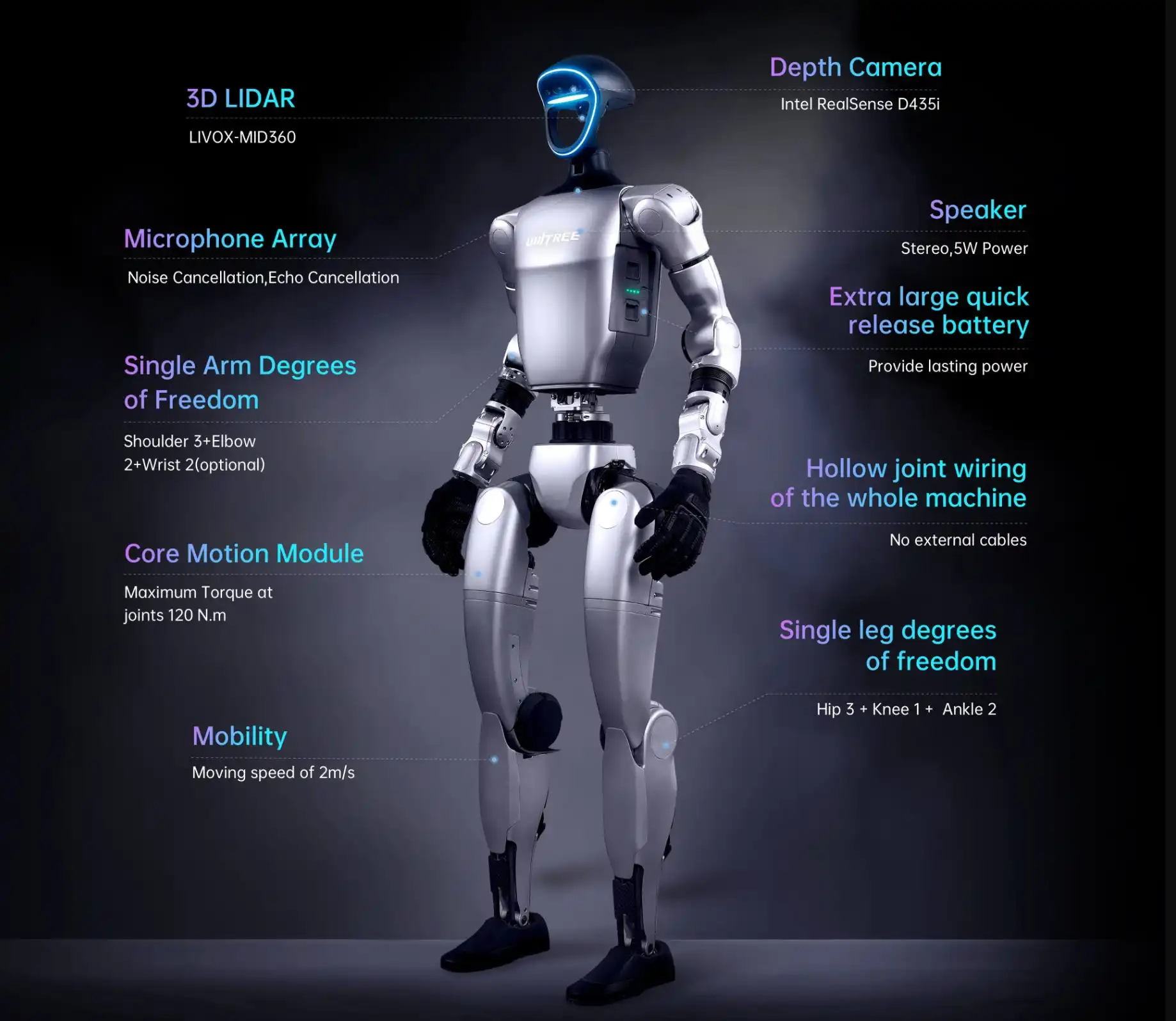
Innovation in robotics is surging at an unprecedented rate. Figure recently unveiled the Figure 03 humanoid robot, designed for home and commercial applications. It can perform chores like folding clothes and loading dishwashers, though not yet perfectly. Tesla is running its Optimus humanoid robot in limited internal pilot projects on factory floors. Autonomous drones and legged robots are increasingly being used for dangerous inspection tasks. Meanwhile, companies like Unitree and technologies like FlexiTac are working on enabling robots to navigate cluttered home environments, ensure safe movement around pets and children, and assist with daily chores. Once ready, intelligent robots will focus on general intelligence and situational awareness, such as recognizing that a spilled glass of water needs to be cleaned up without explicit instruction.

Investors are pouring significant capital into the technology stack expected to underpin the next generation of robotic hardware. In January 2026, Skild AI raised $14 billion in a Series C round, reaching a valuation of $14 billion, to scale its general-purpose robotics foundation model; while Figure AI raised over $10 billion in its 2025 Series C round, achieving a post-money valuation of $39 billion, to expand human manufacturing capabilities and industrial deployment. Apptronik expanded its Series A to $935 million, and NEURA Robotics added €120 million in its Series B round. These highlight a growing consensus: Physical AI is becoming a strategic foundation for consumer and industrial robots.

Has the Tipping Point for Intelligent Robot Adoption Arrived?

The acceleration currently seen in the field is the result of the convergence of multiple technologies. For decades, the various modules that constitute intelligent robots were developed independently, such as advanced AI algorithms, high-fidelity sensors, robotic arms, and real-time control systems. It is only recently that these modules have begun to merge, enabling robots to effectively perceive, reason, and act in real-world environments. The following are the key factors driving this "robotics tipping point":

Economic Factors: Hardware has finally become commoditized. In the past, robots were expensive because every component was custom-made. Now, they benefit from the supply chains of consumer electronics and electric vehicles.

  • Actuators: Actuators for high-torque humanoid robots have historically been expensive, often costing over $1,000 per joint in small-batch industrial systems. New vertically integrated designs from companies like Tesla and Unitree are driving down the cost of some actuator components to a few hundred dollars.

  • Sensors: The cost of LiDAR and depth cameras has dropped significantly over the past decade. High-end devices that once cost around $10,000 are now available for a few hundred dollars. This is thanks to advancements in solid-state designs, mass production, and applications in the automotive and mobile device sectors.

  • Batteries: Massive global investment in electric vehicles has reduced the cost and improved the reliability of high-density lithium-ion batteries, enabling many robots to operate for 2-4 hours on a single charge.

Edge Computing: Robots must process information locally because real-time control tasks, such as balancing or grasping objects, do not tolerate network latency. Chips like NVIDIA's Jetson Thor are designed to run AI inference onboard while processing multiple sensor data streams. This allows robots to process and track their environment locally, responding quickly to changing conditions without relying on a network connection.

"Brain" Breakthroughs (AI Models): This is the biggest change. The shift is from "if/then" programming to "World Models." A World Model is a type of AI model that learns how the real world works by watching videos. Instead of programming a robot to "turn a doorknob," it is shown 10,000 videos of doors opening. The AI, just by observing the videos, builds a mental model of how physics works, developing a physical intuition and mentally simulating scenarios before taking action. Google Deepmind's Genie 3 and NVIDIA's Cosmos are examples of these new types of World Models.

As machines become smarter, costs continue to fall. For example, the Noetix Bumi robot (priced at $1,400) now costs roughly the same as an iPhone 17 Pro Max. The combination of falling hardware costs, improved AI chip performance, and enhanced World Model capabilities makes intelligent robots more accessible to the masses and expands the scope of R&D from cutting-edge tech labs to a broader field.

If the "ChatGPT moment" for robotics arrives soon, it will likely first see applications in industry and logistics, before truly domestic humanoid robots become a reality. Although many challenges remain before intelligent robots become truly widespread, rational optimists realize that current trends point towards a future where the widespread application of intelligent robots is increasingly likely.

Major software breakthroughs often accompany hardware breakthroughs. The emergence of Instagram and TikTok was made possible by the necessary hardware. If intelligent robot hardware becomes widely available in the near future, an interesting question arises: will robot applications be the next wave?

What Challenges Currently Hinder This Momentum?

Robot Training Data: This is the biggest bottleneck for the development of general-purpose intelligent robots. Unlike text AI, which can scrape the entire internet, robots need real-world experience, such as feeling force, maintaining balance, and interacting with objects. Collecting this data is slow, expensive, and very labor-intensive.

The "Physicality" Problem: Watching videos cannot fully teach a robot how to manipulate objects or move safely; it must physically feel force and contact. Teleoperation, where a human guides the robot in real-time, captures both intent and force simultaneously, and is the gold standard for data collection. Generating hundreds of hours of high-quality data requires the operator's presence throughout, making it far less scalable than digital data collection.

The Simulation-to-Reality Gap: Simulation can generate large amounts of data at low cost, but robots often fail to transfer skills to the real world due to unmodeled physical phenomena or unpredictable environments.

On-Chain Machine Economy

The combination of blockchain and robotics offers a practical solution to the current challenges in robotics. Token incentive mechanisms can help coordinate millions of robots and reward contributors of teleoperated devices or sensor data. Every interaction becomes a valuable data asset, building a rapidly growing, community-owned robot dataset on a scale far beyond any single company.

Tokenization of Data Collection

Robotic data is extremely valuable, but real-world sensing and interaction data is scarce. Large companies collect vast amounts of driving and industrial data through their fleets, giving them a scale advantage unattainable by independent developers.

Decentralized Physical AI allows users to remotely operate robots or contribute sensor data and receive token incentives. Decentralized networks can coordinate thousands of enthusiasts worldwide to help robots navigate complex terrain, or contributors in special environments can upload data and receive rewards. Although these platforms are still in their early stages, they herald a future where robot data can be shared more widely, weakening the monopoly of a few large enterprises.

Robots as Economic Agents

In the "Robot-as-a-Service" model, intelligent robots themselves can become "tokenized" assets. Each robot (or usage right) can be represented by a digital token, allowing multiple users to own or lease it. Service fees paid to the robot can be sent directly to the robot's wallet via tokens or stablecoins. This setup enables autonomous revenue generation: the robot earns money through work, pays its own operating costs, and automatically distributes profits to token holders. Essentially, this is a Web3 protocol that turns robots into programmable, self-sufficient service providers with transparent and traceable earnings.

The Physical AI Market Landscape

As a new generation of intelligent machines learns and understands the complex realities of the three-dimensional world, the boundary between digital intelligence and physical behavior is blurring.

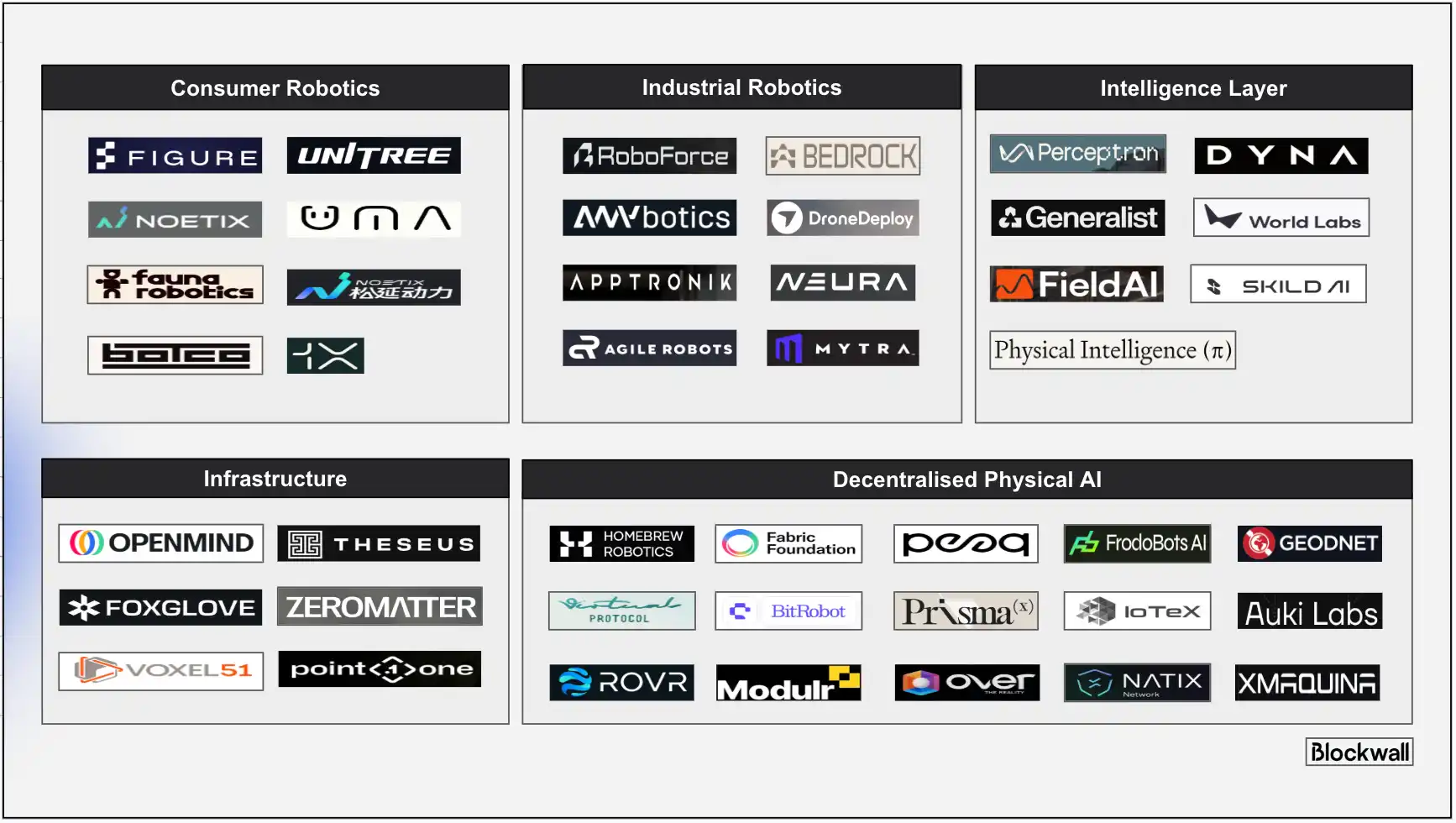
At the core of this revolution are AI models. Sophisticated "brains" developed by companies like Physical Intelligence and Skild AI go beyond static code, providing general intelligence for various physical forms. These models treat agility and mobility as software problems, enabling a single unified "brain" to adapt to multiple robot bodies. This intelligence layer is supported by simulation platforms and data pipelines (such as those provided by Zeromatter), allowing systems to train safely in virtual environments before deployment in the real world.

Evolving alongside the robot brains is Decentralized Physical AI. For example, the decentralized infrastructure network Fabric Protocol provides on-chain identities and crypto wallets for autonomous robots and uses cryptography to verify machine work. Companies like Auki, Peaq, and IoTeX are building a "machine economy" where robots can share 3D maps, verify data, and transact autonomously. This decentralized approach ensures the coordination layer is not controlled by a single enterprise.

In the industrial sector, Bedrock Robotics' autonomous construction equipment and Mytra's warehouse automation are redefining labor, while ANYbotics handles routine maintenance in hazardous environments. Meanwhile, breakthroughs in the consumer market for home assistants are imminent as companies like Figure and Unitree advance.

2030 Outlook

From a rational optimist's perspective, the robotics renaissance is already here. Four unstoppable forces are converging: hardware costs are plummeting, AI model intelligence is rising, edge computing chips provide unprecedented processing power, and a global workforce of contributors promises to solve the data problem. By 2030, this synergy will push Physical AI into every corner of the world, from autonomous agriculture to high-risk areas like firefighting and elderly care.

History shows that transformative software innovation often occurs after hardware stabilizes. We may usher in an era of "intelligence rentals," where standardized humanoid robots run standard operating systems and integrate app stores. Much like the previous smartphone revolution, the coming years could be defined by the "robot app store," where users don't buy dedicated devices but subscribe to a robot's skills. In this model, value shifts from the machine itself to the specific "skills" it can perform. You wouldn't buy a dedicated French tutoring robot; you'd simply download a "French Skill App" on your general-purpose humanoid robot, and it becomes your French teacher. By 2030, for affluent individuals, the preferred holiday gift might no longer be a flagship foldable phone but an intelligent assistant that can genuinely help manage household chores.

This prediction is built on rational optimism. Although the path to the future is rarely smooth, the convergence of technologies is预示着一场深刻的机器技术变革 (hinting at a profound machine technology transformation).

Related reading: When Robots Learn to Think, Earn, and Collaborate: Analyzing 15 Types of Robotic Technologies and Application Cases

Связанные с этим вопросы

QWhat are the key factors driving the current 'robotics tipping point' according to the article?

AThe key factors driving the robotics tipping point are: 1) Economic factors: Hardware commoditization, with actuators, sensors, and batteries becoming significantly cheaper due to supply chains from consumer electronics and electric vehicles. 2) Edge computing: Specialized chips like NVIDIA's Jetson Thor enable on-board AI processing for real-time control. 3) 'Brain' breakthroughs (AI models): A shift from 'if/then' programming to 'World Models' that learn physics and intuition by observing videos, such as Google Deepmind Genie 3 and NVIDIA Cosmos.

QHow is blockchain technology proposed to address challenges in robotics development?

ABlockchain technology offers solutions through tokenized incentives. It can coordinate millions of robots and reward contributors of remote operation or sensor data, creating a large, community-owned dataset. It also enables 'Robots as economic agents,' where robots can be tokenized assets that earn service fees, pay their own operating costs, and distribute profits to token holders autonomously, creating a decentralized machine economy.

QWhat is identified as the biggest bottleneck for developing general-purpose intelligent robots?

AThe biggest bottleneck is robot training data. Unlike text-based AI that can scrape the entire internet, robots require real-world physical experience data, such as feeling force, maintaining balance, and interacting with objects. Collecting this data is slow, expensive, and labor-intensive.

QWhat major shift in AI model design is enabling robots to develop 'physical intuition'?

AThe major shift is from 'if/then' programming to 'World Models.' These are models that learn how the physical world works by watching thousands of videos. Instead of being programmed with specific command for a task like 'turn a doorknob,' the AI observes videos to build a mental model of physics, allowing it to develop physical intuition and mentally simulate scenarios before taking action.

QWhat does the article predict could be the defining paradigm for robotics by 2030, analogous to the smartphone revolution?

AThe article predicts a 'skills rental' era defined by a 'robot app store.' Standardized humanoid robots would run a standard operating system, and users would not need to buy specialized devices but instead subscribe to specific skills or applications. Value would shift from the physical robot hardware to the specific 'skills' it can perform, much like how smartphone value comes from its apps.

Похожее

US Government Suddenly Halts Anthropic's Strongest Model, "Quasi-IPO Stock Price" Plunges 3.7% Overnight

U.S. Government Halts Anthropic's Top AI Models, 'Pre-IPO' Price Drops 3.7% On June 12, the U.S. government ordered Anthropic to shut down access to its two most powerful AI models, Claude Fable 5 and Claude Mythos 5, citing national security concerns. The directive, issued by the Department of Commerce, required Anthropic to block access for all foreign nationals, leading the company to disable the models globally for all users. Anthropic strongly opposed the move, arguing the government's basis was a "narrow jailbreak vulnerability" and warning that applying such a standard industry-wide would effectively halt all frontier model deployments. The news impacted Anthropic's implied valuation in speculative markets. The Anthropic perpetual contract on Hyperliquid fell approximately 3.7% to around $1,627, down from highs above $1,800 following the models' release. Unauthorized tokenized products linked to Anthropic on Solana also saw significant declines. The models, launched just days earlier on June 9, represented a major capability leap for Anthropic. Fable 5 was its first public release of a "Mythos"-tier model above its flagship Claude Opus. The shutdown creates an ironic situation for Anthropic, a company founded on "AI safety" principles, and adds uncertainty to its ongoing IPO preparations. The company is actively engaging with regulators to resolve what it calls a "misunderstanding" and restore service.

marsbit13 мин. назад

US Government Suddenly Halts Anthropic's Strongest Model, "Quasi-IPO Stock Price" Plunges 3.7% Overnight

marsbit13 мин. назад

SpaceX IPO Creates Trillion-Dollar Billionaire: Musk's Wealth Equals Half of Crypto Market

SpaceX's record-breaking IPO has propelled Elon Musk to become the first modern billionaire with a personal net worth exceeding $1 trillion, reaching $1.11 trillion according to Bloomberg. This staggering wealth surpasses the total market capitalization of all cryptocurrencies excluding Bitcoin and equals roughly half of the entire crypto market's value. The milestone highlights extreme wealth concentration and the significant devaluation of the altcoin market, whose total cap has nearly halved since late 2025 as capital flows into large tech stocks. SpaceX's Nasdaq debut saw its valuation hit $2.2 trillion, with shares soaring from a $135 offer price to close at $161. Its first-day trading volume of $85 billion set a new global IPO record. Musk owns 42% of the company. Despite his wealth dwarfing the altcoin sector, Musk maintains deep ties to digital assets. He personally holds Bitcoin, Ethereum, and Dogecoin, while his companies, SpaceX and Tesla, collectively hold over 30,000 Bitcoin, ranking among the top corporate BTC holders globally. His acquisition and integration of financial data tools into X (formerly Twitter) further connect his ecosystem to the markets. Ultimately, Musk's trillion-dollar status underscores the immense wealth controlled by tech founders, though this fortune remains largely tied to volatile stock prices rather than liquid assets.

Foresight News20 мин. назад

SpaceX IPO Creates Trillion-Dollar Billionaire: Musk's Wealth Equals Half of Crypto Market

Foresight News20 мин. назад

Hardcore First Look | Ocean Embodied Intelligence Company 'Shihang Intelligence' Secures Record-Breaking 1 Billion in Funding, Zhu Xiaohu, Temasek Place Bets

Breaking News | Ocean Embodied Intelligence company "Shihang Intelligent" secures a record-breaking 1 billion RMB (approximately 10 billion yuan) in Series A financing, with investment from Zhu Xiaohu and Temasek. Author: Qiu Xiaofen | Editor: Yuan Silai Ocean Embodied Intelligence company "Shihang Intelligent" has completed its Series A funding round, raising over 1 billion RMB. This marks the largest single funding round in the global marine robotics field to date. Investors include upstream momentum funds from chip companies "Moore Thread" and "Kunlunxin," Singapore's state-owned investment platform Vertex Growth, and listed company Dyneo, among others. Existing investors like GSR Ventures (whose founder Zhu Xiaohu has invested for the fifth time), Vertex Ventures China, Hua Ying Capital, and Long Capital also significantly increased their investments. Founder and CEO Chen Xiaobo, a 1989-born alumnus of Harbin Engineering University, is a long-time expert in underwater robotics. He received the National Defense Science and Technology Progress Award at age 28 (the youngest recipient) and led the development of China's first commercial underwater cleaning robot. The funds will be used for core technology R&D, global market expansion, and building the industry chain ecosystem to scale the application of marine robots in complex underwater scenarios. The ocean is considered one of the most challenging environments for robotics due to low light, high turbidity, complex currents, limited communication, high pressure, and corrosion. "Shihang Intelligent" focuses on developing core underlying technologies for marine robots, covering six key systems: power, control, sensing, navigation, sealing, and deployment. Its robots are capable of operating at depths from 0 to 10,000 meters with full degrees of freedom, performing complex maneuvers, autonomous navigation, and multi-robot collaboration. Applications include ship cleaning, underwater security, offshore wind power, marine ranching, and seabed inspection. The company's order value for the first half of 2026 alone has exceeded 1 billion RMB. Its "Orca Robot" is used by major shipping companies and has performed maintenance on over a thousand large vessels. In April of this year, the company launched its ocean embodied large model "Cangqiong CEORION." Unlike traditional remote-controlled or pre-programmed robots, this model integrates environmental perception, task understanding, and action generation into a single end-to-end architecture. Trained on millions of hours of commercial operation data and simulation data, it covers 12 major underwater operation scenarios. In simulations, it achieved over 90% task success rate and over 70% zero-shot adaptation capability to unseen environments. A built-in physics reasoning module reduces collision risk by 80%, enabling autonomous operation even with weak or no communication. Recently, "Shihang Intelligent" was selected as a core technology partner for Singapore's Maritime and Port Authority national hull inspection and cleaning program. These advancements indicate marine robotics is moving from pilot projects to scaled applications, with real-world operations generating valuable data to continuously improve robot capabilities. CEO Chen Xiaobo stated the company will continue investing in core marine robotics technology, the embodied intelligence model, and global application scenarios to expand into more high-risk, high-difficulty, and high-value underwater operations.

marsbit46 мин. назад

Hardcore First Look | Ocean Embodied Intelligence Company 'Shihang Intelligence' Secures Record-Breaking 1 Billion in Funding, Zhu Xiaohu, Temasek Place Bets

marsbit46 мин. назад

Three Months, 35 Billion Yuan: Investors Rush to Grab the OpenAI of the Physical World

Investors flock to a physical AI startup as the race for the "OpenAI of the physical world" heats up. Ji Jia Shi Jie (GigaWorld), a company dedicated to developing Artificial General Intelligence (AGI) for the physical world, has raised 3.5 billion RMB (approximately $490 million) in just three months, according to a report from investment media outlet Touzijie. The latest B2 funding round of 1 billion RMB attracted a wide range of top-tier investors, including sovereign wealth funds, industrial capital, and financial institutions. This brings the total funding for the young company, now valued over 10 billion RMB, to 3.5 billion RMB across three recent rounds. The company is led by Huang Guan, a post-90s Tsinghua University PhD with extensive experience in AI, autonomous driving, and entrepreneurship. Its core innovation is a "dual-pyramid" system comprising a five-layer data pyramid (from internet videos to real-world robot data) and a three-layer algorithm pyramid focused on world simulation, action alignment, and reinforcement learning. This system underpins its key models: the "World Action Model" (e.g., GigaBrain series for robot control) and the "World Generation Model" (e.g., GigaWorld series for simulating and understanding the physical world). Its models have reportedly achieved top rankings in global robotics benchmarks. Ji Jia Shi Jie argues that while current digital AGI excels in information processing, the next frontier is physical AGI—systems that can understand and interact with the real world. The company believes the field is approaching its "GPT-3 moment," a key inflection point in capability scaling. To achieve this, the company is pursuing a dual-market strategy. For the consumer (C) market, it launched the "SeeLight" brand and its S1 general-purpose humanoid robot, which has secured initial orders for deployment in real homes. For the business (B) market, it focuses on industrial automation with its Maker series robots, having signed agreements for large-scale deployment in factories, and its DriveDreamer world model for autonomous driving, which is already in use with over 30 automakers and tech companies. The report concludes that by bridging the gap between digital intelligence and physical action, Ji Jia Shi Jie aims to unlock a new wave of productivity, ultimately bringing physical AGI into everyday life.

marsbit1 ч. назад

Three Months, 35 Billion Yuan: Investors Rush to Grab the OpenAI of the Physical World

marsbit1 ч. назад

What's the Connection Between Pinduoduo's Huang Zheng and Blockchain?

This text explores the unexpected connection between Pinduoduo founder Colin Huang and blockchain, as suggested in his article *Turning Capitalism Upside Down*. Huang argues Pinduoduo's core business is about managing "uncertainty." He posits that wealth flows to the rich because they absorb life's uncertainties (e.g., illness, job loss) that devastate the poor, who pay a premium for certainty through insurance or stable prices. Pinduoduo's model attempts a "reverse insurance": by aggregating consumer demand via group-buying and flash sales, it creates a large, predictable order for manufacturers. This certainty allows factories to remove risk premiums, passing savings back as lower prices, thus partially reversing the wealth flow. The key obstacle, Huang notes, is that an individual's buying intent is an unreliable promise. He then asks if blockchain is the natural solution for this "reverse insurance." The text elaborates that blockchain, through smart contracts with binding deposits, could transform casual intent into a costly-to-break, enforceable commitment. This replaces interpersonal trust with coded rules, making promises credible, pricable, and resistant to fraud. Finally, the author draws a parallel to Bitcoin, framing two paths to creating certainty: the "Pinduoduo path" of aggregating decentralized will into scale, and the "Bitcoin path" of locking rules into immutable code. Both sacrifice something—personal freedom or system flexibility—to manufacture trust and predictability.

链捕手2 ч. назад

What's the Connection Between Pinduoduo's Huang Zheng and Blockchain?

链捕手2 ч. назад

Торговля

Спот
Фьючерсы

Популярные статьи

Неделя обучения по популярным токенам (2): 2026 может стать годом приложений реального времени, сектор AI продолжает оставаться в тренде

2025 год — год институциональных инвесторов, в будущем он будет доминировать в приложениях реального времени.

1.8k просмотров всегоОпубликовано 2025.12.16Обновлено 2025.12.16

Неделя обучения по популярным токенам (2): 2026 может стать годом приложений реального времени, сектор AI продолжает оставаться в тренде

Обсуждения

Добро пожаловать в Сообщество HTX. Здесь вы сможете быть в курсе последних новостей о развитии платформы и получить доступ к профессиональной аналитической информации о рынке. Мнения пользователей о цене на AI (AI) представлены ниже.

活动图片