Michael Saylor Pitched Bitcoin To ‘Every’ Middle East Sovereign Wealth Fund

bitcoinistОпубликовано 2025-12-09Обновлено 2025-12-09

Введение

In a fireside chat at BTC MENA 2025, Michael Saylor pitched Bitcoin to Middle East sovereign wealth funds and banks, framing it as "digital capital" and advocating for the creation of Bitcoin-backed "digital credit" to generate yield. He detailed his meetings with numerous regional investors, funds, and regulators, presenting a blueprint for banks to custody Bitcoin and offer low-volatility, high-yield credit products. Saylor argued that such a strategy could attract trillions in capital, positioning a nation or bank as a dominant global financial hub—the "Switzerland of digital capital." He expressed strong optimism about the region's enthusiastic response. Bitcoin traded at $90,164 at press time.

In a fireside chat with Metaplanet CEO Simon Gerovich at BTC MENA 2025, Michael Saylor turned a technical conversation about Bitcoin treasuries into a direct pitch to the Middle East’s sovereign wealth funds and banks, outlining how a nation or large financial institution could attract tens of trillions of dollars and become the “Switzerland” of digital capital.

Saylor and Gerovich began by framing Bitcoin as “digital capital.” As Saylor put it, “Our company pursued a strategy of accumulating digital capital. Bitcoin is digital capital. What do you do when you have capital? You issue credit against it.” Both MicroStrategy and Metaplanet are building balance sheets of Bitcoin and then issuing perpetual preferred instruments as “digital credit” backed by that capital.

Gerovich described Japan as a massive but yield-starved market. “There’s $7 trillion of cash sitting on personal bank accounts, bank balance sheets earning nothing, and corporates have another $4 or $5 trillion.” A Japanese family that puts money in the bank gets “zero.” Even as deflation fades, investors remain “accustomed to zero” and are “desperately looking for yield.”

Metaplanet’s answer is to connect that idle capital to Bitcoin. It launched “Mercury,” a perpetual preferred paying 4.9% in yen with convertibility into equity, which Gerovich called “probably one of the cheapest call options on Bitcoin out there.” Its follow-up product, “Mars” – Metaplanet Adjustable Rate Securities – is designed as a high-yield, Bitcoin-backed instrument that Japanese investors can hold in their securities accounts as a kind of supercharged bank deposit.

Inside Saylor’s Bitcoin Talks With Sovereign Funds

Saylor used this as a template for the Middle East, explaining that he has been on an intensive tour of the region’s power centers. “I’ve been meeting with all the sovereign wealth funds. I’ve been meeting with, I don’t know, 50, 100 different investors, hedge funds, family office investors... I’ve been meeting with regulators in every jurisdiction.” His message is “very, very straightforward”: “We now have digital capital. Bitcoin is digital capital, is digital gold. On top of digital capital, we have a new asset class called digital credit. Digital credit strips the volatility from the capital and provides yield, income.”

To illustrate the appeal, he contrasted capital and credit. Giving a child $1 million of Manhattan land is pure capital with no cash flow. “Or you can give them a credit instrument that pays them $10,000 a month forever, starting now. And so most people want the credit instrument. They don’t want the capital instrument... They’d rather have 10% non-volatile than 30% volatile with no cash flows.” Treasury companies like MicroStrategy and Metaplanet “exist to convert capital into credit.”

Saylor then laid out the blueprint for any ambitious bank in the region: “Have the bank custody Bitcoin. Everybody talks about self-custody. Self-custody for the bank in the country. Buy Bitcoin, have your bank custody the Bitcoin, and then start to offer credit networks on top of the Bitcoin.” If a national bank extends loans such as “SOFR plus 50 basis point loans on Bitcoin,” he argued, then as Bitcoin’s market grows from $2 trillion to $20 trillion, that bank could attract “5% or 10% of it,” pulling in “a trillion dollars or a few trillion dollars” simply because “most big conventional regulated banks don’t handle Bitcoin.”

The “biggest idea” is to turn Bitcoin-backed credit into a bank account that outcompetes the entire global deposit system. By taking digital credit instruments like Stretch or Mars, placing them in a fund that is mostly credit with a currency buffer and reserve layer, Saylor envisions a regulated account that pays around 8% with “vol of zero.” In that setup, “I wire you my billions of dollars or tens of billions of dollars, and you pay me 8% interest every day, zero vol, in a regulated bank, powered by digital credit, which is in turn powered by a treasury company with 5x as much digital capital, over-collateralized.”

In such a regime, he argued, “you could presumably attract 20 trillion dollars or 50 trillion dollars.” For depositors, “the perfect product is a bank account with zero volatility that pays you 400 basis points more than the risk-free rate in your favorite currency.” For Saylor, that account is “the lightsaber of money, the laser beam of money, the nuclear fusion reactor of money.”

He framed it as an open race: “The question is, who wants to be the Switzerland of the 21st century and attract all the money in the world?” In his view, “the answer is going to be whoever appreciates money the most, wants the money the most, that understands technology the best, that is willing to take a courageous stance of conviction with a degree of clarity,” he said.

He concluded: “That is the opportunity, and all the conversations have been extraordinarily energetic, enthusiastic, and I couldn’t be more excited. I think it will happen somewhere in this region. We’ll see where.”

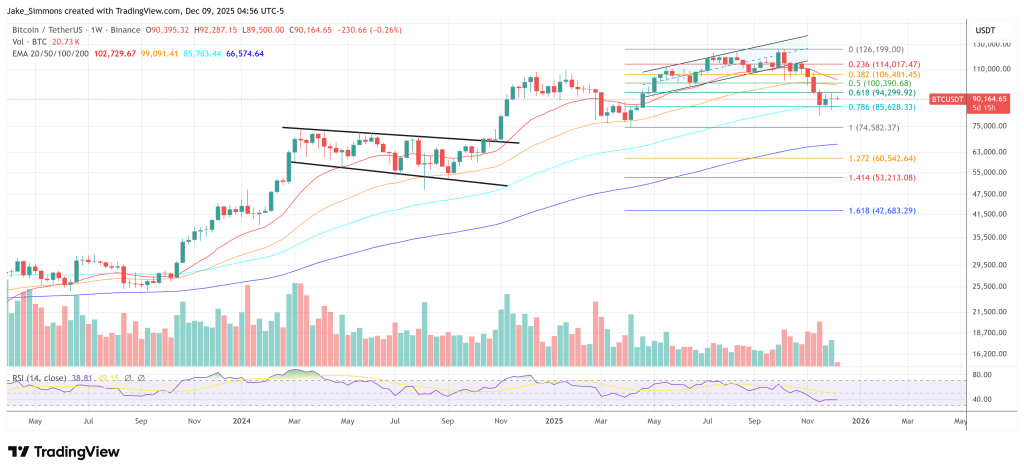
At press time, Bitcoin traded at $90,164.

Bitcoin remains below the 0.618 Fib, 1-week chart | Source: BTCUSDT on TradingView.com

Похожее

Why Hasn't the U.S. Seen the Rise of 'Huabei' or 'Jiebei'?

The article explores why the U.S. lacks large-scale consumer credit products like China's "Huabei" and "Jiebei," despite having a developed financial sector. Key reasons include: 1. **Structural Barriers**: A fragmented federal and state regulatory system, reinforced by post-2008 reforms like the Dodd-Frank Act, raises compliance costs and protects traditional banks, stifling fintech innovation. 2. **Credit Card Dominance**: Credit cards, used by 70-80% of adults, form a $1.28 trillion debt market with high APRs (avg. 22.3%). This system cross-subsidizes users who pay in full with those carrying balances, creating a predatory yet entrenched ecosystem. 3. **Data Privacy Laws**: Strict regulations (e.g., FCRA, CCPA) prevent tech giants from leveraging behavioral data for credit scoring, unlike in China where such data fuels fintech models. 4. **Capital Market Disincentives**: Wall Street penalizes tech firms entering finance due to lower valuations associated with heavy regulation and risk, as seen in Apple’s failure with Apple Card. 5. **Banking Oligopoly**: Major banks control consumer lending, leveraging lobbying power and consumer habits to maintain high-cost credit, while alternatives like payday loans (400% APR) or "unbanked" services remain niche or exploitative. Ultimately, regulatory, structural, and corporate interests collectively block the emergence of accessible, low-cost digital lending in the U.S.

Odaily星球日报1 ч. назад

Why Hasn't the U.S. Seen the Rise of 'Huabei' or 'Jiebei'?

Odaily星球日报1 ч. назад

Торговля

Спот
Фьючерсы

Популярные статьи

Тест по Bitcoin Биткоина

HTX Learn: Изучите Bitcoin halving и Заработаете Токены USDT

3.0k просмотров всегоОпубликовано 2024.04.16Обновлено 2024.04.16

Тест по Bitcoin  Биткоина

Что такое $BITCOIN

ЦИФРОВОЕ ЗОЛОТО ($BITCOIN): Комплексный анализ Введение в ЦИФРОВОЕ ЗОЛОТО ($BITCOIN) ЦИФРОВОЕ ЗОЛОТО ($BITCOIN) — это проект на основе блокчейна, работающий в сети Solana, который стремится объединить характеристики традиционных драгоценных металлов с инновациями децентрализованных технологий. Хотя он носит имя Биткойн, часто называемого “цифровым золотом” из-за его восприятия как средства хранения ценности, ЦИФРОВОЕ ЗОЛОТО является отдельным токеном, предназначенным для создания уникальной экосистемы в ландшафте Web3. Его цель — позиционировать себя как жизнеспособный альтернативный цифровой актив, хотя детали его применения и функциональности все еще развиваются. Что такое ЦИФРОВОЕ ЗОЛОТО ($BITCOIN)? ЦИФРОВОЕ ЗОЛОТО ($BITCOIN) — это токен криптовалюты, специально разработанный для использования в блокчейне Solana. В отличие от Биткойна, который выполняет широко признанную роль хранения ценности, этот токен, похоже, сосредоточен на более широких приложениях и характеристиках. Примечательные аспекты включают: Инфраструктура блокчейна: Токен построен на блокчейне Solana, известном своей способностью обрабатывать высокоскоростные и недорогие транзакции. Динамика предложения: ЦИФРОВОЕ ЗОЛОТО имеет максимальное предложение, ограниченное 100 квадриллионами токенов (100P $BITCOIN), хотя детали о его обращающемся предложении в настоящее время не раскрыты. Утилита: Хотя точные функциональные возможности не описаны, есть указания на то, что токен может быть использован для различных приложений, потенциально связанных с децентрализованными приложениями (dApps) или стратегиями токенизации активов. Кто создатель ЦИФРОВОГО ЗОЛОТА ($BITCOIN)? На данный момент личность создателей и команды разработчиков, стоящих за ЦИФРОВЫМ ЗОЛОТОМ ($BITCOIN), остается неизвестной. Эта ситуация типична для многих инновационных проектов в области блокчейна, особенно тех, которые связаны с децентрализованными финансами и феноменом мем-криптовалют. Хотя такая анонимность может способствовать культуре, ориентированной на сообщество, она усиливает опасения по поводу управления и ответственности. Кто инвесторы ЦИФРОВОГО ЗОЛОТА ($BITCOIN)? Доступная информация указывает на то, что у ЦИФРОВОГО ЗОЛОТА ($BITCOIN) нет известных институциональных спонсоров или значительных венчурных капиталовложений. Проект, похоже, функционирует по модели пирингового взаимодействия, сосредоточенной на поддержке и принятии сообществом, а не на традиционных путях финансирования. Его активность и ликвидность в основном сосредоточены на децентрализованных биржах (DEX), таких как PumpSwap, а не на устоявшихся централизованных торговых платформах, что еще больше подчеркивает его подход, ориентированный на grassroots. Как работает ЦИФРОВОЕ ЗОЛОТО ($BITCOIN) Операционные механизмы ЦИФРОВОГО ЗОЛОТА ($BITCOIN) можно подробно описать на основе его дизайна блокчейна и характеристик сети: Механизм консенсуса: Используя уникальный механизм доказательства истории (PoH) Solana в сочетании с моделью доказательства доли (PoS), проект обеспечивает эффективную валидацию транзакций, что способствует высокой производительности сети. Токеномика: Хотя конкретные дефляционные механизмы не были подробно описаны, большое максимальное предложение токенов подразумевает, что оно может быть предназначено для микротранзакций или нишевых случаев использования, которые еще предстоит определить. Интероперабельность: Существует потенциал для интеграции с более широкой экосистемой Solana, включая различные платформы децентрализованных финансов (DeFi). Однако детали относительно конкретных интеграций остаются неуточненными. Хронология ключевых событий Вот хронология, которая подчеркивает значимые вехи, касающиеся ЦИФРОВОГО ЗОЛОТА ($BITCOIN): 2023: Первоначальное развертывание токена происходит в блокчейне Solana, отмеченное его адресом контракта. 2024: ЦИФРОВОЕ ЗОЛОТО приобретает видимость, когда оно становится доступным для торговли на децентрализованных биржах, таких как PumpSwap, позволяя пользователям обменивать его на SOL. 2025: Проект наблюдает спорадическую торговую активность и потенциальный интерес к инициативам, возглавляемым сообществом, хотя на данный момент не зафиксировано никаких значительных партнерств или технических достижений. Критический анализ Сильные стороны Масштабируемость: Основная инфраструктура Solana поддерживает высокие объемы транзакций, что может повысить полезность $BITCOIN в различных сценариях транзакций. Доступность: Потенциально низкая цена торговли за токен может привлечь розничных инвесторов, способствуя более широкому участию благодаря возможностям дробного владения. Риски Отсутствие прозрачности: Отсутствие публично известных спонсоров, разработчиков или процесса аудита может вызвать скептицизм относительно устойчивости и надежности проекта. Волатильность рынка: Торговая активность сильно зависит от спекулятивного поведения, что может привести к значительной волатильности цен и неопределенности для инвесторов. Заключение ЦИФРОВОЕ ЗОЛОТО ($BITCOIN) является интригующим, но неоднозначным проектом в быстро развивающейся экосистеме Solana. Хотя он пытается использовать нарратив “цифрового золота”, его отход от установленной роли Биткойна как средства хранения ценности подчеркивает необходимость более четкого различения его предполагаемой утилиты и структуры управления. Будущее принятие и усвоение, вероятно, будут зависеть от решения текущей непрозрачности и более четкого определения его операционных и экономических стратегий. Примечание: Этот отчет охватывает синтезированную информацию, доступную на октябрь 2023 года, и с тех пор могут произойти события.

99 просмотров всегоОпубликовано 2025.05.13Обновлено 2025.05.13

Что такое $BITCOIN

Fractal Bitcoin: масштабирование Биткоина с помощью рекурсивной системы

Fractal Bitcoin — масштабное Layer-1-решнение, созданное на базе кода Биткоина, позволяющего достигать бесконечного масштабирования с помощью рекурсивного подхода.

2.2k просмотров всегоОпубликовано 2025.06.30Обновлено 2025.06.30

Fractal Bitcoin: масштабирование Биткоина с помощью рекурсивной системы

Обсуждения

Добро пожаловать в Сообщество HTX. Здесь вы сможете быть в курсе последних новостей о развитии платформы и получить доступ к профессиональной аналитической информации о рынке. Мнения пользователей о цене на BTC (BTC) представлены ниже.

活动图片