Maduro Arrested: A $60 Billion Bitcoin Mystery Surfaces

比推Опубликовано 2026-01-06Обновлено 2026-01-06

Введение

English Summary: In January 2026, the arrest of Venezuelan President Nicolás Maduro has reignited speculation about a rumored "shadow reserve" of 600,000 to 660,000 Bitcoin (worth $60-67 billion), allegedly accumulated by his regime. The report investigates three primary methods: the failed state-backed "Petro" cryptocurrency, which established a regulatory body later suspected of money laundering; the PDVSA-Crypto scandal involving $21 billion in unaccounted oil revenue potentially converted to crypto via intermediaries and mixers; and military-controlled Bitcoin mining operations using confiscated hardware. However, the existence of this massive Bitcoin holdings remains unverified, lacking concrete on-chain evidence. If real, the keys are likely controlled by a small group (e.g., financier Alex Saab, Maduro's family) using multisig schemes. The uncertainty poses significant market risks—potential massive sell-off if keys are loose, or reduced supply if seized by the US. The story underscores crypto's role in sanctions evasion and the balance between financial freedom and regulatory control.

Author: Cathy, Plain Talk Blockchain

Original Title: Did Maduro Really Hide $60 Billion in BTC?


In the early hours of January 3, 2026, U.S. special forces arrested Venezuelan President Nicolás Maduro in Caracas during a military operation codenamed "Absolute Resolve."

This event has sparked a major question in the crypto world: Did the Maduro regime truly possess the rumored "shadow reserves"?

According to a report from the investigative agency Whale Hunting and multiple intelligence sources, a startling rumor is circulating in the market: the Maduro regime may hold 600,000 to 660,000 Bitcoin. If true, this would be worth a staggering $60-67 billion at early 2026 market prices.

What does this mean?

MicroStrategy (now renamed Strategy), the company known as the "Bitcoin whale," held over 670,000 BTC as of January 2026, valued at approximately $61.3 billion. If the Venezuelan rumor is true, its holdings would be comparable to the world's largest corporate buyer, representing about 3% of Bitcoin's total supply (21 million coins).

But the question is: Does this fortune actually exist? And if so, where is it hidden?

In the crypto world, there's an ironclad rule: "Not your keys, not your coins."

01 How Did the Rumor Originate?

To understand where the rumor of "600,000 BTC" came from, we first need to understand the theoretical avenues through which the Maduro regime could have accumulated Bitcoin. It must be emphasized that the following analysis is based on public reports and intelligence estimates, not proven facts.

Avenue One: The Petro Scam – Paving the Way for Crypto

In February 2018, under heavy pressure from U.S. sanctions, Maduro announced the launch of the world's first "national cryptocurrency" – the Petro. The government claimed it raised $735 million on the first day, with a total fundraising target of $6 billion.

However, multiple investigations revealed serious problems with this ICO from the very beginning.

The Petro was first claimed to be based on Ethereum, then on NEM, and ultimately seemed to run on a private chain that didn't exist. The government claimed the Petro was backed by 5.3 billion barrels of crude oil in the Ayacucho block, but field investigations showed dilapidated infrastructure with no mining activity whatsoever.

The so-called "fundraising" was likely just internal regime assets shifting from one hand to another.

But while the Petro failed, it left a crucial byproduct: Sunacrip (National Superintendency of Crypto Assets). This agency was given the power to regulate all crypto activities, issue mining licenses, and even directly operate national mining pools. It wasn't a regulator; it was a national money laundering center.

In January 2024, Maduro officially shut down the Petro. This wasn't a failure, but a strategic pivot – moving from "issuer" to "holder," fully transitioning to truly globally liquid Bitcoin and USDT.

Avenue Two: The PDVSA-Crypto Scandal – $21 Billion Unaccounted For

Market rumors suggest the core source of the Maduro regime's Bitcoin reserves may have been the diversion of oil export revenues from the state-owned oil company PDVSA.

In 2019, the U.S. imposed comprehensive sanctions on PDVSA, cutting off its access to the global banking system. To survive, PDVSA initiated an "anti-blockade" strategy:

Dark Fleet: Using tankers with transponders turned off to ship crude oil to "teapot refineries" (small, non-state-owned refineries) in Asia.

Intermediary Network: Masking the origin of crude through shell companies registered in the UAE, Russia, and elsewhere. These intermediaries often had no oil trading experience; their only qualification was personal connections to the regime's core figures.

Crypto Settlements: Unable to receive dollar wire transfers, intermediaries were instructed to pay for oil in USDT (Tether).

In March 2023, Venezuela was rocked by the shocking "PDVSA-Crypto" scandal. An internal government audit revealed that approximately $21 billion in accounts receivable from oil exports between 2020 and 2023 was unaccounted for.

Where did this money go? It remains a mystery.

Some intelligence analysts speculate that a portion may have found its way back to regime-controlled wallets via cryptocurrency. Reportedly, Sunacrip established an automated "hop" mechanism:

  • Receive: Intermediaries send USDT to intermediate wallets controlled by Sunacrip

  • Launder: Obfuscate the fund trail through mixers like Tornado Cash

  • Exchange: Convert USDT to Bitcoin at OTC desks in Russia or Eastern Europe

  • Store: Bitcoin transferred to offline-generated cold wallets, with private keys held by the highest levels of the regime

The core designers of this system were Tareck El Aissami (former Oil Minister) and Alex Saab (the regime's "financial diplomat"). El Aissami resigned in March 2023 and was arrested in April 2024 on corruption charges, facing counts of treason, money laundering, and more. The assets he controlled were likely confiscated by the Maduro family.

Saab, however, returned to Venezuela in a prisoner swap with the U.S. in December 2023. Maduro exchanged 10 American prisoners for this financial architect, underscoring his perceived indispensability – an importance likely stemming from his control over the financial lifeline.

Avenue Three: Military Mining – "National Hashrate" from Confiscated Rigs

Beyond oil revenue, another theory suggests the Venezuelan regime may have directly produced Bitcoin by controlling the "means of production."

Venezuela has some of the world's cheapest electricity, primarily from the Guri Dam. This makes Bitcoin mining highly profitable. The Maduro government monopolized this advantage through a military commercial entity – CAMIMPEG (Military Company for Mining, Oil, and Gas).

CAMIMPEG established "Bolivarian Army Digital Asset Production Centers." These military mining farms enjoyed privileges:

  • Guaranteed Power: Priority access during nationwide frequent blackouts

  • Security: Heavily guarded by the National Guard

  • Zero-Cost Operation: With electricity effectively free (state-subsidized), marginal costs were near zero

But where did the equipment for these military farms come from? Largely from the confiscation of private miners.

Starting in 2020, Sunacrip, in conjunction with the military, launched a series of raids on private mining operations:

  • 2020: National Guard seized 315 Antminer S9 units in Bolívar State

  • 2023: Raided the headquarters of the "Tren de Aragua" gang in Tocorón Prison, seizing大量(mining rigs and weapons)

  • 2024: Seized over 2300 Antminer S19J Pro units in a single operation in Maracay

According to intelligence source estimates, between 2020 and 2025, the government may have acquired tens of thousands of mining machines through confiscations from private farms and gang facilities. These devices were not destroyed but redeployed to CAMIMPEG-controlled facilities.

Based on the known thousands of high-performance miners, plus output from state-owned farms, this "zombie army" could have produced tens of thousands of Bitcoin over the past few years.

02 Data Sources and Skepticism Regarding the "600,000 BTC" Rumor

Key Question: Is this number credible?

Based on intelligence reports from Chainalysis, TRM Labs, and the investigative agency "Whale Hunting," the estimated figure circulating in the market is 600,000 to 660,000 BTC. But it must be emphasized:

This figure comes only from intelligence sources, not hard data traceable on the blockchain

No public on-chain evidence supports this number

The Whale Hunting report clearly states: "This estimate is from HUMINT (Human Intelligence), unconfirmed by blockchain analysis"

Nonetheless, the report still provided a hypothetical breakdown:
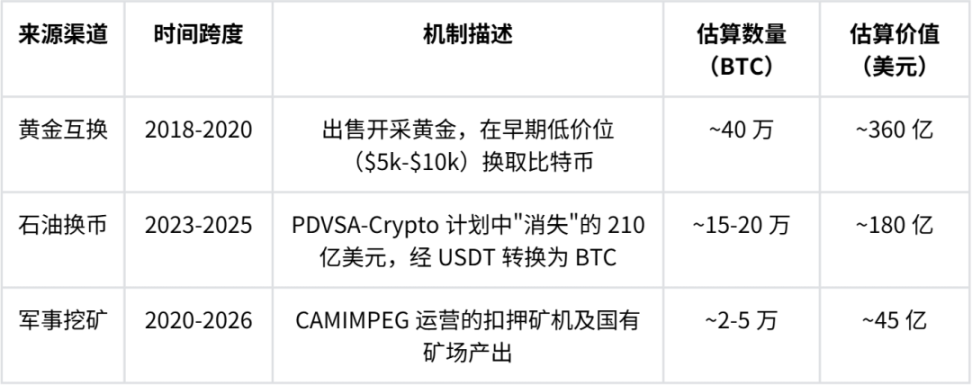
Is this rumor logically plausible?

Supporters' Viewpoints:

MicroStrategy Comparison: MicroStrategy (now Strategy) held over 670,000 BTC as of January 2026. A sovereign nation theoretically has the capacity to reach a similar scale.

Financial Backing: PDVSA had $21 billion unaccounted for in 2020-2023. If 50% of that was converted to Bitcoin, at average prices of the time, it could purchase 300,000-400,000 BTC.

Skeptics' Viewpoints:

  • Lack of On-Chain Evidence: If 600,000 BTC truly existed, traces should be found on the blockchain, but no one has been able to pinpoint specific addresses.

  • Suspiciously Round Number: The figure of 600,000 seems more like an estimate than an actual count and may be significantly overestimated.

  • Questionable Motive: This rumor might be used for political purposes or market manipulation.

Conclusion: In the absence of concrete blockchain evidence, this remains an unverified rumor.

03 If the Rumor is True: Who Would Hold the Private Keys?

Assuming this "shadow reserve" does exist, even Maduro's arrest does not mean the U.S. can control it.

The FBI's primary challenge would be: How to prove the existence of these Bitcoins and find the private keys?

Who might hold the private keys?

If this asset exists, intelligence analysts speculate it is unlikely managed by a single account, but more likely uses a multi-signature (Multisig) or private key sharding scheme.

Theoretical key holders might include:

  • Alex Saab: As the regime's financial architect, Saab not only understands the full picture of fund flows but likely holds the recovery seed phrases or knows the physical location of hardware wallets. His return to Venezuela in the December 2023 prisoner swap – 10 American prisoners for this financial brain – highlights his indispensability to the regime.

  • Nicolasito (Maduro's Son): Named in indictments, he was deeply involved in illegal gold mining and the regime's daily operations, potentially holding a backup of the family's portion of the private keys.

  • Cilia Flores (First Lady): Known as the "First Combatant," she holds a high position within the regime's inner circle. She might control physical access to some cold wallets.

  • Technocrat Layer: Former Sunacrip technicians might be responsible for maintaining the multi-signature technical infrastructure. While they might not know the complete private keys, their cooperation could be crucial for reconstructing wallet access.

Speculated Crypto Architecture

The most likely architecture is an M-of-N signature scheme (e.g., 3/5 or 5/7). This means signatures from 3 out of 5 core individuals would be required to move the funds.

If Maduro, Flores, and Saab were all under U.S. control, theoretically the U.S. could compel them to cooperate in unlocking the funds. But reality is far more complex:

  • Geographic Dispersion: Cold wallets could be stored分散ly in bunkers in Caracas, safes in Russia, or safe houses in Cuba.

  • Dead Man's Switch: The system might include an automatic trigger mechanism. If specific actions aren't performed for a prolonged period (e.g., Maduro goes missing), funds could automatically transfer to irrecoverable addresses or be sent to allies.

  • Ideological Resistance: Even facing life imprisonment, core figures holding the keys might refuse to cooperate. For them, this is not just wealth, but the final weapon against "American imperialism."

04 Market Impact: The Rumor Itself is Uncertainty

Even if this rumor is unverified, it has itself become a "Sword of Damocles" hanging over the crypto market. 600,000 Bitcoin represents 3% of BTC's total supply. If real, the impact would be enormous.

Three Possible Scenarios

Scenario One: Rumor is False

If thorough investigation by the FBI and blockchain analysis firms ultimately proves this "shadow reserve" does not exist or is severely overestimated, the market might breathe a sigh of relief. This means no potential selling pressure, neutral or slightly bullish for price.

Scenario Two: Rumor is True and FBI Gains Control

If this asset exists and the U.S. successfully seizes it, following standard procedure, these Bitcoin would enter judicial freezing, potentially locked for years. This effectively locks up a huge supply, reducing market circulation, which is bullish for price.

This is similar to the FBI's seizure of Silk Road Bitcoin in 2013. Around 170,000 BTC were frozen and eventually auctioned in batches. But during the freeze, these coins exited circulation, objectively reducing market selling pressure.

Scenario Three: Rumor is True but Keys are Lost

This is the most dangerous scenario. If the asset exists but the private keys are not controlled by the U.S., remnants of the fleeing regime might attempt to sell Bitcoin on OTC markets to fund their escape, triggering panic selling.

The German government's sale of just 50,000 BTC in 2024 caused short-term market volatility. 600,000 in selling pressure would be catastrophic.

05 Summary

Maduro's arrest has revealed a glimpse of the Venezuelan regime's use of cryptocurrency to evade sanctions.

From the failed Petro experiment to the $21 billion PDVSA-Crypto scandal, to militarized mining facilities – these are all confirmed facts. But the rumor of a "600,000 BTC shadow reserve" still lacks solid evidence.

What we can confirm: Venezuela did use crypto to evade sanctions, PDVSA did have $21 billion unaccounted for, and the regime did confiscate大量mining equipment.

What we cannot confirm includes: Whether 600,000 BTC were actually accumulated, who holds the private keys (if they exist), and whether these Bitcoin will enter the market.

This indeed raises a尖锐question: When decentralized technology is used to evade sanctions, how do we find a balance between freedom and order?

But until more evidence surfaces, the "$60 billion shadow reserve" remains just an unverified rumor.


Twitter:https://twitter.com/BitpushNewsCN

Bitpush TG Discussion Group:https://t.me/BitPushCommunity

Bitpush TG Subscription: https://t.me/bitpush

Original link:https://www.bitpush.news/articles/7600464

Связанные с этим вопросы

QWhat is the alleged value of the Bitcoin 'shadow reserves' linked to the Maduro regime, and how does it compare to MicroStrategy's holdings?

AThe alleged Bitcoin 'shadow reserves' linked to the Maduro regime are estimated to be worth between $60 billion and $67 billion at early 2026 prices. This is comparable to MicroStrategy (now named Strategy), which held over 670,000 BTC worth approximately $61.3 billion at the time.

QWhat were the three primary methods theorized for how the Maduro regime could have accumulated Bitcoin?

AThe three primary theorized methods are: 1) The failed Petro coin ICO, which established the infrastructure for crypto operations. 2) The diversion of an estimated $21 billion in missing oil export receivables from PDVSA, potentially settled in USDT and converted to Bitcoin. 3) The confiscation and state-operated military mining of Bitcoin using seized hardware and subsidized electricity.

QWhat major event in January 2026 is central to this story, and what key question did it raise?

AThe central event was the arrest of Venezuelan President Nicolás Maduro by U.S. special forces in a military operation codenamed 'Absolute Determination' on January 3, 2026. This event raised the key question of whether the Maduro regime truly possessed the rumored massive 'shadow reserve' of Bitcoin.

QAccording to the article, what is the main reason the '600,000 BTC' figure is still considered an unverified rumor?

AThe main reason is a lack of concrete on-chain evidence. The figure is based on human intelligence (HUMINT) reports and estimates, but no specific blockchain addresses or verifiable data have been publicly identified to confirm the existence or the exact amount of these holdings.

QWho are the key individuals speculated to potentially hold the private keys to these alleged Bitcoin reserves?

AThe key individuals speculated to hold the private keys or parts of them include: Alex Saab (the regime's financial architect), Nicolás Maduro's son 'Nicolasito', First Lady Cilia Flores, and possibly former technical staff from the national crypto asset regulator, Sunacrip. The assets were likely secured using a multi-signature scheme requiring cooperation from several of these individuals.

Похожее

pump.fun's New Feature Brings 'Black Mirror' Into Reality

The article begins by recounting a dark fictional story from *Black Mirror* (Season 7, Episode 1 "Common People"), where a man is forced to perform humiliating tasks online to pay for his wife's life-sustaining medical subscription. It then draws a parallel to a new real-world feature on the crypto platform pump.fun called "Pump.fun Go," which allows users to post and complete paid bounty tasks. This feature gained mainstream attention, often negatively, through extreme examples. A prominent case involved a bounty of 40 SOL (~$2,600) offered to permanently tattoo "$bountywork" on one's forehead. An Indian man completed the task, stating the money "changed his life," and later earned significantly more from a related meme coin. Another bounty paid 200 SOL (~$14,000) for a "bounty.fun" forehead tattoo, with the participant simply stating, "We need the money." The article highlights how this system can amplify darkness, citing the dev behind $Bountywork who spent thousands on bounties for attention-grabbing stunts like eating bugs or drinking hot sauce for small sums. It compares this to past tragic live-streaming incidents where people harmed themselves for money, noting regulation cannot stop those in desperate need. However, it also points to positive, altruistic bounties that have emerged, such as organizing anti-work rallies in New York, performing random acts of kindness for strangers, organizing community food drives, or even helping an elderly person cross the street. The piece concludes by acknowledging the platform reflects both the dark and light sides of human nature when actions are given a price, hoping for more of the latter.

marsbit6 мин. назад

pump.fun's New Feature Brings 'Black Mirror' Into Reality

marsbit6 мин. назад

As the US and Japan Hike Interest Rates, Which Asset Class is Most at Risk?

This week, global markets face two major events: the Bank of Japan's likely interest rate hike and the US Federal Reserve's FOMC meeting. For risk assets, it is a pivotal and volatile week. In the US, expectations for rate cuts have faded dramatically. May's higher-than-expected CPI and resilient jobs data have shifted the Fed's focus from potential cuts to the possibility of future hikes. New Fed Chair Wash is unlikely to raise rates at this meeting, but any hawkish shift in communication, the dot plot, or the policy statement could lead markets to price in tighter policy, pushing up short-term Treasury yields and strengthening the dollar. High-valuation growth stocks, AI-related assets, and small-cap stocks reliant on cheap funding are most vulnerable to rising rates. In Japan, a 25 basis point hike is almost fully priced in (98.3% probability), which would bring the policy rate to 1%, its highest since 1995. The concern is not the hike itself, but its potential to unwind the massive "carry trade," where investors borrowed low-yielding yen to invest globally. Historically, Japan's rate hikes have coincided with global market stress (2000, 2007, 2024). While this well-telegraphed hike may be digested smoothly, two key factors increase uncertainty: 1) Governor Ueda's absence due to illness, putting communication in the hands of less-familiar deputies, and 2) the Fed meeting occurring just days later, creating potential for a compounded market reaction if both central banks sound hawkish. Asset implications: * **Bonds:** US short-term yields sensitive to Fed signals. Japan's rate hike could pressure its massive US Treasury holdings. * **Currencies:** Dollar likely supported by Fed; Yen's reaction hinges on BoJ's forward guidance. * **Equities:** US growth stocks, small-caps most at risk. Japanese stocks face pressure from a stronger yen. * **Crypto:** Assets like Bitcoin face headwinds from higher rates and tighter liquidity; high-beta altcoins are even more vulnerable. The convergence of these two central bank meetings amplifies market volatility risks, with potential spillovers across asset classes globally.

marsbit12 мин. назад

As the US and Japan Hike Interest Rates, Which Asset Class is Most at Risk?

marsbit12 мин. назад

Data Decrypts the BTC Cycle: Three Major Bottom Signals Illuminate Simultaneously, Q4 Could Be a Crucial Turning Point Window?

"Decoding the Bitcoin Cycle: Three Bottom Signals Flash Simultaneously, Is Q4 the Key Turning Point?" The article analyzes Bitcoin's current market position, comparing it to historical cycles. BTC has corrected over 52% from its October 2025 peak of $126,198 to around $59,100 in June 2026. While significant, this drawdown is milder than the 77-86% declines seen in past bear markets. The analysis is framed within Bitcoin's four-year halving cycle. Past cycles show a pattern: prices peak 12-18 months post-halving, bottom 12-14 months after the peak, with lows typically occurring roughly 17 months before the next halving. Following the April 2024 halving and the October 2025 peak, this pattern suggests a potential bottoming window around Q4 2026, ahead of the expected 2028 halving. Three key on-chain metrics are signaling undervaluation: The MVRV Z-Score has dropped near 0.27, approaching historic bottom zones. The market price is only about 9% above the network's average realized price of ~$53,600, a rare low premium. Bitcoin's price recently touched its 200-week moving average (~$62,200), a level that aligned with bottoms in 2015, 2018, and 2020. While US spot Bitcoin ETFs saw record outflows in May/June 2026, indicating retail panic, whale addresses (holding 100+ BTC) reached a yearly high. Entities like MicroStrategy resumed buying, and long-term holders control a near-record 78% of the supply, suggesting accumulation. A major macro overhang was partially removed with a US-Iran ceasefire agreement in mid-June 2026, which eased oil prices and triggered a sharp BTC rally. However, persistent inflation means high-interest rates remain a constraint. The conclusion notes that genuine investment opportunities often arise when confidence is lowest, amidst narratives that "this time is different." While not guaranteeing an immediate bottom, the confluence of cycle timing, undervaluation signals, and shifting macro risks suggests late 2026 may be a critical period for reassessing risk/reward and patient accumulation for long-term believers.

marsbit12 мин. назад

Data Decrypts the BTC Cycle: Three Major Bottom Signals Illuminate Simultaneously, Q4 Could Be a Crucial Turning Point Window?

marsbit12 мин. назад

Торговля

Спот
Фьючерсы

Популярные статьи

Тест по Bitcoin Биткоина

HTX Learn: Изучите Bitcoin halving и Заработаете Токены USDT

3.1k просмотров всегоОпубликовано 2024.04.16Обновлено 2024.04.16

Тест по Bitcoin  Биткоина

Что такое $BITCOIN

ЦИФРОВОЕ ЗОЛОТО ($BITCOIN): Комплексный анализ Введение в ЦИФРОВОЕ ЗОЛОТО ($BITCOIN) ЦИФРОВОЕ ЗОЛОТО ($BITCOIN) — это проект на основе блокчейна, работающий в сети Solana, который стремится объединить характеристики традиционных драгоценных металлов с инновациями децентрализованных технологий. Хотя он носит имя Биткойн, часто называемого “цифровым золотом” из-за его восприятия как средства хранения ценности, ЦИФРОВОЕ ЗОЛОТО является отдельным токеном, предназначенным для создания уникальной экосистемы в ландшафте Web3. Его цель — позиционировать себя как жизнеспособный альтернативный цифровой актив, хотя детали его применения и функциональности все еще развиваются. Что такое ЦИФРОВОЕ ЗОЛОТО ($BITCOIN)? ЦИФРОВОЕ ЗОЛОТО ($BITCOIN) — это токен криптовалюты, специально разработанный для использования в блокчейне Solana. В отличие от Биткойна, который выполняет широко признанную роль хранения ценности, этот токен, похоже, сосредоточен на более широких приложениях и характеристиках. Примечательные аспекты включают: Инфраструктура блокчейна: Токен построен на блокчейне Solana, известном своей способностью обрабатывать высокоскоростные и недорогие транзакции. Динамика предложения: ЦИФРОВОЕ ЗОЛОТО имеет максимальное предложение, ограниченное 100 квадриллионами токенов (100P $BITCOIN), хотя детали о его обращающемся предложении в настоящее время не раскрыты. Утилита: Хотя точные функциональные возможности не описаны, есть указания на то, что токен может быть использован для различных приложений, потенциально связанных с децентрализованными приложениями (dApps) или стратегиями токенизации активов. Кто создатель ЦИФРОВОГО ЗОЛОТА ($BITCOIN)? На данный момент личность создателей и команды разработчиков, стоящих за ЦИФРОВЫМ ЗОЛОТОМ ($BITCOIN), остается неизвестной. Эта ситуация типична для многих инновационных проектов в области блокчейна, особенно тех, которые связаны с децентрализованными финансами и феноменом мем-криптовалют. Хотя такая анонимность может способствовать культуре, ориентированной на сообщество, она усиливает опасения по поводу управления и ответственности. Кто инвесторы ЦИФРОВОГО ЗОЛОТА ($BITCOIN)? Доступная информация указывает на то, что у ЦИФРОВОГО ЗОЛОТА ($BITCOIN) нет известных институциональных спонсоров или значительных венчурных капиталовложений. Проект, похоже, функционирует по модели пирингового взаимодействия, сосредоточенной на поддержке и принятии сообществом, а не на традиционных путях финансирования. Его активность и ликвидность в основном сосредоточены на децентрализованных биржах (DEX), таких как PumpSwap, а не на устоявшихся централизованных торговых платформах, что еще больше подчеркивает его подход, ориентированный на grassroots. Как работает ЦИФРОВОЕ ЗОЛОТО ($BITCOIN) Операционные механизмы ЦИФРОВОГО ЗОЛОТА ($BITCOIN) можно подробно описать на основе его дизайна блокчейна и характеристик сети: Механизм консенсуса: Используя уникальный механизм доказательства истории (PoH) Solana в сочетании с моделью доказательства доли (PoS), проект обеспечивает эффективную валидацию транзакций, что способствует высокой производительности сети. Токеномика: Хотя конкретные дефляционные механизмы не были подробно описаны, большое максимальное предложение токенов подразумевает, что оно может быть предназначено для микротранзакций или нишевых случаев использования, которые еще предстоит определить. Интероперабельность: Существует потенциал для интеграции с более широкой экосистемой Solana, включая различные платформы децентрализованных финансов (DeFi). Однако детали относительно конкретных интеграций остаются неуточненными. Хронология ключевых событий Вот хронология, которая подчеркивает значимые вехи, касающиеся ЦИФРОВОГО ЗОЛОТА ($BITCOIN): 2023: Первоначальное развертывание токена происходит в блокчейне Solana, отмеченное его адресом контракта. 2024: ЦИФРОВОЕ ЗОЛОТО приобретает видимость, когда оно становится доступным для торговли на децентрализованных биржах, таких как PumpSwap, позволяя пользователям обменивать его на SOL. 2025: Проект наблюдает спорадическую торговую активность и потенциальный интерес к инициативам, возглавляемым сообществом, хотя на данный момент не зафиксировано никаких значительных партнерств или технических достижений. Критический анализ Сильные стороны Масштабируемость: Основная инфраструктура Solana поддерживает высокие объемы транзакций, что может повысить полезность $BITCOIN в различных сценариях транзакций. Доступность: Потенциально низкая цена торговли за токен может привлечь розничных инвесторов, способствуя более широкому участию благодаря возможностям дробного владения. Риски Отсутствие прозрачности: Отсутствие публично известных спонсоров, разработчиков или процесса аудита может вызвать скептицизм относительно устойчивости и надежности проекта. Волатильность рынка: Торговая активность сильно зависит от спекулятивного поведения, что может привести к значительной волатильности цен и неопределенности для инвесторов. Заключение ЦИФРОВОЕ ЗОЛОТО ($BITCOIN) является интригующим, но неоднозначным проектом в быстро развивающейся экосистеме Solana. Хотя он пытается использовать нарратив “цифрового золота”, его отход от установленной роли Биткойна как средства хранения ценности подчеркивает необходимость более четкого различения его предполагаемой утилиты и структуры управления. Будущее принятие и усвоение, вероятно, будут зависеть от решения текущей непрозрачности и более четкого определения его операционных и экономических стратегий. Примечание: Этот отчет охватывает синтезированную информацию, доступную на октябрь 2023 года, и с тех пор могут произойти события.

102 просмотров всегоОпубликовано 2025.05.13Обновлено 2025.05.13

Что такое $BITCOIN

Fractal Bitcoin: масштабирование Биткоина с помощью рекурсивной системы

Fractal Bitcoin — масштабное Layer-1-решнение, созданное на базе кода Биткоина, позволяющего достигать бесконечного масштабирования с помощью рекурсивного подхода.

2.3k просмотров всегоОпубликовано 2025.06.30Обновлено 2025.06.30

Fractal Bitcoin: масштабирование Биткоина с помощью рекурсивной системы

Обсуждения

Добро пожаловать в Сообщество HTX. Здесь вы сможете быть в курсе последних новостей о развитии платформы и получить доступ к профессиональной аналитической информации о рынке. Мнения пользователей о цене на BTC (BTC) представлены ниже.

活动图片