Less Than a Year in Office and Leaving Again: Why Are Core Figures of the Ethereum Foundation Departing Once More?

marsbitОпубликовано 2026-02-14Обновлено 2026-02-14

Введение

Tomasz Stańczak, the co-executive director of the Ethereum Foundation (EF), has announced his resignation, just 11 months after taking the role. He was appointed alongside Hsiao-Wei Wang in March 2025, replacing long-time leader Aya Miyaguchi amid community criticism that EF was too slow and disconnected. Stańczak, founder of core Ethereum client Nethermind, was brought in to make EF more decisive and execution-focused. During his tenure, he streamlined operations, refocused strategy on Layer-1 scaling, accelerated upgrade timelines, and pushed new initiatives in AI integration and privacy. His departure hints at internal tension. In his statement, Stańczak suggested his ability to operate independently within EF diminished as the leadership became more self-sufficient. He expressed a desire to return to hands-on product building, specifically in AI/blockchain convergence, echoing Ethereum’s early experimental spirit. He is replaced by Bastian Aue, a low-profile internal figure focused on "principled" decision-making aligned with "cypherpunk values," signaling a potential shift back towards a coordination-focused rather than execution-driven approach. This leadership change comes at a critical time. EF is preparing to release key proposals on "Lean Ethereum" and future roadmaps, while Ethereum faces intense competition, Layer-2 fragmentation, and market pressure—with its price risk falling below inflation-adjusted 2018 levels.

The Ethereum Foundation (EF) once again finds itself at a crossroads of personnel turmoil.

Tomasz Stańczak, the co-executive director of the Ethereum Foundation, has announced that he will step down at the end of this month. This comes just 11 months after he and Hsiao-Wei Wang jointly succeeded the long-standing leader Aya Miyaguchi in March last year to form a new leadership core.

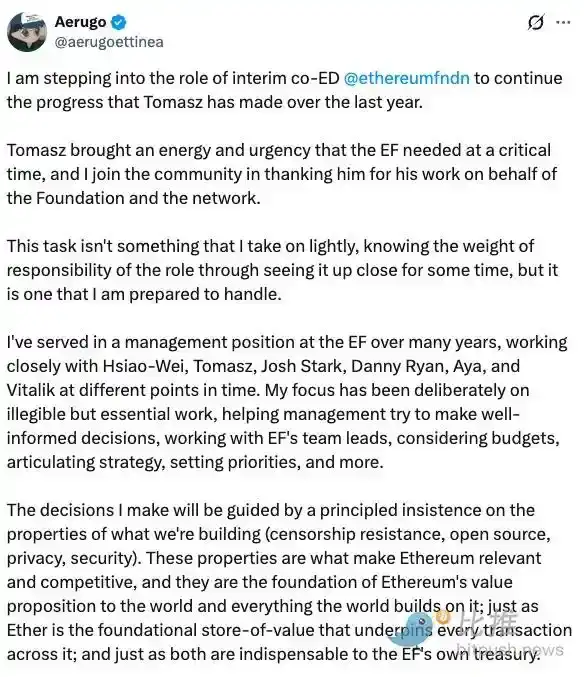
He will be succeeded by Bastian Aue. There is very little public information about this individual; his X account was registered just eight months ago and has almost no record of posts. He will continue to co-lead this organization, which controls the core resources and direction of the Ethereum ecosystem, alongside Hsiao-Wei Wang.

This seemingly sudden personnel change is actually an inevitable result of the interplay of internal conflicts, external pressures, and strategic transformation within the Ethereum Foundation.

Stepping Up in a Crisis: A Turbulent Year

To understand Stańczak's departure, one must first return to the context of his appointment.

In early 2025, the Ethereum community was in a period of anxiety. At that time, the overall cryptocurrency market was rising after the U.S. election, with Bitcoin repeatedly hitting new highs, and competing chains like Solana gaining strong momentum. However, Ethereum's price performance was relatively weak, and the Ethereum Foundation itself became a target of criticism.

The criticism was directed squarely at then-Executive Director Aya Miyaguchi. The developer community complained that the Foundation was severely disconnected from frontline builders, had conflicting strategic interests, and was insufficiently promoting Ethereum. Some questioned whether the Foundation was too "passive," and in its gentle posture of acting as a "coordinator" rather than a "leader," was letting Ethereum lose its first-mover advantage.

As the "central bank" of Ethereum, the Foundation was being asked not to govern by inaction, but to strike out forcefully.

Amid this storm of public opinion, Miyaguchi stepped back into a board role. Stańczak and Wang were thrust into the spotlight to take charge.

Stańczak was not an outsider. He is the founder of Nethermind, a company that is one of the core execution clients of the Ethereum ecosystem, playing a key role in infrastructure construction. He understands technology, has entrepreneurial experience, and has a firsthand understanding of the community's pain points.

In his own words, the directive he received upon taking office was clear: "The community is calling out—you are too chaotic, you need to be a bit more centralized, a bit faster, to deal with this critical period."

What was done this year?

The combination of Stańczak and Wang did bring visible changes.

First, organizational efficiency. The Foundation laid off 19 employees, streamlined its structure, and attempted to shed its bureaucratic label. The strategic focus shifted from Layer 2 back to Layer 1 itself, with a clear statement prioritizing the scaling of the Ethereum mainnet over letting L2s operate independently. The upgrade pace noticeably accelerated, and the promotion of EIPs became more decisive than before.

Second, an adjustment in posture. The Foundation began publishing series of videos on social media, proactively explaining Ethereum's technical roadmap and development direction to the public. This "outreach" communication style contrasted with its previous relatively closed and mysterious image.

In terms of strategic layout, Stańczak promoted exploration in several new directions: privacy protection,应对量子计算威胁 (responding to quantum computing threats), and the integration of artificial intelligence with Ethereum. Particularly regarding AI, he explicitly stated he saw the trend of "agentic systems" and "AI-assisted discovery" reshaping the world.

Financially, the Foundation began discussing more transparent budget management and fund allocation strategies, attempting to address external doubts about the efficiency of treasury use.

Vitalik Buterin's evaluation of Stańczak was: "He helped greatly improve the efficiency of multiple departments within the Foundation, making the organization more agile in responding to the external world."

Reading Between the Lines of the Resignation Statement

Why leave after less than a year?

Stańczak's resignation statement was quite candid and somewhat thought-provoking. He provided several key points of information:

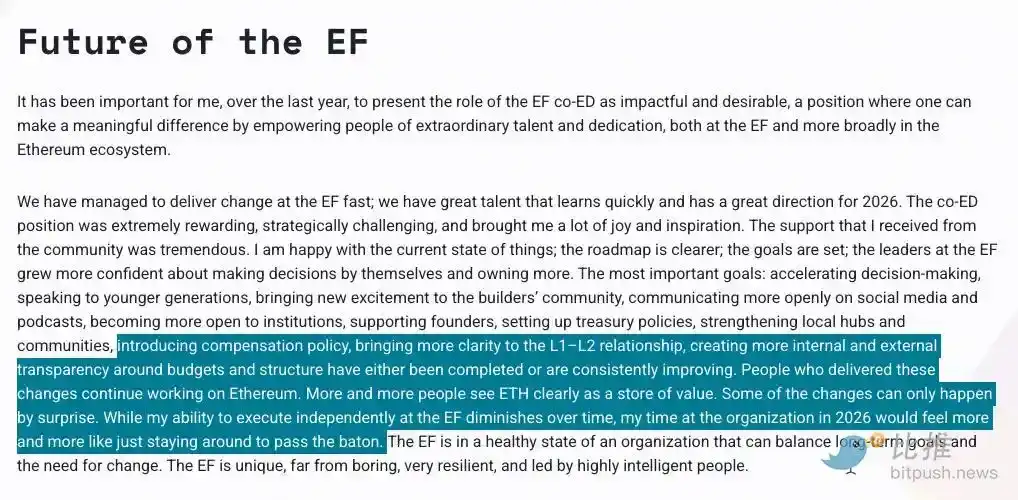
First, he believes the Ethereum Foundation and the entire ecosystem are "in a healthy state." The time for handing over the baton has come.

Second, he wants to return to being a "hands-on product builder," focusing on the combination of AI and Ethereum. He said his current mindset is similar to when he founded Nethermind in 2017.

Third, and most intriguingly: "The leadership layer of the Foundation is increasingly confident in making their own decisions and taking control of more matters. Over time, my ability to execute independently within the Foundation has diminished. If I stayed on, in 2026 I would mostly just be 'waiting to hand over the baton.'"

This sentence reveals two layers of meaning: first, the new leadership team has developed self-drive and no longer needs his involvement in everything; second, his actual sphere of influence may have been shrinking. For someone accustomed to getting hands-on and with a strong entrepreneurial temperament, this feeling was clearly not a good fit for him.

He also mentioned, "I know many current ideas about agentic AI might be immature, even useless, but it is this kind of playful experimentation that defined the innovative spirit of early Ethereum."

This statement carries a hint of implicit criticism of the status quo: as the organization becomes more "mature" and decisions become more "stable," will that wild, experimental spirit be lost?

Stańczak's departure,表面上 (on the surface) a personal choice,背后 (behind it) lies the long-standing dilemma faced by the Ethereum Foundation.

Since its inception, this organization has been in an awkward position. Theoretically, Ethereum is decentralized, and the Foundation should not be a command-and-control power center. But in practice, it controls significant funds, core developer resources, and has a coordinating voice in the ecosystem, objectively承担着 (bearing) the dual roles of "central bank" and "economic planning agency."

This identity paradox has long placed the Foundation in a double bind: doing too much draws accusations of centralization; doing too little invites criticism for inaction. The Miyaguchi era leaned towards a "coordinator"定位 (positioning), resulting in criticism of weakness; Stańczak attempted to shift towards an "executor" role, efficiency did improve, but the internal distribution of power within the organization naturally became more concentrated.

Stańczak's resignation statement恰恰暴露了 (precisely exposes) this tension: as the organization became more efficient and decisions more decisive, the personal maneuvering room for founding team members was反而压缩 (instead compressed). For an ecosystem that needs to balance "decentralized spirit" and "market competition efficiency," this internal friction is almost unavoidable.

What kind of person is Bastian Aue, who is replacing Stańczak?

There is extremely little public information. His own description on X is that he was previously responsible for "work that is difficult to quantify but crucial" at the Foundation: assisting management decision-making, communicating with team leaders, budget considerations, strategic梳理 (sorting), priority setting. This low-key style contrasts with Stańczak's distinct entrepreneurial气质 (temperament).

Aue said in his acceptance statement: "My basis for making decisions is a principled insistence on certain properties of what we are building. The mission of the Foundation is to ensure that truly permissionless infrastructure—the core is the cypherpunk spirit—can be built."

This language sounds more like the style of the Miyaguchi era: emphasizing principles, emphasizing spirit, emphasizing coordination rather than leadership.

Does this mean the Foundation will rebalance its direction, dialing back from "aggressive execution" to "principled coordination"? This remains to be seen.

Ethereum's Confusion

Stańczak's departure comes at a time when Ethereum is discussing a series of major proposals. According to him, the Foundation is about to release several key documents, including specific plans for "Lean Ethereum," the future development roadmap, and DeFi coordination mechanisms.

Among them, the "Lean Ethereum" proposal has been jokingly called "Ethereum's weight loss era" by some community members—intending to simplify the protocol, reduce burdens, and make the mainnet run more efficiently.

These directional documents will profoundly影响 (affect) Ethereum's evolution path in the coming years. Changing the core executive负责人 (person in charge) at this moment undoubtedly adds uncertainty to the implementation of these proposals.

The broader context is that Ethereum is facing challenges from multiple fronts: competition from high-performance chains like Solana, the fragmentation issue with Layer 2s, the new narrative window of AI and blockchain integration, and the impact of overall crypto market sentiment fluctuations on ecosystem funding and attention.

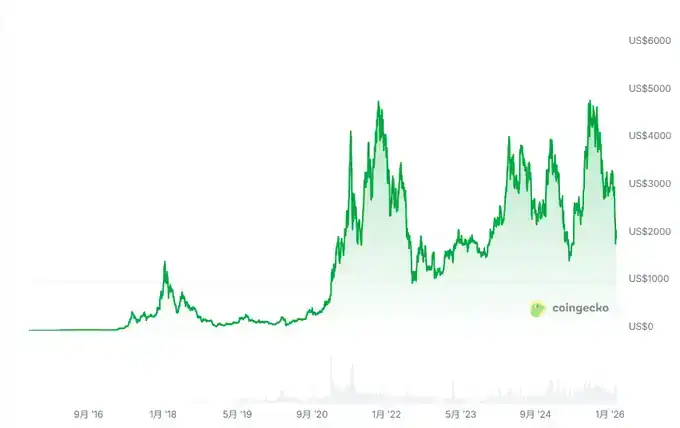
On the same day Stańczak announced his departure, ETH一度跌入 (once fell into) the $1800 range. If it continues to break below this level, an awkward fact will emerge: the comprehensive return on holding ETH may fall below the dollar cash interest rate.

Do the math for a more painful realization: In January 2018, ETH first stood above $1400. That $1400, adjusted for U.S. CPI inflation with compound interest, would be equivalent to approximately $1806 by February 2026.

In other words, if an investor bought ETH in 2018 and held it裸持 (naked, meaning without staking) until now, after eight years, they not only made no money but even underperformed U.S. dollars left in a bank earning interest.

For the "Ethereum Guards" (E 卫兵, loyal supporters) who have believed all along, the real拷问 (questioning) might not be "who won the路线之争 (route dispute)," but rather: how much longer can this last?

The only certainty is: this core organization, which controls one of the most important ecosystems in the crypto world, is still searching for its定位 (positioning) in a rapidly changing industry, and this path is注定 (destined) not to be平静 (calm).

Связанные с этим вопросы

QWho is leaving the Ethereum Foundation (EF) and after how long in the role?

ATomasz Stańczak, the EF's co-executive director, is leaving after just 11 months in the position.

QWhat were some of the key changes implemented during Tomasz Stańczak's tenure?

AKey changes included organizational streamlining with 19 employees laid off, a strategic refocus on Layer 1 scaling over Layer 2, faster upgrade cycles, more proactive public communication, and exploration of new areas like AI integration and quantum resistance.

QWhat reason did Tomasz Stańczak give for his departure from the Ethereum Foundation?

AHe stated he wanted to return to being a hands-on product builder, focusing on AI and Ethereum. He also implied his ability to execute independently within the foundation was diminishing as the leadership team became more self-sufficient.

QWho is replacing Tomasz Stańczak and what is known about his approach?

ABastian Aue is replacing him. Public information is scarce, but his statements suggest a leadership style that emphasizes principle-based decisions and a focus on 'cryptopunk spirit' and coordination, which contrasts with Stańczak's more execution-focused, entrepreneurial approach.

QWhat broader challenge for Ethereum is highlighted by the ETH price comparison from 2018?

AThe article highlights a significant performance challenge: an ETH bought in January 2018 and held without staking would be worth less in real terms (adjusted for inflation) than if the same amount of USD had been kept in a bank account earning interest, raising questions about long-term value retention for passive holders.

Похожее

After 50x Storage Surge, Justin Sun Always Looks to the Next Decade

Sun Yuchen, known for his controversial stunts like a $30 million lunch with Warren Buffett (canceled due to a kidney stone) and eating a $6.2 million duct-taped banana, is often overshadowed by a significant fact: his decade-long track record of spotting major investment trends. In 2016, he famously advised young people to invest in Bitcoin, Nvidia, Tesla, and Tencent instead of buying property. A hypothetical $20,000 investment in Nvidia and Tesla from that list would now be worth over 50 million RMB. His latest major call was on November 6, 2025, predicting a "50x storage opportunity" tied to the AI boom, which materialized with Sandisk's stock surging nearly 50-fold by 2026. Looking ahead, Sun now focuses on the next frontier: Physical AI. He identifies four key areas: 1. **Embodied AI/Robotics**: He sees this reaching its "iPhone moment," with companies like UBTech and Galaxy General leading in commercialization. 2. **Drones**: Viewed as the first commercially viable form of Physical AI, revolutionizing sectors from warfare (e.g., AeroVironment's Switchblade) to logistics. 3. **Spatial Computing**: Beyond VR, it's about AI understanding physical space, a foundational technology for robotics and autonomous systems, exemplified by Apple's Vision Pro. 4. **Space Exploration**: After a 2025 suborbital flight with Blue Origin, Sun advocates for space as the ultimate frontier, discussing blockchain's potential role in space asset management and data transactions. His investment philosophy involves betting on entire, inevitable trends rather than single companies. For robotics, he sees Tesla (the body/manufacturer) and Nvidia (the brain/AI platform) as complementary plays. In defense drones, he highlights companies making tanks obsolete (AeroVironment) and those augmenting fighter jets (Kratos). For space, he participated in Blue Origin's flight and anticipates SpaceX's potential IPO to redefine the sector's valuation. Sun Yuchen's vision frames the next two decades not as a revolution in information flow (like the internet), but in the fundamental operation of the physical world through AI-powered robots, autonomous systems, and spatial intelligence, ultimately extending human and AI activity into space. While many still focus on conventional assets, he continues to look toward the next technological horizon.

marsbit49 мин. назад

After 50x Storage Surge, Justin Sun Always Looks to the Next Decade

marsbit49 мин. назад

The Billionaires Behind the Most Expensive Midterm Election in History

"The Most Expensive Midterm Elections and Their Billionaire Backers" This analysis details the unprecedented scale of spending in the 2026 midterm elections, highlighting the key billionaire donors shaping the political landscape. Jeff Yass, founder of Susquehanna International Group, has contributed over $81 million, ranking third among individual donors behind George Soros ($102.6M) and Elon Musk ($84.8M). Yass is a major donor to Trump's MAGA Inc. and supports school choice and various candidates. Overall, federal committees have raised over $4.7 billion this cycle, with political ad spending projected to reach $10.8 billion. Republican-aligned groups are significantly out-raising their Democratic counterparts. "Dark money" from undisclosed sources continues to grow. The core stakes involve control of Congress and policy direction for Trump's final term. Donors are also motivated by specific issues: Sergey Brin and Chris Larsen are funding opposition to a proposed California wealth tax and supporting crypto-friendly policies. Other top donors include OpenAI's Greg Brockman and his wife Anna ($50M total to MAGA Inc. and an AI-focused PAC), Richard Uihlein ($45.3M to conservative causes), venture capitalists Marc Andreessen and Ben Horowitz (each over $44M to crypto/AI PACs and MAGA Inc.), Miriam Adelson ($42.6M to GOP leadership PACs), Paul Singer ($33.9M), and Diane Hendricks ($25.8M to MAGA Inc.). The article notes that the peak fundraising period is still ahead, with major primaries approaching.

marsbit52 мин. назад

The Billionaires Behind the Most Expensive Midterm Election in History

marsbit52 мин. назад

The Largest IPO in History Is Approaching, Surpassing SpaceX, 28 Years of AI Self-Iteration, Countdown to Intelligence Explosion

"Anthropic Nears Trillion-Dollar IPO, Fueled by Explosive Growth and 2028 'Intelligence Explosion' Warning Anthropic is considering a deal valuing the AI company near $1 trillion, potentially leading to one of the largest IPOs ever and surpassing SpaceX. Its revenue has skyrocketed, with Annual Recurring Revenue (ARR) reaching $45 billion in May 2026—a 500% increase in just five months. This vertical growth curve is attributed to its key products, Claude Code and Cowork, dominating AI coding and enterprise collaboration. Beyond commercial success, co-founder Jack Clark issued a pivotal warning in an interview: there is a greater than 50% chance that by the end of 2028, AI systems will achieve recursive self-improvement—the ability to autonomously build a 'better version' of themselves, initiating an 'intelligence explosion.' This prophecy underpins the company's astronomical valuation, as the market prices in the potential for transformative and disruptive AI. Further signaling its ambition, Anthropic formed a $1.5 billion joint venture with Goldman Sachs and Blackstone, aiming to disrupt traditional consulting firms like McKinsey by deploying Claude AI for complex strategic work. This move tests AI's capacity to replace high-level cognitive labor, a precursor to its predicted autonomous evolution. The narrative presents a dual future: unprecedented economic opportunity alongside significant risks like economic restructuring and security threats. Anthropic's meteoric rise and Clark's 2028 prediction frame the coming years as a countdown to a potential technological singularity."

marsbit1 ч. назад

The Largest IPO in History Is Approaching, Surpassing SpaceX, 28 Years of AI Self-Iteration, Countdown to Intelligence Explosion

marsbit1 ч. назад

Торговля

Спот
Фьючерсы

Популярные статьи

Manyu: восходящая мем-звезда на Ethereum, готовая открыть новую эру культуры Shiba

Manyu - это мемтокен на Ethereum, который приносит децентрализованную культурную и развлекательную ценность через вирусное влияние в соцсетях и вовлечённость сообщества.

1.9k просмотров всегоОпубликовано 2025.11.27Обновлено 2025.11.27

Manyu: восходящая мем-звезда на Ethereum, готовая открыть новую эру культуры Shiba

Неделя обучения по популярным токенам 14: Glamsterdam — самое ожидаемое обновление Ethereum в 2026 году

Ordinals/Runes по-прежнему стимулируют доходы от комиссий за блоки и активность разработчиков, рассматриваются как отправная точка «нативной эмиссии активов» в сети.

1.3k просмотров всегоОпубликовано 2026.04.29Обновлено 2026.04.29

Неделя обучения по популярным токенам 14: Glamsterdam — самое ожидаемое обновление Ethereum в 2026 году

Обсуждения

Добро пожаловать в Сообщество HTX. Здесь вы сможете быть в курсе последних новостей о развитии платформы и получить доступ к профессиональной аналитической информации о рынке. Мнения пользователей о цене на ETH (ETH) представлены ниже.

活动图片