If You’re Wondering When The Next Bitcoin Bull Run Will Begin, You Should See This Chart

bitcoinistОпубликовано 2026-02-17Обновлено 2026-02-17

Введение

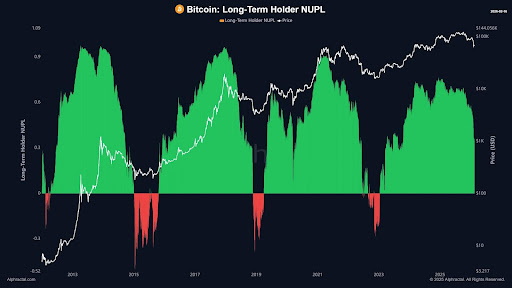
Market participants are searching for signals for Bitcoin’s next bull run. A chart by Joao Wedson, analyzing the Long-Term Holder Net Unrealized Profit/Loss (NUPL) metric, offers insight. Currently at 0.36, it shows long-term holders remain in profit, historically aligning with late bull markets or consolidation phases. The critical signal occurs when NUPL turns negative—marking unrealized losses even for resilient investors. These red zones have coincided with late bear markets, maximum pessimism, and cycle bottoms, preceding every major bull run. Since the metric remains positive, historical patterns suggest the final capitulation phase hasn't yet occurred, meaning the next bull run may not be imminent.

Market participants continue to search for reliable signals that can define the timing of Bitcoin’s next major expansion phase. While price forecasts, macro narratives, and ETF flows increasingly shape expectations, a chart published on February 16, 2025, by Alphractal founder and CEO Joao Wedson has added a new layer to that discussion. Focusing specifically on the profit positioning of long-term Bitcoin holders, this chart reveals a historic pattern about bull market timing.

What The Bitcoin Chart Tracks — And Why It Matters

In his post, Wedson presented a long-range chart built around the Long-Term Holder Net Unrealized Profit/Loss metric. The indicator measures the average unrealized gains or losses held by investors classified as long-term participants—wallets historically associated with stronger holding behavior and lower sell-side activity.

Related Reading: This Key Bitcoin Metric Signals That The Downside May Persist A Bit Longer

Rather than emphasizing short-term speculation, Wedson framed the metric as a lens into the financial condition of Bitcoin’s most resilient market cohort. According to the data shared, the current reading sits at 0.36. That level indicates long-term holders remain in aggregate profit, meaning their holdings, on average, are valued above acquisition cost.

Source: Chart from Joao Wedson on X

The chart visualizes this positioning through color-coded zones. Green regions represent periods where long-term holders hold unrealized profits. These phases have historically aligned with either late bull market environments or transitional consolidation ranges. The persistence of green, in Wedson’s presentation, signals that deep cycle stress has not yet fully materialized among conviction investors. By contrast, the most consequential signals in the chart appear when the metric shifts below zero.

When The Metric Turns Negative

Wedson’s analysis places primary emphasis on the moments when Long-Term Holder NUPL enters negative territory. In these intervals, even the most historically patient investors hold unrealized losses. The chart marks these periods in red, visually distinguishing them from profit-dominant phases.

Related Reading: Historical Pattern From 2017 Signals Bitcoin Price Crash To $35,000

Historically, those red zones have coincided with late bear-market conditions—periods characterized by widespread pessimism and compressed valuations. Wedson described this stage as one reflecting maximum market depression, where financial stress extends beyond speculative traders to reach long-term capital.

The chart’s historical mapping shows that these negative phases have preceded every major Bitcoin bull cycle. Each time the metric dropped below zero, it aligned with late-stage capitulation dynamics: seller exhaustion, reduced distribution pressure, and a transfer of coins toward entities with stronger holding capacity.

Within this framework, the red zone functions less as a signal of structural weakness and more as a reset phase. It marks the point where excess leverage and speculative positioning have been cleared, establishing conditions historically associated with cycle bottoms.

Wedson’s interpretation positions opportunity within these depression phases rather than during profit-heavy expansions. As illustrated in the chart, prior bull runs did not begin while long-term holders were comfortably in profit. They emerged after losses had permeated the cohort. With the metric still positive at 0.36, the chart suggests that, based strictly on historical precedent, the final capitulation preceding the next bull run has yet to occur.

BTC trading at $67,815 on the 1D chart | Source: BTCUSDT on Tradingview.com

Связанные с этим вопросы

QWhat is the key metric discussed in the article that helps predict Bitcoin bull runs?

AThe key metric is the Long-Term Holder Net Unrealized Profit/Loss (NUPL), which measures the average unrealized gains or losses held by long-term Bitcoin investors.

QAccording to the chart, what does a negative Long-Term Holder NUPL value historically indicate?

AA negative NUPL value indicates that long-term holders are in unrealized losses, which historically coincides with late bear-market conditions, maximum market depression, and has preceded every major Bitcoin bull cycle.

QWhat is the current reading of the Long-Term Holder NUPL metric mentioned in the article?

AThe current reading of the Long-Term Holder NUPL metric is 0.36, indicating that long-term holders remain in aggregate profit.

QWhat does the article suggest about the timing of the next Bitcoin bull run based on the current NUPL data?

AThe article suggests that since the NUPL is still positive at 0.36, the final capitulation phase (where the metric turns negative) has not yet occurred, meaning the next bull run has not begun based on this historical pattern.

QWho created and shared the chart that is the focus of this article?

AThe chart was created and shared by Joao Wedson, the founder and CEO of Alphractal, on February 16, 2025.

Похожее

You Bet on the News, the Pros Read the Rules: The True Cognitive Gap in Losing Money on Polymarket

The article explains that the key to profiting on Polymarket, a prediction market platform, lies not just predicting real-world events correctly, but in meticulously understanding the specific rules that govern how each market will be resolved. It illustrates this with examples, such as a market on Venezuela's 2026 leader, where the official rules defining "officially holds" the office overruled the intuitive answer of who was in practical control. Other examples include debates over the definition of a "token" or what constitutes an "agreement." The core argument is that a "reality vs. rules" gap creates pricing discrepancies that savvy traders ("车头" or "whales") exploit. The platform has a formal dispute resolution process managed by UMA token holders to settle ambiguous outcomes. This process involves proposal submission, a challenge window, a discussion period, and a final vote. However, the article highlights a critical flaw in this system compared to a traditional court: the lack of separation between the arbiters (UMA voters) and the interested parties (traders with financial stakes in the outcome). This conflict of interest undermines the discussion phase, leads to herd mentality, and results in opaque final decisions without explanatory rulings. Consequently, the system lacks a body of precedent, making it difficult for users to learn from past disputes. The ultimate takeaway is that success on Polymarket requires a lawyer-like scrutiny of the rules to identify and capitalize on the cognitive gap between how events appear and how they are contractually defined for settlement.

marsbit24 мин. назад

You Bet on the News, the Pros Read the Rules: The True Cognitive Gap in Losing Money on Polymarket

marsbit24 мин. назад

Will the Fed Still Cut Interest Rates? Tonight's Data Is Crucial

The core debate surrounding the Federal Reserve's potential interest rate cuts is intensifying amid geopolitical conflict and rebounding inflation. The key question is whether high energy prices will cause persistent inflation or weaken consumer demand enough to force the Fed to cut rates. Citigroup presents a bullish case for cuts, arguing that oil supply disruptions from the Strait of Hormuz are temporary and will not lead to lasting inflationary pressure. They point to receding bond yields and oil prices as evidence the market is pricing in a short-lived shock. Citi's data also shows tightening financial conditions, a stabilizing labor market, and healthy tax returns, supporting their view that the path to lower rates remains open. Conversely, Deutsche Bank offers a starkly contrasting, more hawkish outlook. They argue the Fed's current policy is already neutral and expect rates to remain unchanged indefinitely. Their view is based on stalled disinflation progress and a shift toward more hawkish rhetoric from key Fed officials like Waller, who cited risks from prolonged Middle East conflict and tariffs. Other officials, including Williams and Hammack, signaled rates would likely stay on hold for a "considerable time." The market pricing has shifted dramatically, now forecasting zero cuts in 2026. The imminent release of the March retail sales "control group" data is highlighted as a critical test. This metric, which excludes gas station sales, will reveal if high gasoline prices are eroding consumer spending in other areas. A weak reading could support the case for imminent rate cuts, while a strong one would bolster the argument for the Fed to hold steady. This data is pivotal for determining the near-term policy path.

marsbit45 мин. назад

Will the Fed Still Cut Interest Rates? Tonight's Data Is Crucial

marsbit45 мин. назад

Торговля

Спот
Фьючерсы

Популярные статьи

Тест по Bitcoin Биткоина

HTX Learn: Изучите Bitcoin halving и Заработаете Токены USDT

3.0k просмотров всегоОпубликовано 2024.04.16Обновлено 2024.04.16

Тест по Bitcoin  Биткоина

Что такое $BITCOIN

ЦИФРОВОЕ ЗОЛОТО ($BITCOIN): Комплексный анализ Введение в ЦИФРОВОЕ ЗОЛОТО ($BITCOIN) ЦИФРОВОЕ ЗОЛОТО ($BITCOIN) — это проект на основе блокчейна, работающий в сети Solana, который стремится объединить характеристики традиционных драгоценных металлов с инновациями децентрализованных технологий. Хотя он носит имя Биткойн, часто называемого “цифровым золотом” из-за его восприятия как средства хранения ценности, ЦИФРОВОЕ ЗОЛОТО является отдельным токеном, предназначенным для создания уникальной экосистемы в ландшафте Web3. Его цель — позиционировать себя как жизнеспособный альтернативный цифровой актив, хотя детали его применения и функциональности все еще развиваются. Что такое ЦИФРОВОЕ ЗОЛОТО ($BITCOIN)? ЦИФРОВОЕ ЗОЛОТО ($BITCOIN) — это токен криптовалюты, специально разработанный для использования в блокчейне Solana. В отличие от Биткойна, который выполняет широко признанную роль хранения ценности, этот токен, похоже, сосредоточен на более широких приложениях и характеристиках. Примечательные аспекты включают: Инфраструктура блокчейна: Токен построен на блокчейне Solana, известном своей способностью обрабатывать высокоскоростные и недорогие транзакции. Динамика предложения: ЦИФРОВОЕ ЗОЛОТО имеет максимальное предложение, ограниченное 100 квадриллионами токенов (100P $BITCOIN), хотя детали о его обращающемся предложении в настоящее время не раскрыты. Утилита: Хотя точные функциональные возможности не описаны, есть указания на то, что токен может быть использован для различных приложений, потенциально связанных с децентрализованными приложениями (dApps) или стратегиями токенизации активов. Кто создатель ЦИФРОВОГО ЗОЛОТА ($BITCOIN)? На данный момент личность создателей и команды разработчиков, стоящих за ЦИФРОВЫМ ЗОЛОТОМ ($BITCOIN), остается неизвестной. Эта ситуация типична для многих инновационных проектов в области блокчейна, особенно тех, которые связаны с децентрализованными финансами и феноменом мем-криптовалют. Хотя такая анонимность может способствовать культуре, ориентированной на сообщество, она усиливает опасения по поводу управления и ответственности. Кто инвесторы ЦИФРОВОГО ЗОЛОТА ($BITCOIN)? Доступная информация указывает на то, что у ЦИФРОВОГО ЗОЛОТА ($BITCOIN) нет известных институциональных спонсоров или значительных венчурных капиталовложений. Проект, похоже, функционирует по модели пирингового взаимодействия, сосредоточенной на поддержке и принятии сообществом, а не на традиционных путях финансирования. Его активность и ликвидность в основном сосредоточены на децентрализованных биржах (DEX), таких как PumpSwap, а не на устоявшихся централизованных торговых платформах, что еще больше подчеркивает его подход, ориентированный на grassroots. Как работает ЦИФРОВОЕ ЗОЛОТО ($BITCOIN) Операционные механизмы ЦИФРОВОГО ЗОЛОТА ($BITCOIN) можно подробно описать на основе его дизайна блокчейна и характеристик сети: Механизм консенсуса: Используя уникальный механизм доказательства истории (PoH) Solana в сочетании с моделью доказательства доли (PoS), проект обеспечивает эффективную валидацию транзакций, что способствует высокой производительности сети. Токеномика: Хотя конкретные дефляционные механизмы не были подробно описаны, большое максимальное предложение токенов подразумевает, что оно может быть предназначено для микротранзакций или нишевых случаев использования, которые еще предстоит определить. Интероперабельность: Существует потенциал для интеграции с более широкой экосистемой Solana, включая различные платформы децентрализованных финансов (DeFi). Однако детали относительно конкретных интеграций остаются неуточненными. Хронология ключевых событий Вот хронология, которая подчеркивает значимые вехи, касающиеся ЦИФРОВОГО ЗОЛОТА ($BITCOIN): 2023: Первоначальное развертывание токена происходит в блокчейне Solana, отмеченное его адресом контракта. 2024: ЦИФРОВОЕ ЗОЛОТО приобретает видимость, когда оно становится доступным для торговли на децентрализованных биржах, таких как PumpSwap, позволяя пользователям обменивать его на SOL. 2025: Проект наблюдает спорадическую торговую активность и потенциальный интерес к инициативам, возглавляемым сообществом, хотя на данный момент не зафиксировано никаких значительных партнерств или технических достижений. Критический анализ Сильные стороны Масштабируемость: Основная инфраструктура Solana поддерживает высокие объемы транзакций, что может повысить полезность $BITCOIN в различных сценариях транзакций. Доступность: Потенциально низкая цена торговли за токен может привлечь розничных инвесторов, способствуя более широкому участию благодаря возможностям дробного владения. Риски Отсутствие прозрачности: Отсутствие публично известных спонсоров, разработчиков или процесса аудита может вызвать скептицизм относительно устойчивости и надежности проекта. Волатильность рынка: Торговая активность сильно зависит от спекулятивного поведения, что может привести к значительной волатильности цен и неопределенности для инвесторов. Заключение ЦИФРОВОЕ ЗОЛОТО ($BITCOIN) является интригующим, но неоднозначным проектом в быстро развивающейся экосистеме Solana. Хотя он пытается использовать нарратив “цифрового золота”, его отход от установленной роли Биткойна как средства хранения ценности подчеркивает необходимость более четкого различения его предполагаемой утилиты и структуры управления. Будущее принятие и усвоение, вероятно, будут зависеть от решения текущей непрозрачности и более четкого определения его операционных и экономических стратегий. Примечание: Этот отчет охватывает синтезированную информацию, доступную на октябрь 2023 года, и с тех пор могут произойти события.

99 просмотров всегоОпубликовано 2025.05.13Обновлено 2025.05.13

Что такое $BITCOIN

Fractal Bitcoin: масштабирование Биткоина с помощью рекурсивной системы

Fractal Bitcoin — масштабное Layer-1-решнение, созданное на базе кода Биткоина, позволяющего достигать бесконечного масштабирования с помощью рекурсивного подхода.

2.2k просмотров всегоОпубликовано 2025.06.30Обновлено 2025.06.30

Fractal Bitcoin: масштабирование Биткоина с помощью рекурсивной системы

Обсуждения

Добро пожаловать в Сообщество HTX. Здесь вы сможете быть в курсе последних новостей о развитии платформы и получить доступ к профессиональной аналитической информации о рынке. Мнения пользователей о цене на BTC (BTC) представлены ниже.

活动图片