How Did Cardano Token NIGHT Ignite Nearly $10 Billion in Daily Trading Volume?

比推Опубликовано 2025-12-24Обновлено 2025-12-24

Введение

The Cardano-based privacy token NIGHT, associated with the Midnight sidechain, recently recorded nearly $10 billion in daily trading volume across major exchanges like Binance, OKX, and Bybit. Its price surged over 300% in less than two weeks after launch, reaching a fully diluted valuation of over $2.5 billion before settling around $0.08. Midnight, developed by Cardano’s parent company IOG, focuses on programmable data protection using zero-knowledge proofs (ZKPs) packaged into developer-friendly TypeScript APIs. It employs a dual-token model: NIGHT for governance and generating DUST, the utility token used for transaction and privacy fees. This design aims to meet regulatory requirements by separating governance from transactional assets. The token’s rapid growth is attributed to a massive airdrop campaign targeting 37 million addresses across multiple blockchains, alongside distribution partnerships with top exchanges. With Cardano planning major upgrades in 2025—including scaling solutions, Midnight’s mainnet launch, native stablecoin integration, and enhanced interoperability—NIGHT’s rise may signal renewed momentum for the ecosystem.

Author: Eric, Foresight News

Original Title: A Token with Nearly $10 Billion in Daily Trading Volume, Actually from Cardano?


Recently, a token named NIGHT, which was listed for spot or contract trading on Bitget, Binance, OKX, and Bybit earlier this month, saw its 24-hour global trading volume exceed $9 billion, approaching $10 billion. Bybit even surpassed Binance in 24-hour spot trading volume thanks to NIGHT.

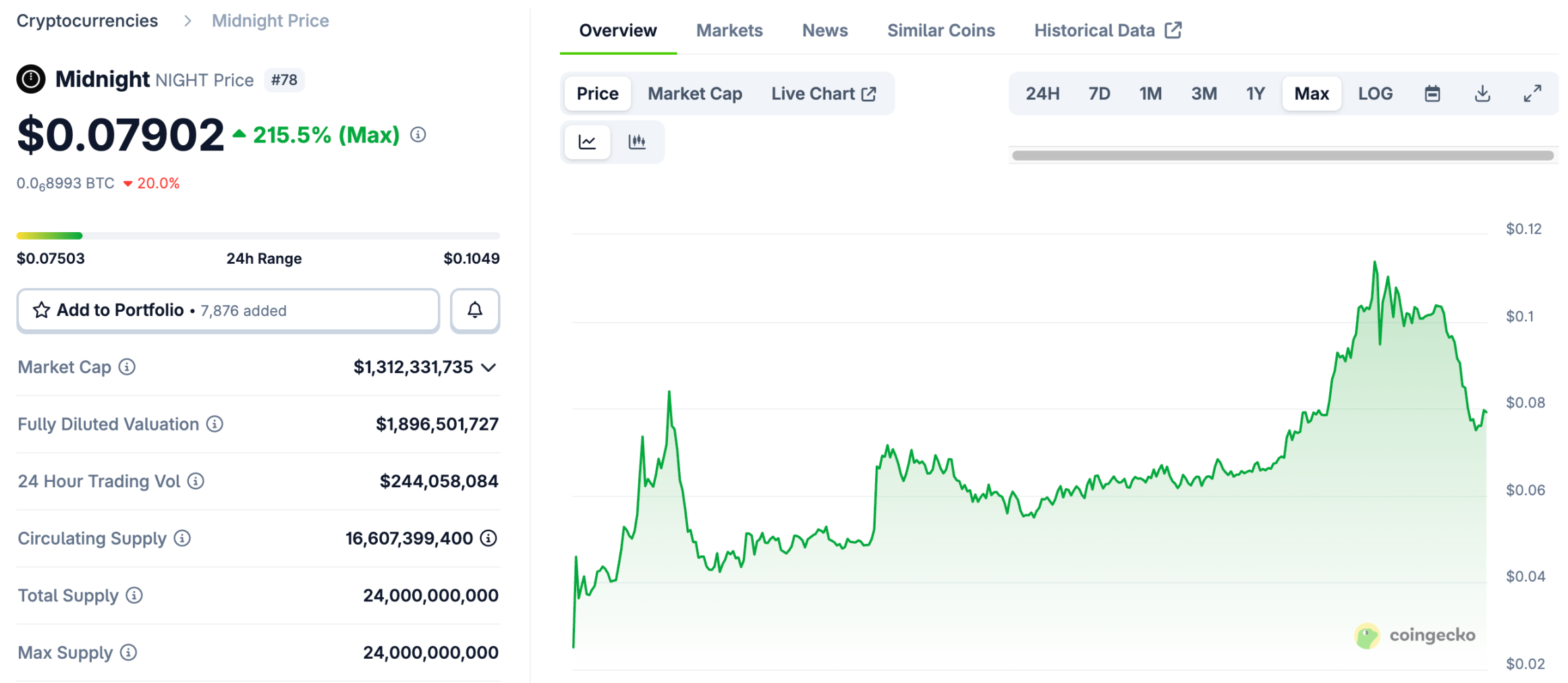
NIGHT was officially launched on December 9. According to CoinGecko data, the token's price rose from around $0.025 to nearly $0.114 in less than two weeks, a increase of over 3 times. Its FDV once exceeded $2.5 billion, which would place it within the top 50 by market capitalization. At the time of writing, NIGHT price has retraced to around $0.08.

Such performance from a token listed on several major exchanges simultaneously is not entirely unexpected. However, the interesting part is that NIGHT is the token of Midnight, a privacy-focused sidechain of Cardano. The explosive power of a project bearing both the "Cardano" and "privacy" labels truly surprised most people.

What Makes Midnight "Valuable"?

Midnight is a sidechain developed by Input Output Global (IOG, the parent company of Cardano) with "programmable data protection" as its core selling point. It packages zero-knowledge proofs (ZKP) into a ready-to-use TypeScript API, allowing Web2 developers to implement "selective disclosure" on-chain without needing to learn cryptography. The entire network uses Cardano as its consensus layer and Halo2 as its ZK backend, employing a dual-token model (NIGHT+DUST). The goal is first to land the "data availability without visibility" that enterprises care about most, and then gradually expand to scenarios like DeFi, RWA, and on-chain compliant identity.

Overall, it doesn't seem particularly unique. It adopts ZKP privacy technology but doesn't natively protect privacy; instead, it makes privacy features optional to address practical needs.

IOG first publicly announced the plan to develop Midnight in November 2022, but the testnet wasn't launched until nearly two years later, in October 2024. This is indeed IOG's style—it took almost 5 years from announcing smart contracts for Cardano to actual implementation, which wasn't achieved until September 2021, long after the bull market had passed.

In May of this year, Midnight established a foundation, with Fahmi Syed, former CFO of Polkadot development team Parity, as chairman, signaling the first step towards TGE (Token Generation Event). Just two days after announcing the foundation's establishment, Cardano founder Charles Hoskinson revealed plans to airdrop tokens to 37 million addresses on 8 major blockchains, stating that the airdrop would target only retail users, with no VC participation in the project.

Perhaps what truly ignited market sentiment was Midnight's "massive airdrop." In addition to the airdrop, Midnight also distributed nearly 3 billion NIGHT tokens in collaboration with Binance, OKX, and Bybit. This large-scale approach, which contrasts sharply with the recent popular ICO models, garnered a positive market response.

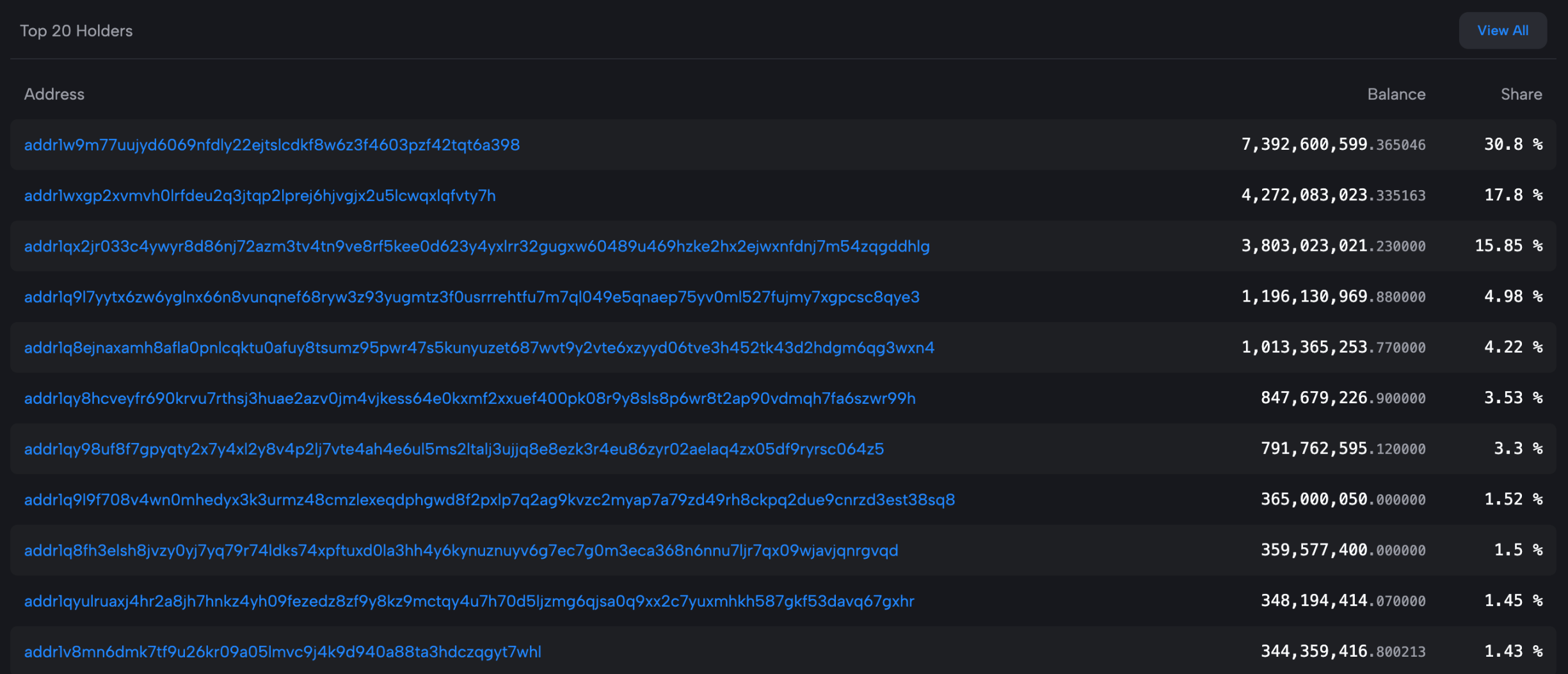
Looking at the block explorer, aside from the top three addresses which likely belong to IOG or the Midnight Foundation, the holdings of the remaining addresses are relatively decentralized. According to data provided on the official website, the author estimates that the airdrop itself, combined with exchange collaboration events, distributed nearly one-third of the total supply (24 billion tokens), which indeed qualifies as a massive effort.

Midnight's tokenomics feature not just NIGHT, but a "NIGHT+DUST" dual-token model. This rare design isn't based on some "whimsical idea" but rather aims to ensure regulatory compliance. NIGHT can be used for network governance, incentives, and generating the other token, DUST. NIGHT itself is not related to privacy and supports on-chain auditing.

DUST, generated by holding NIGHT, is used to pay for transaction fees, similar to Gas. Additionally, DUST will be used to pay for privacy fees—if one wants to add optional privacy features to on-chain transactions, they must pay DUST. DUST is automatically distributed to NIGHT holders' accounts with each block produced and "decays" over time to prevent malicious hoarding and network attacks.

Thus, Midnight's "equity" token, NIGHT, does not participate in paying on-chain transaction fees but exists solely as a governance token and a generator for the actual on-chain fuel, DUST. DUST itself, as a "renewable resource" generated by NIGHT and constantly decreasing over time, would be considered a resource rather than an asset from a regulatory perspective, potentially satisfying regulatory requirements in various jurisdictions.

Cardano to Heavily Invest in On-Chain Ecosystem Next Year

According to Cardano's roadmap, next year will be focused on comprehensively boosting on-chain activity.

First and foremost, Cardano will undergo a network upgrade to increase throughput to 1000-10,000 TPS through parallel block processing and a layered structure for vertical scaling, while maintaining security and decentralization. Following this will be the mainnet launch of the protagonist of this article, Midnight. Cardano believes Midnight's launch will bring more DeFi activity and TVL through its optional privacy features. Additionally, the Cardano Treasury will allocate funds to support the native issuance of major stablecoins like USDT and USDC on Cardano.

The last point, which the author finds most important, is Cardano's plan to focus on interoperability—not simple cross-chain functionality, but enabling users from other chains to interact directly with DApps on Cardano by paying gas fees on their source chain.

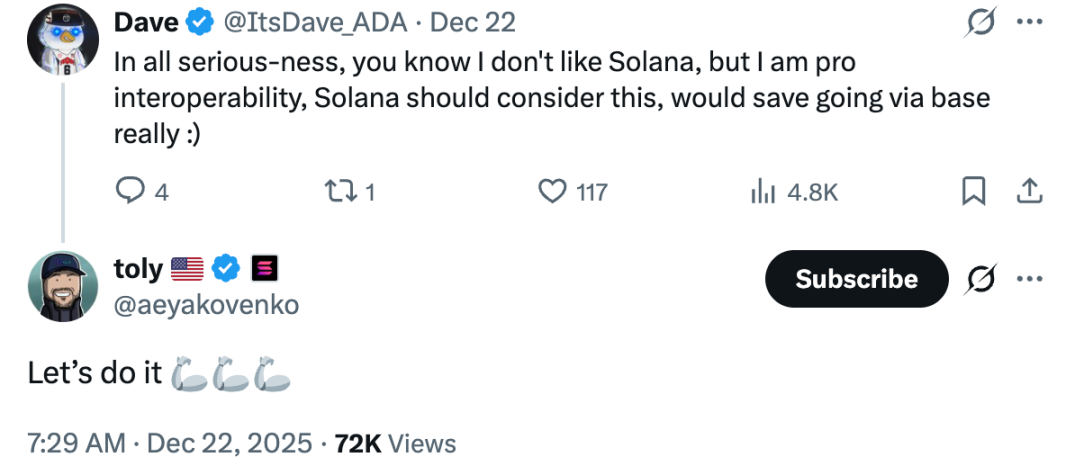
Last week, Cardano achieved atomic swaps between BTC and ADA through Fluid, not via cross-chain bridges, wrapped tokens, or centralized custody, but directly through underlying script-to-script transactions, which is somewhat facilitated by Cardano's own UTXO ledger model. Two days ago, interactions between Cardano stake pool operators and Solana's co-founder on X also confirmed this development direction.

Accompanying the strategic and product plans is capital investment. The Cardano Foundation plans to increase its marketing budget by 12% and "make an appearance" at events like TOKEN2049 and Consensus. Venture Hub will also invest 2 million ADA to support startups and ecosystem projects. Furthermore, the Cardano Foundation plans to inject tens of millions of ADA into on-chain DeFi to improve liquidity and attract institutional participation.

From this perspective, driving up the price of NIGHT might just be the appetizer Cardano is serving for a series of plans. Perhaps 2026 is really the year to keep an eye on this project, which launched its mainnet back in 2017 and has been almost forgotten by the mainstream Web3 market.


Twitter:https://twitter.com/BitpushNewsCN

Bitpush TG Discussion Group:https://t.me/BitPushCommunity

Bitpush TG Subscription: https://t.me/bitpush

Original link:https://www.bitpush.news/articles/7598128

Связанные с этим вопросы

QWhat is NIGHT and which blockchain is it from?

ANIGHT is the native token of Midnight, a privacy-focused sidechain developed by Input Output Global (IOG), the parent company of Cardano.

QWhat was the 24-hour trading volume of NIGHT that sparked significant attention?

ANIGHT achieved a 24-hour trading volume of nearly $9 billion, approaching $10 billion, which was a major point of discussion.

QWhat is the core technological feature of the Midnight blockchain?

AMidnight's core feature is 'programmable data protection,' offering TypeScript APIs for zero-knowledge proofs (ZKPs) to enable 'selective disclosure' without requiring developers to learn cryptography.

QHow does Midnight's dual-token model (NIGHT and DUST) work and why was it designed this way?

ANIGHT is used for governance and generating DUST, while DUST acts as gas for transaction fees and privacy features. This design helps comply with regulatory requirements by separating the governance token from the transactional resource.

QWhat are some of Cardano's key plans for its ecosystem in the coming year as mentioned in the article?

ACardano plans to upgrade network throughput to 1000-10,000 TPS, launch the Midnight mainnet, support native issuance of stablecoins like USDT and USDC, focus on interoperability allowing users to interact with DApps using their native chain's gas tokens, and invest in marketing and liquidity.

Похожее

a16z: AI's 'Amnesia', Can Continuous Learning Cure It?

The article "a16z: AI's 'Amnesia' – Can Continual Learning Cure It?" explores the limitations of current large language models (LLMs), which, like the protagonist in the film *Memento*, are trapped in a perpetual present—unable to form new memories after training. While methods like in-context learning (ICL), retrieval-augmented generation (RAG), and external scaffolding (e.g., chat history, prompts) provide temporary solutions, they fail to enable true internalization of new knowledge. The authors argue that compression—the core of learning during training—is halted at deployment, preventing models from generalizing, discovering novel solutions (e.g., mathematical proofs), or handling adversarial scenarios. The piece introduces *continual learning* as a critical research direction to address this, categorizing approaches into three paths: 1. **Context**: Scaling external memory via longer context windows, multi-agent systems, and smarter retrieval. 2. **Modules**: Using pluggable adapters or external memory layers for specialization without full retraining. 3. **Weights**: Enabling parameter updates through sparse training, test-time training, meta-learning, distillation, and reinforcement learning from feedback. Challenges include catastrophic forgetting, safety risks, and auditability, but overcoming these could unlock models that learn iteratively from experience. The conclusion emphasizes that while context-based methods are effective, true breakthroughs require models to compress new information into weights post-deployment, moving from mere retrieval to genuine learning.

marsbit50 мин. назад

a16z: AI's 'Amnesia', Can Continuous Learning Cure It?

marsbit50 мин. назад

Can a Hair Dryer Earn $34,000? Deciphering the Reflexivity Paradox in Prediction Markets

An individual manipulated a weather sensor at Paris Charles de Gaulle Airport with a portable heat source, causing a Polymarket weather market to settle at 22°C and earning $34,000. This incident highlights a fundamental issue in prediction markets: when a market aims to reflect reality, it also incentivizes participants to influence that reality. Prediction markets operate on two layers: platform rules (what outcome counts as a win) and data sources (what actually happened). While most focus on rules, the real vulnerability lies in the data source. If reality is recorded through a specific source, influencing that source directly affects market settlement. The article categorizes markets by their vulnerability: 1. **Single-point physical data sources** (e.g., weather stations): Easily manipulated through physical interference. 2. **Insider information markets** (e.g., MrBeast video details): Insiders like team members use non-public information to trade. Kalshi fined a剪辑师 $20,000 for insider trading. 3. **Actor-manipulated markets** (e.g., Andrew Tate’s tweet counts): The subject of the market can control the outcome. Evidence suggests Tate’sociated accounts coordinated to profit. 4. **Individual-action markets** (e.g., WNBA disruptions): A single person can execute an event to profit from their pre-placed bets. Kalshi and Polymarket handle these issues differently. Kalshi enforces strict KYC, publicly penalizes insider trading, and reports to regulators. Polymarket, with its anonymous wallet-based system, has historically been more permissive, arguing that insider information improves market accuracy. However, it cooperated with authorities in the "Van Dyke case," where a user traded on classified government information. The core paradox is reflexivity: prediction markets are designed to discover truth, but their financial incentives can distort reality. The more valuable a prediction becomes, the more likely participants are to influence the event itself. The market ceases to be a mirror of reality and instead shapes it.

marsbit1 ч. назад

Can a Hair Dryer Earn $34,000? Deciphering the Reflexivity Paradox in Prediction Markets

marsbit1 ч. назад

Торговля

Спот
Фьючерсы

Популярные статьи

Как купить ADA

Добро пожаловать на HTX.com! Мы сделали приобретение Cardano (ADA) простым и удобным. Следуйте нашему пошаговому руководству и отправляйтесь в свое крипто-путешествие.Шаг 1: Создайте аккаунт на HTXИспользуйте свой адрес электронной почты или номер телефона, чтобы зарегистрироваться и бесплатно создать аккаунт на HTX. Пройдите удобную регистрацию и откройте для себя весь функционал.Создать аккаунтШаг 2: Перейдите в Купить криптовалюту и выберите свой способ оплатыКредитная/Дебетовая Карта: Используйте свою карту Visa или Mastercard для мгновенной покупки Cardano (ADA).Баланс: Используйте средства с баланса вашего аккаунта HTX для простой торговли.Третьи Лица: Мы добавили популярные способы оплаты, такие как Google Pay и Apple Pay, для повышения удобства.P2P: Торгуйте напрямую с другими пользователями на HTX.Внебиржевая Торговля (OTC): Мы предлагаем индивидуальные услуги и конкурентоспособные обменные курсы для трейдеров.Шаг 3: Хранение Cardano (ADA)После приобретения вами Cardano (ADA) храните их в своем аккаунте на HTX. В качестве альтернативы вы можете отправить их куда-либо с помощью перевода в блокчейне или использовать для торговли с другими криптовалютами.Шаг 4: Торговля Cardano (ADA)С легкостью торгуйте Cardano (ADA) на спотовом рынке HTX. Просто зайдите в свой аккаунт, выберите торговую пару, совершайте сделки и следите за ними в режиме реального времени. Мы предлагаем удобный интерфейс как для начинающих, так и для опытных трейдеров.

1.8k просмотров всегоОпубликовано 2024.03.29Обновлено 2025.07.02

Как купить ADA

SNEK: ведущий мемкоин на блокчейне Cardano, открывающий новую эпоху для экосистемы Cardano

SNEK - это дефляционный мемкоин, выпущенный на блокчейне Cardano. Он создаёт децентрализованную культурную и развлекательную ценность за счёт участия глобального сообщества.

2.0k просмотров всегоОпубликовано 2025.10.15Обновлено 2025.10.15

SNEK: ведущий мемкоин на блокчейне Cardano, открывающий новую эпоху для экосистемы Cardano

Неделя обучения по популярным токенам 8: запуск основной сети Ouroboros Leios для ADA ожидается в 2026 году

Основная сеть Ouroboros Leios для ADA, как ожидается, будет запущена в 2026 году, а хардфорк до версии протокола 11 запланирован на I квартал 2026 года.

1.9k просмотров всегоОпубликовано 2026.02.10Обновлено 2026.02.12

Неделя обучения по популярным токенам 8: запуск основной сети Ouroboros Leios для ADA ожидается в 2026 году

Обсуждения

Добро пожаловать в Сообщество HTX. Здесь вы сможете быть в курсе последних новостей о развитии платформы и получить доступ к профессиональной аналитической информации о рынке. Мнения пользователей о цене на ADA (ADA) представлены ниже.

活动图片