Hoskinson Claims Cardano Can Surpass Bitcoin By Solving Crypto’s Trust Problem

bitcoinistОпубликовано 2026-06-09Обновлено 2026-06-09

Введение

In a June 8 livestream, Cardano founder Charles Hoskinson presented an ambitious long-term vision for the network, framing its mission as solving the global "trust problem" rather than merely competing for crypto market share. He argued that the cryptocurrency industry's core purpose is to reduce the massive annual costs associated with trusted third parties in finance and commerce through "verifiable reflexivity"—where transactions carry their own proof of correctness. Hoskinson outlined four key requirements for this goal: a decentralized engine (via Ouroboros), the right accounting model (extended UTXO), modular expansion (exemplified by partner chains like Midnight), and robust decentralized governance. He emphasized that Cardano's design aims to avoid dependency on intermediaries for reconciliation and scale for specialized applications through technologies like Hydra. While governance structures are still developing, Hoskinson claimed that if Cardano succeeds in building this trust infrastructure, ADA could become the "currency of global trust" and has the potential to eventually surpass Bitcoin. He stressed that for Cardano to reach its next level, it must prove it is a self-healing system capable of surviving even a loss of confidence in its founder.

Charles Hoskinson says Cardano is not merely competing for crypto market share, but for a much larger role: becoming the infrastructure layer for global trust. In a June 8 livestream titled “Why Cardano is the only Ecosystem that can run the world,” the Cardano founder argued that ADA’s long-term value depends on whether the network can reduce the world’s reliance on trusted third parties and eventually surpass Bitcoin.

Hoskinson framed the current market environment as more than a downturn in sentiment. “Right now the markets are not reflecting a bear market. They’re reflecting an existential crisis,” he said, arguing that investors are asking whether cryptocurrencies “even matter” as attention shifts toward AI, synthetic biology and other high-growth technologies.

Cardano’s Endgame Is Bigger Than Token Price

His answer was that crypto’s core function has been misunderstood. In Hoskinson’s view, the industry’s purpose is not simply to create currencies or blockchains, but to reduce the cost of trust in global commerce. He estimated that the current trust apparatus in regulated financial markets, including auditing, insurance, compliance, custody, reconciliation and other intermediating functions represents hundreds of billions of dollars in annual costs.

“The solution is actually something called verifiable reflexivity,” Hoskinson said. “It’s a property. Basically, something carries its own proof of being correct.”

That concept became the central thread of the livestream. Hoskinson used voting as a simplified example: rather than relying on a trusted third party to determine whether a ballot is valid, the ballot itself would carry proof that it is legitimate. Applied more broadly, he said, the same principle could extend across finance, identity, governance, proof of reserves, solvency, settlement and social coordination.

For Hoskinson, blockchains are the storage layer for these “verifiable reflexive transactions,” while smart contracts, zero-knowledge proofs and recursion provide the machinery to make them useful. Cryptocurrencies, in this framing, are not the end product. They are the economic resource that pays for the decentralized infrastructure required to maintain the system.

Hoskinson argued that this is where Cardano separates itself from rival networks. He identified four requirements: an engine of decentralization, the right accounting model, modular expansion of major functionality, and decentralized governance capable of specialization.

On decentralization, Hoskinson pointed to Ouroboros, describing it as the protocol architecture that allows ADA to scale while becoming more decentralized rather than less. He contrasted that with systems moving toward permissioned or compliance-gated models, which he said reintroduce trusted third parties into the settlement layer.

He also highlighted Cardano’s extended UTXO model, saying it preserves local determinism while enabling programmability. That matters, in his argument, because if Alice, Bob and the network do not share the same view of a transaction, they must rely on another actor to reconcile the difference. Cardano’s design, he said, is meant to avoid that dependency.

Hoskinson then turned to Hydra and “channel isomorphism,” which he described as allowing activity to happen in specialized domains and return to Cardano “as if you did it on Cardano.” He said this gives the network a path to scale for application-specific environments, including regulated real-world assets and other specialized commercial systems.

The third piece is modularity through partner chains. Hoskinson cited Midnight as the first example, arguing that Cardano can add functionality without making the base layer excessively complex or fragile. “When you’re modular, if that module fails, it doesn’t kill Cardano, which builds trust in the underlying system,” he said.

The most unfinished part, by his own description, is governance. Hoskinson said Cardano still needs stronger “executive function” and specialization, including budget, strategy and execution functions that can identify KPIs and allocate resources. He cited possible ecosystem metrics such as user-paid fees, active developers, retained revenue, stablecoin supply, active users, stake ratio, TVL, decentralization and adjusted transfer value.

Hoskinson placed that governance challenge inside a broader argument about Cardano’s ability to self-heal. He said Cardano must survive crises, including loss of confidence in its founder, to prove that it is more than a founder-led project. “You have to lose confidence in your founder for Cardano to get to the next level because if it survives that, it means it’s a self-healing system,” he said.

The livestream also included a direct long-term market claim. If Cardano succeeds in building a system for verifiable trust, Hoskinson argued, the cryptocurrency that fuels it could become “the currency of global trust.” He added that there is “an inevitability” that Cardano can win and “surpass Bitcoin” if the ecosystem continues building toward that objective.

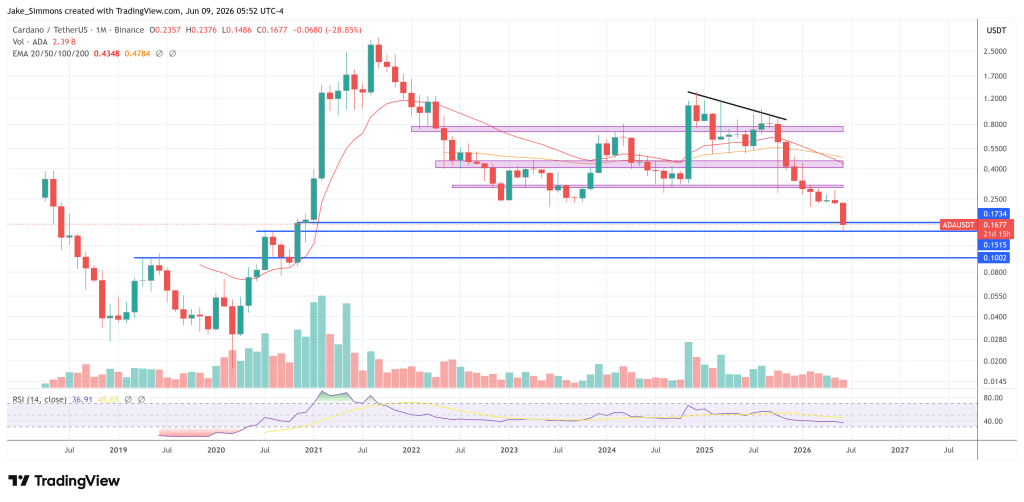
At press time, ADA traded at $0.16.

ADA hovers above key support, 1-month chart | Source: ADAUSDT on TradingView.com

Связанные с этим вопросы

QWhat is the core function of the cryptocurrency industry according to Charles Hoskinson?

AAccording to Charles Hoskinson, the core function of the cryptocurrency industry is not simply to create currencies or blockchains, but to reduce the cost of trust in global commerce.

QWhat concept did Charles Hoskinson identify as the solution to reducing the cost of trust, and what is a simplified example he used?

AHe identified 'verifiable reflexivity' as the solution, where something carries its own proof of being correct. A simplified example he used was voting, where a ballot itself would carry proof of its legitimacy instead of relying on a trusted third party.

QAccording to Hoskinson, what four requirements must a network meet to build a system for verifiable trust, and which part does he describe as the most unfinished for Cardano?

AThe four requirements are: 1) an engine of decentralization, 2) the right accounting model, 3) modular expansion of major functionality, and 4) decentralized governance capable of specialization. He described governance as the most unfinished part for Cardano.

QWhat specific technical features of Cardano did Hoskinson highlight to support its goal of reducing dependency on trusted third parties?

AHe highlighted several features: the Ouroboros protocol for scalable decentralization, the extended UTXO model to preserve local determinism, Hydra and 'channel isomorphism' for application-specific scaling, and modularity through partner chains like Midnight.

QWhat long-term market claim did Charles Hoskinson make regarding Cardano's success in building a system for verifiable trust?

AHe claimed that if Cardano succeeds in building a system for verifiable trust, the cryptocurrency (ADA) that fuels it could become 'the currency of global trust' and has 'an inevitability' to surpass Bitcoin.

Похожее

Apple's Desired On-Device AI Sees a Dark Horse Emerge: The First Cognitive Model is Born, 4B Matches GPT-5.4

A Chinese company, Tomorrow's Journey (Nextie), has introduced what it is calling the industry's first "cognitive model" for edge devices. Named New Journey Alpha, this 4-billion-parameter model reportedly matches the performance of trillion-parameter giants like GPT-5.4 in group intelligence tasks such as debate and collective decision-making. The development follows Andrej Karpathy's vision of stripping vast factual knowledge from large language models to retain only a smaller "cognitive core" capable of reasoning, planning, and knowing its own limits. This approach directly addresses the soaring computational costs and token expenses hindering AI's widespread deployment, as highlighted by incidents like Amazon shutting down an internal AI tool due to prohibitive costs. Trained via reinforcement learning on a corpus of academic papers from 1800-2020 to enhance generalization, the model enables three key advancements: 1) Improved decision quality in multi-agent systems, 2) Drastically reduced compute costs, allowing for cost-effective cloud or on-device (e.g., MacBook) deployment, and 3) The feasibility of "proactive" AI agents that act autonomously without user prompts, unlocking new commercial possibilities beyond today's reactive models. Built by the former Microsoft Xiaoice team—known for creating a 3.6B model that outperformed a 65B Llama model—the company is now focusing on the multi-agent systems sector, a field gaining significant investor interest. The model's economic impact is profound; by achieving high-level performance with minimal parameters, it fundamentally alters the cost structure of AI services, challenging the prevailing model of ever-larger parameter counts.

marsbit59 мин. назад

Apple's Desired On-Device AI Sees a Dark Horse Emerge: The First Cognitive Model is Born, 4B Matches GPT-5.4

marsbit59 мин. назад

OpenAI's 'Blueprint for the Future': Making AI Beneficial for Every Person on the Planet

A new transformative technology emerges every few generations. OpenAI draws a parallel with the advent of electricity in the 1920s, which initially brought convenience but ultimately enabled unprecedented progress in medicine, engineering, and living standards by empowering people to create new possibilities. AI is poised to recreate this phenomenon. Its true significance lies not in the technology itself, but in what people can achieve with it—from understanding a medical bill or starting a business to aiding scientific discovery. OpenAI believes AI should be universally accessible, allowing everyone to use it according to their own needs. This future, however, is not guaranteed. While transformative tech can centralize power, OpenAI's philosophy is that AI must serve humanity, augmenting human capabilities and broadly distributing its benefits. The company's first commitment is to build AI for human service, aiming to empower the many rather than concentrate power in a few. Safety, alignment with human intent, and oversight are paramount. OpenAI is optimistic about AI's potential to expand human welfare but remains clear-eyed about risks. The goal is to help people achieve more, not to replace them. Full automation is not the desired future; human judgment, values, and direction will become even more critical. OpenAI outlines three core goals: 1. Build automated AI researchers to accelerate and increasingly automate the research process itself, maintaining close human collaboration. The internal projection is that by March 2028, a significant portion of their research will be conducted by AI systems working alongside human researchers. 2. Accelerate economic development by advancing science, boosting productivity, and fostering growth, while ensuring the fruits are widely shared. 3. Provide a personal AGI for everyone on Earth, allowing individuals to benefit from this transformative technology in their own way. The company is entering its third phase, moving from foundational AGI research (Phase 1) to product deployment and learning from real-world use (Phase 2). The current challenge is making advanced AI abundant, affordable, safe, practical, and usable for all individuals and organizations. OpenAI concludes that a widely distributed power structure leads to a more resilient, adaptable, and free society. A positive AI future should not be controlled by a handful of entities but built, benefited from, and owned by many. If realized correctly, AI can become a cornerstone for enhancing global productivity, creativity, scientific advancement, and economic opportunity, fulfilling the mission to ensure AGI benefits all of humanity.

marsbit1 ч. назад

OpenAI's 'Blueprint for the Future': Making AI Beneficial for Every Person on the Planet

marsbit1 ч. назад

Arthur Hayes' New Article: AI Bubble Nears Bursting, Crypto Market Faces Short-Term Pressure

In a new essay, Arthur Hayes argues that the AI market bubble is approaching a rupture, which will place significant short-term pressure on crypto assets. He identifies rising oil prices, a trio of massive tech IPOs (SpaceX, Anthropic, OpenAI), and potential anti-AI political rhetoric from Trump as the three key catalysts for a correction. Hayes posits that the prolonged blockage of the Strait of Hormuz will drive energy prices higher, increasing operational costs for data centers and squeezing AI company profits. Simultaneously, the market may struggle to absorb the upcoming wave of multi-trillion dollar tech IPOs. Furthermore, with high inflation hurting his election chances, Trump could pivot to attacking the AI sector with proposals for heavy taxation and regulation to win over voters, spooking the market. Hayes notes that nearly all new dollar liquidity since 2022 has flowed into the AI sector, leaving little for Bitcoin, explaining its recent underperformance. He believes an AI stock crash would trigger a broad risk-off sentiment and credit contraction, dragging down crypto in the near term. Consequently, his fund, Maelstrom, has sold all AI-related stocks and non-core cryptocurrencies, retaining only Bitcoin and Ethereum while building positions in traditional energy stocks. He anticipates Bitcoin will bottom and resume its bull run only after the AI bubble pops and a new monetary easing cycle begins.

marsbit1 ч. назад

Arthur Hayes' New Article: AI Bubble Nears Bursting, Crypto Market Faces Short-Term Pressure

marsbit1 ч. назад

Торговля

Спот
Фьючерсы

Популярные статьи

Тест по Bitcoin Биткоина

HTX Learn: Изучите Bitcoin halving и Заработаете Токены USDT

3.1k просмотров всегоОпубликовано 2024.04.16Обновлено 2024.04.16

Тест по Bitcoin  Биткоина

Что такое $BITCOIN

ЦИФРОВОЕ ЗОЛОТО ($BITCOIN): Комплексный анализ Введение в ЦИФРОВОЕ ЗОЛОТО ($BITCOIN) ЦИФРОВОЕ ЗОЛОТО ($BITCOIN) — это проект на основе блокчейна, работающий в сети Solana, который стремится объединить характеристики традиционных драгоценных металлов с инновациями децентрализованных технологий. Хотя он носит имя Биткойн, часто называемого “цифровым золотом” из-за его восприятия как средства хранения ценности, ЦИФРОВОЕ ЗОЛОТО является отдельным токеном, предназначенным для создания уникальной экосистемы в ландшафте Web3. Его цель — позиционировать себя как жизнеспособный альтернативный цифровой актив, хотя детали его применения и функциональности все еще развиваются. Что такое ЦИФРОВОЕ ЗОЛОТО ($BITCOIN)? ЦИФРОВОЕ ЗОЛОТО ($BITCOIN) — это токен криптовалюты, специально разработанный для использования в блокчейне Solana. В отличие от Биткойна, который выполняет широко признанную роль хранения ценности, этот токен, похоже, сосредоточен на более широких приложениях и характеристиках. Примечательные аспекты включают: Инфраструктура блокчейна: Токен построен на блокчейне Solana, известном своей способностью обрабатывать высокоскоростные и недорогие транзакции. Динамика предложения: ЦИФРОВОЕ ЗОЛОТО имеет максимальное предложение, ограниченное 100 квадриллионами токенов (100P $BITCOIN), хотя детали о его обращающемся предложении в настоящее время не раскрыты. Утилита: Хотя точные функциональные возможности не описаны, есть указания на то, что токен может быть использован для различных приложений, потенциально связанных с децентрализованными приложениями (dApps) или стратегиями токенизации активов. Кто создатель ЦИФРОВОГО ЗОЛОТА ($BITCOIN)? На данный момент личность создателей и команды разработчиков, стоящих за ЦИФРОВЫМ ЗОЛОТОМ ($BITCOIN), остается неизвестной. Эта ситуация типична для многих инновационных проектов в области блокчейна, особенно тех, которые связаны с децентрализованными финансами и феноменом мем-криптовалют. Хотя такая анонимность может способствовать культуре, ориентированной на сообщество, она усиливает опасения по поводу управления и ответственности. Кто инвесторы ЦИФРОВОГО ЗОЛОТА ($BITCOIN)? Доступная информация указывает на то, что у ЦИФРОВОГО ЗОЛОТА ($BITCOIN) нет известных институциональных спонсоров или значительных венчурных капиталовложений. Проект, похоже, функционирует по модели пирингового взаимодействия, сосредоточенной на поддержке и принятии сообществом, а не на традиционных путях финансирования. Его активность и ликвидность в основном сосредоточены на децентрализованных биржах (DEX), таких как PumpSwap, а не на устоявшихся централизованных торговых платформах, что еще больше подчеркивает его подход, ориентированный на grassroots. Как работает ЦИФРОВОЕ ЗОЛОТО ($BITCOIN) Операционные механизмы ЦИФРОВОГО ЗОЛОТА ($BITCOIN) можно подробно описать на основе его дизайна блокчейна и характеристик сети: Механизм консенсуса: Используя уникальный механизм доказательства истории (PoH) Solana в сочетании с моделью доказательства доли (PoS), проект обеспечивает эффективную валидацию транзакций, что способствует высокой производительности сети. Токеномика: Хотя конкретные дефляционные механизмы не были подробно описаны, большое максимальное предложение токенов подразумевает, что оно может быть предназначено для микротранзакций или нишевых случаев использования, которые еще предстоит определить. Интероперабельность: Существует потенциал для интеграции с более широкой экосистемой Solana, включая различные платформы децентрализованных финансов (DeFi). Однако детали относительно конкретных интеграций остаются неуточненными. Хронология ключевых событий Вот хронология, которая подчеркивает значимые вехи, касающиеся ЦИФРОВОГО ЗОЛОТА ($BITCOIN): 2023: Первоначальное развертывание токена происходит в блокчейне Solana, отмеченное его адресом контракта. 2024: ЦИФРОВОЕ ЗОЛОТО приобретает видимость, когда оно становится доступным для торговли на децентрализованных биржах, таких как PumpSwap, позволяя пользователям обменивать его на SOL. 2025: Проект наблюдает спорадическую торговую активность и потенциальный интерес к инициативам, возглавляемым сообществом, хотя на данный момент не зафиксировано никаких значительных партнерств или технических достижений. Критический анализ Сильные стороны Масштабируемость: Основная инфраструктура Solana поддерживает высокие объемы транзакций, что может повысить полезность $BITCOIN в различных сценариях транзакций. Доступность: Потенциально низкая цена торговли за токен может привлечь розничных инвесторов, способствуя более широкому участию благодаря возможностям дробного владения. Риски Отсутствие прозрачности: Отсутствие публично известных спонсоров, разработчиков или процесса аудита может вызвать скептицизм относительно устойчивости и надежности проекта. Волатильность рынка: Торговая активность сильно зависит от спекулятивного поведения, что может привести к значительной волатильности цен и неопределенности для инвесторов. Заключение ЦИФРОВОЕ ЗОЛОТО ($BITCOIN) является интригующим, но неоднозначным проектом в быстро развивающейся экосистеме Solana. Хотя он пытается использовать нарратив “цифрового золота”, его отход от установленной роли Биткойна как средства хранения ценности подчеркивает необходимость более четкого различения его предполагаемой утилиты и структуры управления. Будущее принятие и усвоение, вероятно, будут зависеть от решения текущей непрозрачности и более четкого определения его операционных и экономических стратегий. Примечание: Этот отчет охватывает синтезированную информацию, доступную на октябрь 2023 года, и с тех пор могут произойти события.

99 просмотров всегоОпубликовано 2025.05.13Обновлено 2025.05.13

Что такое $BITCOIN

Fractal Bitcoin: масштабирование Биткоина с помощью рекурсивной системы

Fractal Bitcoin — масштабное Layer-1-решнение, созданное на базе кода Биткоина, позволяющего достигать бесконечного масштабирования с помощью рекурсивного подхода.

2.3k просмотров всегоОпубликовано 2025.06.30Обновлено 2025.06.30

Fractal Bitcoin: масштабирование Биткоина с помощью рекурсивной системы

Обсуждения

Добро пожаловать в Сообщество HTX. Здесь вы сможете быть в курсе последних новостей о развитии платформы и получить доступ к профессиональной аналитической информации о рынке. Мнения пользователей о цене на BTC (BTC) представлены ниже.

活动图片