Global Top 10 Assets Reshuffle in 2025: Why Has Bitcoin Lost Its Shine?

marsbitОпубликовано 2026-01-05Обновлено 2026-01-05

Введение

In 2025, global asset markets experienced significant shifts, with traditional hard assets like gold and silver dominating while Bitcoin underperformed. Gold surged over 65% to approximately $43,100 per ounce, reaching a theoretical market cap of $30 trillion, while silver rose 150% to $72, driven by geopolitical tensions, inflation, and industrial demand from AI and solar sectors. Major AI-related tech stocks like Nvidia and TSMC saw solid gains but entered a consolidation phase. Bitcoin, despite briefly hitting $126,000 mid-year, ended 2025 around $88,000 with an 8% annual loss—marking its first negative post-halving year. Key factors included macro liquidity tightening, increased correlation with equities, large-scale selling by long-term holders, excessive leverage unwinding ($30 billion in derivatives), and slowing institutional inflows, especially from ETFs in Q4. Looking ahead to 2026, analysts remain broadly optimistic. Institutions like J.P. Morgan, Standard Chartered, and Bernstein project targets between $140,000 and $170,000, citing potential ETF-driven demand, regulatory clarity, and macro improvements. However, skeptics like Bloomberg’s Mike McGlone warn of a possible drop to $50,000 or lower due to speculative risks. Overall, 2026 is seen as a potential rebound year for Bitcoin, contingent on macro conditions and institutional adoption.

Author:zhou, ChainCatcher

2025 was a year of dramatic divergence in the global asset markets.

Geopolitical conflicts, recurring inflation,AI technology breakthroughs, and massive central bank purchases drove a strong comeback for traditional hard assets, while cryptocurrencies came under pressure in the tug-of-war between institutional expectations and macroeconomic realities.

2025 Changes in the Global Top 10 Assets: Gold Dominates, Silver Rises, Bitcoin Rallies Then Falls

According to CompaniesMarketCap data, the ranking of the global top 10 assets in2025 showed profound structural adjustments. Gold led the pack with a theoretical market cap of approximately $30 trillion, while silver's market cap approached $4 trillion, securing a spot in the top three. Tech stocks occupied the middle of the rankings, while Bitcoin's market cap was around $1.8 trillion, slipping to eighth place.
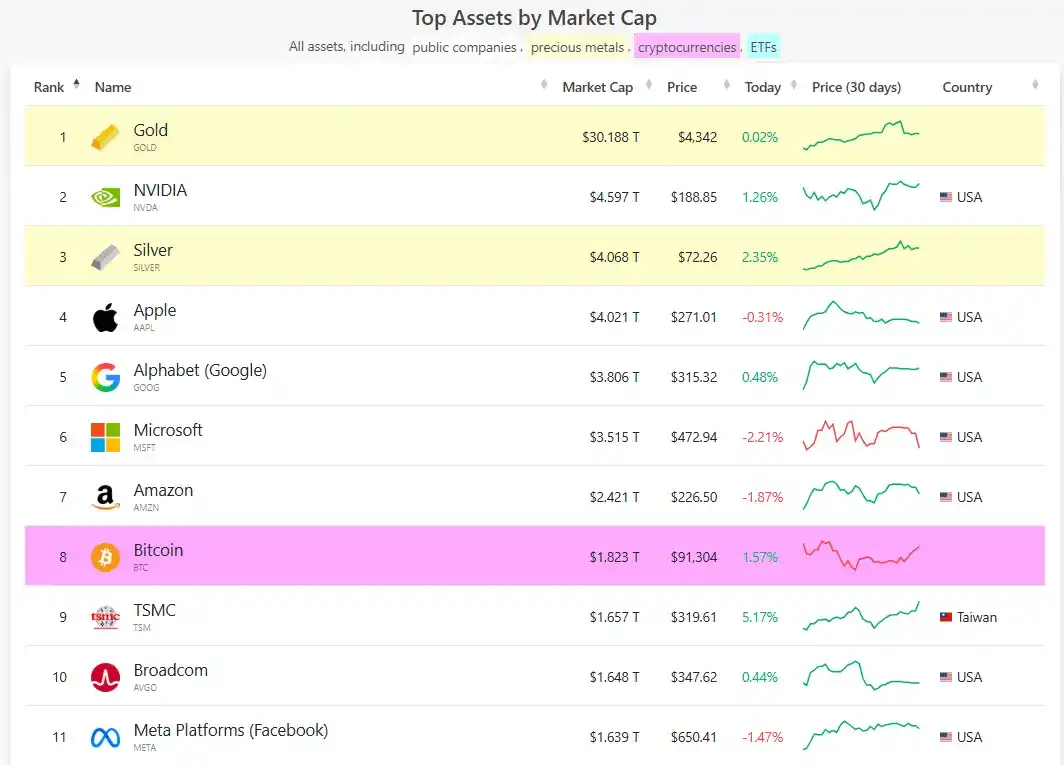

Hard Assets Gold and Silver Dominated the Year's Narrative

As the king of safe havens, the gold price soared from $2,630 at the beginning of the year to $4,310 by year-end, a gain of over65% , the largest in46 years. Driven by central bank purchases and geopolitical避险, its market cap nearly doubled and crushed the combined value of all listed companies. Silver became the year's biggest dark horse, its price surging from $29 at the start of the year to $72, a150% gain that far outpaced gold. Beyond its safe-haven属性, explosive growth in industrial demand from photovoltaics andAI computing power propelled silver from a peripheral asset强势into the global top three.

AI -Related Tech Stocks Were Strong But Entered a Digestion Phase

NVIDIA, as the chip leader, saw its market cap grow30% to $4.6 trillion, briefly surpassing the $5 trillion mark during the year. TSMC and Broadcom benefited from computing power demand, with their market caps both rising from $1 trillion to $1.6 trillion, gains of around60%. Although the AI sector overall hit record highs, the growth rate became more moderate, reflecting a more cautious market assessment of productivity realization.

Bitcoin Rallied Then Fell, Relatively Weak

Although Bitcoin briefly surged to $126,000 mid-year, with its market cap temporarily breaking into the global top five, a flash crash and volatility in the fourth quarter brought its year-end price back to around $88,000. With a negative return of approximately8% for the year, this marked the first time Bitcoin recorded a negative return in the year following a halving cycle.

Legacy Tech Giants Performed Steadily But Largely Lacked Explosiveness

Alphabet recorded a52% gain thanks to the integration of Gemini AI, its market cap rising to $3.8 trillion. The gains for Amazon, Microsoft, and Apple ranged between14% and33% . Although they maintained dominance in search, cloud computing, and consumer electronics, overall growth had significantly slowed.Meta saw its market cap increase to $1.67 trillion, driven by its Llama model and record engagement on its social platforms, fiercely competing with Broadcom for the tenth spot at year-end.

It is worth noting that in the 2025 asset ranking reshuffle, several traditional giants were squeezed out of the top ten. Among them, Eli Lilly, which had previously led due to the weight-loss drug boom, saw its gains slow due to the siphoning effect of the AI theme, falling to around 15th place. Additionally, companies like Tesla and Saudi Aramco were接近or briefly entered the top ten early in the year but fell to positions 15-20 by year-end, affected by intensified EV competition, oil price volatility, and the explosive growth of tech/precious metal assets. These changes highlight the structural shift of global capital towards AI computing infrastructure and hard asset避险demand.

Overall, the turning point in the global asset market in 2025 was the suppression of tech stocks by the market cap of hard assets. Tech stocks faced bubble concerns at historical highs, while Bitcoin experienced a shift from狂热to fatigue in its high-open, low-close performance, becoming a relative loser for the year.

Why Did Bitcoin Underperform? Narrative Shift from狂热to Fatigue

Bitcoin's performance in 2025 was typically characterized by a rise followed by a fall. At the beginning of the year, driven by pro-crypto policy expectations, massive institutionalETF inflows, and macro easing policies, its price started from the $90,000 level and reached a historical high of $126,000 in October, with its market cap briefly exceeding $2.4 trillion.

However, the situation changed急剧in the fourth quarter, with a severe flash crash pushing the price down to a low of $84,000. Bitcoin最终closed the year at around $88,000, recording a negative return of approximately8% . Compared to gold's70% and silver's over140% gains, Bitcoin's relative weakness reflected its vulnerability in a complex macro environment.

This performance was caused by multiple factors.

First, macro liquidity tightening and pressure from capital reallocation. The Fed's pace of interest rate cuts in the second half of the year fell short of expectations, coupled with the Bank of Japan maintaining its hiking stance, leading to tighter global liquidity. Capital was forced to withdraw from high-volatility assets and flow into safe-haven assets like gold and silver or productivity-oriented equity markets. Meanwhile, Bitcoin's correlation with US stocks surged from0.23 at the beginning of the year to over0.86 by year-end, gradually losing its appeal as an independent allocation asset.

Second, selling by long-term holders and leverage liquidation amplified market volatility. In 2025, the old whale group sold a record1.6 million Bitcoins, creating sustained selling pressure. The flash crash on October 10th wiped out months of gains in a very short time, triggering a chain reaction in the derivatives market.Matrixport pointed out that since the阶段性high in October 2025, nearly $30 billion in leverage corresponding to the open interest规模of BTC and ETH futures has been liquidated. Over-leveraging made it difficult for the market to quickly restore confidence after the暴跌.

Furthermore, the slowdown in institutional adoption progress further exacerbated the downward pressure. Although BitcoinETF maintained net inflows for the year, tens of billions of dollars were withdrawn in the fourth quarter. The strength of corporate acquisitions was also significantly limited. As the stock prices of some companies holding digital assets (DAT) fell, the market saw阶段性Bitcoin selling行为. The cooling of institutional sentiment directly suppressed market performance at year-end, preventing Bitcoin from continuing its past glory in 2025.

Bitcoin's Future?

Although Bitcoin recorded a negative return in 2025 and broke the traditional four-year cycle expectation, consensus at the institutional level remains optimistic. The market generally believes that this year's deep adjustment is paving the way for a more sustainable, institutionally-driven bull market in the future.

As 2026 arrives, with gradual improvement in global macro liquidity and further clarification of the regulatory environment, Bitcoin is expected to end the current period of震荡and return to a growth trajectory, potentially even challenging new historical levels.

According to summaries from various media, current public predictions show that analysts likeTom Lee, Standard Chartered, and Bernstein are generally bullish, but there are divergences.

Mainstream price targets mostly fall between $140,000 and $170,000, for example:

J.P. Morgan , based on a volatility-adjusted gold ratio model, calculated a theoretical fair value of approximately $170,000, believing Bitcoin still has significant upside potential.

Standard Chartered and Bernstein set their year-end 2026 targets at around $150,000, emphasizing structural support from ETF inflows, slowed corporate treasury adoption, and the long-term inflow of institutional capital will dominate the cycle.

Grayscale defines 2026 as the dawn of the institutional era, expecting Bitcoin to set new historical highs in the first half of the year, ending the traditional four-year cycle and shifting to a steady uptrend driven by sustained institutional demand.

Bitwise believes ETFs will absorb over 100% of the new supply, further strengthening price support, and predicts 2026 will belong to the bulls. Citi's baseline scenario is $143,000, with a bull scenario reaching $189,000.

Beyond these mainstream views, there are more激进perspectives. For example,Cardano founder Charles Hoskinson expects the Bitcoin price to reach $250,000, citing the powerful thrust from Bitcoin's fixed supply and growing institutional demand.

However, there are also significant bearish voices.Bloomberg Intelligence 's Mike McGlone is the most pessimistic, suggesting that in a deflationary macro environment, Bitcoin could fall back to $50,000 or even $10,000, particularly emphasizing the mean reversion risk faced by speculative assets.

Matrixport believes 2026 will be a year of high volatility rather than a smooth trend. Influenced by the Fed leadership transition, a疲软labor market, and election-year policy risks, the market will face密集risk event windows. The firm提醒investors to maintain flexibility and actively manage positions, precisely把握market exposure around key policy events.

Overall, although预测data shows significant divergence, mainstream institutions generally agree that 2026 will be a year of structural rebound for Bitcoin.ETF as a permanent demand engine, regulatory clarity, and accelerated corporate/institutional allocation will be the core catalysts. In the short term, the Bitcoin price may bottom out in the $80,000 to $100,000 range, but the probability of an upward breakout is significantly increasing as the macro environment turns and capital flows back.

Click to learn about open positions at ChainCatcher

Связанные с этим вопросы

QWhat were the top three assets by market capitalization in 2025, according to the article?

AAccording to the article, the top three assets by market capitalization in 2025 were: 1. Gold (with a theoretical market cap of approximately $30 trillion), 2. Silver (approaching $4 trillion), and 3. Nvidia (with a market cap of $4.6 trillion).

QWhy did Bitcoin underperform in 2025, recording a negative return for the year?

ABitcoin underperformed due to several factors: a tightening of global macro liquidity leading to capital outflows from high-volatility assets, record selling by long-term holders ('whales') creating supply pressure, a flash crash in Q4 that triggered massive liquidations in the derivatives market, and a slowdown in institutional adoption with net outflows from Bitcoin ETFs in the fourth quarter.

QWhat was the primary reason for the massive surge in the price and market cap of silver in 2025?

AThe massive 150% surge in silver's price was driven not only by its safe-haven属性 but also by explosive growth in demand from the photovoltaic (solar) industry and AI computing power, which are industrial uses for the metal.

QWhat is the general consensus among major institutional analysts (like J.P. Morgan, Standard Chartered) regarding Bitcoin's price target for 2026?

AThe general consensus among major institutional analysts is optimistic, with mainstream price targets for the end of 2026 falling in the range of $140,000 to $170,000. They cite reasons such as continued ETF inflows, clearer regulations, and long-term institutional capital adoption as key catalysts.

QWhich analyst provided the most pessimistic outlook for Bitcoin in 2026, and what was their prediction?

AMike McGlone from Bloomberg Intelligence provided the most pessimistic outlook. He suggested that in a deflationary macro environment, Bitcoin could fall back to $50,000 or even $10,000, emphasizing the mean reversion risk for speculative assets.

Похожее

The Right Way to Use Skills: 5 Reflections After Anthropic Publicly Shared Its Internal Methodology

A deep dive into Anthropic's internal methodology for building effective AI "Skills" reveals five key insights for maximizing their value. First, Skills should focus on capturing "Gotchas" and tacit organizational knowledge—like common pitfalls and undocumented rules—rather than restating general information the AI already knows. Second, think of Skills as a form of "Context Engineering"; they are best structured as folders, not monolithic documents. A core `SKILL.md` file should act as a navigational index, progressively pulling in detailed references, examples, and assets only as needed to avoid overwhelming the model's context window. Third, whenever possible, automate repetitive tasks with scripts. This preserves the model's reasoning capacity for judgment and analysis, while scripts reliably handle the execution, saving tokens and improving accuracy. Instructions within a Skill provide the "why" and the expert judgment, while scripts provide the concrete "how." Fourth, a Skill's description is critical and often misunderstood. It should not be a list of features but a routing rule that clearly signals *when* the Skill should be triggered based on user intent and common phrasing. Finally, as Skills scale from personal tools to team-wide assets, management is crucial. Anthropic advocates for a lightweight, organic approach: let new Skills spread organically within small groups first. Those that prove genuinely useful through adoption naturally graduate to a formal marketplace, ensuring the curated library contains only high-value, battle-tested tools.

marsbit6 мин. назад

The Right Way to Use Skills: 5 Reflections After Anthropic Publicly Shared Its Internal Methodology

marsbit6 мин. назад

Vying for the AI Payment Track: Traditional Card Networks Face Off Against Coinbase

As AI agents increasingly conduct commercial transactions, a battle for control over the underlying payment infrastructure is unfolding. The competition centers on two divergent and incompatible technical approaches for autonomous AI payments. One camp, led by traditional card networks Visa and Mastercard, relies on tokenized card credentials within the established banking rails. Visa's "Intelligent Commerce" and Mastercard's "Agent Pay" services extend their existing tokenization technology to authorized AI agents for consumer retail transactions, leveraging decades of fraud protection and dispute resolution systems. Their partners include major AI firms like Anthropic, OpenAI, and Microsoft. The opposing camp, spearheaded by Coinbase, advocates for an open internet protocol using stablecoins. Coinbase's x402 protocol utilizes the HTTP 402 status code to enable direct, machine-to-machine micropayments with USDC on-chain. This model eliminates card fees and is designed for high-frequency, low-value transactions between AI agents, such as paying for API calls or data streams, where traditional card costs are prohibitive. Currently, application scenarios are clearly divided. Mainstream consumer-facing AI shopping services (e.g., ChatGPT's "one-click checkout," Amazon's AI-assisted shopping) predominantly use card channels due to their mature consumer protections and merchant networks. Conversely, the stablecoin channel dominates machine-to-machine payments, as seen in Amazon Bedrock's core payment service using Base blockchain. Significantly, traditional card networks are not solely defending their turf; they are also investing in the stablecoin arena. Visa has rapidly expanded its stablecoin settlement volume and partnered with Coinbase on interoperability, while Mastercard moved to acquire stablecoin platform BVNK. This dual-strategy indicates their intent to become the fee-collecting gateway for all payment flows, regardless of the underlying rail. The short-term outlook is for coexistence: cards for personal retail, stablecoins for machine transactions. The long-term outcome hinges on whether AI-driven commerce will resemble traditional retail or evolve into a vast network of machine micropayments. Visa and Mastercard's hedging strategy suggests they are prepared for either future, while companies betting on a single channel face greater risk.

Foresight News8 мин. назад

Vying for the AI Payment Track: Traditional Card Networks Face Off Against Coinbase

Foresight News8 мин. назад

For the First Time, Pure Human Video Pretrained VLA for Dexterous Manipulation: Deployable with Minimal Fine-Tuning Data

For the first time, a purely human-video-pretrained Vision-Language-Action (VLA) model for dexterous manipulation requires only a small amount of data for fine-tuning to achieve successful real-world deployment. Achieving human-level dexterous manipulation remains a core challenge in robotics. While multi-fingered hands offer hardware potential, Visual-Language-Action (VLA) models lag behind due to the high cost of collecting diverse, high-quality robot data. A novel framework, VITRA, developed by Microsoft Research Asia and Tsinghua University, addresses this by automatically transforming massive, unlabeled real-world human activity videos into a structured V-L-A training dataset. Key innovations include precise 3D hand motion annotation from monocular video, atomic action segmentation based on hand-speed minima, and automated instruction generation using VLMs combined with 3D trajectory visualization. This process created a massive dataset of 1 million clips. Pretrained exclusively on this human video data, the VLA model (combining a VLM backbone with a Diffusion Transformer action expert) demonstrates strong zero-shot hand motion prediction in unseen environments. Crucially, it requires minimal fine-tuning (~1.2k demonstrations) on real robot data to achieve high-success-rate dexterous manipulation tasks like grasping, placing, pouring, and sweeping on hardware like the Realman robot with the XHAND1 dexterous hand. The model shows exceptional generalization to novel objects and environments. The research also observes promising scaling behavior, where performance improves with more pretraining data, paving the way for more generalized embodied intelligence.

marsbit18 мин. назад

For the First Time, Pure Human Video Pretrained VLA for Dexterous Manipulation: Deployable with Minimal Fine-Tuning Data

marsbit18 мин. назад

Торговля

Спот
Фьючерсы

Популярные статьи

Тест по Bitcoin Биткоина

HTX Learn: Изучите Bitcoin halving и Заработаете Токены USDT

3.1k просмотров всегоОпубликовано 2024.04.16Обновлено 2024.04.16

Тест по Bitcoin  Биткоина

Что такое $BITCOIN

ЦИФРОВОЕ ЗОЛОТО ($BITCOIN): Комплексный анализ Введение в ЦИФРОВОЕ ЗОЛОТО ($BITCOIN) ЦИФРОВОЕ ЗОЛОТО ($BITCOIN) — это проект на основе блокчейна, работающий в сети Solana, который стремится объединить характеристики традиционных драгоценных металлов с инновациями децентрализованных технологий. Хотя он носит имя Биткойн, часто называемого “цифровым золотом” из-за его восприятия как средства хранения ценности, ЦИФРОВОЕ ЗОЛОТО является отдельным токеном, предназначенным для создания уникальной экосистемы в ландшафте Web3. Его цель — позиционировать себя как жизнеспособный альтернативный цифровой актив, хотя детали его применения и функциональности все еще развиваются. Что такое ЦИФРОВОЕ ЗОЛОТО ($BITCOIN)? ЦИФРОВОЕ ЗОЛОТО ($BITCOIN) — это токен криптовалюты, специально разработанный для использования в блокчейне Solana. В отличие от Биткойна, который выполняет широко признанную роль хранения ценности, этот токен, похоже, сосредоточен на более широких приложениях и характеристиках. Примечательные аспекты включают: Инфраструктура блокчейна: Токен построен на блокчейне Solana, известном своей способностью обрабатывать высокоскоростные и недорогие транзакции. Динамика предложения: ЦИФРОВОЕ ЗОЛОТО имеет максимальное предложение, ограниченное 100 квадриллионами токенов (100P $BITCOIN), хотя детали о его обращающемся предложении в настоящее время не раскрыты. Утилита: Хотя точные функциональные возможности не описаны, есть указания на то, что токен может быть использован для различных приложений, потенциально связанных с децентрализованными приложениями (dApps) или стратегиями токенизации активов. Кто создатель ЦИФРОВОГО ЗОЛОТА ($BITCOIN)? На данный момент личность создателей и команды разработчиков, стоящих за ЦИФРОВЫМ ЗОЛОТОМ ($BITCOIN), остается неизвестной. Эта ситуация типична для многих инновационных проектов в области блокчейна, особенно тех, которые связаны с децентрализованными финансами и феноменом мем-криптовалют. Хотя такая анонимность может способствовать культуре, ориентированной на сообщество, она усиливает опасения по поводу управления и ответственности. Кто инвесторы ЦИФРОВОГО ЗОЛОТА ($BITCOIN)? Доступная информация указывает на то, что у ЦИФРОВОГО ЗОЛОТА ($BITCOIN) нет известных институциональных спонсоров или значительных венчурных капиталовложений. Проект, похоже, функционирует по модели пирингового взаимодействия, сосредоточенной на поддержке и принятии сообществом, а не на традиционных путях финансирования. Его активность и ликвидность в основном сосредоточены на децентрализованных биржах (DEX), таких как PumpSwap, а не на устоявшихся централизованных торговых платформах, что еще больше подчеркивает его подход, ориентированный на grassroots. Как работает ЦИФРОВОЕ ЗОЛОТО ($BITCOIN) Операционные механизмы ЦИФРОВОГО ЗОЛОТА ($BITCOIN) можно подробно описать на основе его дизайна блокчейна и характеристик сети: Механизм консенсуса: Используя уникальный механизм доказательства истории (PoH) Solana в сочетании с моделью доказательства доли (PoS), проект обеспечивает эффективную валидацию транзакций, что способствует высокой производительности сети. Токеномика: Хотя конкретные дефляционные механизмы не были подробно описаны, большое максимальное предложение токенов подразумевает, что оно может быть предназначено для микротранзакций или нишевых случаев использования, которые еще предстоит определить. Интероперабельность: Существует потенциал для интеграции с более широкой экосистемой Solana, включая различные платформы децентрализованных финансов (DeFi). Однако детали относительно конкретных интеграций остаются неуточненными. Хронология ключевых событий Вот хронология, которая подчеркивает значимые вехи, касающиеся ЦИФРОВОГО ЗОЛОТА ($BITCOIN): 2023: Первоначальное развертывание токена происходит в блокчейне Solana, отмеченное его адресом контракта. 2024: ЦИФРОВОЕ ЗОЛОТО приобретает видимость, когда оно становится доступным для торговли на децентрализованных биржах, таких как PumpSwap, позволяя пользователям обменивать его на SOL. 2025: Проект наблюдает спорадическую торговую активность и потенциальный интерес к инициативам, возглавляемым сообществом, хотя на данный момент не зафиксировано никаких значительных партнерств или технических достижений. Критический анализ Сильные стороны Масштабируемость: Основная инфраструктура Solana поддерживает высокие объемы транзакций, что может повысить полезность $BITCOIN в различных сценариях транзакций. Доступность: Потенциально низкая цена торговли за токен может привлечь розничных инвесторов, способствуя более широкому участию благодаря возможностям дробного владения. Риски Отсутствие прозрачности: Отсутствие публично известных спонсоров, разработчиков или процесса аудита может вызвать скептицизм относительно устойчивости и надежности проекта. Волатильность рынка: Торговая активность сильно зависит от спекулятивного поведения, что может привести к значительной волатильности цен и неопределенности для инвесторов. Заключение ЦИФРОВОЕ ЗОЛОТО ($BITCOIN) является интригующим, но неоднозначным проектом в быстро развивающейся экосистеме Solana. Хотя он пытается использовать нарратив “цифрового золота”, его отход от установленной роли Биткойна как средства хранения ценности подчеркивает необходимость более четкого различения его предполагаемой утилиты и структуры управления. Будущее принятие и усвоение, вероятно, будут зависеть от решения текущей непрозрачности и более четкого определения его операционных и экономических стратегий. Примечание: Этот отчет охватывает синтезированную информацию, доступную на октябрь 2023 года, и с тех пор могут произойти события.

99 просмотров всегоОпубликовано 2025.05.13Обновлено 2025.05.13

Что такое $BITCOIN

Fractal Bitcoin: масштабирование Биткоина с помощью рекурсивной системы

Fractal Bitcoin — масштабное Layer-1-решнение, созданное на базе кода Биткоина, позволяющего достигать бесконечного масштабирования с помощью рекурсивного подхода.

2.3k просмотров всегоОпубликовано 2025.06.30Обновлено 2025.06.30

Fractal Bitcoin: масштабирование Биткоина с помощью рекурсивной системы

Обсуждения

Добро пожаловать в Сообщество HTX. Здесь вы сможете быть в курсе последних новостей о развитии платформы и получить доступ к профессиональной аналитической информации о рынке. Мнения пользователей о цене на BTC (BTC) представлены ниже.

活动图片















