Fidelity’s New Bitcoin Study Challenges The Traditional 60/40 Portfolio

bitcoinistОпубликовано 2026-03-26Обновлено 2026-03-26

Введение

Fidelity Digital Assets' new research argues that a zero allocation to bitcoin now requires active justification, as historical data shows BTC was the top-performing asset in 11 of the past 15 years. The report highlights bitcoin’s low correlation to traditional assets, its role as an inflation hedge, and its positive impact on risk-adjusted returns. Even small allocations (1-3%) historically improved Sharpe and Sortino ratios in a 60/40 portfolio without drastically increasing drawdowns. Fidelity questions the sustainability of traditional portfolio tailwinds, like falling rates and rich equity valuations, suggesting bitcoin offers asymmetric returns in a changing macro environment. The study does not prescribe a universal allocation but emphasizes that bitcoin can deliver material portfolio impact even from a small starting weight.

Fidelity Digital Assets has used a new research report to make a sharper institutional case for bitcoin: not that every allocator must own it, but that a zero position now needs to be actively defended. In a study published March 25, Chris Kuiper argues bitcoin’s role in portfolios can no longer be dismissed as a fringe question, especially as the assumptions behind the classic 60/40 mix come under pressure.

The report opens with an unusually direct framing. “The central question is no longer” whether bitcoin merits consideration, Fidelity says. Instead, it asks: “What is your current bitcoin allocation, and why?” For the firm’s research team, zero exposure may still be valid, but it now requires a “well-informed rationale.”

Tiny Bitcoin Exposure, Big Portfolio Impact

That argument rests first on bitcoin’s historical numbers. Fidelity says bitcoin has been the top-performing asset in 11 of the past 15 years and, over multiple time horizons, has posted the highest returns as well as the highest risk-adjusted returns among the assets it examined. The report acknowledges the familiar objection, bitcoin’s volatility remains the highest in the group, but argues that Sharpe and Sortino ratios still compare favorably, while bonds have looked particularly weak on both nominal and inflation-adjusted terms.

From there, the paper tries to move the discussion away from philosophy and into portfolio construction. Fidelity leans on bitcoin’s hard cap, its low long-term correlation to major asset classes, and its sensitivity to monetary expansion.

One of the report’s stronger macro claims is that changes in global M2 have explained 87% of BTC’s price changes over the past 15 years on an r-squared basis, though Fidelity explicitly notes that correlation does not by itself prove causation. It also argues that bitcoin and gold are similar enough to share an inflation-hedge narrative, but distinct enough to remain complementary rather than interchangeable in diversified portfolios.

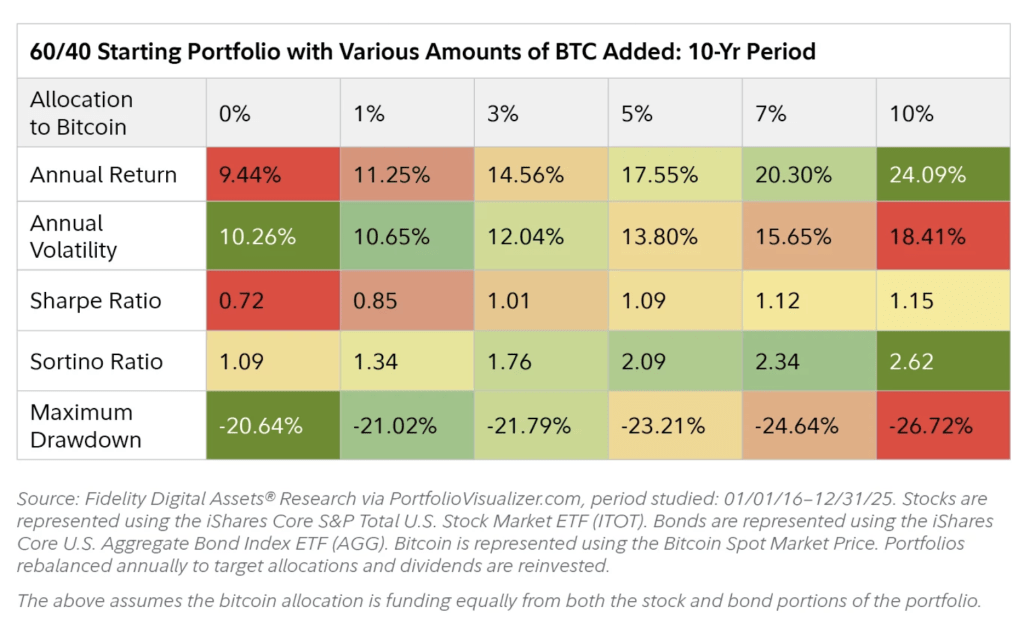
The most consequential section for allocators is the portfolio work. Using a traditional 60/40 portfolio of US stocks and aggregate US bonds as the base case, Fidelity says adding BTC would have historically lifted both annual and total returns. Volatility rose, as expected, but the report says the increase was compensated by stronger risk-adjusted returns, with the biggest improvement in Sharpe and Sortino ratios showing up when allocations moved from 1% to 3%.

60/40 portfolio with various amounts of Bitcoin | Source: Fidelity

Perhaps more notable for conservative managers, Fidelity says maximum drawdowns did not increase as dramatically as many would assume, partly because of low correlation and partly because annual rebalancing kept the bitcoin sleeve from dominating the portfolio.

Fidelity’s modeling gets more aggressive deeper in the paper. In a mean-variance optimization exercise using what it calls conservative bitcoin assumptions, 25% expected annual return and 50% volatility, against 14.5% expected equity returns and 2% for bonds, the maximum-Sharpe portfolio included 9.4% bitcoin and no bonds at all.

A separate Kelly Criterion exercise produced a 65% position size using historical annual returns, though Fidelity immediately warns that this is not an investment recommendation and notes that more conservative assumptions bring that figure down to 10%. The point is less that institutions should adopt those weights than that BTC’s asymmetric payoff profile can justify larger allocations than intuition might suggest.

That is where the report’s challenge to 60/40 becomes explicit. Fidelity argues the last decade’s strength in traditional portfolios was helped by four decades of falling rates, richening equity valuations, and repeated policy support for credit markets.

It questions whether those tailwinds are durable. On bonds, the paper points to episodes of sharp losses, rising stock-bond correlations, and the risk of negative real returns in a world of persistent debt expansion; on equities, it argues that elevated valuations may leave markets “priced for perfection” even if AI and capital-light business models support margins.

The report stops short of prescribing a universal BTC weight, but its message is clear enough. Fidelity is not presenting bitcoin as a replacement for every traditional asset or as a one-way macro hedge. It is arguing that in a world where fixed income may no longer offer the same ballast and equity valuations already reflect high expectations, even a small bitcoin allocation can produce what it calls a “material outcome” from a non-material starting weight.

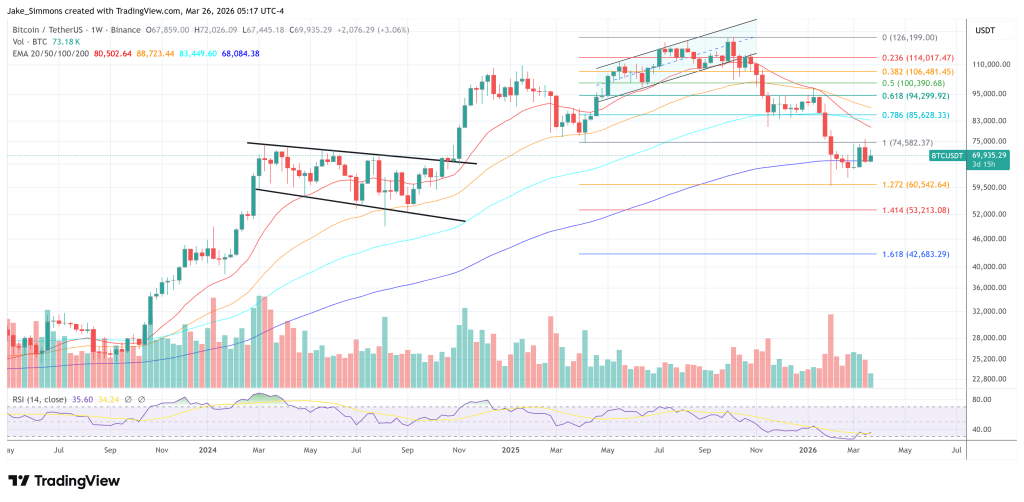
At press time; BTC traded at $69,935.

BTC must break above $74,500 1-week chart | Source: BTCUSDT on TradingView.com

Связанные с этим вопросы

QAccording to Fidelity's report, what is the new central question regarding Bitcoin allocation for institutional investors?

AThe central question is no longer whether Bitcoin merits consideration, but rather 'What is your current Bitcoin allocation, and why?'

QWhat key statistical relationship does Fidelity report between global M2 and Bitcoin's price?

AChanges in global M2 have explained 87% of BTC's price changes over the past 15 years on an r-squared basis, though Fidelity notes correlation does not prove causation.

QHow did adding Bitcoin to a traditional 60/40 portfolio affect risk-adjusted returns in Fidelity study?

AAdding Bitcoin historically lifted both annual and total returns, and the increase in volatility was compensated by stronger risk-adjusted returns, with the biggest improvement in Sharpe and Sortino ratios showing when allocations moved from 1% to 3%.

QWhat was the maximum-Sharpe portfolio allocation to Bitcoin in Fidelity's mean-variance optimization using conservative assumptions?

AThe maximum-Sharpe portfolio included 9.4% Bitcoin and no bonds at all, using conservative assumptions of 25% expected annual return and 50% volatility for Bitcoin.

QWhat three factors does Fidelity identify as having supported traditional portfolio strength in the last decade that may not be durable?

AFour decades of falling rates, richening equity valuations, and repeated policy support for credit markets.

Похожее

20 Billion Valuation, Alibaba and Tencent Competing to Invest, Whose Money Will Liang Wenfeng Take?

DeepSeek, an AI startup founded by Liang Wenfeng, is reportedly in talks with Alibaba and Tencent for an external funding round that could value the company at over $20 billion. This marks a significant shift, as DeepSeek had previously relied solely on funding from its parent company,幻方量化 (Huanfang Quantitative), and had resisted external investment. The potential valuation would place DeepSeek among the top-tier AI model companies in China, comparable to competitors like MoonDark (valued at ~$18 billion) and ahead of recently listed firms like MiniMax and Zhipu. The funding—which could range from $600 million (for a 3% stake) to $2 billion (for 10%)—is seen as a move to secure resources for model development, retain talent, and support infrastructure needs, particularly as competition in inference models and AI agents intensifies. Both Alibaba and Tencent are eager to invest, not only for financial returns but also to integrate DeepSeek into their broader AI ecosystems. However, DeepSeek’s leadership is cautious about maintaining independence and may prefer financial investors over strategic ones to avoid being locked into a specific tech ecosystem. Alternative options, such as state-backed funds, offer longer-term capital and policy support but may come with slower decision-making and potential constraints on global expansion. With competing AI firms accelerating their IPO plans, DeepSeek’s window for securing optimal terms may be narrowing. The final decision will reflect a trade-off between capital, resources, and strategic independence.

marsbit1 ч. назад

20 Billion Valuation, Alibaba and Tencent Competing to Invest, Whose Money Will Liang Wenfeng Take?

marsbit1 ч. назад

After Losing 97% of Its Market Value, iQiyi Attempts to Use AI to Forcefully Extend Its Lifespan

After losing 97% of its market value since its 2018 peak, iQiyi is aggressively pivoting to AI in a desperate attempt to survive. At its 2026 World Conference, CEO Gong Yu announced an "AI Artist Library" with over 100 virtual performers and a new AIGC platform, "NaDou Pro," promising faster production and lower costs. This shift comes as the company faces severe financial distress: its market cap sits near delisting thresholds at $1.36 billion, with significant losses, declining membership revenue, and depleted cash flow. The AI strategy has sparked controversy. Top actors have issued legal threats against unauthorized digital replicas, while in Hengdian, over 134,000 background actors are seeing their already scarce job opportunities vanish as AI replaces them for background roles. iQiyi's move represents a fundamental shift from being a high-cost content buyer to a landlord" to becoming a "platform capitalist" that transfers production risk to creators. This contrasts with competitors like Douyin (TikTok's Chinese counterpart), which is investing heavily in *real* actor-led short dramas, betting that authentic human connection retains users better than AI-generated content. The article draws a parallel to the 1920s transition to "talkies," which made cinema musicians obsolete but ultimately enriched the art form. In contrast, iQiyi's AI drive is framed not as an artistic evolution but as a cost-cutting measure that could degrade storytelling, replacing genuine human emotion with algorithmically calculated stimulation and potentially numbing audiences' capacity for empathy. The core question remains: can a company focused solely on financial survival preserve the art of storytelling?

marsbit1 ч. назад

After Losing 97% of Its Market Value, iQiyi Attempts to Use AI to Forcefully Extend Its Lifespan

marsbit1 ч. назад

Торговля

Спот
Фьючерсы

Популярные статьи

Тест по Bitcoin Биткоина

HTX Learn: Изучите Bitcoin halving и Заработаете Токены USDT

3.0k просмотров всегоОпубликовано 2024.04.16Обновлено 2024.04.16

Тест по Bitcoin  Биткоина

Что такое $BITCOIN

ЦИФРОВОЕ ЗОЛОТО ($BITCOIN): Комплексный анализ Введение в ЦИФРОВОЕ ЗОЛОТО ($BITCOIN) ЦИФРОВОЕ ЗОЛОТО ($BITCOIN) — это проект на основе блокчейна, работающий в сети Solana, который стремится объединить характеристики традиционных драгоценных металлов с инновациями децентрализованных технологий. Хотя он носит имя Биткойн, часто называемого “цифровым золотом” из-за его восприятия как средства хранения ценности, ЦИФРОВОЕ ЗОЛОТО является отдельным токеном, предназначенным для создания уникальной экосистемы в ландшафте Web3. Его цель — позиционировать себя как жизнеспособный альтернативный цифровой актив, хотя детали его применения и функциональности все еще развиваются. Что такое ЦИФРОВОЕ ЗОЛОТО ($BITCOIN)? ЦИФРОВОЕ ЗОЛОТО ($BITCOIN) — это токен криптовалюты, специально разработанный для использования в блокчейне Solana. В отличие от Биткойна, который выполняет широко признанную роль хранения ценности, этот токен, похоже, сосредоточен на более широких приложениях и характеристиках. Примечательные аспекты включают: Инфраструктура блокчейна: Токен построен на блокчейне Solana, известном своей способностью обрабатывать высокоскоростные и недорогие транзакции. Динамика предложения: ЦИФРОВОЕ ЗОЛОТО имеет максимальное предложение, ограниченное 100 квадриллионами токенов (100P $BITCOIN), хотя детали о его обращающемся предложении в настоящее время не раскрыты. Утилита: Хотя точные функциональные возможности не описаны, есть указания на то, что токен может быть использован для различных приложений, потенциально связанных с децентрализованными приложениями (dApps) или стратегиями токенизации активов. Кто создатель ЦИФРОВОГО ЗОЛОТА ($BITCOIN)? На данный момент личность создателей и команды разработчиков, стоящих за ЦИФРОВЫМ ЗОЛОТОМ ($BITCOIN), остается неизвестной. Эта ситуация типична для многих инновационных проектов в области блокчейна, особенно тех, которые связаны с децентрализованными финансами и феноменом мем-криптовалют. Хотя такая анонимность может способствовать культуре, ориентированной на сообщество, она усиливает опасения по поводу управления и ответственности. Кто инвесторы ЦИФРОВОГО ЗОЛОТА ($BITCOIN)? Доступная информация указывает на то, что у ЦИФРОВОГО ЗОЛОТА ($BITCOIN) нет известных институциональных спонсоров или значительных венчурных капиталовложений. Проект, похоже, функционирует по модели пирингового взаимодействия, сосредоточенной на поддержке и принятии сообществом, а не на традиционных путях финансирования. Его активность и ликвидность в основном сосредоточены на децентрализованных биржах (DEX), таких как PumpSwap, а не на устоявшихся централизованных торговых платформах, что еще больше подчеркивает его подход, ориентированный на grassroots. Как работает ЦИФРОВОЕ ЗОЛОТО ($BITCOIN) Операционные механизмы ЦИФРОВОГО ЗОЛОТА ($BITCOIN) можно подробно описать на основе его дизайна блокчейна и характеристик сети: Механизм консенсуса: Используя уникальный механизм доказательства истории (PoH) Solana в сочетании с моделью доказательства доли (PoS), проект обеспечивает эффективную валидацию транзакций, что способствует высокой производительности сети. Токеномика: Хотя конкретные дефляционные механизмы не были подробно описаны, большое максимальное предложение токенов подразумевает, что оно может быть предназначено для микротранзакций или нишевых случаев использования, которые еще предстоит определить. Интероперабельность: Существует потенциал для интеграции с более широкой экосистемой Solana, включая различные платформы децентрализованных финансов (DeFi). Однако детали относительно конкретных интеграций остаются неуточненными. Хронология ключевых событий Вот хронология, которая подчеркивает значимые вехи, касающиеся ЦИФРОВОГО ЗОЛОТА ($BITCOIN): 2023: Первоначальное развертывание токена происходит в блокчейне Solana, отмеченное его адресом контракта. 2024: ЦИФРОВОЕ ЗОЛОТО приобретает видимость, когда оно становится доступным для торговли на децентрализованных биржах, таких как PumpSwap, позволяя пользователям обменивать его на SOL. 2025: Проект наблюдает спорадическую торговую активность и потенциальный интерес к инициативам, возглавляемым сообществом, хотя на данный момент не зафиксировано никаких значительных партнерств или технических достижений. Критический анализ Сильные стороны Масштабируемость: Основная инфраструктура Solana поддерживает высокие объемы транзакций, что может повысить полезность $BITCOIN в различных сценариях транзакций. Доступность: Потенциально низкая цена торговли за токен может привлечь розничных инвесторов, способствуя более широкому участию благодаря возможностям дробного владения. Риски Отсутствие прозрачности: Отсутствие публично известных спонсоров, разработчиков или процесса аудита может вызвать скептицизм относительно устойчивости и надежности проекта. Волатильность рынка: Торговая активность сильно зависит от спекулятивного поведения, что может привести к значительной волатильности цен и неопределенности для инвесторов. Заключение ЦИФРОВОЕ ЗОЛОТО ($BITCOIN) является интригующим, но неоднозначным проектом в быстро развивающейся экосистеме Solana. Хотя он пытается использовать нарратив “цифрового золота”, его отход от установленной роли Биткойна как средства хранения ценности подчеркивает необходимость более четкого различения его предполагаемой утилиты и структуры управления. Будущее принятие и усвоение, вероятно, будут зависеть от решения текущей непрозрачности и более четкого определения его операционных и экономических стратегий. Примечание: Этот отчет охватывает синтезированную информацию, доступную на октябрь 2023 года, и с тех пор могут произойти события.

99 просмотров всегоОпубликовано 2025.05.13Обновлено 2025.05.13

Что такое $BITCOIN

Fractal Bitcoin: масштабирование Биткоина с помощью рекурсивной системы

Fractal Bitcoin — масштабное Layer-1-решнение, созданное на базе кода Биткоина, позволяющего достигать бесконечного масштабирования с помощью рекурсивного подхода.

2.2k просмотров всегоОпубликовано 2025.06.30Обновлено 2025.06.30

Fractal Bitcoin: масштабирование Биткоина с помощью рекурсивной системы

Обсуждения

Добро пожаловать в Сообщество HTX. Здесь вы сможете быть в курсе последних новостей о развитии платформы и получить доступ к профессиональной аналитической информации о рынке. Мнения пользователей о цене на BTC (BTC) представлены ниже.

活动图片