Everyone is MicroStrategy: When JPMorgan Starts Accepting BTC as Collateral, Will You Still Sell Your Coins?

marsbitОпубликовано 2025-12-10Обновлено 2025-12-10

Введение

The article discusses a major shift on Wall Street, where major banks like JPMorgan, Citi, and Bank of America have reportedly begun accepting Bitcoin as collateral for cash loans. This move, revealed by MicroStrategy's Michael Saylor, signifies Bitcoin's evolution into a "pristine collateral" asset, comparable to U.S. Treasuries or gold. It allows holders to access liquidity without selling their Bitcoin, avoiding capital gains taxes and maintaining exposure to potential price appreciation. This development effectively democratizes the "Buy, Borrow, Die" strategy previously accessible only to large institutions and the ultra-wealthy. It is framed as a critical step in Bitcoin's monetary evolution, enabling credit creation. A "credit flywheel" is described: rising BTC prices increase collateral value, allowing for larger loans, which can be used to purchase more assets, potentially driving prices higher. This shift also suggests a weakening of restrictive regulations like the SEC's SAB 121, transferring power from crypto-native exchanges to traditional financial institutions. The article concludes with a warning about the risks of leverage, as price drops could trigger mass, forced liquidations. It offers advice for investors: adopt a "debt mindset" to use loans for expenses while holding assets, cautiously manage loan-to-value ratios to avoid margin calls, and watch for a resurgence of regulated, compliant CeFi platforms.

Why sell your coins when you can borrow money?

This mantra, once only circulated among crypto whales, has now become the official creed of Wall Street's big six banks.

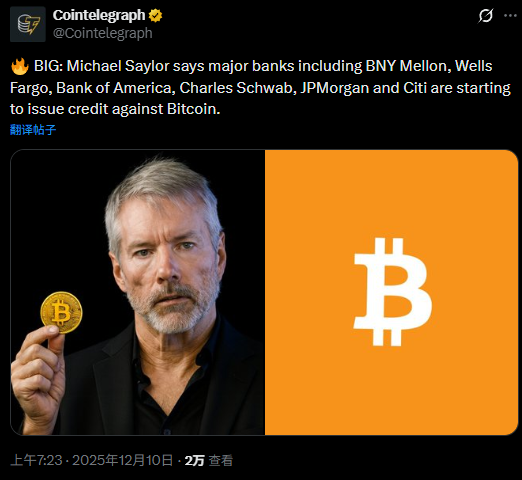
According to MicroStrategy founder Michael Saylor, top financial institutions including JPMorgan, Citi, and Bank of America have quietly launched a revolutionary business: accepting Bitcoin as collateral to provide clients with fiat currency loans.

Don't underestimate this news that didn't make the headlines. If the approval of ETFs meant Bitcoin entered Wall Street's stock accounts, then "accepting collateral" means Bitcoin has entered the core of Wall Street's balance sheets.

This is a qualitative change in monetary nature: Bitcoin is no longer just a chip for trading; it has officially gained the status of "Pristine Collateral," on par with U.S. Treasury bonds and gold. From now on, Bitcoin holders can obtain liquidity without selling a single Satoshi.

A "buy, don't sell" credit flywheel is slowly turning.


Everyone is MicroStrategy

Over the past four years, Michael Saylor has stunned the world with an almost insane strategy: issue debt to buy coins, use coins as collateral to buy more coins, issue more debt, buy more coins.

This "stepping on your own feet to spiral upwards"玩法 had one huge barrier to entry—you had to be a publicly listed company or a billionaire with an extremely high credit rating to borrow money at low interest rates. Ordinary institutions and high-net-worth individuals who wanted to exchange Bitcoin for cash often had to turn to DeFi protocols (facing the risk of contract hacks) or second-tier lending platforms (facing the risk of misuse like FTX), with high interest rates and full of uncertainty.

Now, Wall Street has broken down this barrier.

When JPMorgan and Citi start accepting BTC as collateral, it means they have standardized, productized, and合规化 Saylor's strategy.

Imagine this scenario: a family office holding 1000 BTC, which previously needed $10 million for周转, had to sell part of its Bitcoin, not only paying high capital gains taxes but also losing future upside potential. Now, it only needs to抵押 its Bitcoin to the bank to get $10 million in cash.

  • Tax-wise: A loan is not income, so it is not taxable.
  • Asset-wise: Ownership of the Bitcoin remains in its hands, and it still enjoys the benefits of price appreciation.

This is the common strategy for the wealthy class: "Buy, Borrow, Die." When this strategy is普及 by Wall Street to the entire crypto market, the logic of Bitcoin selling pressure will be completely rewritten: In this market, true diamond hands will no longer need to sell coins.


Credit Expansion: Fiat Flows In Like Water

From a macro perspective, this is also the most critical step in Bitcoin's monetization process: Credit Creation.

In the modern financial system, money is not only printed by central banks but also loaned out by commercial banks. When banks accept real estate as collateral to loan out dollars, real estate participates in the credit expansion of the dollar; when banks accept Bitcoin as collateral to loan out dollars, Bitcoin effectively becomes the anchor for the issuance of "shadow dollars."

This means the flood barrier between the Bitcoin system and the fiat system has been blown open.

In the past, pushing up the Bitcoin price required real "net inflows" of capital. Now, through抵押借贷, Bitcoin itself can create new purchasing power. You抵押 BTC to borrow dollars, and then you can use those dollars to buy more BTC (or buy a house, buy stocks).

This forms a positive Credit Flywheel: Coin price rises ->抵押物 value increases -> Loanable amount increases -> Loan out more fiat -> Buy more assets -> Coin price continues to rise.

As long as Bitcoin's long-term volatility remains controllable within the banks' risk models, this flywheel will introduce astronomical levels of fiat liquidity. This is a more ferocious catalyst than ETF inflows because ETFs are linear capital accumulation, while credit is exponential expansion with leverage.


Regulatory Acquiescence and the Demise of SAB 121

The fact that the big six banks dare to do this is itself a huge political signal.

Remember, the SEC's SAB 121 (Staff Accounting Bulletin No. 121) was once a tight curse. It required banks that custody crypto assets to record those assets on their balance sheets as liabilities, which greatly increased the banks' capital pressure and effectively prohibited banks from engaging in crypto custody.

Now, the fact that Wall Street giants are collectively launching抵押借贷 businesses indicates that SAB 121 is practically dead in terms of implementation, or that banks have found ways to circumvent the regulation (or obtained regulatory exemptions).

This is not surprising. When Bitcoin ETF规模突破千亿美元, Bitcoin has become too big to ignore. Rather than letting these high-value assets flow to crypto-native companies like Coinbase, it's better for "Old Money" to firmly control them through custody and credit业务.

This is a transfer of power. The pricing power and liquidity control of Bitcoin are shifting from exchanges like Binance to the headquarters of JPMorgan in Manhattan.


Risk: The Cruelty of Deleveraging

Of course, the flywheel can spin forward, but it can also reverse.

When we incorporate Bitcoin into the traditional credit system, we also expose Bitcoin to the risks of traditional debt crises.

Although "never selling coins" sounds beautiful, borrowing comes with a清算线 (Margin Call). When the Bitcoin price experiences a sharp correction of 30% or more, the banks' risk control systems will be more冷酷无情 than any DeFi protocol. They will forcibly sell the抵押品 to recover the loan.

This kind of credit-driven rise is often accompanied by an even more brutal deleveraging process. The future Bitcoin market might see reduced volatility due to institutional involvement, but once a systemic crash occurs, its chain reaction will no longer be confined to the crypto circle but could spill over into traditional financial markets.


Investor Survival Guide

Facing this new "creditized" cycle, how should ordinary investors respond?

Learn "Debt Thinking":

  • Your goal used to be "accumulate more coins," then sell them for U.S. dollars when the price rose.
  • Your future goal should be "accumulate more high-quality assets (BTC)," establish a good credit history, learn to use low-interest loans like the wealthy to cover living expenses, and retain the appreciation rights of your assets.

Beware the "Leverage死神":

  • Wall Street can play the "borrowing flywheel" because they have unlimited margin and hedging tools.
  • If ordinary retail investors imitate Saylor's循环抵押 (using抵押 BTC to buy more BTC), be sure to control the Loan-to-Value ratio (LTV). Bitcoin is still a highly volatile asset. It is recommended that LTV never exceed 30%-40%, leaving yourself a safety cushion of more than 50% for price drops. Don't fall to forced liquidation just before dawn.

Pay Attention to the "Return of CeFi":

  • As banks enter the game, centralized lending (CeFi) will experience a second spring, but the protagonists this time are not Celsius or BlockFi, but compliant licensed institutions. Pay attention to those crypto wealth management platforms that have打通 fiat on/off ramps and have deep cooperation with banks, as they might be the new红利入口.

Связанные с этим вопросы

QWhat revolutionary service have top financial institutions like JPMorgan and Citibank started offering, according to the article?

AThey have started accepting Bitcoin as collateral to provide fiat currency loans to clients.

QHow does using Bitcoin as collateral for loans instead of selling it benefit holders from a tax and asset perspective?

ABorrowing against Bitcoin is not considered taxable income, so no taxes are incurred, and the borrower retains ownership of the Bitcoin, allowing them to benefit from any price appreciation.

QWhat is the 'Buy, Borrow, Die' strategy mentioned in the article, and how does it relate to Bitcoin?

AIt is a strategy where individuals buy assets (like Bitcoin), borrow against them for liquidity without selling, and hold the assets indefinitely to avoid capital gains taxes and benefit from long-term appreciation. Wall Street is now making this strategy accessible for Bitcoin holders.

QWhat significant regulatory hurdle (SAB 121) did banks overcome to offer Bitcoin collateralized loans, and what does its bypassing signify?

ASAB 121 required banks to hold crypto assets as liabilities on their balance sheets, increasing capital requirements. Its effective bypassing indicates regulatory acceptance or exemption, allowing traditional banks to integrate Bitcoin into their financial services.

QWhat major risk does the article associate with using Bitcoin in the traditional credit system, particularly during a market downturn?

AThe risk is a brutal deleveraging process where a sharp Bitcoin price drop (e.g., 30%+) triggers margin calls, leading to forced liquidation of collateral by banks, which could cause a systemic crash affecting both crypto and traditional markets.

Похожее

Торговля

Спот
Фьючерсы

Популярные статьи

Тест по Bitcoin Биткоина

HTX Learn: Изучите Bitcoin halving и Заработаете Токены USDT

3.0k просмотров всегоОпубликовано 2024.04.16Обновлено 2024.04.16

Тест по Bitcoin  Биткоина

Что такое $BITCOIN

ЦИФРОВОЕ ЗОЛОТО ($BITCOIN): Комплексный анализ Введение в ЦИФРОВОЕ ЗОЛОТО ($BITCOIN) ЦИФРОВОЕ ЗОЛОТО ($BITCOIN) — это проект на основе блокчейна, работающий в сети Solana, который стремится объединить характеристики традиционных драгоценных металлов с инновациями децентрализованных технологий. Хотя он носит имя Биткойн, часто называемого “цифровым золотом” из-за его восприятия как средства хранения ценности, ЦИФРОВОЕ ЗОЛОТО является отдельным токеном, предназначенным для создания уникальной экосистемы в ландшафте Web3. Его цель — позиционировать себя как жизнеспособный альтернативный цифровой актив, хотя детали его применения и функциональности все еще развиваются. Что такое ЦИФРОВОЕ ЗОЛОТО ($BITCOIN)? ЦИФРОВОЕ ЗОЛОТО ($BITCOIN) — это токен криптовалюты, специально разработанный для использования в блокчейне Solana. В отличие от Биткойна, который выполняет широко признанную роль хранения ценности, этот токен, похоже, сосредоточен на более широких приложениях и характеристиках. Примечательные аспекты включают: Инфраструктура блокчейна: Токен построен на блокчейне Solana, известном своей способностью обрабатывать высокоскоростные и недорогие транзакции. Динамика предложения: ЦИФРОВОЕ ЗОЛОТО имеет максимальное предложение, ограниченное 100 квадриллионами токенов (100P $BITCOIN), хотя детали о его обращающемся предложении в настоящее время не раскрыты. Утилита: Хотя точные функциональные возможности не описаны, есть указания на то, что токен может быть использован для различных приложений, потенциально связанных с децентрализованными приложениями (dApps) или стратегиями токенизации активов. Кто создатель ЦИФРОВОГО ЗОЛОТА ($BITCOIN)? На данный момент личность создателей и команды разработчиков, стоящих за ЦИФРОВЫМ ЗОЛОТОМ ($BITCOIN), остается неизвестной. Эта ситуация типична для многих инновационных проектов в области блокчейна, особенно тех, которые связаны с децентрализованными финансами и феноменом мем-криптовалют. Хотя такая анонимность может способствовать культуре, ориентированной на сообщество, она усиливает опасения по поводу управления и ответственности. Кто инвесторы ЦИФРОВОГО ЗОЛОТА ($BITCOIN)? Доступная информация указывает на то, что у ЦИФРОВОГО ЗОЛОТА ($BITCOIN) нет известных институциональных спонсоров или значительных венчурных капиталовложений. Проект, похоже, функционирует по модели пирингового взаимодействия, сосредоточенной на поддержке и принятии сообществом, а не на традиционных путях финансирования. Его активность и ликвидность в основном сосредоточены на децентрализованных биржах (DEX), таких как PumpSwap, а не на устоявшихся централизованных торговых платформах, что еще больше подчеркивает его подход, ориентированный на grassroots. Как работает ЦИФРОВОЕ ЗОЛОТО ($BITCOIN) Операционные механизмы ЦИФРОВОГО ЗОЛОТА ($BITCOIN) можно подробно описать на основе его дизайна блокчейна и характеристик сети: Механизм консенсуса: Используя уникальный механизм доказательства истории (PoH) Solana в сочетании с моделью доказательства доли (PoS), проект обеспечивает эффективную валидацию транзакций, что способствует высокой производительности сети. Токеномика: Хотя конкретные дефляционные механизмы не были подробно описаны, большое максимальное предложение токенов подразумевает, что оно может быть предназначено для микротранзакций или нишевых случаев использования, которые еще предстоит определить. Интероперабельность: Существует потенциал для интеграции с более широкой экосистемой Solana, включая различные платформы децентрализованных финансов (DeFi). Однако детали относительно конкретных интеграций остаются неуточненными. Хронология ключевых событий Вот хронология, которая подчеркивает значимые вехи, касающиеся ЦИФРОВОГО ЗОЛОТА ($BITCOIN): 2023: Первоначальное развертывание токена происходит в блокчейне Solana, отмеченное его адресом контракта. 2024: ЦИФРОВОЕ ЗОЛОТО приобретает видимость, когда оно становится доступным для торговли на децентрализованных биржах, таких как PumpSwap, позволяя пользователям обменивать его на SOL. 2025: Проект наблюдает спорадическую торговую активность и потенциальный интерес к инициативам, возглавляемым сообществом, хотя на данный момент не зафиксировано никаких значительных партнерств или технических достижений. Критический анализ Сильные стороны Масштабируемость: Основная инфраструктура Solana поддерживает высокие объемы транзакций, что может повысить полезность $BITCOIN в различных сценариях транзакций. Доступность: Потенциально низкая цена торговли за токен может привлечь розничных инвесторов, способствуя более широкому участию благодаря возможностям дробного владения. Риски Отсутствие прозрачности: Отсутствие публично известных спонсоров, разработчиков или процесса аудита может вызвать скептицизм относительно устойчивости и надежности проекта. Волатильность рынка: Торговая активность сильно зависит от спекулятивного поведения, что может привести к значительной волатильности цен и неопределенности для инвесторов. Заключение ЦИФРОВОЕ ЗОЛОТО ($BITCOIN) является интригующим, но неоднозначным проектом в быстро развивающейся экосистеме Solana. Хотя он пытается использовать нарратив “цифрового золота”, его отход от установленной роли Биткойна как средства хранения ценности подчеркивает необходимость более четкого различения его предполагаемой утилиты и структуры управления. Будущее принятие и усвоение, вероятно, будут зависеть от решения текущей непрозрачности и более четкого определения его операционных и экономических стратегий. Примечание: Этот отчет охватывает синтезированную информацию, доступную на октябрь 2023 года, и с тех пор могут произойти события.

99 просмотров всегоОпубликовано 2025.05.13Обновлено 2025.05.13

Что такое $BITCOIN

Fractal Bitcoin: масштабирование Биткоина с помощью рекурсивной системы

Fractal Bitcoin — масштабное Layer-1-решнение, созданное на базе кода Биткоина, позволяющего достигать бесконечного масштабирования с помощью рекурсивного подхода.

2.2k просмотров всегоОпубликовано 2025.06.30Обновлено 2025.06.30

Fractal Bitcoin: масштабирование Биткоина с помощью рекурсивной системы

Обсуждения

Добро пожаловать в Сообщество HTX. Здесь вы сможете быть в курсе последних новостей о развитии платформы и получить доступ к профессиональной аналитической информации о рынке. Мнения пользователей о цене на BTC (BTC) представлены ниже.

活动图片