Ethereum Whales’s $15 Million Move, Is This Another Insider Trader?

bitcoinistОпубликовано 2026-01-23Обновлено 2026-01-23

Введение

An inactive Ethereum whale, dormant for over three months, has re-entered the market by withdrawing $15 million worth of ETH (5,099 ETH) from Kraken and converting it into stETH via Lido Finance. The timing of this large transaction, amid Ethereum's muted price action and recent selling pressure, has sparked speculation about potential insider trading, though no evidence currently supports this. Concurrently, another anonymous whale has opened a massive $202 million long position on leverage, signaling strong bullish sentiment despite ETH's ongoing downtrend. The trade carries a high risk of liquidation if ETH falls to $2,495. These significant whale movements are being closely watched by the market for signals of a potential price turnaround.

An inactive Ethereum whale has just re-entered the trading scene, withdrawing over $15 million worth of ETH in just a single day. Considering Ethereum’s slow price growth over the past few months and the whale’s sudden appearance despite being dormant for months, there could be a possibility of insider trading.

Dormant Ethereum Whale Moves $15 Million ETH

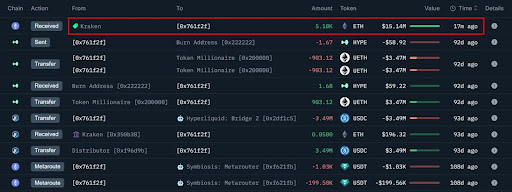
A sudden $15.14 million Ethereum transaction has caught the crypto market’s attention, with the move either driven by insider knowledge or simple strategic positioning. According to data from blockchain analytics platform, Onchain Lens, the transfer shifted approximately 5,099 ETH from a dormant wallet address on Kraken into active circulation on Thursday, January 22.

Based on on-chain records, the whale, identified by the address ‘0x761F2F,’ has remained inactive in the market for more than three months. The last few times the whale was actively moving in the market were when it executed a series of stablecoin and HYPE transactions. The anonymous whale had initiated multiple million-dollar trades in UETH, USDT, and USDC. Meanwhile, the HYPE transactions were primarily token burns.
Source: Hyperbot

After withdrawing 5,099 ETH from Kraken, Arkham Intelligence reported that the whale had transferred the ETH to Lido Finance, converting it into 5,100 STETH. While there is currently no evidence of insider trading, the timing of the transaction raises questions, especially given Ethereum’s muted price action over the past few months and the mounting selling pressure from large scale holders.

Typically, insider trading in crypto occurs when individuals with non-public information make large transactions ahead of major market events that could influence market price. Currently, there has been no spike in Ethereum’s price, nor any major news that could suddenly affect its movements. In fact, ETH continues to trade lower, down by roughly 1.7% over the past 24 hours. Its daily trading volume is also down by 34.89%, signaling reduced confidence among traders and investors.

Whales Go Long On Ethereum

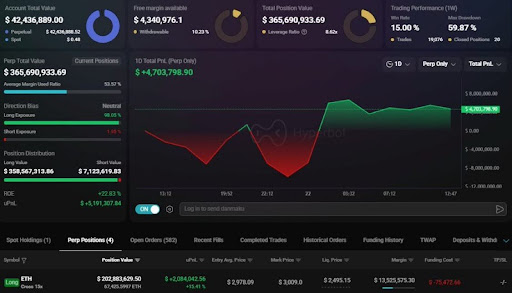
While dormant large-scale players are suddenly re-entering the market, some active whales remain bullish on Ethereum’s long-term prospects despite its ongoing downtrend. According to well-known market analyst Max Crypto, an anonymous whale has just opened a $202 million long position in ETH with 15x leverage.

The scale of the trade is extraordinary considering Ethereum’s recent volatility. It shows strong confidence in the cryptocurrency’s future price action and its potential to overcome its ongoing downtrend. Notably, the position has a liquidation price of $2,495, meaning that if ETH falls to that level, the trade could be forcibly closed by the crypto exchange, resulting in substantial losses for the whale.
Source: Hyperbot

Market participants are closely watching the whales’ positioning, with some calling it a brave but chaotic bet. Others have even speculated that the position may have been taken based on insider information, fueling discussions about potential market moves and a possible bullish turnaround for ETH.

ETH fails to continue recovery | Source: ETHUSDT on Tradingview.com

Связанные с этим вопросы

QWhat was the total value of Ethereum withdrawn by the dormant whale, and on which date did this transaction occur?

AThe dormant whale withdrew over $15 million worth of ETH, specifically $15.14 million, on Thursday, January 22.

QAccording to the article, what are the two possible reasons suggested for the whale's large Ethereum transaction?

AThe two possible reasons suggested are insider knowledge or simple strategic positioning.

QAfter withdrawing the ETH from Kraken, what did the whale do with the 5,099 ETH?

AThe whale transferred the 5,099 ETH to Lido Finance and converted it into 5,100 stETH.

QWhat is the significance of the $202 million long position opened by an anonymous whale, as mentioned in the article?

AIt shows strong confidence in Ethereum's future price action and its potential to overcome its ongoing downtrend. The position has a liquidation price of $2,495.

QWhat does the article cite as evidence that there is currently no spike in Ethereum's price or major market-moving news?

AETH continues to trade lower, down by roughly 1.7% over the past 24 hours, and its daily trading volume is down by 34.89%, signaling reduced confidence among traders and investors.

Похожее

Saylor's Purchase of 1550 Bitcoin Is a Bad Trade

**Title: Saylor's Purchase of 1,550 Bitcoins Was a Bad Trade** The article critically analyzes Strategy's recent move of selling 32 bitcoins followed by a much larger purchase of 1,550 bitcoins. While appearing bullish, the author argues this trade is detrimental to MSTR shareholders. The core argument revolves around the concept of "breakeven modified Net Asset Value (mNAV)," a key metric for Strategy. To increase Bitcoin per share (BPS) for MSTR holders, Strategy must issue new shares at a premium high enough that the funds raised can buy more bitcoin than the bitcoin backing each existing share. Currently, this breakeven mNAV is estimated at 1.30. The recent trade failed on two counts: 1. The shares for the $181 million raise were issued at an mNAV *below* the 1.30 breakeven point. Selling "cheap" shares to buy bitcoin actually *reduces* BPS. 2. Only $101.3 million of the raised funds were used to buy bitcoin; the rest went to boost the company's dollar reserves. The breakeven mNAV calculation assumes *100%* of proceeds are used for bitcoin purchases. Diverting funds, even if mNAV were high, dilutes BPS. The result is an estimated 0.19% decrease in Bitcoin per share for MSTR holders. In exchange, Strategy merely extended its operational runway for its dollar reserves from ~6.3 months to 7 months. The author interprets this as Strategy prioritizing the survival and development of its STRC business over its stated core goal of increasing MSTR's BPS. This constitutes a gamble: if sacrificing MSTR value leads to improved market sentiment and a recovery in STRC's price (and thus mNAV), the whole system could work. If not, Strategy may be forced into a cycle of further diluting MSTR to stay afloat, potentially leading to deferred STRC dividends or corporate decline. The article concludes with a hope for price recovery for Bitcoin, MSTR, and STRC.

Foresight News3 мин. назад

Saylor's Purchase of 1550 Bitcoin Is a Bad Trade

Foresight News3 мин. назад

The AI Bear Market Lasting Two Days Is Over; Why Did Funds Buy Back Storage Stocks First?

After a severe two-day selloff in early June that erased over $1 trillion from U.S. chip stock market value, capital is flowing back first to the memory sector. The correction was not driven by a collapse in AI demand but rather a market reassessment of high expectations. Stocks like Broadcom faced selling pressure despite strong AI revenue guidance, signaling a shift in focus from who has an "AI story" to who can most rapidly translate AI demand into verifiable profits and earnings per share (EPS). Memory companies, such as Micron and SK Hynix, are leading the recovery because their EPS growth is more immediately verifiable. The AI server boom directly increases demand for high-bandwidth memory (HBM) and high-capacity server DRAM, tightening supply and driving up contract prices for conventional DRAM and NAND Flash. This price increase, coupled with a shift to higher-margin products, flows directly into near-term revenue and profitability, as evidenced in recent earnings reports. In contrast, other AI semiconductor segments like GPUs, ASICs, and optical modules, while central to the long-term AI infrastructure story, face longer and less certain paths to EPS validation. Their growth depends more on future product cycles, customer adoption timelines, and capital expenditure plans. The rebound in memory stocks highlights a market preference for assets with shorter, more transparent EPS conversion cycles following the recent de-risking phase. However, this does not negate the potential of other AI hardware segments should they provide clearer near-term order visibility. The episode has raised the validation bar for all AI-related investments.

marsbit3 мин. назад

The AI Bear Market Lasting Two Days Is Over; Why Did Funds Buy Back Storage Stocks First?

marsbit3 мин. назад

Monera Digital|Crypto Market May Report: Four Major Reasons Behind the Accelerated Decline

Monera Digital Crypto Market May Report: Four Key Reasons Behind the Accelerated Decline The crypto market experienced a significant downturn in May, driven by an internal liquidity crisis rather than external macro factors. Bitcoin fell from around $82,850 to $73,674, even as traditional markets rallied in the final week, highlighting a clear "liquidity transmission failure" specific to crypto. Four primary internal factors caused the accelerated sell-off: 1. **Major ETF Outflows:** U.S. spot Bitcoin ETFs saw a net outflow of $2.425 billion for the month, the third-largest monthly withdrawal since their launch. Ethereum ETFs also reversed to net outflows. This turned a key pillar of the bull run into a source of selling pressure. 2. **Holder Capitulation:** On-chain data showed textbook "surrender" patterns. The Short-Term Holder MVRV ratio fell below 1.0, indicating this cohort is now in aggregate loss. The Net Unrealized Profit/Loss (NUPL) metric also deteriorated significantly. 3. **Contagious Negative Sentiment:** The Coinbase Premium Index, which shows U.S. institutional buying/selling pressure, turned deeply negative for most of the month. This confirmed the ETF outflows and reflected a strategic shift away from crypto toward assets like U.S. Treasuries. 4. **Leverage Unwinding and Psychological Breaks:** Despite the downturn, futures open interest initially grew, signaling leveraged positioning. This culminated in a sharp deleveraging event with $307 million in long liquidations. Furthermore, the price broke below the critical $75K-$76K support zone, which is both a key gamma option level and the approximate average cost basis for major public companies holding Bitcoin, turning them from potential buyers into potential sellers. The report concludes that the market's pricing power has shifted from macro narratives to internal liquidation. While Bitcoin's 200-week moving average quantile has entered a historical "value zone" at 10.2%, this indicates a deep bear market reset is underway, not an immediate reversal. A sustainable recovery will require both a genuine improvement in the macro liquidity environment and clear signs of renewed on-chain demand, such as ETF inflows resuming and the Coinbase Premium turning positive. Until then, discipline and capital preservation are paramount.

marsbit14 мин. назад

Monera Digital|Crypto Market May Report: Four Major Reasons Behind the Accelerated Decline

marsbit14 мин. назад

Торговля

Спот
Фьючерсы

Популярные статьи

Manyu: восходящая мем-звезда на Ethereum, готовая открыть новую эру культуры Shiba

Manyu - это мемтокен на Ethereum, который приносит децентрализованную культурную и развлекательную ценность через вирусное влияние в соцсетях и вовлечённость сообщества.

1.9k просмотров всегоОпубликовано 2025.11.27Обновлено 2025.11.27

Manyu: восходящая мем-звезда на Ethereum, готовая открыть новую эру культуры Shiba

Неделя обучения по популярным токенам 14: Glamsterdam — самое ожидаемое обновление Ethereum в 2026 году

Ordinals/Runes по-прежнему стимулируют доходы от комиссий за блоки и активность разработчиков, рассматриваются как отправная точка «нативной эмиссии активов» в сети.

1.5k просмотров всегоОпубликовано 2026.04.29Обновлено 2026.04.29

Неделя обучения по популярным токенам 14: Glamsterdam — самое ожидаемое обновление Ethereum в 2026 году

Обсуждения

Добро пожаловать в Сообщество HTX. Здесь вы сможете быть в курсе последних новостей о развитии платформы и получить доступ к профессиональной аналитической информации о рынке. Мнения пользователей о цене на ETH (ETH) представлены ниже.

活动图片