Ethereum looks quiet – But liquidity is building for a bigger move

ambcryptoОпубликовано 2026-03-29Обновлено 2026-03-29

Введение

Ethereum's price appears subdued, but underlying liquidity is building significantly. Stablecoin supply has risen sharply, with nearly $5.8 billion added in a month, pushing total liquidity toward $163.3–$163.4 billion. While capital is concentrating on Ethereum, DeFi TVL stabilizes near $53 billion. Rising transaction counts and transfer volumes signal real usage is increasing despite weak price action. Transaction data confirms liquidity is not just building but is actively being deployed, with counts exceeding 2.6 to 2.8 million. This shift, driven by stablecoin transfers, lending flows, and DEX activity, validates real demand. Regulatory clarity further supports sustained participation. Institutional entry is strengthening Ethereum's financial rails, with firms like BlackRock and Franklin Templeton moving beyond pilots into real deployment. Tokenized real-world assets (RWAs) are expanding into the tens of billions, indicating capital is integrating into real financial use cases. As institutional capital builds exposure, Ethereum strengthens its role as financial infrastructure, positioning price to follow utility once deployment accelerates.

Ethereum’s [ETH] price appears subdued, yet liquidity tells a different story as a structural shift toward infrastructure unfolds beneath the surface.

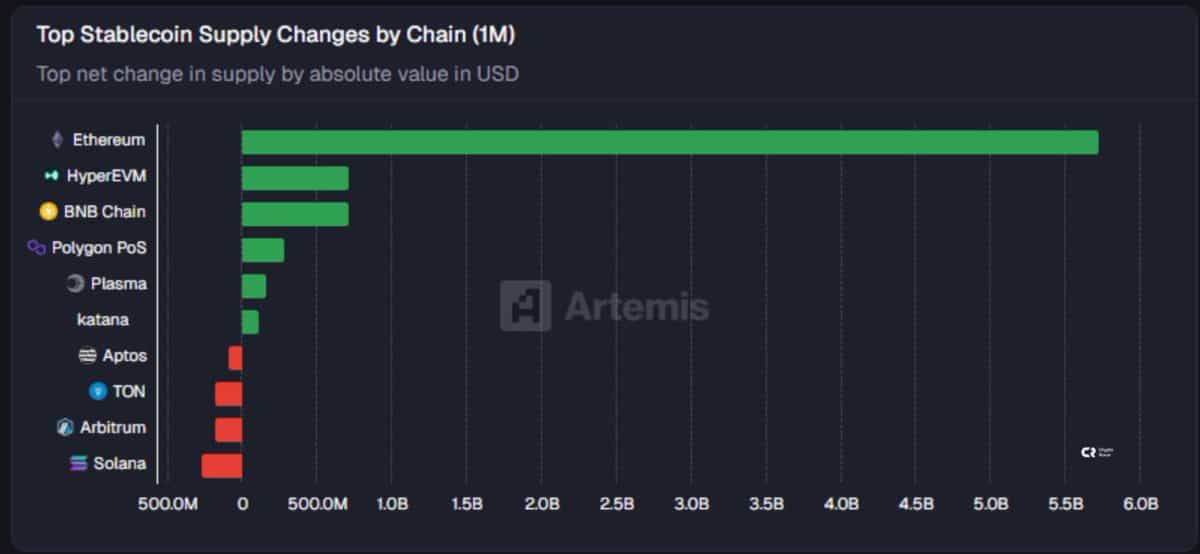
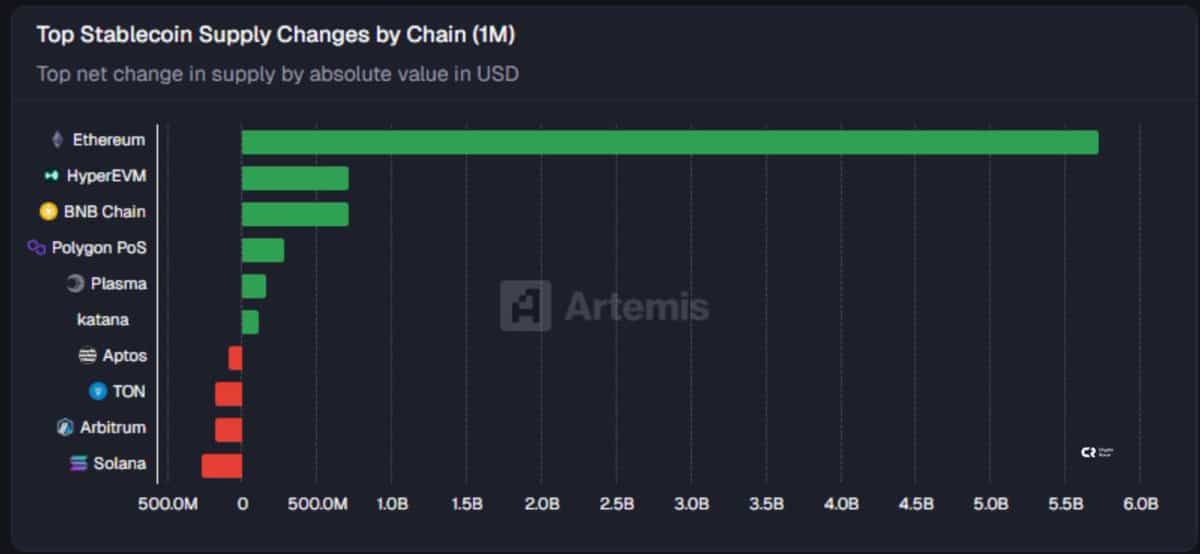
Stablecoin supply rises sharply, with nearly $5.8 billion added in a month, pushing total liquidity toward $163.3–$163.4 billion.

Source: Artemis

While HyperEVM adds about $1.7 billion, capital clearly concentrates on Ethereum. This divergence shows participants favor deep liquidity and established settlement layers over fragmented ecosystems.

Meanwhile, DeFi TVL stabilizes near $53 billion, indicating capital is consolidating into proven protocols. However, rising transaction counts and transfer volumes signal real usage is building beneath weak price action.

This matters because liquidity is accumulating, yet until deployed, Ethereum likely remains range-bound before a broader expansion phase.

Rising activity confirms real demand

Transaction data now confirms that liquidity is not just building on Ethereum; it is actively being deployed across the network.

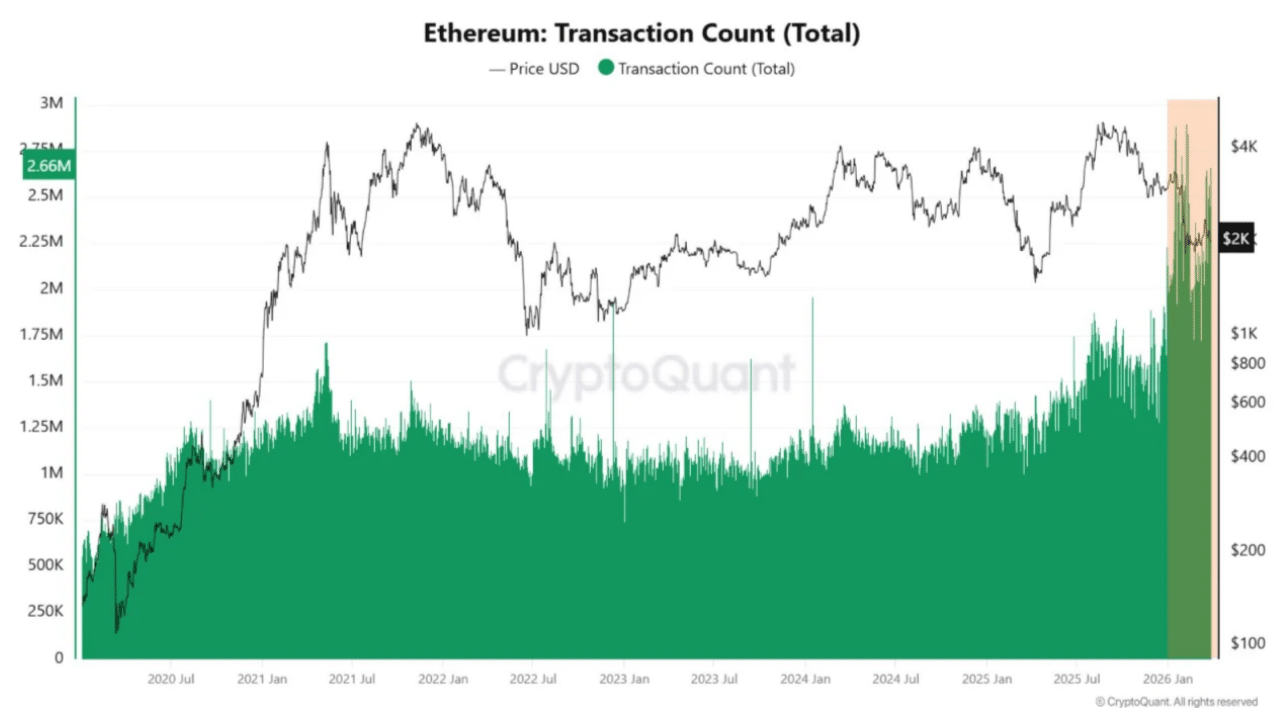
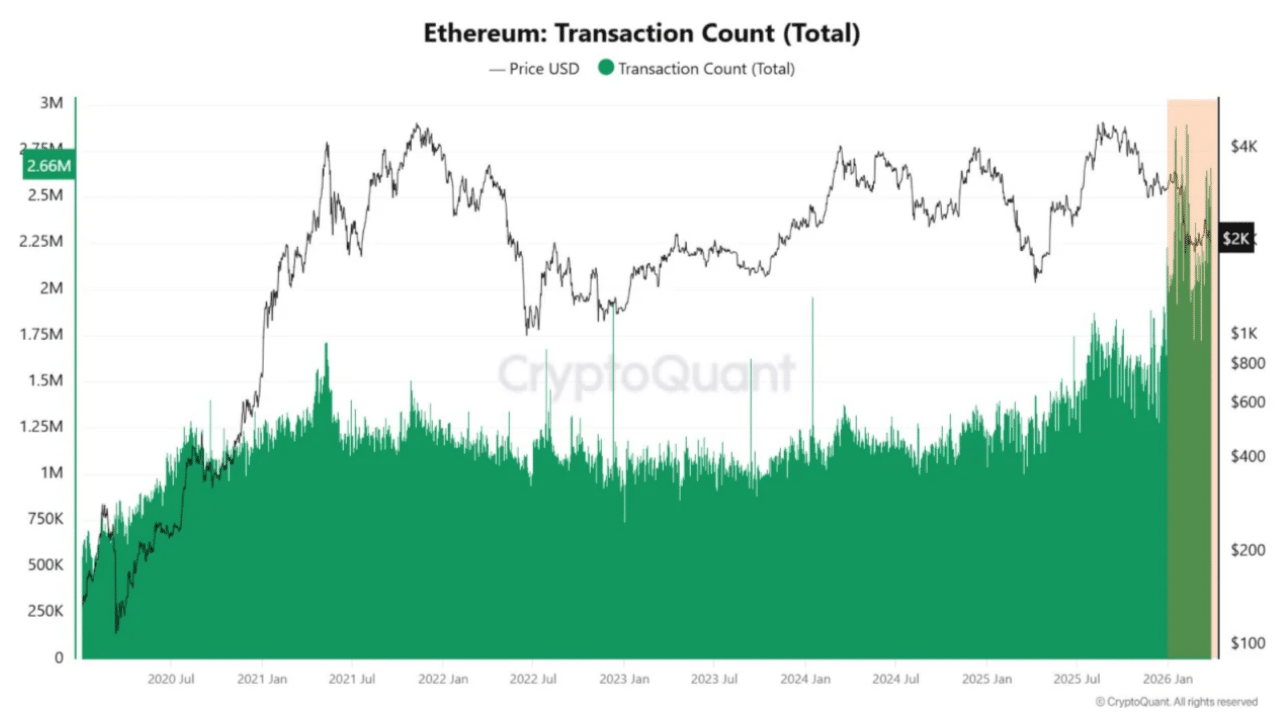
Activity rises sharply, with counts exceeding 2.6 to 2.8 million, even while price remains capped between $2,000 and $4,000.

Source: CryptoQuant

This shift validates real usage, as stablecoin transfers, lending flows, and DEX activity drive consistent throughput rather than speculative spikes. Capital is clearly circulating, which confirms that earlier inflows are translating into measurable engagement.

Regulatory clarity further supports this trend, as reduced uncertainty encourages sustained participation and protocol-level interaction. This reinforces the idea that activity growth is structural, not temporary.

The signal is clear. Deployment is now visible, and with usage leading price, Ethereum is building demand that can eventually translate into stronger price expansion.

Institutional entry reinforces Ethereum’s financial rails

Activity is no longer the only signal strengthening Ethereum; the type of capital entering the network is also changing. What was once retail-driven is now increasingly shaped by institutions moving into tokenized finance.

Major firms like BlackRock and Franklin Templeton are pushing products beyond pilots into real deployment, which shows growing confidence in Ethereum’s infrastructure.

This shift happens because regulatory clarity is improving, reducing legal risk and making on-chain finance more accessible.

Meanwhile, tokenized RWAs expand into the tens of billions, while stablecoins continue to power payments, lending, and treasury flows. This indicates capital is not only entering but also integrating into real financial use cases.

The implication is clear. Capital quality is improving, and as institutions build exposure, Ethereum strengthens its role as financial rails, positioning price to follow utility once deployment accelerates.


Final Summary

  • Ethereum shows rising stablecoin liquidity and transaction activity, confirming real demand.
  • Ethereum attracts institutional capital and expanding RWAs, reinforcing its role as financial infrastructure, with price likely to follow sustained utility growth.

Связанные с этим вопросы

QWhat is the current trend in Ethereum stablecoin supply and total liquidity according to the article?

AThe stablecoin supply is rising sharply, with nearly $5.8 billion added in a month, pushing total liquidity toward $163.3–$163.4 billion.

QDespite subdued price action, what does the rising transaction count and transfer volume on Ethereum indicate?

AThe rising transaction counts and transfer volumes signal that real usage and demand are building beneath the weak price action, with capital actively circulating and being deployed.

QHow is the type of capital entering the Ethereum network changing, as mentioned in the article?

AThe capital is shifting from being retail-driven to increasingly shaped by institutions, such as BlackRock and Franklin Templeton, who are moving into tokenized finance and deploying real products.

QWhat role does regulatory clarity play in the current Ethereum ecosystem, according to the analysis?

ARegulatory clarity reduces uncertainty, encourages sustained participation and protocol-level interaction, and improves confidence in Ethereum's infrastructure, making on-chain finance more accessible.

QWhat is the overall implication of the capital accumulation and deployment for Ethereum's future price action?

AThe article suggests that liquidity is accumulating and being deployed into real financial use cases, building real demand. This positions Ethereum for a broader expansion phase, with price likely to follow sustained utility growth once deployment accelerates.

Похожее

WeChat Agent Issues a 'Heroic Summons,' Half of the Internet Responds

WeChat AI Agent is on the horizon. The WeChat Open Platform has issued a guide for developers, offering them ways to integrate into the WeChat AI ecosystem. This will enable mini-programs to be discovered and invoked by the AI. Meituan has already announced its integration, allowing users to access services like food delivery through WeChat AI. Other platforms like Ctrip and Tongcheng have followed suit. Furthermore, WeChat is collaborating with major smartphone manufacturers to enable their native AI assistants to perform actions within WeChat, such as initiating calls or sending messages, through a controlled protocol called Agent-to-Agent (A2A). Reports indicate the WeChat AI Agent will be accessible by swiping right on the main interface. It aims to understand user intent within the rich context of chats, groups, and past interactions, then automatically call upon relevant mini-programs to complete tasks like ordering coffee or booking restaurants. This positions it as a potential "super app" with direct access to WeChat's vast ecosystem of services, social connections, and payment systems. Technically, this is a complex endeavor. It requires advanced natural language understanding, a "world model" to predict interactions within mini-programs (UI-Oceanus), multi-model orchestration for cost efficiency, and careful coordination with millions of third-party service providers. Tencent's development follows a "Co-Design" approach, where product teams and the Hunyuan model team collaborate closely, allowing capabilities honed in other AI products (like Yuanbao for chat, ima for search, WorkBuddy for office tasks) to be transferred to the WeChat Agent. Tencent is strategically opting for the A2A protocol over GUI-based automation (which it has blocked in the past), maintaining control over its ecosystem. To manage the immense scale and cost of serving 1.4 billion monthly active users, Tencent is deepening its ties with DeepSeek, known for its cost-effective training, to secure a low-cost inference backbone. The ultimate goal is to solve practical, everyday problems for users within the WeChat ecosystem, moving beyond technical benchmarks to deliver real utility, which Tencent sees as the key to winning in the long-term AI game.

marsbit1 ч. назад

WeChat Agent Issues a 'Heroic Summons,' Half of the Internet Responds

marsbit1 ч. назад

Humanity Loses $31 Million in Attack, Token Price Plummets 90% Due to a Single Private Key

On June 9th, the digital identity project Humanity Protocol suffered a major security breach resulting in over $31 million in losses. According to on-chain analyst Specter, hundreds of wallets holding the project's H token were drained. The attack was confirmed by founder Terence Kwok to be caused by the compromise of a foundation member's private key. As a precaution, users are advised to avoid interacting with Humanity's cross-chain bridge or liquidity pools. The incident caused the H token price to crash over 90%, from around $0.70 to a low of $0.052, wiping its market cap from $2 billion to approximately $35.7 million. The attacker allegedly minted 100 million new H tokens and is selling them for BNB. This breach adds to existing controversies surrounding Humanity Protocol. Founded in 2024, it aimed to verify human users via palm-print biometrics and zero-knowledge proofs. However, a leaked conversation in 2025 revealed that only about 1 million of its 9 million claimed Human IDs had completed biometric verification, suggesting 88% might be bots. Furthermore, the project has faced allegations of being a repackaged product from a Chinese access control vendor, raising privacy and authenticity concerns. Founder Terence Kwok's previous venture, Tink Labs, a hotel smartphone startup that raised $170 million, failed and entered bankruptcy in 2020 after burning through its funding. The current attack highlights the persistent critical issue of private key management in crypto. Unlike smart contract exploits, a private key compromise bypasses all on-chain security mechanisms. With no user compensation plan announced yet, this $31 million breach may be a final blow to the project's credibility, already weakened by previous controversies and a heavily depreciated token.

marsbit1 ч. назад

Humanity Loses $31 Million in Attack, Token Price Plummets 90% Due to a Single Private Key

marsbit1 ч. назад

Торговля

Спот
Фьючерсы

Популярные статьи

Manyu: восходящая мем-звезда на Ethereum, готовая открыть новую эру культуры Shiba

Manyu - это мемтокен на Ethereum, который приносит децентрализованную культурную и развлекательную ценность через вирусное влияние в соцсетях и вовлечённость сообщества.

1.9k просмотров всегоОпубликовано 2025.11.27Обновлено 2025.11.27

Manyu: восходящая мем-звезда на Ethereum, готовая открыть новую эру культуры Shiba

Неделя обучения по популярным токенам 14: Glamsterdam — самое ожидаемое обновление Ethereum в 2026 году

Ordinals/Runes по-прежнему стимулируют доходы от комиссий за блоки и активность разработчиков, рассматриваются как отправная точка «нативной эмиссии активов» в сети.

1.5k просмотров всегоОпубликовано 2026.04.29Обновлено 2026.04.29

Неделя обучения по популярным токенам 14: Glamsterdam — самое ожидаемое обновление Ethereum в 2026 году

Обсуждения

Добро пожаловать в Сообщество HTX. Здесь вы сможете быть в курсе последних новостей о развитии платформы и получить доступ к профессиональной аналитической информации о рынке. Мнения пользователей о цене на ETH (ETH) представлены ниже.

活动图片