Ethereum Institutional Adoption Expands: ETH Held In Corporate Reserves Climbs To New Landmark

bitcoinistОпубликовано 2026-05-19Обновлено 2026-05-19

Введение

Institutional demand for Ethereum is rising as corporate reserves of ETH hit a new high of 7.33 million tokens, valued at approximately $16 billion, despite the cryptocurrency's recent sideways and declining price action. This accumulation, representing about 6% of ETH's total supply, signals growing institutional acceptance of Ethereum as a strategic long-term asset. Meanwhile, on-chain data reveals a divergence in investor behavior: small and medium-sized whales are selling their holdings, while large whales are accumulating, potentially positioning for future gains. ETH is currently trading around $2,120, finding support in a buy-wall zone but facing resistance near $2,250.

Ethereum’s sideways price action has continued, but demand for the leading altcoin on the institutional level has not yet cooled down. During this persistent price action, institutions across the sector have been quietly increasing their exposure to ETH, buying more of the altcoin.

Corporate Demand Pushes Ethereum Reserves Higher

A recent report has revealed an underlying persistent demand for Ethereum even as its price continues to face downside pressure. In the face of volatility, institutional investors have continued acquiring ETH as the amount of ETH held in corporate reserves climbs sharply to fresh levels.

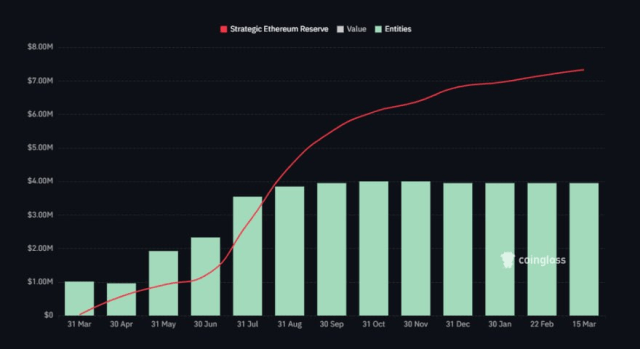
According to Crypto Patel, a researcher and on-chain analyst, the number of ETH collectively held in corporate reserves has recently reached 7.33 million ETH, valued at a whopping $16 billion. This figure marks its highest level yet.

Source: Chart from Crypto Patel on X

The milestone shows that businesses across the crypto and financial sectors are becoming more open to treating Ethereum as a strategic part of long-term treasury and digital asset plans rather than just as a speculative asset. When institutions are buying, it often points to rising confidence in Ethereum and the network’s expanding role across the blockchain sector.

With roughly 6% of ETH’s total supply now sitting on corporate balance sheets, Crypto Patel has labeled this a rapidly growing institutional accumulation. Overall, the increase in corporate ETH reserves underscores ETH’s role as one of the leading assets for long-term investments in the broader and ever-dynamic cryptocurrency sector.

Small And Medium-Sized ETH Whales Are On A Selling Spree

It is important to note that sentiment toward Ethereum is not uniformly bullish. CW, a market expert and verified author at CryptoQuant, has outlined a negative shift in sentiment among small and medium-sized ETH whales.

In the expert’s post shared on the X platform, it is shown that the groups of key investors are steadily offloading their ETH holdings, indicating growing caution amid the current bearish market environment. These investors are likely selling their coins in order to secure more gains and prevent more losses.

While small and medium-sized whales continue to sell their ETH, large whales are doing the opposite as their balance has steadily increased. CW stated that this suggests that large whales are snatching up the coins being sold by these cohorts. In the meantime, this trend could play a critical role in shaping momentum, particularly when large holders begin positioning for potential upside.

Currently, the price of ETH is trading at $2,119, showing a more than 3% decline over the past day. However, after examining its price action on the 4-hour time frame, CW noted that Ethereum has now entered a buy wall zone, which is acting as a key support zone for the altcoin. While ETH is in a buy wall zone, a region where robust demand might promote price stability and possibly spur a recovery, a sell wall has also emerged around the $2,250 price level, which also paints a potential bearish outlook for the token.

ETH trading at $2,120 on the 1D chart | Source: ETHUSDT on Tradingview.com

Связанные с этим вопросы

QAccording to the article, what is the current total value of Ethereum held in corporate reserves?

AThe total value of Ethereum held in corporate reserves is a whopping $16 billion.

QWhat does the milestone of 7.33 million ETH in corporate reserves signify about institutional perception of Ethereum?

AIt signifies that businesses are becoming more open to treating Ethereum as a strategic part of long-term treasury and digital asset plans, rather than just as a speculative asset, indicating rising confidence in Ethereum and its expanding role in the blockchain sector.

QWhat is the contrasting behavior between small/medium-sized ETH whales and large whales as mentioned by CryptoQuant's expert CW?

ASmall and medium-sized ETH whales are steadily offloading their holdings, showing caution. In contrast, large whales are increasing their balances, likely buying up the coins being sold by the smaller cohorts.

QWhat two key price levels, according to the on-chain analysis, are currently important for Ethereum's price action?

AAccording to the analysis, Ethereum is currently in a buy wall zone acting as a key support level. A sell wall has also emerged around the $2,250 price level.

QWhat percentage of Ethereum's total supply is currently held in corporate reserves?

ARoughly 6% of Ethereum's total supply is now held in corporate reserves.

Похожее

Five Core Forms of AI Agent in YC's Eyes

The article outlines five core architectural patterns for effective AI Agents, emerging from tools like Codex and Claude, that move beyond simple prompts towards reusable, process-based capabilities. 1. **Skills**: Reusable, parameterized workflows that function like method calls, allowing a single process (e.g., "/investigate") to handle various tasks based on input parameters. 2. **Thin Harness**: A lightweight execution framework (~200 lines) that manages the AI model's "hands and feet"—handling loops, file I/O, and context—without becoming bloated. 3. **Resolvers**: Routing tables that map tasks to specific Skills, preventing "context corruption" when managing dozens of Skills and ensuring outputs go to the correct locations. 4. **Latent vs. Deterministic Layer**: A critical separation where LLMs handle judgment, synthesis, and pattern recognition, while deterministic code handles tasks requiring precision, consistency, and low cost (like calculations). 5. **Memory**: A persistent, accumulating knowledge base (e.g., a markdown folder) with a "current trusted conclusion" section and an append-only timeline, enabling the system to learn and retain context over time. Together, these patterns create a "process power"—a durable competitive advantage. Unlike one-off prompt-based applications whose value quickly commoditizes, a well-designed AI Agent system encodes experience into reusable, parameterized workflows, offloads stable rules to code, and continuously learns through memory. This creates a structured, hard-to-replicate capability that can provide sustained value for individuals or businesses, such as an accountant automating client reviews while preserving privacy and accumulating expertise.

marsbit1 ч. назад

Five Core Forms of AI Agent in YC's Eyes

marsbit1 ч. назад

Tiger Research: On-Chain Risk Operators, The Market Cap Gap Between 147 Trillion and 70 Billion

This report by Tiger Research examines the evolution of risk management in decentralized finance (DeFi) lending. It highlights a power shift from protocol developers to specialized professional risk operators who manage on-chain capital. The era of protocols and community governance solely dictating DeFi lending is ending. A new professional asset management layer has emerged. While the sector is nascent, capital and distribution channels are rapidly consolidating around top risk operator teams, whose past performance is now a key criterion for institutional entry. The industry's development, accelerated by modular infrastructures like Morpho, has led to a clear division of labor mirroring traditional finance: distribution channels (e.g., exchanges), strategy/risk management (the risk operators), and product infrastructure/asset custody (smart contract protocols). This structure lowers the entry barrier for traditional institutions. Currently, the total value managed by risk operators is approximately $70 billion, dominated by a few leading teams like Steakhouse (RWA focus), Sentora (AI models), and Gauntlet (crisis management). Competition now centers on collateral standards, distribution access, and crisis response capabilities. The report outlines three primary entry paths for institutions: 1) **Distribution Model**: Leveraging external risk operators as backend service providers (common for exchanges). 2) **Asset Supply Model**: Onboarding real-world assets to DeFi as collateral. 3) **Independent Operator Model**: Building an in-house team to become a risk operator (e.g., Bitwise). The core opportunity lies in the strategy/risk management layer, where traditional financial institutions can leverage their existing expertise in due diligence and risk assessment without deep technical development. A vast opportunity gap exists: the global traditional asset management industry manages ~$147 trillion, while the entire DeFi sector is only ~$800 billion, with the risk operator niche at ~$70 billion. This disparity signifies immense growth potential. Once robust risk frameworks and clearer regulations are established, even a minor allocation from traditional markets could trigger exponential DeFi growth. Early movers who help build these foundational systems will gain significant rule-setting influence and first-mover advantages.

marsbit1 ч. назад

Tiger Research: On-Chain Risk Operators, The Market Cap Gap Between 147 Trillion and 70 Billion

marsbit1 ч. назад

Торговля

Спот
Фьючерсы

Популярные статьи

Manyu: восходящая мем-звезда на Ethereum, готовая открыть новую эру культуры Shiba

Manyu - это мемтокен на Ethereum, который приносит децентрализованную культурную и развлекательную ценность через вирусное влияние в соцсетях и вовлечённость сообщества.

1.9k просмотров всегоОпубликовано 2025.11.27Обновлено 2025.11.27

Manyu: восходящая мем-звезда на Ethereum, готовая открыть новую эру культуры Shiba

Неделя обучения по популярным токенам 14: Glamsterdam — самое ожидаемое обновление Ethereum в 2026 году

Ordinals/Runes по-прежнему стимулируют доходы от комиссий за блоки и активность разработчиков, рассматриваются как отправная точка «нативной эмиссии активов» в сети.

1.3k просмотров всегоОпубликовано 2026.04.29Обновлено 2026.04.29

Неделя обучения по популярным токенам 14: Glamsterdam — самое ожидаемое обновление Ethereum в 2026 году

Обсуждения

Добро пожаловать в Сообщество HTX. Здесь вы сможете быть в курсе последних новостей о развитии платформы и получить доступ к профессиональной аналитической информации о рынке. Мнения пользователей о цене на ETH (ETH) представлены ниже.

活动图片