Ethereum And Solana Are Flashing Caution Signals With Negative Buy/Sell Pressure Data – What This Means

bitcoinistОпубликовано 2026-01-29Обновлено 2026-01-29

Ethereum and Solana are gradually demonstrating bullish movements following a rebound on Tuesday, but the broader outlook still appears to be bearish. On-chain metrics are flashing caution as selling pressure continues to dominate among investors of ETH and SOL, suggesting an extension of the ongoing volatile market.

Market Balance Tilts Bearish For Ethereum And Solana

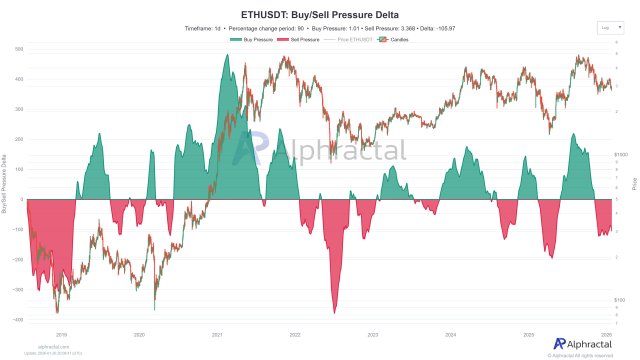
While the broader cryptocurrency market has faced steady downside pressure over the past few weeks, the market dynamics of both Ethereum and Solana are undergoing a crucial shift. This shift is being reflected in the Buy/Sell Pressure Delta for ETH and SOL, which has recently turned negative.

The Buy/Sell Pressure Delta is a key metric that measures the imbalance between buying and selling forces in the market. It is worth noting that when the delta goes negative, it indicates a lack of bullish momentum since selling pressure is greater than purchasing pressure.

According to Alphractal, an advanced on-chain data analytics platform, the metric flipping negative suggests that Ethereum and Solana sellers are gaining control of the market. With buying momentum currently fading, the risk of short-term downside or consolidation becomes high.

Selling pressure outweighing buying activity | Source: Chart from Alphractal on X

This shift typically points to trend exhaustion, not necessarily an immediate reversal. It also points to a cooling phase after periods of stronger momentum and buying activity. In some scenarios from the past, the platform highlighted that a negative Buy/Sell Pressure Delta has also led to price bottoms. However, this is mostly common when selling pressure starts to lose strength again, with capital flows favoring accumulation over distribution.

Furthermore, Alphractal noted that for this ongoing trend to signal a potential bottom in Ethereum and Solana prices, it is critical to monitor whether the delta is exhibiting stability or a recovery, rather than expanding further into negative territory. In the meantime, analyzing the lower timeframes would aid in spotting early signs of a shift back toward buying pressure.

At this point, it is not a standalone signal, and context matters. Price action, volume, and broader on-chain data must confirm whether the market is transitioning into a period of continuation or accumulation. As this imbalance develops across the two networks, it increases the downside risk and emphasizes how crucial it is to keep an eye on whether demand can stabilize or keep declining in the upcoming sessions.

ETH Position Inside A Dense Basis Cluster

Ethereum remains capped by the growing volatility across the crypto market, hovering below the $3,000 price mark. After delving into ETH’s recent price action, Chris Beamish has outlined that the leading altcoin is trading on a dense cost basis cluster.

The positioning carries significance as it represents a breakeven zone for many ETH holders. As ETH holds this zone, the market is leaning toward absorption and the formation of a base. However, a breakdown would move the price into thinner support where underwater supply may derisk.

ETH trading at $3,007 on the 1D chart | Source: ETHUSDT on Tradingview.com

Связанные с этим вопросы

QWhat does a negative Buy/Sell Pressure Delta indicate for Ethereum and Solana according to the article?

AA negative Buy/Sell Pressure Delta indicates that selling pressure is greater than buying pressure, suggesting a lack of bullish momentum and that sellers are gaining control of the market.

QWhich on-chain analytics platform provided the data showing the negative Buy/Sell Pressure Delta for ETH and SOL?

AThe data was provided by Alphractal, an advanced on-chain data analytics platform.

QAccording to the analysis, what is the significance of Ethereum trading in a 'dense cost basis cluster'?

AIt represents a breakeven zone for many ETH holders. Holding this zone suggests market absorption and the potential formation of a base, while a breakdown could move the price into thinner support.

QWhat must happen for the negative Buy/Sell Pressure Delta to signal a potential price bottom for ETH and SOL?

AThe delta must show signs of stability or a recovery, rather than expanding further into negative territory, and this must be confirmed by price action, volume, and broader on-chain data.

QWhat is the current broader market outlook for Ethereum and Solana despite recent bullish movements?

AThe broader outlook still appears to be bearish, with on-chain metrics flashing caution as selling pressure continues to dominate, suggesting an extension of the ongoing volatile market.

Похожее

a16z: AI's 'Amnesia', Can Continuous Learning Cure It?

The article "a16z: AI's 'Amnesia' – Can Continual Learning Cure It?" explores the limitations of current large language models (LLMs), which, like the protagonist in the film *Memento*, are trapped in a perpetual present—unable to form new memories after training. While methods like in-context learning (ICL), retrieval-augmented generation (RAG), and external scaffolding (e.g., chat history, prompts) provide temporary solutions, they fail to enable true internalization of new knowledge. The authors argue that compression—the core of learning during training—is halted at deployment, preventing models from generalizing, discovering novel solutions (e.g., mathematical proofs), or handling adversarial scenarios. The piece introduces *continual learning* as a critical research direction to address this, categorizing approaches into three paths: 1. **Context**: Scaling external memory via longer context windows, multi-agent systems, and smarter retrieval. 2. **Modules**: Using pluggable adapters or external memory layers for specialization without full retraining. 3. **Weights**: Enabling parameter updates through sparse training, test-time training, meta-learning, distillation, and reinforcement learning from feedback. Challenges include catastrophic forgetting, safety risks, and auditability, but overcoming these could unlock models that learn iteratively from experience. The conclusion emphasizes that while context-based methods are effective, true breakthroughs require models to compress new information into weights post-deployment, moving from mere retrieval to genuine learning.

marsbit50 мин. назад

a16z: AI's 'Amnesia', Can Continuous Learning Cure It?

marsbit50 мин. назад

Can a Hair Dryer Earn $34,000? Deciphering the Reflexivity Paradox in Prediction Markets

An individual manipulated a weather sensor at Paris Charles de Gaulle Airport with a portable heat source, causing a Polymarket weather market to settle at 22°C and earning $34,000. This incident highlights a fundamental issue in prediction markets: when a market aims to reflect reality, it also incentivizes participants to influence that reality. Prediction markets operate on two layers: platform rules (what outcome counts as a win) and data sources (what actually happened). While most focus on rules, the real vulnerability lies in the data source. If reality is recorded through a specific source, influencing that source directly affects market settlement. The article categorizes markets by their vulnerability: 1. **Single-point physical data sources** (e.g., weather stations): Easily manipulated through physical interference. 2. **Insider information markets** (e.g., MrBeast video details): Insiders like team members use non-public information to trade. Kalshi fined a剪辑师 $20,000 for insider trading. 3. **Actor-manipulated markets** (e.g., Andrew Tate’s tweet counts): The subject of the market can control the outcome. Evidence suggests Tate’sociated accounts coordinated to profit. 4. **Individual-action markets** (e.g., WNBA disruptions): A single person can execute an event to profit from their pre-placed bets. Kalshi and Polymarket handle these issues differently. Kalshi enforces strict KYC, publicly penalizes insider trading, and reports to regulators. Polymarket, with its anonymous wallet-based system, has historically been more permissive, arguing that insider information improves market accuracy. However, it cooperated with authorities in the "Van Dyke case," where a user traded on classified government information. The core paradox is reflexivity: prediction markets are designed to discover truth, but their financial incentives can distort reality. The more valuable a prediction becomes, the more likely participants are to influence the event itself. The market ceases to be a mirror of reality and instead shapes it.

marsbit1 ч. назад

Can a Hair Dryer Earn $34,000? Deciphering the Reflexivity Paradox in Prediction Markets

marsbit1 ч. назад

Торговля

Спот
Фьючерсы

Популярные статьи

Manyu: восходящая мем-звезда на Ethereum, готовая открыть новую эру культуры Shiba

Manyu - это мемтокен на Ethereum, который приносит децентрализованную культурную и развлекательную ценность через вирусное влияние в соцсетях и вовлечённость сообщества.

1.9k просмотров всегоОпубликовано 2025.11.27Обновлено 2025.11.27

Manyu: восходящая мем-звезда на Ethereum, готовая открыть новую эру культуры Shiba

Обсуждения

Добро пожаловать в Сообщество HTX. Здесь вы сможете быть в курсе последних новостей о развитии платформы и получить доступ к профессиональной аналитической информации о рынке. Мнения пользователей о цене на ETH (ETH) представлены ниже.

活动图片