Delphi Digital: Solana to Undergo the Most Radical Technical Upgrade Cycle in Its History

marsbitОпубликовано 2026-01-21Обновлено 2026-01-21

Введение

Delphi Digital outlines Solana's ambitious 2026 roadmap, describing it as the network's most radical upgrade cycle. The goal is to transform Solana into an exchange-grade environment where its on-chain Central Limit Order Book (CLOB) can compete with centralized exchanges (CEX) in latency, liquidity depth, and fairness. Key upgrades include: - **Alpenglow:** A major consensus overhaul introducing Votor and Rotor. Votor reduces finality time to 100-150ms by aggregating votes off-chain. It ensures liveness with up to 40% of nodes offline or malicious. Proof of History is deprecated. - **Firedancer:** A second validator client built in C++ by Jump, aimed at increasing client diversity and network resilience. - **DoubleZero:** A private fiber-optic network overlay for validators, minimizing latency disparities and enabling faster consensus. - **Block Building:** Innovations like Jito's BAM, which uses Trusted Execution Environments for transaction privacy, and Harmonic, an open block builder aggregation layer. - **Raiku:** A scheduling/auction layer providing deterministic, guaranteed execution for applications like high-frequency trading. These upgrades aim to position Solana as the premier L1 for on-chain capital markets, supporting everything from meme coins to perpetuals and native chain-on stocks, by achieving performance parity with traditional exchanges.

Written by: Delphi Digital

Compiled by: Nicky, Foresight News

Solana's 2026 roadmap may be the most radical upgrade cycle in the network's history, featuring a comprehensive overhaul from the consensus mechanism to infrastructure, aiming to become the decentralized Nasdaq.

Solana's roadmap aims to transform it into an exchange-grade environment, enabling native on-chain central limit order books (CLOBs) to compete with centralized exchanges (CEXs) in terms of latency, liquidity depth, and fairness. Here are all the upgrades to achieve this goal.

Alpenglow: A Comprehensive Overhaul of the Consensus Mechanism

Alpenglow is the most significant protocol-level change in Solana's history. It introduces a completely new consensus architecture built around two core components: Votor and Rotor.

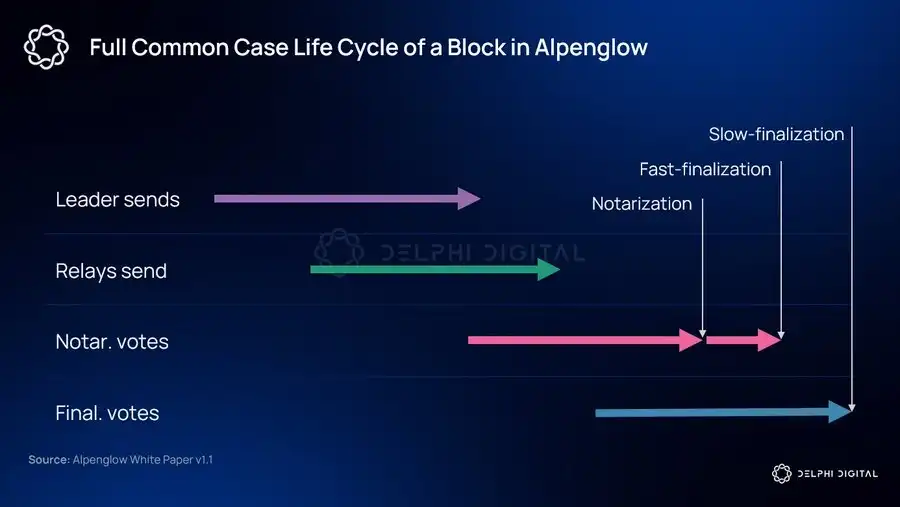
Votor completely revamps how the network reaches consensus. Instead of chaining multiple voting rounds together, it allows validators to aggregate votes off-chain and submit finality within one or two rounds. The result is a theoretical reduction in finality time from the original 12.8 seconds to 100-150 milliseconds.

Votor runs two finality paths in parallel. If a block receives overwhelming support (over 80% stake) in the first round, it is finalized immediately. If support is between 60%-80%, a second round of voting is initiated. If the second round also garners over 60% support, the block is finalized. This design ensures finality even if parts of the network are unresponsive.

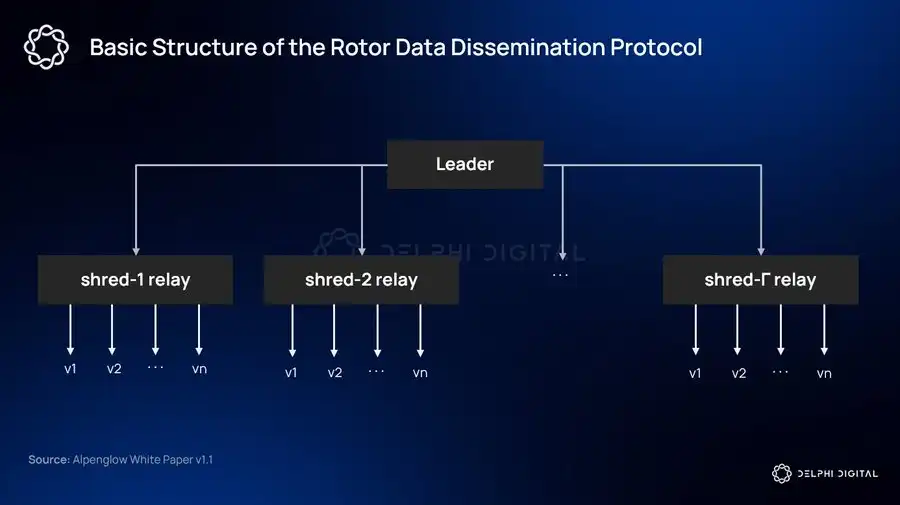
Rotor revolutionizes the block propagation mechanism by routing messages directly through validators with high stake and stable bandwidth.

Alpenglow also introduces a "20+20" resilience model: security is guaranteed as long as malicious stake does not exceed 20%; liveness is maintained even if an additional 20% goes offline. This means Alpenglow can still achieve finality even with up to 40% of the network's nodes being malicious or offline.

Under Alpenglow, the Proof of History mechanism is effectively deprecated, replaced by deterministic epoch scheduling and local timers. This upgrade is expected to launch in early to mid-2026.

Firedancer: Runtime Performance Improvements

Since its inception, Solana has relied on a single validator client (now called Agave). This monoculture has long been a core weakness of the network. Any bug or failure at the client level could lead to a full network outage.

Firedancer is a second, independent validator client developed by Jump, written in C++. Its design goal is to turn Solana validators into deterministic, high-throughput engines capable of handling millions of TPS with minimal latency variance.

Frankendancer is its transitional version, combining Firedancer's network and block production modules with Agave's runtime and consensus components. As Firedancer gradually becomes mainnet-ready, validator diversity is expected to increase significantly.

In this competitive context, both teams have been iterating heavily.

DoubleZero: High-Performance Fiber Infrastructure

DoubleZero is a private network overlay that connects validators via dedicated fiber optic cables, the same infrastructure used by traditional exchanges (like Nasdaq and CME) for microsecond transmissions.

As the validator set expands, information propagation becomes more difficult. More nodes mean more destinations, introducing time inconsistencies in the network. DoubleZero eliminates this variance by routing messages along optimal paths, rather than bouncing around the public internet.

Alpenglow's finality model relies on validators receiving and responding to messages within strict time windows. If propagation is inconsistent, votes arrive late, quorums form slower, and finality takes longer. By narrowing the latency gap between validators, DoubleZero allows Votor to achieve finality faster and enables more uniform propagation for Rotor.

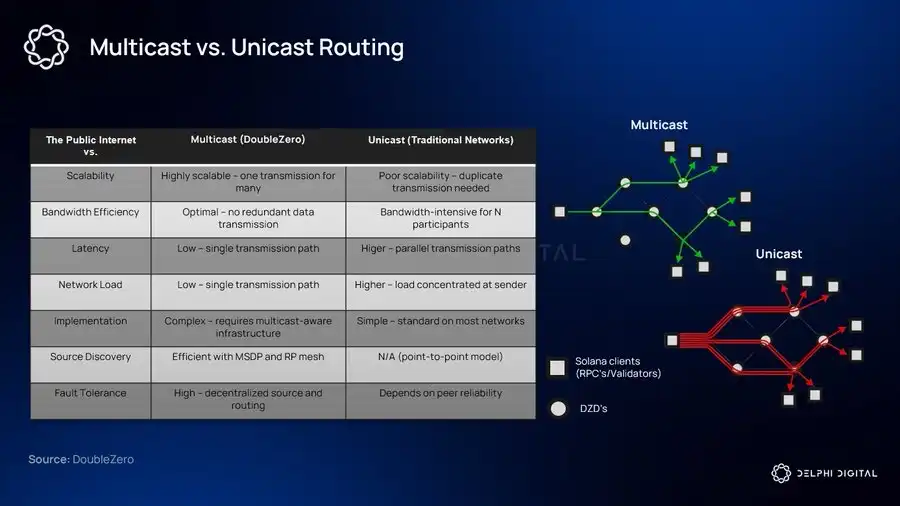
DoubleZero also supports multicast, replicating data within the network and delivering it to all validators simultaneously.

Block Building: BAM and Harmonic

Two complementary trends are reshaping Solana's block building layer:

BAM (Block Assembly Marketplace) is Jito's reimagining of Solana's transaction pipeline. Instead of the slot leader unilaterally deciding transaction ordering, it inserts a market and privacy layer between ordering and execution. Transactions are imported into a Trusted Execution Environment (TEE), meaning neither validators nor builders can see the raw transaction content before ordering is finalized. This prevents opportunistic pre-execution behaviors like front-running.

Harmonic targets another part of the pipeline – who builds the block. It introduces an open block builder aggregation layer, allowing validators to accept block proposals from multiple competing builders in real-time. Think of Harmonic as a meta-market, while BAM is a micro-market.

Raiku: Deterministic Execution Guarantees

Raiku fills the remaining void. Solana has arguably solved most throughput bottlenecks, but it does not natively provide deterministic latency or programmable execution guarantees for specific applications. The granular control required for high-frequency trading (HFT)-style matching and on-chain central limit order books (CLOBs) far exceeds what an L1 can reasonably provide.

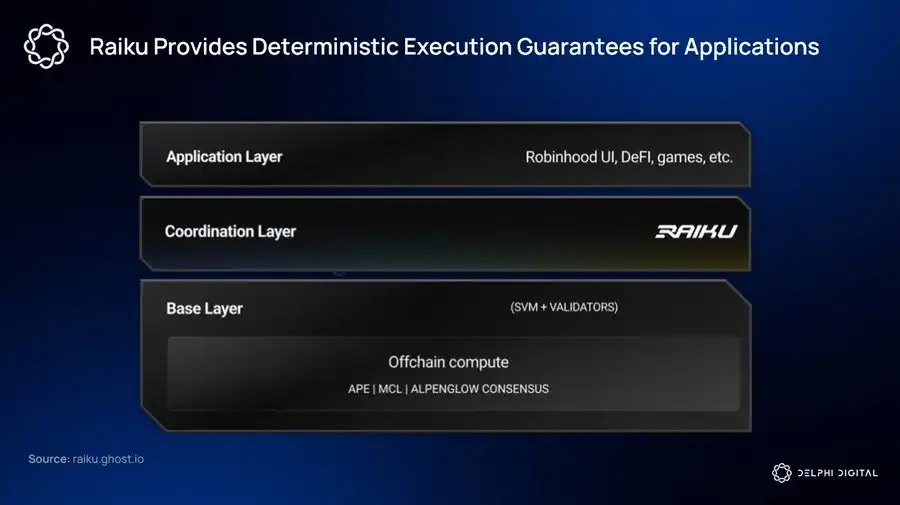
Raiku provides a scheduling/auction layer that runs parallel to the Solana validator set, offering applications a programmable, deterministic pre-execution environment without modifying the L1 consensus mechanism. It achieves guaranteed execution for pre-committed workflows through Ahead-of-Time (AOT) transactions and meets real-time execution needs via Just-in-Time (JIT) transactions.

Bringing Capital Markets On-Chain

Among high-performance public chains, Solana remains the dominant player, but this dominance is meaningless without users and efficient on-chain markets. While the vast majority of meme coins are still traded on Solana, the on-chain perpetual futures market is rapidly consolidating on a few platforms.

To compete with centralized players, performance must be on par. We believe the Solana ecosystem recognizes this issue and is optimistic about closing the gap. The upcoming upgrades are highly anticipated, and new Solana-native perpetual exchanges like BULK are set to launch early in the year.

Retail demand for trading spot assets on Solana remains huge. While Hyperliquid has temporarily captured the perpetuals market, Solana has established itself as the preferred L1 for trading any spot pair. Centralized exchanges still lead significantly, but Solana is currently the go-to solution for on-chain trading.

Products like xStocks are bringing on-chain stocks directly to Solana. Liquidity, price discovery, and speculative attention are converging onto this single chain that offers faster settlement, better user experience, and denser capital.

This is Solana's rationale for bringing capital markets on-chain.

Связанные с этим вопросы

QWhat is the main goal of Solana's 2026 roadmap according to Delphi Digital?

AThe main goal is to transform Solana into an exchange-grade environment where native on-chain centralized limit order books (CLOBs) can compete with centralized exchanges (CEXs) in terms of latency, liquidity depth, and fairness.

QWhat are the two core components of the Alpenglow consensus mechanism upgrade?

AThe two core components are Votor, which overhauls how the network reaches consensus, and Rotor, which revolutionizes block propagation.

QHow does Firedancer improve Solana network's performance and security?

AFiredancer is a second independent validator client written in C++ that aims to turn Solana's validators into deterministic, high-throughput engines capable of handling millions of TPS with minimal latency variance, thereby increasing client diversity and reducing the risk of network-wide outages.

QWhat is the purpose of DoubleZero in the Solana ecosystem?

ADoubleZero is a private network overlay that connects validators via dedicated fiber optics, reducing latency inconsistencies and enabling faster finality by routing messages on optimal paths rather than over the public internet.

QWhat problem does Raiku solve for applications like high-frequency trading (HFT) and on-chain CLOBs?

ARaiku provides a deterministic execution guarantee and a programmable pre-execution environment, offering granular control for applications that require assured execution timing, which is essential for HFT-style matching and on-chain CLOBs.

Похожее

Anthropic Cries Wolf: Is the AGI Threat Real, or Just an IPO Story?

Anthropic has published an article titled "When AI builds itself," discussing the emerging concept of "recursive self-improvement," where AI begins to actively participate in designing, training, testing, and optimizing its own subsequent versions. The company presents internal data showing that by May 2026, over 80% of code merged into its codebase was written by Claude, its AI model. Claude's capabilities have expanded to handling complex, open-ended engineering tasks, achieving a 76% success rate in such areas, and even contributing to research processes, such as optimizing code performance and conducting AI safety experiments. Anthropic outlines an evolution from human-driven development to AI-assisted workflows, culminating in the current stage where AI agents can autonomously write, run, and delegate code. The company cautions that the path toward a "closed loop," where AI continuously improves itself, is becoming visible. It calls for coordinated global mechanisms to potentially slow or pause frontier AI development to allow safety research and societal structures to catch up. However, the timing of this warning coincides with Anthropic's preparations for an IPO, framing the narrative not just as a safety concern but also as a demonstration of Claude's advanced capabilities and its integral role in accelerating Anthropic's own R&D—creating a potential "flywheel" effect for competitive advantage. This contrasts with OpenAI's recent, more policy-oriented discussion of the same risks, highlighting the competitive dynamics in the AI industry as companies position themselves in both the technological and regulatory landscape.

marsbit58 мин. назад

Anthropic Cries Wolf: Is the AGI Threat Real, or Just an IPO Story?

marsbit58 мин. назад

BIT Research: ETF Purchases Have Slowed, Strategy (MicroStrategy) Has Slowed, What Else Can Drive Bitcoin's Rise?

Market Refocus on Inflation and Rate Expectations Weighs on Bitcoin Currently, the market is in a phase of macro-repricing dominated by inflation and interest rate expectations. Bitcoin, which previously benefited from easy liquidity and low inflation, is seeing its core bullish drivers weaken. These drivers were market expectations for interest rate cuts and strong inflows from Bitcoin ETFs and institutions like MicroStrategy (referred to as "Strategy" in the text). The logic has shifted. Recent high inflation data (e.g., CPI hitting 3.8% in a May 2026 report) has caused the market to sharply reduce its rate cut expectations for 2025 and even price in potential hikes. This is a key constraint for Bitcoin, as it lacks cash flows and is highly sensitive to rate expectations. Concurrently, institutional capital flows have slowed significantly. Following the hot CPI data, Bitcoin ETFs saw accelerated outflows, with around $4.3 billion leaving over a period. MicroStrategy's ability to keep adding substantial Bitcoin to its balance sheet is also diminishing. Together, ETF and MicroStrategy holdings total roughly $110 billion, but their momentum as growth engines is cooling. In summary, Bitcoin's current pressure stems not from its own fundamentals but from a changing macro environment. As long as inflation stays elevated, Bitcoin is likely to remain in a consolidating phase. However, historically, inflation eventually peaks. Once it recedes and rate cut expectations rebuild, institutional capital could return, potentially fueling a new and more robust recovery phase for Bitcoin.

marsbit1 ч. назад

BIT Research: ETF Purchases Have Slowed, Strategy (MicroStrategy) Has Slowed, What Else Can Drive Bitcoin's Rise?

marsbit1 ч. назад

Earning 1000 Trillion in Half a Year, 'Pocketing' 20 Million per Capita: This Round of Wealth Creation in the Korean Stock Market is Unprecedented in Scale

The South Korean stock market is experiencing an unprecedented wealth surge in 2026, with household equity and fund asset values soaring by over 1,000 trillion KRW (~$730bn) year-to-date. This translates to an average per capita wealth increase of roughly 20 million KRW, fueled by a historic 109% rally in the KOSPI index. The boom is driven by three converging forces: an AI-driven semiconductor supercycle boosting giants like Samsung and SK Hynix; the government's "Value-Up" market reforms addressing long-standing corporate governance issues; and aggressive real estate regulations that have locked capital within financial markets, preventing profits from flowing back into property. This has triggered a wealth effect, boosting high-end consumption significantly. However, the gains are highly concentrated. The two semiconductor behemoths account for over half the index's value, but retail investors own relatively low stakes in them, systematically missing the biggest rallies. Wealth and consumption benefits are skewed towards luxury goods and imported cars, bypassing mainstream retail. Further risks stem from excessive leverage, with high trading volume in leveraged ETFs, and a market sentiment heavily reliant on the AI sector's fortunes and speculative rumors. While this cycle marks a potential shift from real estate to equities as a primary wealth generator for Koreans, its sustainability, amid structural imbalances and leverage, remains a critical test.

marsbit1 ч. назад

Earning 1000 Trillion in Half a Year, 'Pocketing' 20 Million per Capita: This Round of Wealth Creation in the Korean Stock Market is Unprecedented in Scale

marsbit1 ч. назад

Торговля

Спот
Фьючерсы

Популярные статьи

Обсуждения

Добро пожаловать в Сообщество HTX. Здесь вы сможете быть в курсе последних новостей о развитии платформы и получить доступ к профессиональной аналитической информации о рынке. Мнения пользователей о цене на SOL (SOL) представлены ниже.

活动图片