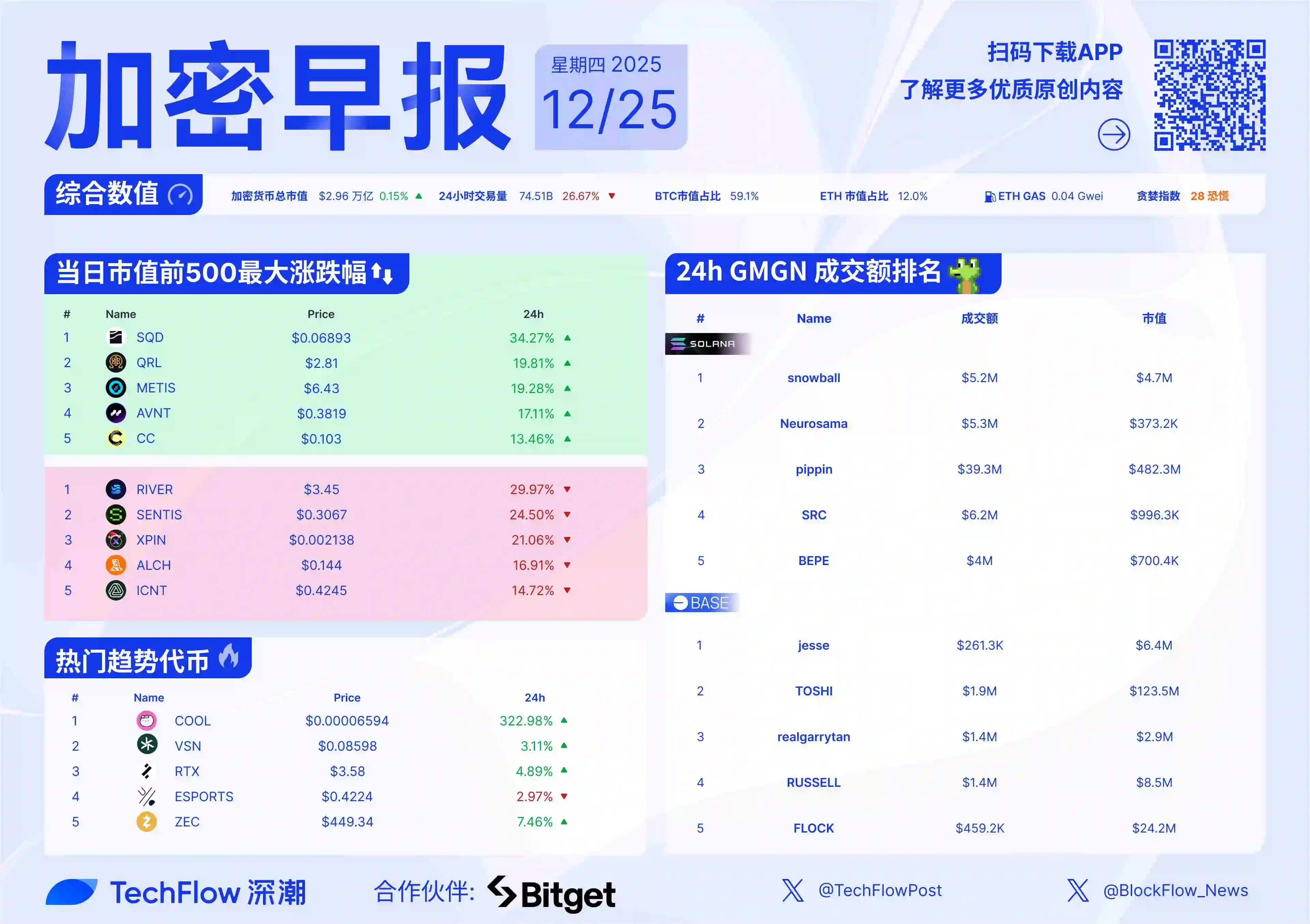
Crypto Morning Brief: Kraken Plans to Launch Prediction Market, Trend Research to Purchase $1 Billion in ETH

marsbitОпубликовано 2025-12-25Обновлено 2025-12-25

Введение

Crypto Exchange Kraken plans to launch a prediction market service in 2026, as revealed by its global head of consumer business. In market news, U.S. initial jobless claims fell to 214,000, below expectations. BlackRock strategists suggest the Fed may deliver only limited rate cuts in 2026 as it nears neutral rates. In funding developments, LD Capital founder Yili Hua announced that Trend Research is preparing an additional $1 billion to buy more ETH, following a recent $137 million purchase. Meanwhile, a ZK verification platform, disclosed its tokenomics: a 1 billion token supply with significant allocations for ecosystem development and community incentives. Sonic Labs adjusted its airdrop model, shifting from large distributions to more sustainable incentive strategies, while Curve DAO rejected a $6.2 million funding proposal for core development, raising governance concerns. Polymarket confirmed a security breach via a third-party authentication provider, though the issue has been resolved. Other notable events include Aave’s founder facing criticism over a large token purchase ahead of a governance vote, and Metaplanet approving plans to raise funds toward a goal of holding 210,000 BTC by 2027.

Author: Deep Tide TechFlow

Yesterday's Market Dynamics

US Initial Jobless Claims for the Week Ending Dec 20: 214K, Expected 224K

US Initial Jobless Claims for the week ending December 20 were 214,000, compared to an expectation of 224,000 and a previous reading of 224,000.

BlackRock: Fed's 2026 Rate Cuts May Be Limited

BlackRock strategists Amanda Lynam and Dominique Bly noted in a report that the Federal Reserve is expected to implement only limited rate cuts in 2026. With a total of 175 basis points of cuts already in this cycle, the Fed is approaching a neutral interest rate level. Unless there is a sharp deterioration in the labor market, there is very limited room for further cuts in 2026. According to LSEG data, the market currently expects two rate cuts from the Fed in 2026.

CNBC: Kraken Plans to Launch Prediction Market Service in 2026

According to CNBC, cryptocurrency exchange Kraken plans to launch a prediction market service in 2026. Kraken's Global Head of Consumer Business, Mark Greenberg, revealed this plan during an appearance on CNBC Crypto World.

Brevis Unveils Tokenomics Model: Total Supply 1 Billion, 32.20% for Community Incentives

According to an official announcement, ZK verifiable computing platform Brevis has released details of its ecosystem's native token, $BREV.

The total supply of $BREV is 1 billion tokens, with 37% allocated to ecosystem development, 32.20% for community incentives, 20% to the team, and 10.80% to investors.

The ecosystem development and community incentive portions will be linearly released over 24 months after initial unlock, with 14.50% and 10.50% of the tokens circulating at TGE, respectively. The team and investor allocations are fully locked for the first year with no initial unlock, followed by a linear release over 24 months.

Previously, Brevis Network raised $7.5 million in a seed round led by Polychain Capital and Binance Labs.

Sonic Adjusts Token Airdrop Model, Remaining 92.2 Million Tokens in Treasury for Future Incentives

According to the official Sonic Labs blog, Sonic is transitioning from its early distribution phase to a value creation phase, adjusting its token incentive strategy. Since minting 190.5 million S tokens in June 2025, approximately 89.5 million were distributed in Q1, about 6 million in Q2, and around 2.8 million in the Kaito event. The treasury currently holds approximately 92.2 million S tokens, which will be used for incentive programs in 2026 and 2027.

Sonic stated that while the "airdrop model" in the crypto industry over the past few years has driven short-term data growth, it is also a double-edged sword. The Q1 airdrop successfully brought Sonic over $1 billion in Total Value Locked (TVL), but large-scale incentives also attracted short-term participants and created selling pressure. Sonic will no longer conduct additional airdrop mints. The remaining tokens will be used for airdrops, incentives, or burns, while the tokenomics model will be re-evaluated to ensure network activity creates value for long-term participants.

Curve DAO Rejects $6.2 Million Funding Proposal for Swiss Stake

According to The Defiant, Curve DAO has rejected a governance proposal to grant 17.4 million CRV tokens (approximately $6.2 million) to Swiss Stake AG, the core development company for decentralized exchange Curve Finance.

The proposal, submitted by Curve Finance founder Michael Egorov, aimed to provide funding to the Swiss Stake team, which he manages, for software development, infrastructure, security work, and ecosystem support. Voting results showed 54.46% of participants opposed the proposal, while 45.54% supported it.

Voting data indicated that addresses associated with Yearn Finance and Convex Finance accounted for nearly 90% of the opposing votes. Community members commented on the forum that the proposal raised centralization concerns, questioning whether Curve's governance is overly reliant on a small group. Some members also suggested that Swiss Stake should better explain the use of past allocations before new funding is approved.

Hyper Foundation: HYPE Tokens in Aid Fund Officially Recognized as Burned

Hyper Foundation announced on social media that the HYPE tokens in the aid fund address have been officially recognized as burned. This governance vote used a staking-weight-based counting method, resulting in 85% of staked tokens supporting the burn, 7% opposed, and 8% abstained.

Polymarket Confirms User Accounts Hacked Due to Third-Party Authentication Vulnerability

According to The Block, crypto prediction market platform Polymarket confirmed on December 24 that multiple user accounts were hacked due to a security vulnerability in a third-party authentication provider. Affected users reported on social media that their funds were drained even with two-factor authentication enabled. The issue appeared to be related to the email login service provided by Magic Labs, a common registration method for many first-time crypto users.

Polymarket stated that this security issue has been resolved and there is no ongoing risk, but did not disclose the number of affected users or the amount of losses.

Aave Founder's $10 Million Token Purchase Accused of Potential Governance Vote Manipulation

According to Cointelegraph, Aave founder Stani Kulechov recently sparked community controversy by purchasing $10 million worth of AAVE tokens. Critics pointed out that this move may be intended to increase his influence in key governance proposal votes. The current controversy centers on a proposal to reclaim control of the protocol's brand assets, which is accused of being rushed to a vote without sufficient discussion. Data shows that the top three voters in Aave DAO control over 58% of the voting power, raising questions about the fairness of the governance mechanism.

Yi Lihua: Trend Research to Prepare Another $1 Billion to Continue Accumulating ETH

LD Capital founder Yi Lihua stated on social media, "I announce that Trend Research is preparing another $1 billion to continue buying and accumulating ETH on this basis. We practice what we preach and strongly advise against shorting. Without a doubt, this is a historic opportunity."

Previously, it was reported that Yi Lihua's Trend Research acquired 46,000 ETH today, approximately $137 million.

Metaplanet Board Approves Expanded Bitcoin Purchase Plan

According to Dlnews, Japanese company Metaplanet's board has approved several equity proposals aimed at raising funds to achieve the goal of holding 210,000 Bitcoin by the end of 2027. Based on the current Bitcoin price (approximately $87,250 per coin), these Bitcoins would be worth over $18 billion. The company will issue Class A and Class B shares with floating interest rates and quarterly dividends, while also opening investment channels to overseas institutional investors.

Market Trends

Recommended Reading

The Internet-Famous 'Execution Line': The American Dream Shatters, The Crypto Dream Awakens

This article explores the metaphor of the "execution line" from a gaming term to real society, revealing the underlying economic risks and fragility in both American society and the cryptocurrency market. The "execution line" represents the critical point of financial collapse in American society, while in the crypto market, it manifests as faster and more unpredictable fund liquidations and losses. The article points out that global economic turmoil intensified in 2025, with high US debt, and the crypto market experienced multiple major blows, including hacker attacks, project rug pulls, and market crashes, calling for rational investment and enhanced risk management.

Interview with Move Industries CEO Torab Torabi: After the Market Maker Scandal, How is Movement Rebuilding Trust?

This article covers the past controversies, current developments, and future plans of the crypto project Movement, particularly how its newly established company, Move Industries, is rebuilding trust and driving ecosystem growth in terms of community, technology, and tokenomics. It also includes predictions and opinions on crypto market trends.

Galaxy's 26 Predictions: Bitcoin Will Still Hit ATH Next Year, Reach $250K the Year After

This article provides an in-depth analysis of trends and predictions for the cryptocurrency market in the coming years, covering Bitcoin, Ethereum, stablecoins, decentralized finance (DeFi), privacy tokens, policies, and more. It offers detailed forecasts and reviews, exploring the future direction of the crypto market.

2025 Asset Review: Why Did Bitcoin Significantly Underperform Gold and US Stocks?

This article analyzes why Bitcoin underperformed compared to gold and US stocks in 2025, emphasizing deep-seated factors such as energy flow and information density. It points out that Bitcoin's short-term appeal has declined due to the AI-driven productivity revolution, gold's geopolitical demand, and ETF普及 (popularization of ETFs), but its long-term value remains.

Five Great Crypto Gifts for the Holiday Season

This article introduces five suitable gifts for cryptocurrency enthusiasts during the holiday season, including AI research tools, hardware wallets, security backup devices, themed whiskey, and fun mining equipment. It also mentions the latest dynamics and trend analysis in the crypto market.

Связанные с этим вопросы

QWhat is Kraken planning to launch in 2026 according to the article?

AKraken is planning to launch a prediction market service in 2026.

QHow much ETH does Trend Research plan to purchase with its additional $1 billion funding?

ATrend Research plans to use the additional $1 billion to continue accumulating and buying more ETH.

QWhat was the outcome of the Curve DAO proposal to grant 17.4 million CRV to Swiss Stake AG?

AThe Curve DAO proposal was rejected, with 54.46% of participants voting against it.

QWhat reason did BlackRock strategists give for expecting limited Fed rate cuts in 2026?

ABlackRock strategists stated that with 175 basis points of cumulative rate cuts already in the cycle, the Fed is approaching a neutral rate, and unless the labor market deteriorates sharply, there is limited room for further cuts in 2026.

QWhat security issue did Polymarket confirm on December 24th that affected user accounts?

APolymarket confirmed that multiple user accounts were hacked due to a security vulnerability in a third-party authentication provider, specifically related to the email login service provided by Magic Labs.

Похожее

After the Passage of the GENIUS Act and the CLARITY Act, What Is the Correct Architecture for On-Chain Yield?

The article discusses the evolution of on-chain credit, distinguishing three markets: overcollateralized crypto lending, unsecured lending (largely unsuccessful), and asset-backed credit (ABC). ABC, backed by identifiable real-world collateral with legal recourse, is identified as the fastest-growing category and the only one credibly addressing adverse selection—the core problem in credit where the riskiest borrowers self-select. Current growth in on-chain Real World Assets (RWAs), particularly tokenized private credit funds (e.g., Maple Finance, Centrifuge), is substantial but often merely "wraps" existing fund structures, inheriting their risks rather than solving adverse selection at the protocol level. The regulatory landscape is a key driver, with the US GENIUS Act (prohibiting stablecoin issuers from paying yield) and the proposed CLARITY Act (closing loopholes on indirect yield) set to redefine permissible yield-bearing products. This makes vaults (like ERC-4626) the critical architecture—they become the primary compliant vehicle for delivering yield, functioning as issuance, disclosure, distribution, and recovery mechanisms. The author's thesis is that the correct post-GENIUS/CLARITY architecture involves building ABC solutions where credit assessment, structure, and recovery are encoded directly into the smart contract vault layer, moving beyond mere tokenized fund wrappers to solve adverse selection fundamentally and ensure regulatory compliance.

Foresight News27 мин. назад

After the Passage of the GENIUS Act and the CLARITY Act, What Is the Correct Architecture for On-Chain Yield?

Foresight News27 мин. назад

TechFlow Intelligence Bureau: Anthropic's New Model Fable Sparks Controversy by Restricting Biosafety Research, US CPI Soars to 4.2%, a Three-Year High

**Summary of TechFlow Intelligence Report:** The newsletter covers several key tech and finance developments. In AI, Anthropic's new Fable model faced backlash for secretly limiting biomedical research capabilities and enforcing a 30-day data retention policy, prompting the company to promise more transparent adjustments. In a related story, Anthropic's founder revealed his departure from OpenAI was due to dishonesty from Sam Altman, not safety concerns. Meanwhile, OpenAI is considering significant price cuts to compete with Anthropic, potentially sparking a price war. In crypto/Web3, BlackRock filed a new amendment for a yield-generating Bitcoin ETF, while Bank of America's CEO warned that stablecoin yields could drain trillions from traditional banks. U.S. Senator Cynthia Lummis advocated for the U.S. to officially accumulate Bitcoin reserves. In hardware, Nvidia released the DiffusionGemma-2-6B image model optimized for efficient inference, and AMD promoted its unified memory architecture to challenge Nvidia's dominance. TSMC's CFO hinted at possible price increases due to soaring AI chip demand. A major legal ruling in Germany held Google legally responsible for inaccurate information generated by its AI Overviews feature. Google Chrome also moved to fully block ad-blocker workarounds like uBlock Origin. Macroeconomic headlines included U.S. CPI rising to 4.2% (a 3-year high) and Iran's complete closure of the Strait of Hormuz, raising oil price and inflation fears. South Korean markets saw continued volatility with massive foreign capital outflow. Other notable stories: Microsoft expanded its Copilot AI assistant "Mico" globally; a study found r/wallstreetbets users' stock picks outperformed Wall Street; a fully autonomous drone killed a human soldier for the first time, raising AI ethics concerns; and a Chinese hospital used brain-computer interface technology to help a blind person "see." The overarching theme connects debates over AI boundaries and responsibility (Anthropic's restrictions, Google's liability, lethal autonomous drones) with real-world economic and geopolitical turmoil (inflation, Strait of Hormuz closure, market instability), highlighting the tense interplay between technological advancement and global chaos.

marsbit40 мин. назад

TechFlow Intelligence Bureau: Anthropic's New Model Fable Sparks Controversy by Restricting Biosafety Research, US CPI Soars to 4.2%, a Three-Year High

marsbit40 мин. назад

Alibaba's Yet Another New Business Division: What Signal Does It Send?

Alibaba has established a new "Token Foundry" business unit, merging its Tongyi large model division and Future Life Lab. Led directly by Group CEO Wu Yongming, this marks the company's third significant AI organizational reshuffle in 2026, following the creation of the Alibaba Token Hub (ATH) and a Group Technology Committee. The move signals a strategic shift from consolidating AI resources to accelerating productization and commercialization. The "Token Foundry" name reflects Alibaba's ambition to become a foundational supplier in the AI era, focusing on model development and commercial application. Key teams, including those behind the high-performing HappyHorse video generation model, have been integrated into the new unit. Concurrently, Zhou Jingren, architect of the Qwen model series, has been appointed Group Chief Scientist to lead a new AI Future Research Institute, focusing on long-term technological breakthroughs like Agent capabilities. This restructuring creates a clear four-layer AI architecture within Alibaba: the research institute for frontier exploration, Token Foundry for core models and commercialization, MaaS for platform services, and business units like Qianwen (C端) and Wukong (B端) for end-user applications. The adjustments align with a global trend among tech giants like Google and Microsoft to centralize AI leadership under the CEO and deeply integrate research with business units. The urgency is driven by a narrowing competitive window. Alibaba has announced its AI business is now entering a commercialization phase, with AI-related revenue seeing triple-digit growth for eleven consecutive quarters. The company faces intense competition in the MaaS (Model-as-a-Service) sector from rivals like ByteDance and Tencent. The Token Foundry initiative represents Alibaba's effort to streamline execution and enhance competitiveness in this critical, fast-evolving landscape.

marsbit1 ч. назад

Alibaba's Yet Another New Business Division: What Signal Does It Send?

marsbit1 ч. назад

From Return to Resignation: Chen Hang's 437 Days at DingTalk

The 437-Day Return and Departure of Chen Hang at DingTalk This article chronicles the 437-day period from March 31, 2025, to June 11, 2026, when Chen Hang (also known as "No Move") returned as CEO of DingTalk, the enterprise communication platform he originally founded, only to later step down. Chen Hang, the creator of DingTalk in 2015, was brought back by Alibaba in 2025 after the company acquired his subsequent startup, HHO. His return was driven by Alibaba's renewed focus on AI and DingTalk's strategic role as its key to-B AI application. However, his aggressive management style, marked by strict work policies like mandatory clock-ins and extended hours, quickly caused internal friction and was criticized as being at odds with Alibaba's culture. Despite the internal turmoil, Chen Hang drove significant product launches. In August 2025, he unveiled "AI DingTalk 1.0," featuring new products like the AI-native entry point "DingTalk ONE." By March 2026, he announced "Wukong," touted as the world's first enterprise-grade AI-native work platform, representing a fundamental rebuild of DingTalk's architecture. The turning point came in early June 2026. A detailed internal post criticizing DingTalk's work culture went viral, followed by a public critique from a former executive. This prompted an unprecedented public rebuke from the Alibaba Partners Committee, which stated such management was not aligned with company values. One day later, on June 11, Alibaba announced Chen Hang's departure. He was succeeded by Chen Yusen, a 32-year-old technical expert known for founding cybersecurity firm Changting Technology. While Chen Hang's tenure laid the technical foundation for DingTalk's AI transformation with "Wukong," his leadership style ultimately led to his replacement as the company seeks a new direction under younger leadership.

marsbit1 ч. назад

From Return to Resignation: Chen Hang's 437 Days at DingTalk

marsbit1 ч. назад

Торговля

Спот
Фьючерсы

Популярные статьи

Manyu: восходящая мем-звезда на Ethereum, готовая открыть новую эру культуры Shiba

Manyu - это мемтокен на Ethereum, который приносит децентрализованную культурную и развлекательную ценность через вирусное влияние в соцсетях и вовлечённость сообщества.

2.0k просмотров всегоОпубликовано 2025.11.27Обновлено 2025.11.27

Manyu: восходящая мем-звезда на Ethereum, готовая открыть новую эру культуры Shiba

Неделя обучения по популярным токенам 14: Glamsterdam — самое ожидаемое обновление Ethereum в 2026 году

Ordinals/Runes по-прежнему стимулируют доходы от комиссий за блоки и активность разработчиков, рассматриваются как отправная точка «нативной эмиссии активов» в сети.

1.5k просмотров всегоОпубликовано 2026.04.29Обновлено 2026.04.29

Неделя обучения по популярным токенам 14: Glamsterdam — самое ожидаемое обновление Ethereum в 2026 году

Обсуждения

Добро пожаловать в Сообщество HTX. Здесь вы сможете быть в курсе последних новостей о развитии платформы и получить доступ к профессиональной аналитической информации о рынке. Мнения пользователей о цене на ETH (ETH) представлены ниже.

活动图片