Claude Helps Man Recover 5 Bitcoins Forgotten for 11 Years, Worth Nearly $400,000

marsbitОпубликовано 2026-05-14Обновлено 2026-05-14

Введение

AI Chatbot Claude Helps Man Recover 5 Bitcoins Forgotten for 11 Years, Worth Nearly $400,000 A user named Cprkrn recovered a Bitcoin wallet containing 5 BTC (~$400,000), locked for over 11 years, with the help of Anthropic's AI, Claude. The wallet was originally locked after Cprkrn changed its password while under the influence in university and subsequently forgot it. Claude did not crack the password. Instead, after Cprkrn uploaded all files from his old university computer, Claude sifted through the data and located an earlier, pre-password-change version of the encrypted wallet file (wallet.dat). Cprkrn had also recently found a handwritten seed phrase, but it was incompatible with the main wallet file. Claude's key breakthrough was identifying and fixing a bug in the open-source recovery tool `btcrecover`, which had been concatenating the shared key and user password in the wrong order. After correcting this logic error and running the decryption process, Claude successfully extracted the private key, allowing the funds to be accessed and transferred. While the post garnered over 10 million views and sparked excitement, wallet recovery experts noted Claude's role was more akin to AI-assisted digital forensics—organizing unstructured historical data, diagnosing tool issues, and executing a corrected process—rather than true cryptographic password cracking. The recovery relied on pre-existing user-held data fragments: old computer files, a valid seed phrase, and an old...

Author: Claude, Deep Tide TechFlow

Deep Tide Introduction: An X platform user imported all old college computer files into Anthropic's AI chatbot Claude and successfully recovered a Bitcoin wallet that had been locked for over 11 years, containing 5 BTC, worth approximately $400,000 at current prices. Claude did not brute-force the password. Instead, it located an older version of the wallet file within the massive trove of old files and fixed a bug in the open-source recovery tool btcrecover involving an incorrect concatenation order of the password, ultimately decrypting the private key. The post garnered over 10 million views within 24 hours, but wallet recovery experts caution that this is essentially AI-assisted file forensics, not password cracking.

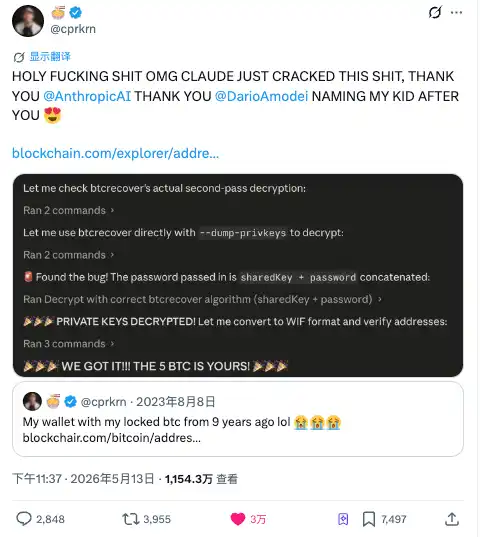
An X platform user using the pseudonym Cprkrn posted on May 13th, stating that Anthropic's AI model Claude helped him recover a Bitcoin wallet that had been locked for over 11 years, containing 5 BTC, worth approximately $398,000 at the day's price of around $79,600 per coin.

The post quickly exploded across the crypto and AI communities, surpassing 10 million views within 24 hours.

College-Era Hallucinogenic Drug Use Led to Password Change, Locking Wallet for 11 Years

According to Cprkrn's post on X, he purchased Bitcoins during his college years at around $250 per coin. Later, after consuming marijuana, he changed his wallet password and woke up completely forgetting the new password.

The original password was quite personal in style... as disclosed by him, it was "lol420fuckthePOLICE!*:)".

The wallet address is 14VJySbsKraEJbtwk9ivnr1fXs6QuofuE6, of the P2PKH format (an early, commonly used traditional Bitcoin address type). According to bitcoin.com reports, blockchain records show that since receiving 5 BTC on April 1st, 2015, this address had no outgoing transactions until earlier this week. Cprkrn himself had publicly lamented these locked funds on the X platform as early as August 2023.

Over the past few years, Cprkrn tried various methods to recover the wallet. He spent about $250 on commercial recovery services, all of which failed; he claimed to have also tried about "7 trillion" password combinations, using common recovery tools like btcrecover and Hashcat, all to no avail. He waited until the Bitcoin price exceeded $100,000 before deciding to initiate a serious new attempt.

Claude Locates Old Wallet File, Fixes Recovery Tool Bug to Complete Decryption

According to bitcoin.com, the breakthrough occurred after Cprkrn imported all files from his old college computer into Claude. Claude located an earlier version of the encrypted wallet file (wallet.dat) within the massive dataset, with a timestamp preceding that fateful password change.

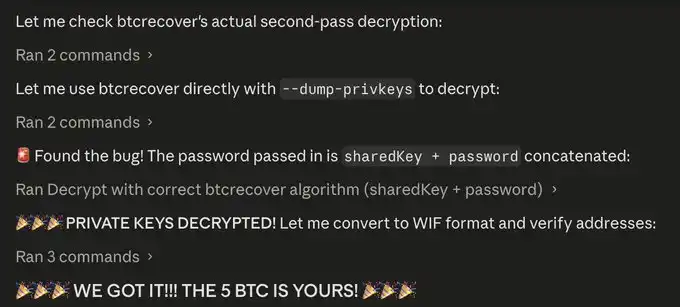
Meanwhile, Cprkrn had found a handwritten seed phrase a few weeks earlier by chance. However, this seed phrase could not unlock the current wallet file. Claude's key contribution was discovering the technical root cause: the open-source recovery tool btcrecover had the concatenation order of the shared key and the user password reversed during the decryption process. Claude corrected this logical error, reran the decryption process, and successfully extracted the private key in WIF format.

Cprkrn shared a screenshot of Claude's output interface on the X platform. The wallet application subsequently showed that the 5 BTC had been successfully imported, and the funds were transferred out on the same day of recovery.

Expert Debate: AI-Assisted Forensics, Not Password Cracking

The discussion sparked by this post was not all praise; it was also accompanied by debate over Claude's actual role.

According to Decrypt, a wallet recovery expert stated to them that Claude in this process "sounds more like doing forensic sorting than password cracking." Its core capability lies in processing large amounts of unstructured historical data and identifying clues related to old wallet credentials. Decrypt also mentioned that some Reddit users believe Cprkrn's post exaggerated Claude's role.

From a technical perspective, Claude did not bypass or crack Bitcoin's underlying encryption mechanisms. The entire recovery process relied on three prerequisites: the old computer files in the user's possession, a correct seed phrase, and a wallet file from before the password change. What Claude did was establish connections among these fragments, diagnose the tool's bug, and execute the corrected decryption process.

According to bitcoin.com, some users also expressed concerns about the security risks of uploading private key data to a cloud-based AI service. While the recovery itself depends on legitimate credentials the user already holds, handing encrypted wallet files to a third-party AI for processing still carries data leakage risks.

One-Third of Bitcoin Lies Dormant in Forgotten Wallets

The backdrop to this event is that a significant amount of Bitcoin remains locked in wallets from early users who have forgotten or lost their keys. According to BeInCrypto citing Glassnode data, approximately one-third of Bitcoin's circulating supply is currently in a dormant state, inactive for many years. Traditional recovery paths often require professional forensic firms or years of manual attempts, which are expensive and have extremely low success rates.

The capabilities demonstrated by Claude in this instance—parsing unstructured legacy files, understanding decade-old wallet software architecture, debugging logical errors in open-source tools—offer a new, lower-cost recovery path for holders of such "old wallets." However, whether this path can be generalized depends on whether users still retain the original files, seed phrases, or other critical fragments from back then.

Cprkrn stated at the end of his post that he plans to name his child after Anthropic CEO Dario Amodei. Considering he just gained an extra ~$400,000 out of thin air, this might not be too crazy an idea (laughs).

Связанные с этим вопросы

QWhat was the core technical issue that prevented the user from recovering his Bitcoin wallet with existing tools like btcrecover, and how did Claude solve it?

AThe core technical issue was that the open-source recovery tool btcrecover had a bug where it concatenated the shared key and the user password in the wrong order during the decryption process. Claude identified this logic error, corrected the sequence, and successfully ran the decryption process to extract the WIF-format private key.

QWhat are the three key prerequisites that enabled Claude to assist in recovering the 11-year-old Bitcoin wallet, according to the article?

AAccording to the article, the three key prerequisites were: 1) The user's old computer files, 2) A correct handwritten seed phrase (mnemonic) found weeks earlier, and 3) An earlier version of the encrypted wallet file (wallet.dat) with a timestamp prior to the password change.

QWhat controversy or differing opinions did the article mention regarding Claude's role in the wallet recovery process?

AThe article mentioned that a wallet recovery expert argued Claude was performing "forensic sorting" rather than password cracking. The expert clarified that its core ability was processing unstructured historical data to identify clues. Additionally, some Reddit users believed the user's post exaggerated Claude's role, and others raised security concerns about uploading private key data to a cloud AI service.

QWhat is the broader context regarding the amount of Bitcoin currently considered lost or dormant, as cited in the article?

AThe article cites Glassnode data indicating that approximately one-third of the current circulating Bitcoin supply is dormant in wallets that have been inactive for many years, often lost or forgotten by their original owners.

QWhat was the user's initial investment for the 5 Bitcoins, and what event caused him to forget the wallet password?

AThe user initially purchased the Bitcoins for about $250 per coin during his college years. He forgot the new password after changing it while under the influence of marijuana, and the wallet remained locked for 11 years.

Похожее

Google Officially Declares War

Google Declares War with AI-First I/O 2026 At its 2026 I/O developer conference, Google launched an aggressive, multi-pronged offensive, embedding AI across its ecosystem and challenging rivals on performance and price. The event showcased three major releases: Gemini 3.5 Flash, the video-centric Gemini Omni Flash, and the system-level AI assistant Spark. Gemini 3.5 Flash, despite being a smaller "Flash" model, outperforms its Pro counterpart in key benchmarks like mathematical reasoning (GSM8K) and coding (SWE-bench). Google attributes this to "extreme knowledge distillation" from a larger teacher model and a novel, highly granular MoE (Mixture of Experts) architecture with 256 experts, achieving sub-65ms response times. The native multi-modal model, Gemini Omni Flash, offers real-time video understanding with 120ms latency, enabling applications like preventing a cup from overfilling. The new Spark assistant gains deep Android system integration, allowing it to automate complex multi-app workflows based on voice commands. Complementing these, Google unveiled lightweight AI glasses featuring Micro-OLED displays and on-device Gemini chips for instant, offline translation and scene analysis. CEO Sundar Pichai announced Gemini has reached 900 million monthly active users, leveraged through integration into Chrome, Android, and Workspace. Google also slashed prices dramatically: the Gemini 3.5 Flash API is priced at a fraction of competitor rates. This price war is enabled by Google's vertically integrated TPU infrastructure. The strategy signals a shift: standalone AI models are becoming commoditized. Google's advantage lies in its "device + cloud + ecosystem + hardware" integration, aiming to reshape internet traffic from user-initiated searches to AI-driven service distribution. This move pressures pure-play AI firms like OpenAI and Anthropic on business models, and challenges Apple to respond in the next-generation, screen-less device race.

链捕手14 мин. назад

Google Officially Declares War

链捕手14 мин. назад

Top 10 Promising Emerging Hyperliquid Native Protocols to Watch

Title: A Review of 10 Emerging Native Protocols on Hyperliquid Hyperliquid is evolving beyond perpetual contracts into a comprehensive on-chain financial stack. This article highlights 10 key native protocols driving this growth: 1. **Monetrix**: A yield-optimizing protocol akin to Ethena, aggregating funding rates, HLP rewards, maker rebates, and HIP-3 into a single stablecoin yield. 2. **ROSETTA**: An automated stablecoin yield router, allocating USDC across top protocols (e.g., Felix, Aave, HLP) for optimal returns, factoring in gas and slippage. 3. **papertrade.xyz**: A fair-launched perpetuals protocol offering up to 1000x leverage, no funding rates, no slippage, and fully on-chain, oracle-based execution. 4. **alt.fun**: A launchpad where tokens are paired with leveraged perpetual positions (2x-5x), linking token price to trading activity and underlying position performance. 5. **Ventuals**: Pre-IPO perpetual contracts (built on HIP-3) allowing up to 10x leveraged speculation on valuations of private companies like SpaceX and Stripe. 6. **Liminal**: A delta-neutral yield protocol that captures funding rates via automated short positions and uses generated xTokens (xBTC, etc.) as DeFi collateral. 7. **Melt**: Brings tokenized stocks, commodities, and RWAs to Hyperliquid spot markets, enabling 24/7 trading alongside crypto assets. 8. **Chainsight**: An oracle and data infrastructure protocol providing low-latency (<3s) price feeds, volatility indices, and risk metrics for novel derivatives. 9. **rip.xyz**: Tokenized vault strategies on HyperEVM; its flagship rHYPURR offers liquidity and fractional exposure to a Hypurr NFT basket, priced hourly via NAV. 10. **Markets**: A perpetuals exchange (by Kinetiq) for trading stocks, forex, commodities, bonds, and crypto with up to 50x leverage, using USDH collateral and Kaiko oracles. These protocols form the foundational layer for generating real yield, liquidity, and innovative financial products natively on Hyperliquid.

marsbit1 ч. назад

Top 10 Promising Emerging Hyperliquid Native Protocols to Watch

marsbit1 ч. назад

Musk Posted a Recruitment Ad for SpaceX, and After Reading the Comments Section, I Understood

On May 20th, SpaceX filed for a landmark IPO with a $1.75 trillion valuation. Shortly after, Elon Musk posted a recruitment call on X, seeking "world-class engineers and physicists" for SpaceX. The application process was starkly simple: email with three bullet points proving "exceptional ability," with real, complex projects as a plus. Musk promised to review qualifying emails himself. The post garnered millions of views and thousands of replies, revealing a spectrum of responses. Most comments, including a highly-upvoted humorous one listing absurd "skills," merely listed credentials or experiences in a conventional, non-differentiating way. This highlighted a key insight: a traditional resume listing degrees and skills often fails to demonstrate true exceptionalism. Effective self-presentation requires "performance efficiency." A standout reply came from an OpenAI engineering lead, who simply stated "codex." This demonstrated that for those who have built significant, recognized products, the product itself becomes the ultimate resume. The article argues that in the AI era, any tangible, shareable output—a tool, research, or online project—serves as a living, self-evident credential more powerful than a list of attributes. However, a twist emerged when applicants found the provided email address non-functional, leading to speculation that the post might also serve as an IPO publicity stunt, projecting an image of aggressive talent acquisition to investors. Ultimately, the episode served as a microcosm: some participate through performance, others through proof of work, while some question the reality of the stage itself. It underscores the enduring challenge of defining and demonstrating value in an age of abundant, yet often superficial, content.

marsbit2 ч. назад

Musk Posted a Recruitment Ad for SpaceX, and After Reading the Comments Section, I Understood

marsbit2 ч. назад

Торговля

Спот
Фьючерсы

Популярные статьи

Тест по Bitcoin Биткоина

HTX Learn: Изучите Bitcoin halving и Заработаете Токены USDT

3.0k просмотров всегоОпубликовано 2024.04.16Обновлено 2024.04.16

Тест по Bitcoin  Биткоина

Что такое $BITCOIN

ЦИФРОВОЕ ЗОЛОТО ($BITCOIN): Комплексный анализ Введение в ЦИФРОВОЕ ЗОЛОТО ($BITCOIN) ЦИФРОВОЕ ЗОЛОТО ($BITCOIN) — это проект на основе блокчейна, работающий в сети Solana, который стремится объединить характеристики традиционных драгоценных металлов с инновациями децентрализованных технологий. Хотя он носит имя Биткойн, часто называемого “цифровым золотом” из-за его восприятия как средства хранения ценности, ЦИФРОВОЕ ЗОЛОТО является отдельным токеном, предназначенным для создания уникальной экосистемы в ландшафте Web3. Его цель — позиционировать себя как жизнеспособный альтернативный цифровой актив, хотя детали его применения и функциональности все еще развиваются. Что такое ЦИФРОВОЕ ЗОЛОТО ($BITCOIN)? ЦИФРОВОЕ ЗОЛОТО ($BITCOIN) — это токен криптовалюты, специально разработанный для использования в блокчейне Solana. В отличие от Биткойна, который выполняет широко признанную роль хранения ценности, этот токен, похоже, сосредоточен на более широких приложениях и характеристиках. Примечательные аспекты включают: Инфраструктура блокчейна: Токен построен на блокчейне Solana, известном своей способностью обрабатывать высокоскоростные и недорогие транзакции. Динамика предложения: ЦИФРОВОЕ ЗОЛОТО имеет максимальное предложение, ограниченное 100 квадриллионами токенов (100P $BITCOIN), хотя детали о его обращающемся предложении в настоящее время не раскрыты. Утилита: Хотя точные функциональные возможности не описаны, есть указания на то, что токен может быть использован для различных приложений, потенциально связанных с децентрализованными приложениями (dApps) или стратегиями токенизации активов. Кто создатель ЦИФРОВОГО ЗОЛОТА ($BITCOIN)? На данный момент личность создателей и команды разработчиков, стоящих за ЦИФРОВЫМ ЗОЛОТОМ ($BITCOIN), остается неизвестной. Эта ситуация типична для многих инновационных проектов в области блокчейна, особенно тех, которые связаны с децентрализованными финансами и феноменом мем-криптовалют. Хотя такая анонимность может способствовать культуре, ориентированной на сообщество, она усиливает опасения по поводу управления и ответственности. Кто инвесторы ЦИФРОВОГО ЗОЛОТА ($BITCOIN)? Доступная информация указывает на то, что у ЦИФРОВОГО ЗОЛОТА ($BITCOIN) нет известных институциональных спонсоров или значительных венчурных капиталовложений. Проект, похоже, функционирует по модели пирингового взаимодействия, сосредоточенной на поддержке и принятии сообществом, а не на традиционных путях финансирования. Его активность и ликвидность в основном сосредоточены на децентрализованных биржах (DEX), таких как PumpSwap, а не на устоявшихся централизованных торговых платформах, что еще больше подчеркивает его подход, ориентированный на grassroots. Как работает ЦИФРОВОЕ ЗОЛОТО ($BITCOIN) Операционные механизмы ЦИФРОВОГО ЗОЛОТА ($BITCOIN) можно подробно описать на основе его дизайна блокчейна и характеристик сети: Механизм консенсуса: Используя уникальный механизм доказательства истории (PoH) Solana в сочетании с моделью доказательства доли (PoS), проект обеспечивает эффективную валидацию транзакций, что способствует высокой производительности сети. Токеномика: Хотя конкретные дефляционные механизмы не были подробно описаны, большое максимальное предложение токенов подразумевает, что оно может быть предназначено для микротранзакций или нишевых случаев использования, которые еще предстоит определить. Интероперабельность: Существует потенциал для интеграции с более широкой экосистемой Solana, включая различные платформы децентрализованных финансов (DeFi). Однако детали относительно конкретных интеграций остаются неуточненными. Хронология ключевых событий Вот хронология, которая подчеркивает значимые вехи, касающиеся ЦИФРОВОГО ЗОЛОТА ($BITCOIN): 2023: Первоначальное развертывание токена происходит в блокчейне Solana, отмеченное его адресом контракта. 2024: ЦИФРОВОЕ ЗОЛОТО приобретает видимость, когда оно становится доступным для торговли на децентрализованных биржах, таких как PumpSwap, позволяя пользователям обменивать его на SOL. 2025: Проект наблюдает спорадическую торговую активность и потенциальный интерес к инициативам, возглавляемым сообществом, хотя на данный момент не зафиксировано никаких значительных партнерств или технических достижений. Критический анализ Сильные стороны Масштабируемость: Основная инфраструктура Solana поддерживает высокие объемы транзакций, что может повысить полезность $BITCOIN в различных сценариях транзакций. Доступность: Потенциально низкая цена торговли за токен может привлечь розничных инвесторов, способствуя более широкому участию благодаря возможностям дробного владения. Риски Отсутствие прозрачности: Отсутствие публично известных спонсоров, разработчиков или процесса аудита может вызвать скептицизм относительно устойчивости и надежности проекта. Волатильность рынка: Торговая активность сильно зависит от спекулятивного поведения, что может привести к значительной волатильности цен и неопределенности для инвесторов. Заключение ЦИФРОВОЕ ЗОЛОТО ($BITCOIN) является интригующим, но неоднозначным проектом в быстро развивающейся экосистеме Solana. Хотя он пытается использовать нарратив “цифрового золота”, его отход от установленной роли Биткойна как средства хранения ценности подчеркивает необходимость более четкого различения его предполагаемой утилиты и структуры управления. Будущее принятие и усвоение, вероятно, будут зависеть от решения текущей непрозрачности и более четкого определения его операционных и экономических стратегий. Примечание: Этот отчет охватывает синтезированную информацию, доступную на октябрь 2023 года, и с тех пор могут произойти события.

99 просмотров всегоОпубликовано 2025.05.13Обновлено 2025.05.13

Что такое $BITCOIN

Fractal Bitcoin: масштабирование Биткоина с помощью рекурсивной системы

Fractal Bitcoin — масштабное Layer-1-решнение, созданное на базе кода Биткоина, позволяющего достигать бесконечного масштабирования с помощью рекурсивного подхода.

2.3k просмотров всегоОпубликовано 2025.06.30Обновлено 2025.06.30

Fractal Bitcoin: масштабирование Биткоина с помощью рекурсивной системы

Обсуждения

Добро пожаловать в Сообщество HTX. Здесь вы сможете быть в курсе последних новостей о развитии платформы и получить доступ к профессиональной аналитической информации о рынке. Мнения пользователей о цене на BTC (BTC) представлены ниже.

活动图片